
BuddhistCatholicContemplativeEvangelicalGeneral ChristianHinduJewishLatter-day SaintMuslimNew VisionsProgressive Christian
Beliefs
- Buddhist
- Catholic
- Contemplative
- Evangelical
- General Christian
- Hindu
- Jewish
- Latter-day Saint
- More Voices
- Muslim
- New Visions
- Pagan
- Progressive Christian
Topics
- Religion News
- Food and Religion
- Sports and Religion
- Religious Art
- Religious Music and Entertainment
- Religious Events
- History and Religion
- Style and Religion
- Politics and Religion
- Women in Religion
- Recreation Outdoors and Religion
- Business Finance and Religion
- Careers Workplace and Religion
- Education and Religion
- Family Parenting and Religion
- Health Fitness and Religion
- Home and Religion
- Relationships and Religion
- Technology and Religion
- Travel and Religion
Columnists
- Buddhist Columnists
- Business Finance and Religion Columnists
- Careers Workplace and Religion Columnists
- Catholic Columnists
- Contemplative Columnists
- Education and Religion Columnists
- Evangelists Columnists
- Family Parenting and Religion Columnists
- General Christian Columnists
- Health Fitness and Religion Columnists
- Hindu Columnists
- History and Religion Columnists
- Home and Religion Columnists
- Jewish Columnists
- More Voices Columnists
- Latter Day Columnists
- Muslim Columnists
- New Visions Columnists
- Nonreligious Columnists
- Pagan Columnists
- Politics and Religion Columnists
- Progressive Columnists
- Recreation Outdoors and Religion Columnists
- Relationships and Religion Columnists
- Religion News Columnists
- Religious Art Columnists
- Religious Events Columnists
- Religious Music and Entertainment Columnists
- Sports and Religion Columnists
- Style and Religion Columnists
- Technology and Religion Columnists
- Travel and Religion Columnists
- Women in Religion Columnists
Resource Library
- 2026 Calendar
- Library of World Religions
- The 100 Most Holy Places on Earth
- Patheos Answers
- Podcasts
- Videos
- Faith Leaders Database
- Anglican Episcopalian
- Bahai
- Baptist
- Buddhism
- Christianity
- Confucianism
- Eastern Orthodoxy
- Hinduism
- Holiness and Pentecostal
- ISKCON
- Islam
- Judaism
- Lutheran
- Methodist
- The Church of Jesus Christ of Latter-day Saints
- New Age
- Paganism
- Presbytarian and Reformed
- Protestantism
- Religion Behind the Scenes
- Roman Catholic
- Scientology
- Shia Islam
- Sikhism
- Sufism
- Sunni Islam
- Taoism
- Zen
- See all religions
Research Tools
 Ad-Free & Subscriber Log-In Subscription Support
Ad-Free & Subscriber Log-In Subscription Support
Follow Patheos 

- Trending:
- Forgiveness
- |
- Marriage
- |
- Consciousness
- |
- Death Penalty
- |
- Election
- |
- Halloween
 The Cordial Catholic
- Home
- Catholic
- A Thesis on Tradition
A Thesis on Tradition
Last updated on: August 3, 2015 at 4:02 pm by K. Albert Little
A Thesis on Tradition 2015-08-03T16:02:37-04:00 K. Albert Little
Patheos Explore the world's faith through different perspectives on religion and spirituality! Patheos has the views of the prevalent religions and spiritualities of the world.
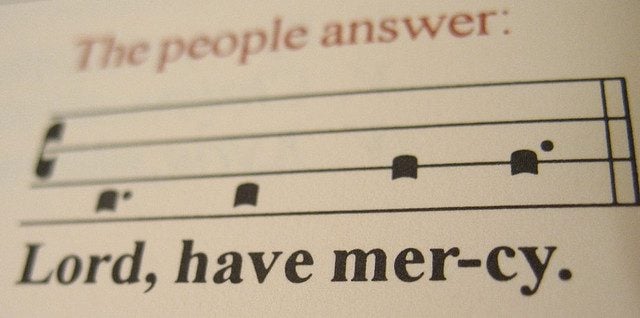
Kyrie. Photo by: Matt.
Pastor Dan had dropped a bomb, and left.
He’d asked me, “What’s more important the Bible or tradition?” When I answered that it was, “the Bible,” he was quick to point out that the Bible was put together by tradition. Tradition came first.
He was right and I found that very difficult to reconcile with my Bible-only faith. Our conversation—Dan’s question—sent me on a deeper journey.
I recently came across an eight-year old blog post on Catholic and Protestant traditions. It must’ve been right after Dan and I had our conversation and my mind was reeling as I worked things through. It was on an old blog I used to keep where I wrote about politics, culture, and faith. I had a small but loyal base of readers who read, I think, to see how often I’d put my foot in my mouth. Spoiler alert: It was often and this particular post drew it’s fair share of controversy especially amongst my almost exclusively Protestant readership.
The article I wrote was a thesis comparing the Sunday morning worship service traditions of Catholics and Protestants. My thesis was simple: Catholic tradition is better than Protestant tradition—and I lined up some fairly robust arguments to support my Catholic point-of-view.
First, I argued, Catholic tradition had been thought out and considered for two thousand years. It’d been developed, refined, and tested. It had been made subject to some of the greatest Christian minds ever to have existed and it had deep, deep roots stretching back to the earliest church. To me, that was a strength.
Meanwhile, my Protestant tradition, especially in the non-demoninational faith I understood at the time, was more hap-hazard, if that’s the right word. No one could articulate why we sang certain songs at a certain time on a Sunday morning or why we took up an offering in the way we did or why the focal point of our gathering was to hear the pastor speak. I realize now, of course, that in many other Protestant denominations these things are much more intentional (that’s a good word) but for me, at the time, it seemed like comparing apples and oranges. The Catholics thought this through; the Protestants did not.
When I wrote back then I saw clarity in the Catholic tradition of the Mass. It was thoughtfully considered. My Sunday morning non-demoninational service? It was planned and it followed a certain order every Sunday but what were its roots, and why?
It’s odd and just a little unbelievable to look back, nearly eight years ago, and see a clear line up to today but it’s there. My understand of tradition, in the sense of the whole of Christianity, has broadened. Catholic and Protestant traditions aren’t Sunday morning traditions but the entire framework in which the faiths work themselves out and have their deepest roots. My non-denominational faith had it’s roots around 1999; the Catholic faith had it’s roots about two thousands years earlier. And while I’ve moved beyond presenting arguments in a rigid thesis formulation the tug of the historicity of the Catholic church, obviously, has had a drastic impact on me. The joy of tracing your faith, and its roots, all the way back to Jesus in an upper room, in a cave called the Gates of Hell, on a lake.
I had been exposed to Catholicism through a podcasting priest, I’d had my opinions and perspectives rattled and refined by some good and bad Catholic examples, and I had a bombshell dropped into my faith walk with the question of tradition. Something was beginning to take shape.
With Dan’s question as a springboard to a deeper desire to understand the Catholic church I began to explore the idea of tradition. In my search I was pulled further in by the tug of two thousand years of history. I’ve since heard too many stories to count of other ordinary people being drawn into the ancient faith traditions (Catholicism and Eastern Orthodoxy) for these same reasons, the appeal of tradition. In a sense, it could be dismissed as the post-modern rebellion against post-modern Protestantism. It could be explained as the craving for structure and rootedness. It could be explained by a call of the Holy Spirit, too. Regardless, something began to work on me, and it would be a slow road to Rome but it would, eventually, snowball and there’d be no looking back.
Previous Post
November 1, 2014
The Bible and Tradition
Next Post
November 9, 2014 My Third Time to Mass
Browse Our Archives
Select a Category Appearances Christian Living Explaining the Faith Podcast Tough Questions Uncategorized Why I'm Catholic
Select a Month January 2024 December 2023 November 2023 July 2023 June 2023 May 2023 April 2023 March 2023 February 2023 January 2023 December 2022 November 2022 October 2022 September 2022 August 2022 July 2022 June 2022 May 2022 April 2022 March 2022 February 2022 January 2022 December 2021 November 2021 October 2021 September 2021 August 2021 July 2021 June 2021 May 2021 April 2021 March 2021 February 2021 January 2021 December 2020 November 2020 October 2020 September 2020 August 2020 July 2020 June 2020 May 2020 April 2020 March 2020 February 2020 January 2020 December 2019 November 2019 October 2019 September 2019 August 2019 July 2019 June 2019 May 2019 April 2019 March 2019 February 2019 January 2019 December 2018 November 2018 October 2018 September 2018 August 2018 July 2018 June 2018 May 2018 April 2018 March 2018 February 2018 January 2018 December 2017 October 2017 September 2017 July 2017 May 2017 April 2017 March 2017 February 2017 January 2017 December 2016 November 2016 October 2016 September 2016 August 2016 July 2016 June 2016 May 2016 April 2016 March 2016 February 2016 January 2016 December 2015 November 2015 October 2015 September 2015 August 2015 July 2015 June 2015 May 2015 April 2015 March 2015 February 2015 January 2015 December 2014 November 2014 October 2014
Follow Us!
TAKE THE
Religious Wisdom Quiz
Who wrote most of the New Testament letters?
Select your answer to see how you score.
John James Paul Peter
Support this
Column


Related posts from The Cordial Catholic

235: Questions I Couldn't Answer (w/ John Martignoni)

234: The Mindblowing World of Sacramentals (w/ Shaun...

233: The Power of Good Catholic Witnesses (w/...

232: The Trajectory of Conversion (w/ Phillip Campbell)
TRENDING AT PATHEOS Catholic

Rejecting Doom: Christian Hope And Human Action
Christianity is a religion of hope. We are to have hope and...

It’s What Comes From Within Which Matters
One of the most difficult things for us to understand is why...

Why I Choose the Eucharist Over the Sermon
Choose the Eucharist, Not the Sermon What are we supposed to get...

5 Design Elements Found in Spiritually Rooted Homes
Putting Spirituality Into Home Decor Our homes are more than our living...

Credo: A Story of God Told with the...
About 10 years ago, I began to imagine a personal "Credo" that...

The Anatomy of Divine Revelation in Catholic Thought
The claim that God has made Himself known to human beings is...
view all Catholic blogs
Ad-Free & Subscriber Log-In Subscription Support
- About Us
- 2026 Calendar
- Videos
- Podcasts
- Library of World Religions
- Faith In Media Tracker
- Advertise With Us
- Write for Us
- Privacy Policy
- Terms of Service
- Do Not Sell My Data
- Contact Us
- Radiant Digital
- Manage Newsletter Subscriptions
- Unsubscribe From Notifications
- Sitemap
Copyright 2008-2026, Patheos. All rights reserved.
Subscription Support Ad-Free & Subscriber Log-In
Follow Patheos