
BuddhistCatholicContemplativeEvangelicalGeneral ChristianHinduJewishLatter-day SaintMuslimNew VisionsProgressive Christian
Beliefs
- Buddhist
- Catholic
- Contemplative
- Evangelical
- General Christian
- Hindu
- Jewish
- Latter-day Saint
- More Voices
- Muslim
- New Visions
- Pagan
- Progressive Christian
Topics
- Religion News
- Food and Religion
- Sports and Religion
- Religious Art
- Religious Music and Entertainment
- Religious Events
- History and Religion
- Style and Religion
- Politics and Religion
- Women in Religion
- Recreation Outdoors and Religion
- Business Finance and Religion
- Careers Workplace and Religion
- Education and Religion
- Family Parenting and Religion
- Health Fitness and Religion
- Home and Religion
- Relationships and Religion
- Technology and Religion
- Travel and Religion
Columnists
- Buddhist Columnists
- Business Finance and Religion Columnists
- Careers Workplace and Religion Columnists
- Catholic Columnists
- Contemplative Columnists
- Education and Religion Columnists
- Evangelists Columnists
- Family Parenting and Religion Columnists
- General Christian Columnists
- Health Fitness and Religion Columnists
- Hindu Columnists
- History and Religion Columnists
- Home and Religion Columnists
- Jewish Columnists
- More Voices Columnists
- Latter Day Columnists
- Muslim Columnists
- New Visions Columnists
- Nonreligious Columnists
- Pagan Columnists
- Politics and Religion Columnists
- Progressive Columnists
- Recreation Outdoors and Religion Columnists
- Relationships and Religion Columnists
- Religion News Columnists
- Religious Art Columnists
- Religious Events Columnists
- Religious Music and Entertainment Columnists
- Sports and Religion Columnists
- Style and Religion Columnists
- Technology and Religion Columnists
- Travel and Religion Columnists
- Women in Religion Columnists
Resource Library
- 2026 Calendar
- Library of World Religions
- The 100 Most Holy Places on Earth
- Patheos Answers
- Podcasts
- Videos
- Faith Leaders Database
- Anglican Episcopalian
- Bahai
- Baptist
- Buddhism
- Christianity
- Confucianism
- Eastern Orthodoxy
- Hinduism
- Holiness and Pentecostal
- ISKCON
- Islam
- Judaism
- Lutheran
- Methodist
- The Church of Jesus Christ of Latter-day Saints
- New Age
- Paganism
- Presbytarian and Reformed
- Protestantism
- Religion Behind the Scenes
- Roman Catholic
- Scientology
- Shia Islam
- Sikhism
- Sufism
- Sunni Islam
- Taoism
- Zen
- See all religions
Research Tools
 Ad-Free & Subscriber Log-In Subscription Support
Ad-Free & Subscriber Log-In Subscription Support
Follow Patheos 

- Trending:
- Forgiveness
- |
- Marriage
- |
- Consciousness
- |
- Death Penalty
- |
- Election
- |
- Halloween
 The Cordial Catholic
- Home
- Catholic
- I Think the Saints are Stalking Me
I Think the Saints are Stalking Me
Last updated on: June 12, 2019 at 1:59 pm by K. Albert Little
I Think the Saints are Stalking Me 2019-06-12T13:59:23-04:00 K. Albert Little
Patheos Explore the world's faith through different perspectives on religion and spirituality! Patheos has the views of the prevalent religions and spiritualities of the world.
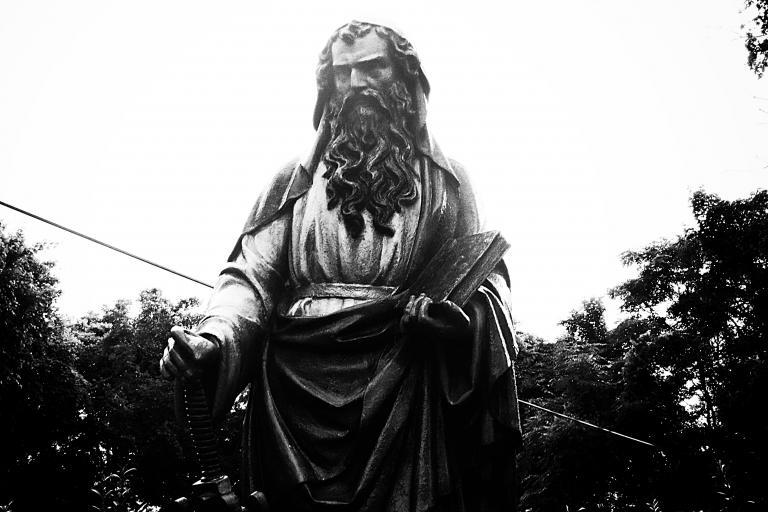
I recently recorded a podcast episode with my good friend JonMarc Grodi. We talked about the saints and, in particular, how we can have a relationship with our Christian brothers and sisters who have gone ahead to their reward.
It was a remarkable conversation and I highly recommend you give it a listen but it impacted me, in the following weeks, in a way I did not expect.
I’ve written about the saints before, it’s not new territory for me. In fact, one of the first major issues I had when I was digging into the history of the Catholic Church was the idea that Catholics worshipped the saints. Spoiler alert: they do not, as I’ve written many times before.
But that’s not what’s been on my mind lately.
After the episode was done, JonMarc stuck around for a bit and we chatted once I’d stopped recording. As we talked we began to share our own favourite “saint stories” and, if I’d still been recording, it would’ve made a great episode all on its own.
JonMarc shared how St. Anthony was key in bringing him and his wife together. I shared how, once, when I was just beginning to explore Catholicism I was encouraged to ask St. Therese of Lisieux to “send me a flower” to let me know that she was praying for me. It was a silly notion, in hindsight, but literal seconds after I prayed it a picture came on the TV newscast I was watching: a woman with an oversized daisy knitted into the front of her winter hat.
It couldn’t have been more obvious. It was a giant flower.
I love this idea of saints being in relationship with us.
It seems, at best, a bit goofy. At worst, rather cultic. But as devout, Jesus-loving Catholics will tell you, it is very much the reality of the Catholic life.
In a similar way to God chasing us down, pursuing us like a Hound of Heaven, because He loves us that much and wants to know us more—so too his most wonderful creations: the saints.
If, as Catholics believe, the intercession of the saints is real and they are in Heaven, eternally, with God right now then they can pray for us, they can help us, they can even, by God’s grace, interact in a kind of tangible way. This isn’t magic; it’s the Communion of the Saints and it’s been the belief of the Christian Church since the very beginning.
And, lately, I think I’m being stalked.
It began innocently enough with one particular saint meme that was being shared around Facebook. But then I encounter that same saint, again, in a book that I was reading. It was a completely unrelated topic, and I was surprised. And then, he popped up again on Twitter. And a friend wrote an article about him. And then a sister, in a community near our house, took her vows on the weekend and chose this saint as part of her new, religious name.
It wasn’t even his feast day, not even close, and he wasn’t an incredibly popular saint.
This was all a little odd.
Uncanny.
And then I got an e-mail.
It was an e-mail on a completely unconnected topic and I read it with interest until I got to the end. It was signed with the sender’s name, their job title, and where they worked.
And can you guess the name of their employer?
It was an official apostolate for the very same saint. A large centre, custodian to a number of his first-class relics.
Did this saint get so tired of trying to send me a sign that he, quite literally, sent someone who worked for him to get my attention?
I had to pick my jaw up off the floor.
I sucked in a very deep breath and closed my e-mail. I opened Facebook to double check the name and the employer and before I could type a thing my newsfeed loaded…
The saint.
Front a centre was a quote from a theologian friend of mine juxtaposed with a giant black and white picture of the very same saint.
It was like winning the lottery and going home to find a brand new car in your driveway too.
I decided it was official: I am being stalked.
And it’s kind of incredible.
See, if the saints are as alive as you and I except in the presence of God then they can take part in our lives in a kind of supernatural way. They can pray for us and, the Catholic Church affirms, live amongst us in this kind of a relationship. And this is exactly, I think, what the Church has in mind.
This particular saint is praying for me, and he is letting me know. He is rooting for me. There is something cooking up there, some good thing in store, and he is working hard to get my attention.
“Just you wait,” it feels like he’s saying, “Something good is coming your way. God has big plans.”
A kind of supernatural affirmation of God’s promises, I think.
And, of course, a hardened skeptic could dismiss it all as wild coincidence. You see what you want to see and filter out the rest. Or worse, it’s a demonic influence trying to steer my attention away from God and onto merely mortal humans. But, I don’t think so. Far from distracting, these tiny little coincidences (and big coincidences too!) are refocusing my attention on God’s divine plan. Like a poke in the side, a firework going off somewhere near by, these little interactions across the veil are causing me to sit up straight, to listen more carefully, to pay attention. What’s God doing here? What’s going on? What am I being shown?
Why does it feel like all of these interactions are leading me towards something incredible; reminding me to sit tight and listen closely? What is God drawing me closer for?
After all, in all ways and always, the saints are there to point us to Christ, to bring us closer to Christ. That was their goal in life and, it must, remain their goal in death too.
Previous Post

June 12, 2019
011: How (Not) to Become a Catholic (w/ Dr. James Tonkowich)
Next Post

June 13, 2019 A Convert's Guide to Not Becoming Catholic
Browse Our Archives
Select a Category Appearances Christian Living Explaining the Faith Podcast Tough Questions Uncategorized Why I'm Catholic
Select a Month January 2024 December 2023 November 2023 July 2023 June 2023 May 2023 April 2023 March 2023 February 2023 January 2023 December 2022 November 2022 October 2022 September 2022 August 2022 July 2022 June 2022 May 2022 April 2022 March 2022 February 2022 January 2022 December 2021 November 2021 October 2021 September 2021 August 2021 July 2021 June 2021 May 2021 April 2021 March 2021 February 2021 January 2021 December 2020 November 2020 October 2020 September 2020 August 2020 July 2020 June 2020 May 2020 April 2020 March 2020 February 2020 January 2020 December 2019 November 2019 October 2019 September 2019 August 2019 July 2019 June 2019 May 2019 April 2019 March 2019 February 2019 January 2019 December 2018 November 2018 October 2018 September 2018 August 2018 July 2018 June 2018 May 2018 April 2018 March 2018 February 2018 January 2018 December 2017 October 2017 September 2017 July 2017 May 2017 April 2017 March 2017 February 2017 January 2017 December 2016 November 2016 October 2016 September 2016 August 2016 July 2016 June 2016 May 2016 April 2016 March 2016 February 2016 January 2016 December 2015 November 2015 October 2015 September 2015 August 2015 July 2015 June 2015 May 2015 April 2015 March 2015 February 2015 January 2015 December 2014 November 2014 October 2014
Follow Us!
TAKE THE
Religious Wisdom Quiz
What was the first plague in Egypt?
Select your answer to see how you score.
Boils Locusts Darkness Water turned to blood
Support this
Column


Related posts from The Cordial Catholic

232: The Trajectory of Conversion (w/ Phillip Campbell)

229: Can Catholics and Evangelicals Agree on How...

228: The Catholic Tools for Spiritual Warfare (w/...
212: Evangelicals, Here's How to Look for a...
TRENDING AT PATHEOS Catholic

Rejecting Doom: Christian Hope And Human Action
Christianity is a religion of hope. We are to have hope and...

It’s What Comes From Within Which Matters
One of the most difficult things for us to understand is why...

Why I Choose the Eucharist Over the Sermon
Choose the Eucharist, Not the Sermon What are we supposed to get...

5 Design Elements Found in Spiritually Rooted Homes
Putting Spirituality Into Home Decor Our homes are more than our living...

Credo: A Story of God Told with the...
About 10 years ago, I began to imagine a personal "Credo" that...

The Anatomy of Divine Revelation in Catholic Thought
The claim that God has made Himself known to human beings is...
view all Catholic blogs
Ad-Free & Subscriber Log-In Subscription Support
- About Us
- 2026 Calendar
- Videos
- Podcasts
- Library of World Religions
- Faith In Media Tracker
- Advertise With Us
- Write for Us
- Privacy Policy
- Terms of Service
- Do Not Sell My Data
- Contact Us
- Radiant Digital
- Manage Newsletter Subscriptions
- Unsubscribe From Notifications
- Sitemap
Copyright 2008-2026, Patheos. All rights reserved.
Subscription Support Ad-Free & Subscriber Log-In
Follow Patheos