
BuddhistCatholicContemplativeEvangelicalGeneral ChristianHinduJewishLatter-day SaintMuslimNew VisionsProgressive Christian
Beliefs
- Buddhist
- Catholic
- Contemplative
- Evangelical
- General Christian
- Hindu
- Jewish
- Latter-day Saint
- More Voices
- Muslim
- New Visions
- Pagan
- Progressive Christian
Topics
- Religion News
- Food and Religion
- Sports and Religion
- Religious Art
- Religious Music and Entertainment
- Religious Events
- History and Religion
- Style and Religion
- Politics and Religion
- Women in Religion
- Recreation Outdoors and Religion
- Business Finance and Religion
- Careers Workplace and Religion
- Education and Religion
- Family Parenting and Religion
- Health Fitness and Religion
- Home and Religion
- Relationships and Religion
- Technology and Religion
- Travel and Religion
Columnists
- Buddhist Columnists
- Business Finance and Religion Columnists
- Careers Workplace and Religion Columnists
- Catholic Columnists
- Contemplative Columnists
- Education and Religion Columnists
- Evangelists Columnists
- Family Parenting and Religion Columnists
- General Christian Columnists
- Health Fitness and Religion Columnists
- Hindu Columnists
- History and Religion Columnists
- Home and Religion Columnists
- Jewish Columnists
- More Voices Columnists
- Latter Day Columnists
- Muslim Columnists
- New Visions Columnists
- Nonreligious Columnists
- Pagan Columnists
- Politics and Religion Columnists
- Progressive Columnists
- Recreation Outdoors and Religion Columnists
- Relationships and Religion Columnists
- Religion News Columnists
- Religious Art Columnists
- Religious Events Columnists
- Religious Music and Entertainment Columnists
- Sports and Religion Columnists
- Style and Religion Columnists
- Technology and Religion Columnists
- Travel and Religion Columnists
- Women in Religion Columnists
Resource Library
- 2026 Calendar
- Library of World Religions
- The 100 Most Holy Places on Earth
- Patheos Answers
- Podcasts
- Videos
- Faith Leaders Database
- Anglican Episcopalian
- Bahai
- Baptist
- Buddhism
- Christianity
- Confucianism
- Eastern Orthodoxy
- Hinduism
- Holiness and Pentecostal
- ISKCON
- Islam
- Judaism
- Lutheran
- Methodist
- The Church of Jesus Christ of Latter-day Saints
- New Age
- Paganism
- Presbytarian and Reformed
- Protestantism
- Religion Behind the Scenes
- Roman Catholic
- Scientology
- Shia Islam
- Sikhism
- Sufism
- Sunni Islam
- Taoism
- Zen
- See all religions
Research Tools
 Ad-Free & Subscriber Log-In Subscription Support
Ad-Free & Subscriber Log-In Subscription Support
Follow Patheos 

- Trending:
- Forgiveness
- |
- Marriage
- |
- Consciousness
- |
- Death Penalty
- |
- Election
- |
- Halloween
 The Cordial Catholic
- Home
- Catholic
- The Liturgy Is Not Me: Why We All Should Worship Like Catholics
The Liturgy Is Not Me: Why We All Should Worship Like Catholics
Last updated on: March 29, 2018 at 3:14 pm by K. Albert Little
The Liturgy Is Not Me: Why We All Should Worship Like Catholics 2018-03-29T15:14:33-04:00 K. Albert Little
Patheos Explore the world's faith through different perspectives on religion and spirituality! Patheos has the views of the prevalent religions and spiritualities of the world.
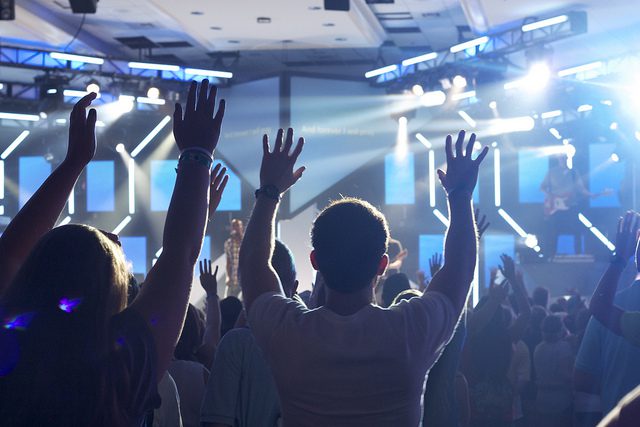
As an eager Evangelical, I once wrote an article about tradition in the context of a Sunday morning worship service.
Long before becoming Catholic, I was processing the idea that all Christian modes of faith come with a certain level of tradition, even if it wasn’t as the high liturgical ritual of a Catholic Mass.
Here’s how a typical Sunday morning in my non-denominational church would look.
We gathered in the pews before the service began catching up with friends before the music started. And then, it began. Up-tempo, contemporary worship music which kept very much in step with the contemporary indie rock music of its time. We’d sing two or three songs, with the band up front, centre stage, and then the worship leader would pray. Then we’d sing another song, and then maybe another, and then the pastor would take the stage.
We’d close our eyes to pray while the worship band miraculously disappeared off the stage. (Occasionally the drummer would knock over a cymbal on his way out from behind the drumkit and the illusion would be shattered!)
Then the lead pastor would preach.
The sermon, the focal point of the morning, would last about 30 minutes and leave us with an intellectual challenge to consider for the week, and then we’d pray.
Years ago, in my Evangelical young adulthood, I reflected on these traditions, on why we structured our worship services in a particular way, and wondered, “Why?”
And I was left wondering.
What, I wondered, were the origins of our worship service? Why did we sing, then pray, then sing, and then listen to a sermon? Why was this particular lecture kind of format the way it was done; why did we do it this way? Who says? And who’s making the decisions?
Was is the senior pastor? The denomination? The board of elders?
Or was my church, a church amongst thousands, just going with the flow—doing it the way its always been done?
I had a lot of questions and the answers were anything but satisfactory.
Back then I realized that my non-denominational, Evangelical church had a very particular set of traditions—even if they weren’t explicitly defined and the roots of these traditions, I realized, were kind of murky. On the other hand, the ancient traditions of the Catholic Church seemed firmly fixed in history. Terra firma.
Much better roots.
Was I worshiping wrong?
The realization concerned me.
Back then I didn’t know any better. I didn’t know the word “liturgy” and didn’t know a thing about liturgical churches—churches that used a define set of worship practices which were rooted in history—all I knew is that I had no idea why we worshiped the way we did; and I didn’t feel comfortable not knowing.
What occurred to me, way back when, was that I was what was defining my experience of God on a Sunday morning.
I choose where to worship, and how to worship, based on a number of factors: the music, the community, the quality of the preaching—and all of these factor were down to my interpretation; my subjective impressions.
My experience of the evangelical liturgy was me.
But this needn’t be the case.
In a culture so focused on “me” and my interior life—my wants, my needs, my opinions on social media—I detect a distinct trickle flowing in the opposite direction. A movement which seeks to find something deeper outside of ourselves.
Enter, the ancient liturgy of the Catholic Church.
See the way we worship in the context of the Mass is a form as old as Christianity itself. We can find evidence of this distinct way of celebrating our life in Christ in a text called the didache, a document of the ancient Church which is dated to be contemporary to the books of the New Testament. The didache outlines a form of worship which sounds very much like the Mass, something ancient and weighty.
A form of worshipping God that, being highly prescriptive, is ultimately incredibly freeing.
Because worship in the setting of the ancient Catholic Mass doesn’t require me to feel a certain way, or subscribe to certain sentiments, or to approve of every element of a worship service.
And if I don’t like how we worship, I don’t really have the luxury of going elsewhere.
What it means is that as a Catholic the Liturgy is not about me.
It isn’t about the style of music or the words we speak or the prayers we pray conforming to my tastes; it’s about conforming my tastes to the ultimate worship taking place in Heaven.
Don’t get me wrong. A tradition of worship born out of the 1950’s revival tent meeting isn’t all bad. My evangelical roots helped to fire me up for Christ—and prime me for the kind of rigorous Bible study and genuine discipleship that eventually led me to become Catholic. And, megachurches with their lights and smoke machines and skinny-jeaned worship pastors can certainly play a role in making saints. (And I love a good pair of skinny jeans.)
But if I’m the one in charge of choosing how I worship then I have my priorities wrong. If we’re tailor-making our worship services to intentionally appeal to a particular audience we’re doing it wrong.
The “audience” of our worship ought to be God. And what we should be tailoring is our hearts to conform to Christ.
The Catholic Church describes the Liturgy as something that is “revealed” to us here on earth. In Revelation—the last book of the Bible—we get a small glimpse into what heavenly worship looks like: angels gathered around an altar, incense—the prayers of the saints—floating up to the Lamb of God.
What the Catholic Church tries to capture in the way it worships, corporately, is precisely this kind of worship.
And it’s incredible.
In a Catholic Mass every small gesture, every visual, audio, and physical cue, is intended to key us into the great worship song being sung in heaven. In fact, the Catholic Church teaches that the Mass is essentially never ending. It began at the last supper and extends forward to the end of time, so to speak. And when we worship we’re connecting up with all of that and with the same celebration taking place, simultaneously, in heaven.
It’s a breath-takingly brilliant theology.
And all that to say, if we’re going to think about how we worship—or re-think how we worship—I’d throw my lot in with the Catholics: To worship in a great tradition that I don’t dictate that stretches back to the very beginning of the Christian Church with a clear and concise origin and with deep, rich theological links to the very same worship service happening right now in Heaven.
A way or worshiping that forms us into Christ, not forcing Christ to conform to our tastes.
It’s worth considering.
Photo courtesy of chintermeyer (flickr).
Previous Post
March 18, 2018
Was Peter the First Pope?
Next Post

April 7, 2018 The Incredible Biblical Basis for Relics
Browse Our Archives
Select a Category Appearances Christian Living Explaining the Faith Podcast Tough Questions Uncategorized Why I'm Catholic
Select a Month January 2024 December 2023 November 2023 July 2023 June 2023 May 2023 April 2023 March 2023 February 2023 January 2023 December 2022 November 2022 October 2022 September 2022 August 2022 July 2022 June 2022 May 2022 April 2022 March 2022 February 2022 January 2022 December 2021 November 2021 October 2021 September 2021 August 2021 July 2021 June 2021 May 2021 April 2021 March 2021 February 2021 January 2021 December 2020 November 2020 October 2020 September 2020 August 2020 July 2020 June 2020 May 2020 April 2020 March 2020 February 2020 January 2020 December 2019 November 2019 October 2019 September 2019 August 2019 July 2019 June 2019 May 2019 April 2019 March 2019 February 2019 January 2019 December 2018 November 2018 October 2018 September 2018 August 2018 July 2018 June 2018 May 2018 April 2018 March 2018 February 2018 January 2018 December 2017 October 2017 September 2017 July 2017 May 2017 April 2017 March 2017 February 2017 January 2017 December 2016 November 2016 October 2016 September 2016 August 2016 July 2016 June 2016 May 2016 April 2016 March 2016 February 2016 January 2016 December 2015 November 2015 October 2015 September 2015 August 2015 July 2015 June 2015 May 2015 April 2015 March 2015 February 2015 January 2015 December 2014 November 2014 October 2014
Follow Us!
TAKE THE
Religious Wisdom Quiz
Who said: "The Lord knows how to rescue the godly from trials and to hold the unrighteous for punishment"?
Select your answer to see how you score.
Paul James Peter Jude
Support this
Column


Related posts from The Cordial Catholic

235: Questions I Couldn't Answer (w/ John Martignoni)

234: The Mindblowing World of Sacramentals (w/ Shaun...

233: The Power of Good Catholic Witnesses (w/...

232: The Trajectory of Conversion (w/ Phillip Campbell)
TRENDING AT PATHEOS Catholic

Rejecting Doom: Christian Hope And Human Action
Christianity is a religion of hope. We are to have hope and...

It’s What Comes From Within Which Matters
One of the most difficult things for us to understand is why...

Why I Choose the Eucharist Over the Sermon
Choose the Eucharist, Not the Sermon What are we supposed to get...

5 Design Elements Found in Spiritually Rooted Homes
Putting Spirituality Into Home Decor Our homes are more than our living...

Credo: A Story of God Told with the...
About 10 years ago, I began to imagine a personal "Credo" that...

The Anatomy of Divine Revelation in Catholic Thought
The claim that God has made Himself known to human beings is...
view all Catholic blogs
Ad-Free & Subscriber Log-In Subscription Support
- About Us
- 2026 Calendar
- Videos
- Podcasts
- Library of World Religions
- Faith In Media Tracker
- Advertise With Us
- Write for Us
- Privacy Policy
- Terms of Service
- Do Not Sell My Data
- Contact Us
- Radiant Digital
- Manage Newsletter Subscriptions
- Unsubscribe From Notifications
- Sitemap
Copyright 2008-2026, Patheos. All rights reserved.
Subscription Support Ad-Free & Subscriber Log-In
Follow Patheos