
BuddhistCatholicContemplativeEvangelicalGeneral ChristianHinduJewishLatter-day SaintMuslimNew VisionsProgressive Christian
Beliefs
- Buddhist
- Catholic
- Contemplative
- Evangelical
- General Christian
- Hindu
- Jewish
- Latter-day Saint
- More Voices
- Muslim
- New Visions
- Pagan
- Progressive Christian
Topics
- Religion News
- Food and Religion
- Sports and Religion
- Religious Art
- Religious Music and Entertainment
- Religious Events
- History and Religion
- Style and Religion
- Politics and Religion
- Women in Religion
- Recreation Outdoors and Religion
- Business Finance and Religion
- Careers Workplace and Religion
- Education and Religion
- Family Parenting and Religion
- Health Fitness and Religion
- Home and Religion
- Relationships and Religion
- Technology and Religion
- Travel and Religion
Columnists
- Buddhist Columnists
- Business Finance and Religion Columnists
- Careers Workplace and Religion Columnists
- Catholic Columnists
- Contemplative Columnists
- Education and Religion Columnists
- Evangelists Columnists
- Family Parenting and Religion Columnists
- General Christian Columnists
- Health Fitness and Religion Columnists
- Hindu Columnists
- History and Religion Columnists
- Home and Religion Columnists
- Jewish Columnists
- More Voices Columnists
- Latter Day Columnists
- Muslim Columnists
- New Visions Columnists
- Nonreligious Columnists
- Pagan Columnists
- Politics and Religion Columnists
- Progressive Columnists
- Recreation Outdoors and Religion Columnists
- Relationships and Religion Columnists
- Religion News Columnists
- Religious Art Columnists
- Religious Events Columnists
- Religious Music and Entertainment Columnists
- Sports and Religion Columnists
- Style and Religion Columnists
- Technology and Religion Columnists
- Travel and Religion Columnists
- Women in Religion Columnists
Resource Library
- 2026 Calendar
- Library of World Religions
- The 100 Most Holy Places on Earth
- Patheos Answers
- Podcasts
- Videos
- Faith Leaders Database
- Anglican Episcopalian
- Bahai
- Baptist
- Buddhism
- Christianity
- Confucianism
- Eastern Orthodoxy
- Hinduism
- Holiness and Pentecostal
- ISKCON
- Islam
- Judaism
- Lutheran
- Methodist
- The Church of Jesus Christ of Latter-day Saints
- New Age
- Paganism
- Presbytarian and Reformed
- Protestantism
- Religion Behind the Scenes
- Roman Catholic
- Scientology
- Shia Islam
- Sikhism
- Sufism
- Sunni Islam
- Taoism
- Zen
- See all religions
Research Tools
 Ad-Free & Subscriber Log-In Subscription Support
Ad-Free & Subscriber Log-In Subscription Support
Follow Patheos 

- Trending:
- Forgiveness
- |
- Marriage
- |
- Consciousness
- |
- Death Penalty
- |
- Election
- |
- Halloween
 The Cordial Catholic
- Home
- Catholic
- The Incredible Satisfaction of Living with the Saints
The Incredible Satisfaction of Living with the Saints
Last updated on: July 18, 2016 at 12:08 pm by K. Albert Little
The Incredible Satisfaction of Living with the Saints 2016-07-18T12:08:55-04:00 K. Albert Little
Patheos Explore the world's faith through different perspectives on religion and spirituality! Patheos has the views of the prevalent religions and spiritualities of the world.
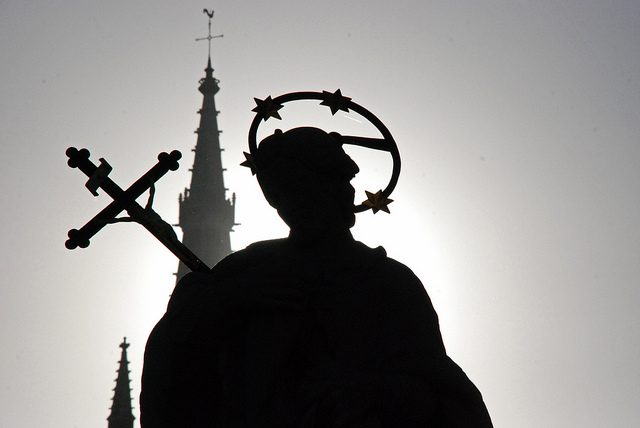
Photo Credit: Gerben van Heijningen.
The belief of in ability of our deceased Christian brothers and sisters to pray for us has roots in the very beginning of Christianity.
St. Polycarp, a disciple of St. John himself, wrote of the very special power held in the relics of the earliest deceased Christians. The prayers, in Heaven, connected to their physical bodies still on earth. By 787AD, the special place of the saints was solidified enough for the Church to declare,
we adore and respect God our Lord; and those who have been genuine servants of our common Lord we honor and venerate because they have the power to make us friends with God the King of all.
As Catholics we honour, venerate, and ask for the prayers of those Christians that have fallen asleep because we believe, as the Church has taught, in their special power.
After all, if I can ask a Christian on earth to pray for me how much more incredible—and powerful—might the prayers of a Christian who is already in the presence of God be?
That we’ve lost the beautiful legacy of a belief in the prayers of our pious predecessors is an absolute travesty.
In an Ocean of God
In his book Theology for Beginners
To paraphrase, Sheed says that God is all around us. That we are, essentially, inside of God—like swimming in an ocean.
Like God is the air we breathe (hey 1999, isn’t there a song about that?).
For as long as I can remember my tendency has been towards picturing a God who is elsewhere; a God who is somewhat abstracted.
We often talk about God as if he’s up in Heaven and our prayers need to be sent skyward but nothing can be further from the truth. Sheed says that God is everywhere; all around us. Instead of up, our prayers emanate outward permeating the very being of God like ripples on the water.
We exist because God breathed us into existence and because he—second by second—sustains us like water holding us up as we float along.
It’s, if not an incredible picture, at least a practical one.
It puts God in His right place, and us in ours.
So much so with the saints.
A Great Cloud of Witnesses
I wasn’t raised on the saints.
In my Evangelical upbringing I believed that communication with the dead was something akin to witchcraft and that the souls in Heaven had no contact any which way with the souls on earth.
But I became a Catholic. I was grafted into a spiritual tradition that holds the saints in incredibly high esteem. That prayers to them, venerates them, carves them into our churches and chapels and monasteries. A tradition that, to be sure, takes a lifetime to truly plumb and for that I’m grateful.
I’m grateful—as many “cradle Catholics” remind me—that I’ve been given the opportunity to approach this faith with fresh eyes. Everything is new.
I wasn’t raised Catholics so suddenly these saints—impossible to miss in any Catholic context—are all around me; and it’s this incredible, unmistakable gift.
A couple of stories from my journey.
St. Thérèse of Lisieux
I’ve always been a “signs and wonders” kind of crappy Christian. I say that because it’s been a bit of a failing of mine.
You know, the kind of Christian who prays far too earnestly for something and ends, inevitably, with “and God, please send me a sign to let me know you hear me.”
Me of little faith.
Oy.
I don’t think I’m alone in my lack of surety of prayer but as I’ve matured in my Christian faith I’ve tried to move away from making deals with God and simply trying to trust more.
Go figure.
But I read somewhere that Pope Francis often prayers to St. Thérèse de Lisieux, the “Little Flower” and had a pious tradition of asking her to send him a flower to let him know she’s on the case. A “sign and wonder” to be sure but if the Pope is OK with asking for a sign, I thought, then maybe it wasn’t the worst thing after all.
So I gave it a whirl.
Being a relatively new Catholic, and new to the power intercessory prayers, I asked St. Thérèse, one morning, to take care of a particular prayer need for me and to send a flower my way to let me know she’s praying. Funny, that a couple of years later I don’t even remember what I prayed for but I do remember the clear indicate of the “Little Flower” taking up my case.
It came, benignly enough, as I ran myself silly on the treadmill at the gym that morning. Some twenty minutes or so after asking for a sign.
Up on the large TV screens that line the gym was a report of a missing women, an elderly lady with dementia who had wandered away from home during the night. There plastered on every screen was the picture of a lady wearing a winter hat with a great, big, impossible-to-miss flower sewn on the front.
It was clear as day.
St. Thérèse was on the job. And, I learned that afternoon, the woman was found safe and returned home too.
St. Gianna Molla
When my wonderful wife was on the cusp of labour with our firstborn I found myself on the hunt for a few good saints.
A few intercessors to trust my petitions with.
I stumbled, mostly by chance, upon Saint Gianna Molla.
She has been my steadfast prayer partner ever since.
Gianna Molla, a doctor, is known for her special connection to pregnancy, labour, and mothers. Gianna died in 1962 shortly after a complicated pregnancy and labour in which she refused to terminate her pregnancy or undergo surgery that might threaten her unborn child but save her own life. Instead, Gianna gave her life, in the end, to save her child’s.
Since her death, St. Gianna Molla has been credited with scores of miracles related to pregnancy and labour and was officially canonized by the Church in 2004.
Throughout the first year of our little son’s life St. Gianna has been a near constant companion through illness, difficult nights, and transitions and while her prayers haven’t seemed to work any incredible miracles he is, at a year old, almost sleeping through the night now.
Miracle?
Good grief!
Lately, however, St. Gianna has been making her presence well known and it’s been an incredible comfort. As my wife’s maternity leave ended and I took over full-time dad duties for the next six month St. Gianna kept popping up everywhere letting me know I can be assured of her prayers.
First, a friend on Instagram posted a picture of the saint with a comment about her intercession. Then, a completely unconnected friend posted a different picture of the saint with a quotation on Facebook. And then, again, in a radio interview I was listening to a story about St. Gianna was mentioned.
All unconnected and all, truly, without having thought about St. Gianna in some time.
It’s these little miracles that are incredibly comforting, that make me aware, once again, of the ocean and the water and the floating.
And the great Communion in which we live.
The Incredible Satisfaction of Living with the Saints
Living amongst such a great cloud of witnesses, as I think God intended us to live from the beginning, is incredibly satisfying.
When I first began learning about the Communion of the Saints and what the ancient Church taught I was admittedly skeptical. I wondered how I could ever “get to know a saint” as so many Catholics I’d admired talked about.
How is it possible to “get to know” someone who is deceased? Who died, in some cases, a thousand year ago?
But the same thing could be said about getting to know God Himself.
How, a skeptic might ask, can the average Christian ever “get to know” an invisible, generally inaudible, omnipotent God?
Yet we know well the deeply personal, tangible relationship that can exist between humankind and our Creator.
Likewise with the saints.
That I can throw up a lifetime to St. Gianna Molla when I’m struggling to accomplish everything I need to to keep our domestic ship upright; that I can quickly and quietly send up a prayer to St. Francis de Sales for courage in the face of a difficult conversion; or the privilege of approaching a holy man like St. Anthony of Padua just to ask him to pray that I might find where the heck I put my keys, again.
To have the incredible satisfaction of knowing that these holy women and men are, in that very moment in time, praying for me at the foot of the throne of the Ever-Living God is almost too much to bear.
To live amongst our holy predecessors, to maintain those relationships, and to float along in such a sea of prayer is one of the greatest blessings given to us by God. A spiritual heritage—an experience—not to be abandoned lightly.
Surely.
Can I get an Amen?
Stay in touch! Like The Cordial Catholic on Facebook:
Previous Post

July 6, 2016
What Would the Early Church Look Like If I Had a Time Machine?
Next Post
July 18, 2016 St. Michael Novena for our Police Officers
Browse Our Archives
Select a Category Appearances Christian Living Explaining the Faith Podcast Tough Questions Uncategorized Why I'm Catholic
Select a Month January 2024 December 2023 November 2023 July 2023 June 2023 May 2023 April 2023 March 2023 February 2023 January 2023 December 2022 November 2022 October 2022 September 2022 August 2022 July 2022 June 2022 May 2022 April 2022 March 2022 February 2022 January 2022 December 2021 November 2021 October 2021 September 2021 August 2021 July 2021 June 2021 May 2021 April 2021 March 2021 February 2021 January 2021 December 2020 November 2020 October 2020 September 2020 August 2020 July 2020 June 2020 May 2020 April 2020 March 2020 February 2020 January 2020 December 2019 November 2019 October 2019 September 2019 August 2019 July 2019 June 2019 May 2019 April 2019 March 2019 February 2019 January 2019 December 2018 November 2018 October 2018 September 2018 August 2018 July 2018 June 2018 May 2018 April 2018 March 2018 February 2018 January 2018 December 2017 October 2017 September 2017 July 2017 May 2017 April 2017 March 2017 February 2017 January 2017 December 2016 November 2016 October 2016 September 2016 August 2016 July 2016 June 2016 May 2016 April 2016 March 2016 February 2016 January 2016 December 2015 November 2015 October 2015 September 2015 August 2015 July 2015 June 2015 May 2015 April 2015 March 2015 February 2015 January 2015 December 2014 November 2014 October 2014
Follow Us!
TAKE THE
Religious Wisdom Quiz
Who denied Jesus three times before the rooster crowed?
Select your answer to see how you score.
John Peter Thomas Judas
Support this
Column


Related posts from The Cordial Catholic

232: The Trajectory of Conversion (w/ Phillip Campbell)
231: Becoming Catholic in a Church Crisis (w/...

229: Can Catholics and Evangelicals Agree on How...
212: Evangelicals, Here's How to Look for a...
TRENDING AT PATHEOS Catholic

Rejecting Doom: Christian Hope And Human Action
Christianity is a religion of hope. We are to have hope and...

It’s What Comes From Within Which Matters
One of the most difficult things for us to understand is why...

Why I Choose the Eucharist Over the Sermon
Choose the Eucharist, Not the Sermon What are we supposed to get...

5 Design Elements Found in Spiritually Rooted Homes
Putting Spirituality Into Home Decor Our homes are more than our living...

Credo: A Story of God Told with the...
About 10 years ago, I began to imagine a personal "Credo" that...

The Anatomy of Divine Revelation in Catholic Thought
The claim that God has made Himself known to human beings is...
view all Catholic blogs
Ad-Free & Subscriber Log-In Subscription Support
- About Us
- 2026 Calendar
- Videos
- Podcasts
- Library of World Religions
- Faith In Media Tracker
- Advertise With Us
- Write for Us
- Privacy Policy
- Terms of Service
- Do Not Sell My Data
- Contact Us
- Radiant Digital
- Manage Newsletter Subscriptions
- Unsubscribe From Notifications
- Sitemap
Copyright 2008-2026, Patheos. All rights reserved.
Subscription Support Ad-Free & Subscriber Log-In
Follow Patheos