
BuddhistCatholicContemplativeEvangelicalGeneral ChristianHinduJewishLatter-day SaintMuslimNew VisionsProgressive Christian
Beliefs
- Buddhist
- Catholic
- Contemplative
- Evangelical
- General Christian
- Hindu
- Jewish
- Latter-day Saint
- More Voices
- Muslim
- New Visions
- Pagan
- Progressive Christian
Topics
- Religion News
- Food and Religion
- Sports and Religion
- Religious Art
- Religious Music and Entertainment
- Religious Events
- History and Religion
- Style and Religion
- Politics and Religion
- Women in Religion
- Recreation Outdoors and Religion
- Business Finance and Religion
- Careers Workplace and Religion
- Education and Religion
- Family Parenting and Religion
- Health Fitness and Religion
- Home and Religion
- Relationships and Religion
- Technology and Religion
- Travel and Religion
Columnists
- Buddhist Columnists
- Business Finance and Religion Columnists
- Careers Workplace and Religion Columnists
- Catholic Columnists
- Contemplative Columnists
- Education and Religion Columnists
- Evangelists Columnists
- Family Parenting and Religion Columnists
- General Christian Columnists
- Health Fitness and Religion Columnists
- Hindu Columnists
- History and Religion Columnists
- Home and Religion Columnists
- Jewish Columnists
- More Voices Columnists
- Latter Day Columnists
- Muslim Columnists
- New Visions Columnists
- Nonreligious Columnists
- Pagan Columnists
- Politics and Religion Columnists
- Progressive Columnists
- Recreation Outdoors and Religion Columnists
- Relationships and Religion Columnists
- Religion News Columnists
- Religious Art Columnists
- Religious Events Columnists
- Religious Music and Entertainment Columnists
- Sports and Religion Columnists
- Style and Religion Columnists
- Technology and Religion Columnists
- Travel and Religion Columnists
- Women in Religion Columnists
Resource Library
- 2026 Calendar
- Library of World Religions
- The 100 Most Holy Places on Earth
- Patheos Answers
- Podcasts
- Videos
- Faith Leaders Database
- Anglican Episcopalian
- Bahai
- Baptist
- Buddhism
- Christianity
- Confucianism
- Eastern Orthodoxy
- Hinduism
- Holiness and Pentecostal
- ISKCON
- Islam
- Judaism
- Lutheran
- Methodist
- The Church of Jesus Christ of Latter-day Saints
- New Age
- Paganism
- Presbytarian and Reformed
- Protestantism
- Religion Behind the Scenes
- Roman Catholic
- Scientology
- Shia Islam
- Sikhism
- Sufism
- Sunni Islam
- Taoism
- Zen
- See all religions
Research Tools
 Ad-Free & Subscriber Log-In Subscription Support
Ad-Free & Subscriber Log-In Subscription Support
Follow Patheos 

- Trending:
- Forgiveness
- |
- Marriage
- |
- Consciousness
- |
- Death Penalty
- |
- Election
- |
- Halloween
 The Cordial Catholic
- Home
- Catholic
- The Incredible Implications of the Bones of St. Peter
The Incredible Implications of the Bones of St. Peter
Last updated on: October 18, 2018 at 7:05 am by K. Albert Little
The Incredible Implications of the Bones of St. Peter 2018-10-18T07:05:51-04:00 K. Albert Little
Patheos Explore the world's faith through different perspectives on religion and spirituality! Patheos has the views of the prevalent religions and spiritualities of the world.
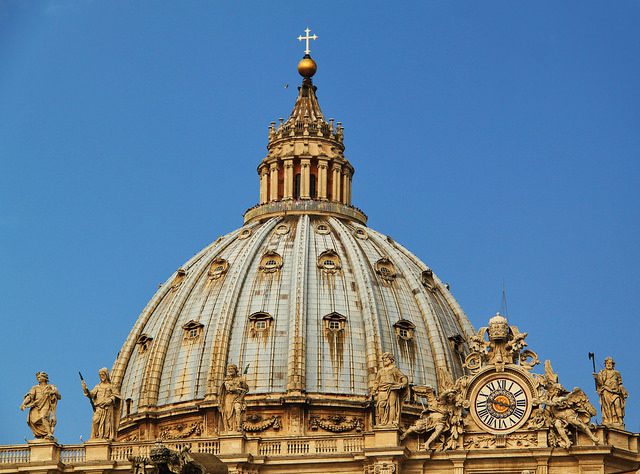
Photo Credit: C. (flickr).
Way back at Christmastime, just after our second child was born, I perfected the art of bouncing a baby on an exercise ball while reading a book. Admittedly, it’s a skill I’m pretty proud of. With our older offspring happily spending the day at preschool I had a lot of time to help out at home during those first two weeks and between the baby eating, sleeping, and pooping there was the bouncing—and a lot of bouncing. And, in turn, a lot of reading. I think I must’ve finished five or six books in that two week stretch of life and one of the books I picked up and couldn’t put down covered the hunt for the bones of St. Peter. A historical text, written by a veteran journalist, which covered the quest to find the final resting place of the chief apostle, long believed to be the location where the formidable St. Peter’s Basilica was eventually built in Rome.
(No, the name is not a coincidence.)
Surprising, for what should’ve been a rather dry and scientific text, was just how many twists, turns, and interesting insights the book afforded into not only the search for the apostle’s bones but of the history of the early Christian Church. It was truly a page-turner and its remarkable conclusion, which was also the conclusion of Pope Paul VI in the late 1960’s, was that the bones of St. Peter were located right where they were thought to be: underneath the main altar of St. Peter’s Basilica—where they had been for almost two thousand years.
That St. Peter’s Basilica was built over the bones of St. Peter.
A truly incredible claim and, finally, supported by hard science.
It was pretty amazing indeed.
But the implications of being able to prove that such a monumental church was built over the historical burial ground of the chief apostle are, in my opinion, equally incredible to consider.
For much of my life as a Christian I remained blissfully ignorant of the history of the Christian Church. In the strain of Evangelical Christianity that I converted to in high school Church History was rather flatly ignored. I’ve heard other Evangelicals describe it as if we believed the Bible had been compiled together and handed to us—with nothing in between. As if Christianity remained completely stagnant when the last apostle died up until I, myself, became a Christian.
It was a very self-centred kind of perspective and to be sure, a pretty bizarre way of understanding the faith.
When I began to take an interest in the history of Christianity, when I started to read about the Early Church, the Dark Ages, and the Reformation, I was pretty shocked by what I learned. And pretty perplexed. The Christianity represented by Christians from the beginning of the faith through to the Middle Ages and up until the Reformation looked starkly different than my Protestant Evangelical system of beliefs and practices.
It was a faith of tangible things called the sacraments; a faith which believed that Jesus came to give us grace through actual, physical things. Things we can touch and feel because this is how human work (and God knows that best). This is why Jesus rubbed mud in the eyes of a blind man, why he turned water into wine, and why he made bread and then told us that we must eat him, too.
It was a faith of men and women called the saints; a faith which honoured those that came before us, that held them up like glass or a mirror or an open window for light to pour through. Like those towering saints from the Old Testament: Abraham, Moses, and David. Like Ruth. A faith that saw the value of elevating such divine examples of the Christian life.
And St. Peter, perhaps one of the best examples of all.
One of the most profound implications of the discovery of St. Peter’s bones beneath the altar of the Basilica in Rome is what it tells us about the Early Christian Church, and Christians today.
According to the earliest accounts from Rome we know, from the beginning, that the first Christians were drawn in flocks to the burial place of St. Peter. The accounts are incredible. In secret, we’re told, Christians would be informed of the location of the apostle’s bones. If word got out to the pagan Roman authorities the bones would surely be destroyed and anyone found therein would be killed, so the secret was tightly kept. But Christians who were let in on the location would visit, often bringing with them a piece of cloth, a handkerchief, or a scrap of clothing which they would lower down into the chamber where the bones were laid. The cloth, lowered down on a rope or string, would be touched to the bones of St. Peter in hopes that it would be infused with some sort of grace—some sort of healing power—which could then be brought out to fledgling Christian communities that were then spreading across Europe, North Africa, and the Middle East.
If the account of touching a handkerchief to an apostle sounds familiar you’re thinking of Acts 19:12 which records handkerchiefs, aprons, and other pieces of cloth being touched to St. Paul and receiving similarly miraculous properties.
(This is not, after all, out of the realm of biblical possibilities.)
And this was the Christian Church in its infancy; these were the first Christians. And what I find most profound is that this practice was so not something out of the ordinary. Like those first believers touching St. Paul’s clothing. This was nominal Christianity. This is what everyone did.
And to early Christians, as with Catholics today, it didn’t seem to matter if a figure of the faith like St. Peter was dead or alive. When speaking of the Christian dead many of the Early Church Fathers write with authority of the power of Christ to conquer death; to tear the veil between living Christians and dead ones. And of course they’d write with such force when this was such a nominal practice. When the first Christians travelled under the most dangerous circumstances just to touch a piece of cloth to the bones of an apostle.
The implications are profound because Catholics argue, vibrantly, for the importance of the physical dimension of our faith. That God created us to touch and feel—as tactile beings—and that our faith should reflect that with the smells and bells, with the physical ups and downs, and with our devotion to bizarre things like pieces of the saints.
The bones of St. Peter, buried beneath the epicentre of Catholic Christianity, profoundly demonstrate that from the very beginning Christians valued the closeness of the saints, the Christ-led triumph over death, and the immediate physicality of our faith.
This should be underscored.
As an Evangelical Christian this history, with such profound implications, was entirely lost to me. I did not know that these beliefs—this physical dimension of faith—was so crucial to the development of Christianity. And, ultimately, it’s not about being right or wrong in how we practice our faith, it’s about what was lost. What Luther, Zwingli, Calvin, and the other Reformers jettisoned in the Reformation, and what was then lost to me as a Protestant, wasn’t pious medieval invention, it wasn’t something which got in the way of my faith by placing stuff in front of Christ, it was Christianity as it had been from the beginning when the very first believers lowered little pieces of cloth through a whole in the ground, touching them to the bones of the Apostle Peter.
Previous Post
September 20, 2018
Why I'm Still Catholic (And Not Going Anywhere)
Next Post

November 7, 2018 What's the Biggest Difference Between Catholics and Evangelicals?
Browse Our Archives
Select a Category Appearances Christian Living Explaining the Faith Podcast Tough Questions Uncategorized Why I'm Catholic
Select a Month January 2024 December 2023 November 2023 July 2023 June 2023 May 2023 April 2023 March 2023 February 2023 January 2023 December 2022 November 2022 October 2022 September 2022 August 2022 July 2022 June 2022 May 2022 April 2022 March 2022 February 2022 January 2022 December 2021 November 2021 October 2021 September 2021 August 2021 July 2021 June 2021 May 2021 April 2021 March 2021 February 2021 January 2021 December 2020 November 2020 October 2020 September 2020 August 2020 July 2020 June 2020 May 2020 April 2020 March 2020 February 2020 January 2020 December 2019 November 2019 October 2019 September 2019 August 2019 July 2019 June 2019 May 2019 April 2019 March 2019 February 2019 January 2019 December 2018 November 2018 October 2018 September 2018 August 2018 July 2018 June 2018 May 2018 April 2018 March 2018 February 2018 January 2018 December 2017 October 2017 September 2017 July 2017 May 2017 April 2017 March 2017 February 2017 January 2017 December 2016 November 2016 October 2016 September 2016 August 2016 July 2016 June 2016 May 2016 April 2016 March 2016 February 2016 January 2016 December 2015 November 2015 October 2015 September 2015 August 2015 July 2015 June 2015 May 2015 April 2015 March 2015 February 2015 January 2015 December 2014 November 2014 October 2014
Follow Us!
TAKE THE
Religious Wisdom Quiz
On what mountain did God give the Ten Commandments?
Select your answer to see how you score.
Mount Ararat Mount Moriah Mount Zion Mount Sinai
Support this
Column


Related posts from The Cordial Catholic

232: The Trajectory of Conversion (w/ Phillip Campbell)

229: Can Catholics and Evangelicals Agree on How...

228: The Catholic Tools for Spiritual Warfare (w/...

227: What was Medieval Catholicism Really Like? (w/...
TRENDING AT PATHEOS Catholic

Rejecting Doom: Christian Hope And Human Action
Christianity is a religion of hope. We are to have hope and...

It’s What Comes From Within Which Matters
One of the most difficult things for us to understand is why...

Why I Choose the Eucharist Over the Sermon
Choose the Eucharist, Not the Sermon What are we supposed to get...

5 Design Elements Found in Spiritually Rooted Homes
Putting Spirituality Into Home Decor Our homes are more than our living...

Credo: A Story of God Told with the...
About 10 years ago, I began to imagine a personal "Credo" that...

The Anatomy of Divine Revelation in Catholic Thought
The claim that God has made Himself known to human beings is...
view all Catholic blogs
Ad-Free & Subscriber Log-In Subscription Support
- About Us
- 2026 Calendar
- Videos
- Podcasts
- Library of World Religions
- Faith In Media Tracker
- Advertise With Us
- Write for Us
- Privacy Policy
- Terms of Service
- Do Not Sell My Data
- Contact Us
- Radiant Digital
- Manage Newsletter Subscriptions
- Unsubscribe From Notifications
- Sitemap
Copyright 2008-2026, Patheos. All rights reserved.
Subscription Support Ad-Free & Subscriber Log-In
Follow Patheos