
BuddhistCatholicContemplativeEvangelicalGeneral ChristianHinduJewishLatter-day SaintMuslimNew VisionsProgressive Christian
Beliefs
- Buddhist
- Catholic
- Contemplative
- Evangelical
- General Christian
- Hindu
- Jewish
- Latter-day Saint
- More Voices
- Muslim
- New Visions
- Pagan
- Progressive Christian
Topics
- Religion News
- Food and Religion
- Sports and Religion
- Religious Art
- Religious Music and Entertainment
- Religious Events
- History and Religion
- Style and Religion
- Politics and Religion
- Women in Religion
- Recreation Outdoors and Religion
- Business Finance and Religion
- Careers Workplace and Religion
- Education and Religion
- Family Parenting and Religion
- Health Fitness and Religion
- Home and Religion
- Relationships and Religion
- Technology and Religion
- Travel and Religion
Columnists
- Buddhist Columnists
- Business Finance and Religion Columnists
- Careers Workplace and Religion Columnists
- Catholic Columnists
- Contemplative Columnists
- Education and Religion Columnists
- Evangelists Columnists
- Family Parenting and Religion Columnists
- General Christian Columnists
- Health Fitness and Religion Columnists
- Hindu Columnists
- History and Religion Columnists
- Home and Religion Columnists
- Jewish Columnists
- More Voices Columnists
- Latter Day Columnists
- Muslim Columnists
- New Visions Columnists
- Nonreligious Columnists
- Pagan Columnists
- Politics and Religion Columnists
- Progressive Columnists
- Recreation Outdoors and Religion Columnists
- Relationships and Religion Columnists
- Religion News Columnists
- Religious Art Columnists
- Religious Events Columnists
- Religious Music and Entertainment Columnists
- Sports and Religion Columnists
- Style and Religion Columnists
- Technology and Religion Columnists
- Travel and Religion Columnists
- Women in Religion Columnists
Resource Library
- 2026 Calendar
- Library of World Religions
- The 100 Most Holy Places on Earth
- Patheos Answers
- Podcasts
- Videos
- Faith Leaders Database
- Anglican Episcopalian
- Bahai
- Baptist
- Buddhism
- Christianity
- Confucianism
- Eastern Orthodoxy
- Hinduism
- Holiness and Pentecostal
- ISKCON
- Islam
- Judaism
- Lutheran
- Methodist
- The Church of Jesus Christ of Latter-day Saints
- New Age
- Paganism
- Presbytarian and Reformed
- Protestantism
- Religion Behind the Scenes
- Roman Catholic
- Scientology
- Shia Islam
- Sikhism
- Sufism
- Sunni Islam
- Taoism
- Zen
- See all religions
Research Tools
 Ad-Free & Subscriber Log-In Subscription Support
Ad-Free & Subscriber Log-In Subscription Support
Follow Patheos 

- Trending:
- Forgiveness
- |
- Marriage
- |
- Consciousness
- |
- Death Penalty
- |
- Election
- |
- Halloween
 The Cordial Catholic
- Home
- Catholic
- The Incredible Biblical Basis for Relics
The Incredible Biblical Basis for Relics
Last updated on: April 7, 2018 at 5:33 am by K. Albert Little
The Incredible Biblical Basis for Relics 2018-04-07T05:33:26-04:00 K. Albert Little
Patheos Explore the world's faith through different perspectives on religion and spirituality! Patheos has the views of the prevalent religions and spiritualities of the world.
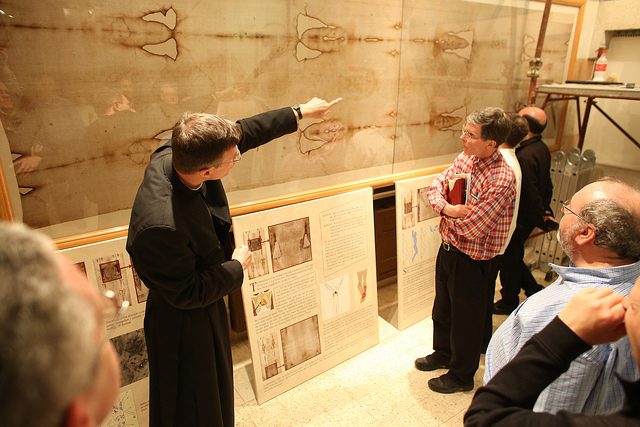
As someone with a more than passing interest in the world of the paranormal and bizarre I’ve always had a particular fascination with the ancient Shroud of Turin. But it wasn’t until I became Catholic and shook off my Protestant superstition towards the physical dimension of my faith that fascination passed into a kind of devotion.
That the burial shroud which covered Christ’s body still exists as something we can see and touch seemed incredible to me. That it would bear the image of Jesus. That it has, to date, defied any kind of scientific explanation. What a grace!
Relics, objects which were touched by esteemed, holy Christian men and women or, sometimes, even bits and pieces of these Christian men and women, have been held to carry certain graces since basically the beginning of Christianity. And while Protestant Christianity has lost much of its past connection with the physical nature of the faith it’s important to recognize that this side of the Christian reality has deep, biblical roots.
Something that might surprise many non-Catholic, non-Orthodox Christians.
Let’s investigate three examples.
1. The Cloak of Christ (Mark 5:25-34; Luke 8:43:48; Matthew 9:20-22)
The first example of physical relics possessing supernatural powers comes from the Gospels.
Recorded in Matthew, Mark, and Luke the account of a woman touching the hem of Jesus’ cloak in order to be healed presents an exceptionally compelling case for the power of physical things. This woman, the Gospels tell us, knew that if she could only touch the hem of Jesus’ cloak she would be healed.
We know from examples in the Old Testament that Jewish believers in Jesus’ time understood the power of God at work through physical relics. The story of Elisha’s bones bringing to life a dead man (2 Kings 13:20-22) would’ve been a well-known text for God-fearing Jews, and this is just a singular example.
Like her first century contemporaries, the bleeding woman depicted in the Gospels knew that physical relics like the cloak of Christ carried a special grace. And of course she did, the Jewish faith was very physical in its practice, its rituals, and its understanding of God—think of the burning bush, the Ten Commandments, the physical, sacrificial system.
Sure, the bleeding woman could’ve reached out and grasped Christ but the Gospel writers make it clear: she needed only touch his cloak.
2. Paul’s Dirty Laundry (Acts 19:12)
Our second piece of biblical backing comes from the Acts of the Apostles. Here, in Acts 19, we see God performing incredible miracles through “the hands of Paul.” Miracles which extend, incredibly, to the physical relics which have come into contact with the great apostle: his dirty laundry.
Acts 19:11-12 says,
God was performing extraordinary miracles by the hands of Paul, so that handkerchiefs or aprons were even carried from his body to the sick, and the diseases left them and the evil spirits went out. (NASB)
Like the power dispelled to the bleeding woman who touched Christ’s cloak, the power of God somehow remained even on the garments which were worn by Paul. Literally, his dirty laundry.
The Shadow of St. Peter (Acts 5:12-16)
Our final example isn’t exactly a physical relic but rather something even more sublime: the physical place where an apostle used to be.
Acts 5:12-16 gives us this incredible account,
Now many signs and wonders were regularly done among the people by the hands of the apostles. And they were all together in Solomon’s Portico. 13 None of the rest dared join them, but the people held them in high esteem. 14 And more than ever believers were added to the Lord, multitudes of both men and women, 15 so that they even carried out the sick into the streets and laid them on cots and mats, that as Peter came by at least his shadow might fall on some of them. 16 The people also gathered from the towns around Jerusalem, bringing the sick and those afflicted with unclean spirits, and they were all healed. (ESV)
Not only were the physical things which had touched Jesus and the apostles held in particular importance—accorded a special place—but even the shadow of an apostle like Peter was seen as something which could channel God’s healing graces.
Quite literally, the place where he’d just been was infused with supernatural grace.
If, then, the Jewish people of Jesus’ time were people who understood and sought out the graces of God through the physical realm it shouldn’t surprise us when relics like the Shroud of Turin or alleged pieces of the True Cross on which Jesus was crucified turn up in Church history.
After all, if the Jewish believers in Jesus’ time understood the power of his cloak, Paul’s dirty laundry, and the mere shadow of an apostle it shouldn’t surprise us that they’d collect Jesus’ burial cloth when it was found abandoned in his empty tomb (John 20:7). Or that his most earnest disciples wouldn’t try to acquire the cross on which he was crucified—and victorious over!
In a first-century Jewish world *these things make sense—*and fit into a roundly biblical context.
I recently read a book about the quest to find the final burial place of Peter, long thought to be in Rome, and came across an outstanding fact about relics. As historians, archaeologists, and anthropologists sought to find the ancient resting place of the apostle they stumbled across evidence of an ancient network of pilgrims. Pilgrims who had come—secretly, in the earliest years of the Church—to get close to the buried body of Peter.
These pilgrims would let down a piece of cloth on a string into the tomb where Peter was originally buried. In fact, a special opening was carved in the tomb for just this purpose. A cloth touched to the body of Peter was thought to possess, like relics of the New Testament, some special graces.
While the Catholic (and Orthodox) world of relics might seem strange and foreign to a materialistic Protestant point-of-view it’s important to recognize the strong biblical basis for our understanding of relics. After all, consider for a moment this: if we had Paul’s dirty laundry, or had captured the shadow of the great apostle Peter, does the grace of God somehow expire?
In other words, if we had Paul’s hankerchief today what’s to say it wouldn’t miraculously heal even still?
And why not?
Here it’s important to recognize this. That relics, today, play the exact same role as they always have. Since the accounts recorded in the Bible. As Catholic (and Orthodox) Christians we believe in a continuous Body of Christ—that our bodily deceased brothers and sisters can still pray for us from Heaven—and, in this context, why wouldn’t the physical things those holy men and women interacted with while they were alive not still hold some special graces?
Just like the cloak of Christ, the shadow of St. Peter, and St. Paul’s dirty laundry?
Photo courtesy of George Martell/TheGoodCatholicLife.com.
Previous Post

March 29, 2018
The Liturgy Is Not Me: Why We All Should Worship Like Catholics
Next Post
April 9, 2018 I Love Being Catholic (But I Don't Always Like It)
Browse Our Archives
Select a Category Appearances Christian Living Explaining the Faith Podcast Tough Questions Uncategorized Why I'm Catholic
Select a Month January 2024 December 2023 November 2023 July 2023 June 2023 May 2023 April 2023 March 2023 February 2023 January 2023 December 2022 November 2022 October 2022 September 2022 August 2022 July 2022 June 2022 May 2022 April 2022 March 2022 February 2022 January 2022 December 2021 November 2021 October 2021 September 2021 August 2021 July 2021 June 2021 May 2021 April 2021 March 2021 February 2021 January 2021 December 2020 November 2020 October 2020 September 2020 August 2020 July 2020 June 2020 May 2020 April 2020 March 2020 February 2020 January 2020 December 2019 November 2019 October 2019 September 2019 August 2019 July 2019 June 2019 May 2019 April 2019 March 2019 February 2019 January 2019 December 2018 November 2018 October 2018 September 2018 August 2018 July 2018 June 2018 May 2018 April 2018 March 2018 February 2018 January 2018 December 2017 October 2017 September 2017 July 2017 May 2017 April 2017 March 2017 February 2017 January 2017 December 2016 November 2016 October 2016 September 2016 August 2016 July 2016 June 2016 May 2016 April 2016 March 2016 February 2016 January 2016 December 2015 November 2015 October 2015 September 2015 August 2015 July 2015 June 2015 May 2015 April 2015 March 2015 February 2015 January 2015 December 2014 November 2014 October 2014
Follow Us!
TAKE THE
Religious Wisdom Quiz
In 2 Timothy, what did Paul leave with Carpus at Troas?
Select your answer to see how you score.
His letters His tent-making tools His money His cloak and scrolls
Support this
Column


Related posts from The Cordial Catholic

228: The Catholic Tools for Spiritual Warfare (w/...

201: Eucharistic Miracles, Marian Apparitions, and More... (w/...
178: Responding to the Toughest Protestant Objections (w/...

153: Grace, Prudence, and Living the Virtues (w/...
TRENDING AT PATHEOS Catholic

Rejecting Doom: Christian Hope And Human Action
Christianity is a religion of hope. We are to have hope and...

It’s What Comes From Within Which Matters
One of the most difficult things for us to understand is why...

Why I Choose the Eucharist Over the Sermon
Choose the Eucharist, Not the Sermon What are we supposed to get...

5 Design Elements Found in Spiritually Rooted Homes
Putting Spirituality Into Home Decor Our homes are more than our living...

Credo: A Story of God Told with the...
About 10 years ago, I began to imagine a personal "Credo" that...

The Anatomy of Divine Revelation in Catholic Thought
The claim that God has made Himself known to human beings is...
view all Catholic blogs
Ad-Free & Subscriber Log-In Subscription Support
- About Us
- 2026 Calendar
- Videos
- Podcasts
- Library of World Religions
- Faith In Media Tracker
- Advertise With Us
- Write for Us
- Privacy Policy
- Terms of Service
- Do Not Sell My Data
- Contact Us
- Radiant Digital
- Manage Newsletter Subscriptions
- Unsubscribe From Notifications
- Sitemap
Copyright 2008-2026, Patheos. All rights reserved.
Subscription Support Ad-Free & Subscriber Log-In
Follow Patheos