
BuddhistCatholicContemplativeEvangelicalGeneral ChristianHinduJewishLatter-day SaintMuslimNew VisionsProgressive Christian
Beliefs
- Buddhist
- Catholic
- Contemplative
- Evangelical
- General Christian
- Hindu
- Jewish
- Latter-day Saint
- More Voices
- Muslim
- New Visions
- Pagan
- Progressive Christian
Topics
- Religion News
- Food and Religion
- Sports and Religion
- Religious Art
- Religious Music and Entertainment
- Religious Events
- History and Religion
- Style and Religion
- Politics and Religion
- Women in Religion
- Recreation Outdoors and Religion
- Business Finance and Religion
- Careers Workplace and Religion
- Education and Religion
- Family Parenting and Religion
- Health Fitness and Religion
- Home and Religion
- Relationships and Religion
- Technology and Religion
- Travel and Religion
Columnists
- Buddhist Columnists
- Business Finance and Religion Columnists
- Careers Workplace and Religion Columnists
- Catholic Columnists
- Contemplative Columnists
- Education and Religion Columnists
- Evangelists Columnists
- Family Parenting and Religion Columnists
- General Christian Columnists
- Health Fitness and Religion Columnists
- Hindu Columnists
- History and Religion Columnists
- Home and Religion Columnists
- Jewish Columnists
- More Voices Columnists
- Latter Day Columnists
- Muslim Columnists
- New Visions Columnists
- Nonreligious Columnists
- Pagan Columnists
- Politics and Religion Columnists
- Progressive Columnists
- Recreation Outdoors and Religion Columnists
- Relationships and Religion Columnists
- Religion News Columnists
- Religious Art Columnists
- Religious Events Columnists
- Religious Music and Entertainment Columnists
- Sports and Religion Columnists
- Style and Religion Columnists
- Technology and Religion Columnists
- Travel and Religion Columnists
- Women in Religion Columnists
Resource Library
- 2026 Calendar
- Library of World Religions
- The 100 Most Holy Places on Earth
- Patheos Answers
- Podcasts
- Videos
- Faith Leaders Database
- Anglican Episcopalian
- Bahai
- Baptist
- Buddhism
- Christianity
- Confucianism
- Eastern Orthodoxy
- Hinduism
- Holiness and Pentecostal
- ISKCON
- Islam
- Judaism
- Lutheran
- Methodist
- The Church of Jesus Christ of Latter-day Saints
- New Age
- Paganism
- Presbytarian and Reformed
- Protestantism
- Religion Behind the Scenes
- Roman Catholic
- Scientology
- Shia Islam
- Sikhism
- Sufism
- Sunni Islam
- Taoism
- Zen
- See all religions
Research Tools
 Ad-Free & Subscriber Log-In Subscription Support
Ad-Free & Subscriber Log-In Subscription Support
Follow Patheos 

- Trending:
- Forgiveness
- |
- Marriage
- |
- Consciousness
- |
- Death Penalty
- |
- Election
- |
- Halloween
 The Cordial Catholic
- Home
- Catholic
- The Bible Made This Evangelical Professor Convert to Catholicism
The Bible Made This Evangelical Professor Convert to Catholicism
Last updated on: June 28, 2021 at 12:25 pm by K. Albert Little
The Bible Made This Evangelical Professor Convert to Catholicism 2021-06-28T12:25:15-04:00 K. Albert Little
Patheos Explore the world's faith through different perspectives on religion and spirituality! Patheos has the views of the prevalent religions and spiritualities of the world.
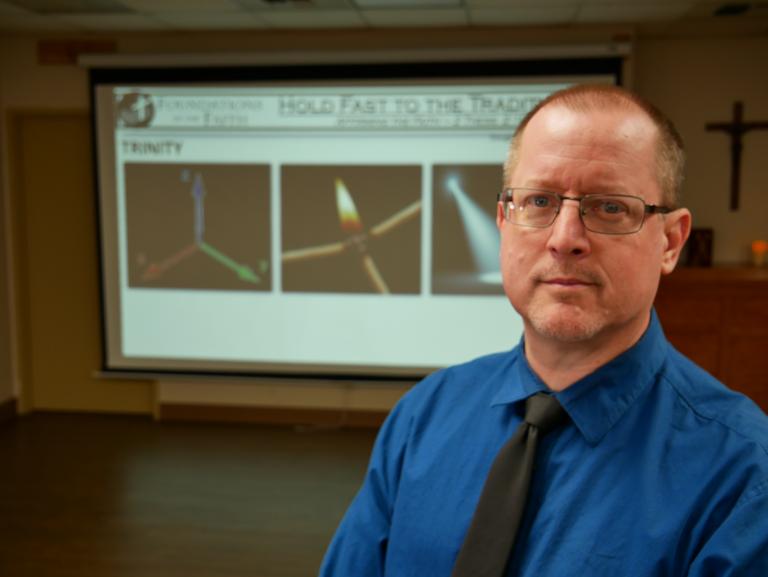
Dr. Douglas Beaumont was, “an Evangelical of Evangelicals,” he says.
As an adult convert, Dr. Beaumont was fervent in his Evangelical Christian faith. He loved discussing the Bible, evangelizing, and wanted to to it full-time. When he enrolled at one of the top Evangelical schools in North American, Southern Evangelical Seminary, he did it intentionally—choosing a school that, he knew, would challenge him to dig deeper in his faith and would train him to evangelize through mentorships with some of the top Evangelical thinkers in the world.
All told, Dr. Beaumont was no slouch.
But studying the Bible in depth led Doug, and his colleagues, to ask questions which couldn’t be readily answered.
Namely, why was the Bible authoritative? And how come so many people understood it in so many different ways?
It was questions like this that led Doug to begin exploring the roots of the biblical canon—how the Bible got put together—and how it’s been used by Christians down through the ages. And it was here that Doug’s Evangelical understanding of the world began to unravel.
Because Doug recognized two things.
The Bible was Collected by the Church
First, that the Bible didn’t fall from the sky completely intact. I’ve had this discussion before. It was part of my own conversion story. And Dr. Beaumont isn’t the first to recognize and grapple with this but he was, indeed, in a very unique position as he did his grappling. He was at one of the top Evangelical school’s in the country. He was amongst some of the brightest lights of Evangelical Christianity and, and he explains, it seemed like no one had the solution.
No one had the solution to how and why Evangelicals can have and use a Bible without recognizing the Church which helped to put it together. In other words, how can we say that the Bible is authoritative in our lives without recognizing that a unique Church—already calling itself Catholic at that point—with a hierarchy of priests and bishops and a Pope, gave their authority to councils which ultimately decided which books belonged in the Bible and which books didn’t.
It was the Church, in its Bishops, that decided which books belonged in what we called the Bible.
And that the Bible itself never actually said it was the sole authority, as Doug was taught to believe as an Evangelical—as Doug was teaching others to believe as an Evangelical seminary professor.
Indeed, as Doug began to question this very notion, he realized that nowhere in the Bible does it actually say this.
A shocking revelation. If the Bible is the sole source of authority, why doesn’t it say that in the Bible?
It was self-contradictory.
How do We Interpret our Bibles?
Second, Dr. Beaumont recognized a problem in that fact that there was so much widespread disagreement amongst Evangelical Christians.
If the Bible was supposed to be how we determined our faith, why couldn’t we agree on what it meant?
Even after “heavy duty theology,” says Dr. Beaumont, we still can’t agree on key issues like baptism, salvation, gender and sexuality issues, not to mention questions about how we ought to worship God, structure our Church hierarchy, and what it means to be a Christian.
It was the last point, especially, that Doug was challenged by.
Working under the late Dr. Norman Geisler, Doug understood that what ultimately bound Protestant Christians together were the “essentials.” What Evangelical Christians all believed; the core of the faith. This helped to explain why there could be so many Christian denominations but still, ultimately, a kind of invisible unity.
But was Dr. Beaumont dug deeper into this question he recognized that even Dr. Geisler himself, in his attempts to define the “essentials” of Christian belief, he came up with several different, contradictory definitions.
In fact no list of “essentials” was the same.
So if Christians couldn’t agree on what Christianity was—not even on what were the most essential things to believe—how was there to be any agreement at all? Any unity in the faith?
Like many converts before him and like many converts after, what Dr. Beaumont ultimately wrestled with, and came to recognize, is that there couldn’t be unity in Bible-only Christianity. Not unless God left an interpreter of the Bible that we could all rally around.
And, realized Dr. Beaumont, he did. In the Catholic Church, in the infallible teaching office of the bishops and the pope, there was an arbiter to help Christians understand what to believe—and what we didn’t believe. And this, in fact, existed since the beginning of Christianity.
To hear more from Dr. Douglas Beaumont check out my interview with him, this week on the show.
Click here to listen to this interview, or listen below.

Next Post

June 30, 2021 116: Where's the Pope in the Bible? (w/ Suan Sonna)
Browse Our Archives
Select a Category Appearances Christian Living Explaining the Faith Podcast Tough Questions Uncategorized Why I'm Catholic
Select a Month January 2024 December 2023 November 2023 July 2023 June 2023 May 2023 April 2023 March 2023 February 2023 January 2023 December 2022 November 2022 October 2022 September 2022 August 2022 July 2022 June 2022 May 2022 April 2022 March 2022 February 2022 January 2022 December 2021 November 2021 October 2021 September 2021 August 2021 July 2021 June 2021 May 2021 April 2021 March 2021 February 2021 January 2021 December 2020 November 2020 October 2020 September 2020 August 2020 July 2020 June 2020 May 2020 April 2020 March 2020 February 2020 January 2020 December 2019 November 2019 October 2019 September 2019 August 2019 July 2019 June 2019 May 2019 April 2019 March 2019 February 2019 January 2019 December 2018 November 2018 October 2018 September 2018 August 2018 July 2018 June 2018 May 2018 April 2018 March 2018 February 2018 January 2018 December 2017 October 2017 September 2017 July 2017 May 2017 April 2017 March 2017 February 2017 January 2017 December 2016 November 2016 October 2016 September 2016 August 2016 July 2016 June 2016 May 2016 April 2016 March 2016 February 2016 January 2016 December 2015 November 2015 October 2015 September 2015 August 2015 July 2015 June 2015 May 2015 April 2015 March 2015 February 2015 January 2015 December 2014 November 2014 October 2014
Follow Us!
TAKE THE
Religious Wisdom Quiz
What does Romans say about those who are led by the Spirit of God?
Select your answer to see how you score.
They are saved They will not sin They will have eternal life They are the children of God (or sons of God)
Support this
Column


Related posts from The Cordial Catholic

235: Questions I Couldn't Answer (w/ John Martignoni)

234: The Mindblowing World of Sacramentals (w/ Shaun...

233: The Power of Good Catholic Witnesses (w/...

232: The Trajectory of Conversion (w/ Phillip Campbell)
TRENDING AT PATHEOS Catholic

Rejecting Doom: Christian Hope And Human Action
Christianity is a religion of hope. We are to have hope and...

It’s What Comes From Within Which Matters
One of the most difficult things for us to understand is why...

Why I Choose the Eucharist Over the Sermon
Choose the Eucharist, Not the Sermon What are we supposed to get...

5 Design Elements Found in Spiritually Rooted Homes
Putting Spirituality Into Home Decor Our homes are more than our living...

Credo: A Story of God Told with the...
About 10 years ago, I began to imagine a personal "Credo" that...

The Anatomy of Divine Revelation in Catholic Thought
The claim that God has made Himself known to human beings is...
view all Catholic blogs
Ad-Free & Subscriber Log-In Subscription Support
- About Us
- 2026 Calendar
- Videos
- Podcasts
- Library of World Religions
- Faith In Media Tracker
- Advertise With Us
- Write for Us
- Privacy Policy
- Terms of Service
- Do Not Sell My Data
- Contact Us
- Radiant Digital
- Manage Newsletter Subscriptions
- Unsubscribe From Notifications
- Sitemap
Copyright 2008-2026, Patheos. All rights reserved.
Subscription Support Ad-Free & Subscriber Log-In
Follow Patheos