
BuddhistCatholicContemplativeEvangelicalGeneral ChristianHinduJewishLatter-day SaintMuslimNew VisionsProgressive Christian
Beliefs
- Buddhist
- Catholic
- Contemplative
- Evangelical
- General Christian
- Hindu
- Jewish
- Latter-day Saint
- More Voices
- Muslim
- New Visions
- Pagan
- Progressive Christian
Topics
- Religion News
- Food and Religion
- Sports and Religion
- Religious Art
- Religious Music and Entertainment
- Religious Events
- History and Religion
- Style and Religion
- Politics and Religion
- Women in Religion
- Recreation Outdoors and Religion
- Business Finance and Religion
- Careers Workplace and Religion
- Education and Religion
- Family Parenting and Religion
- Health Fitness and Religion
- Home and Religion
- Relationships and Religion
- Technology and Religion
- Travel and Religion
Columnists
- Buddhist Columnists
- Business Finance and Religion Columnists
- Careers Workplace and Religion Columnists
- Catholic Columnists
- Contemplative Columnists
- Education and Religion Columnists
- Evangelists Columnists
- Family Parenting and Religion Columnists
- General Christian Columnists
- Health Fitness and Religion Columnists
- Hindu Columnists
- History and Religion Columnists
- Home and Religion Columnists
- Jewish Columnists
- More Voices Columnists
- Latter Day Columnists
- Muslim Columnists
- New Visions Columnists
- Nonreligious Columnists
- Pagan Columnists
- Politics and Religion Columnists
- Progressive Columnists
- Recreation Outdoors and Religion Columnists
- Relationships and Religion Columnists
- Religion News Columnists
- Religious Art Columnists
- Religious Events Columnists
- Religious Music and Entertainment Columnists
- Sports and Religion Columnists
- Style and Religion Columnists
- Technology and Religion Columnists
- Travel and Religion Columnists
- Women in Religion Columnists
Resource Library
- 2026 Calendar
- Library of World Religions
- The 100 Most Holy Places on Earth
- Patheos Answers
- Podcasts
- Videos
- Faith Leaders Database
- Anglican Episcopalian
- Bahai
- Baptist
- Buddhism
- Christianity
- Confucianism
- Eastern Orthodoxy
- Hinduism
- Holiness and Pentecostal
- ISKCON
- Islam
- Judaism
- Lutheran
- Methodist
- The Church of Jesus Christ of Latter-day Saints
- New Age
- Paganism
- Presbytarian and Reformed
- Protestantism
- Religion Behind the Scenes
- Roman Catholic
- Scientology
- Shia Islam
- Sikhism
- Sufism
- Sunni Islam
- Taoism
- Zen
- See all religions
Research Tools
 Ad-Free & Subscriber Log-In Subscription Support
Ad-Free & Subscriber Log-In Subscription Support
Follow Patheos 

- Trending:
- Forgiveness
- |
- Marriage
- |
- Consciousness
- |
- Death Penalty
- |
- Election
- |
- Halloween
 The Cordial Catholic
- Home
- Catholic
- So You’re Invited to Mass: Four Things To Know and Share
So You’re Invited to Mass: Four Things To Know and Share
Last updated on: May 9, 2018 at 2:38 pm by K. Albert Little
So You’re Invited to Mass: Four Things To Know and Share 2018-05-09T14:38:51-04:00 K. Albert Little
Patheos Explore the world's faith through different perspectives on religion and spirituality! Patheos has the views of the prevalent religions and spiritualities of the world.
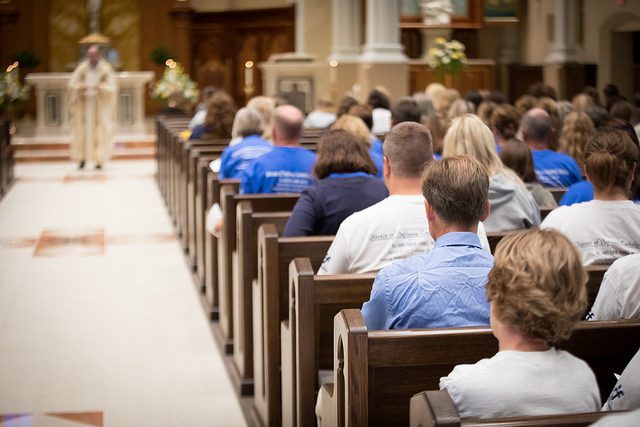
Photo Credit: Catholic Diocese of Saginaw (flickr).
Hello, reader. And welcome.
Let’s, right off the bat, talk about the crazy things that have to bring the two of us—you and me—together today.
First, some crazy person maybe an aunt, an uncle, a deranged sibling, or a complete stranger has invited you to a Catholic Mass. How weird. You know, Catholics aren’t that great at sharing our faith (we’re getting better, I swear!) so the fact that you’ve been invited to Mass is already one decisive step in the direction of bizarre, OK?
And, second, and maybe even more bizarre, you’re actually going to go?
You brave, brave soul.
Well, if somebody insisted on inviting you to Mass and you insist on going allow me to at least provide a short, yet exceptionally handy, guide to a Roman Catholic Mass. I can’t cover everything—there are some great resources for that—but I can give you a few insider tips to help you get the most out of your experience.
And, maybe, to help you understand better the incredible beauty that is our ancient Catholic faith.
Knowing these things, I’ve found, unlocks a whole ton of meaning from the Mass and, if understood, can really enhance your experience of the sacred liturgy taking place.
The Mass is a Foretaste of Heaven (Music Notwithstanding!)
First, know that the Mass is a looking forward; it is a picture of Heaven even if the singing is, sometimes, less than heavenly.
What I mean is that what’s taking place in a Mass is supposed to be a foretaste of how we will live, with God, in eternity. The Catholic Church takes the structure of the Mass and just about all of its elements from the vision of Heaven which we see in the final book of the New Testament, Revelation.
To understand this, alone, is to unlock a whole wealth of understanding about the Mass.
The altar, the incense (if there is any), the prayers of the faithful, and even the words spoken by the priest come from our picture of Heaven—as best we understand it—straight from the pages of the Bible.
Second, you need to understand that the priest is acting as Jesus. In technical terms, we call this persona Christi—in “the person of Christ.” The priest, following in the footsteps of the New Testament Apostles, helps to reveal Christ to us in a particular way.
This is complicated theology but understand this: when the priest prays, when Communion begins, the priest is acting as Jesus as pictured in Revelation. Acting out a divine drama we now is taking place in Heaven, here on earth, just like Christ asked us to at the Last Supper.
Understanding both the roots of the Mass (heavenly worship) and the role of the priest (acting as Jesus) is key to keeping track of what’s happening in a Mass. Because in the Book of Revelation, we see Jesus pictured in Heaven sitting at the right hand of God the Father. Jesus is next to God reminding him, pleading with him, to remember his sacrifice on the cross. Reminding him that he’s redeemed humanity, listening to our prayers and bringing them to the Father, and in this continual kind of love song he’s constantly giving Himself to Himself.
So there’s that.
Catholic Calisthenics: Why We Stand Up, Sit Down, and Kneel
Armed with the knowledge of where the Mass comes from and what exactly the priest is up to should help to unpack a lot of what’s going on during the liturgy. Almost everything the priest is doing is standing in for Christ.
But understanding what’s going on with all the standing, sitting, and kneeling helps, too.
Basically, know this: every one of our postures and gestures at Mass have deep significance. Understanding why we sit, stand, and kneel can help to make the Mass come alive and it isn’t too complicated either.
Why do Catholics stand? To show that something important is happening. Think about when someone walks into a room during an important meeting, you probably stand and greet them. Think about what happens when the national anthem plays. Think about how we show respect for important or significant people in public. In the Mass, we often stand to pray because the Bible pictures us as such: standing before God.
He’s important.
Why do Catholics sit? Sitting is the traditional posture for learning or listening. So, in the Mass, when we’re listening to Scripture being read or listening to the priest’s homily we sit. We sit to listen, absorb, and to silently pray that the priest finishes his homily up soon (quality of homily depending!).
Finally, why do Catholics kneel? We kneel to show reverence—and it’s a lost art these days. Traditionally, we kneel to show respect, reverence, and authority. Think about what happens, typically, when we propose marriage: we kneel to our prospective spouse. In the Mass, we kneel to show reverence towards God who, during Communion, comes and actually dwells among us.
Jesus is Present in the Eucharist
And that leads us to our last point: what’s going on with Communion.
While Communion is typically a monthly, or even less frequent, event in an Evangelical church, Catholics celebrate the Lord’s Supper at each and every Mass. It’s the focal point, the fulcrum, in the Catholic Church’s liturgical life. It’s called “the source and summit” of our faith.
It’s a really big deal.
And for a Mass-goer it’s important to know one powerful and profound thing about what’s taking place. We Catholics believe that Jesus becomes really present during Communion. We believe, strangely enough, that the wafer and wine actual become Jesus in all but their appearance. The body, blood, and divinity of Jesus Christ are made fully present in the Eucharist.
It’s kind of crazy, but this is what the Catholic Church has taught for 2,000 years and what the very first Christians believed too. Why do we kneel during Communion? Because Jesus is actually present in the church. Why does it look like the priest is doing the dishes after he finishes serving Mass? Because he wants to make sure that not a single speck of the Body of Christ is left behind.
And why is the Eucharist the “source and summit” of our faith? Because Jesus has given himself for us to take part in—to actually eat in order to help us become like him. It’s this weird, metaphysical, spiritual training that is the whole purpose of the Mass—the purpose of the Catholic Church. We believe, ultimately, that we’re training for Heaven. That we’re living today, day to day, to become more holy, more like Jesus, more conformed to God because that was, and is, who we’re made to be.
And Mass is helping us to get there—even when the music sucks.
Previous Post

May 1, 2018
There Was Something Wrong With How I Read My Bible
Next Post
May 25, 2018 My Big, Ugly Evangelization
Browse Our Archives
Select a Category Appearances Christian Living Explaining the Faith Podcast Tough Questions Uncategorized Why I'm Catholic
Select a Month January 2024 December 2023 November 2023 July 2023 June 2023 May 2023 April 2023 March 2023 February 2023 January 2023 December 2022 November 2022 October 2022 September 2022 August 2022 July 2022 June 2022 May 2022 April 2022 March 2022 February 2022 January 2022 December 2021 November 2021 October 2021 September 2021 August 2021 July 2021 June 2021 May 2021 April 2021 March 2021 February 2021 January 2021 December 2020 November 2020 October 2020 September 2020 August 2020 July 2020 June 2020 May 2020 April 2020 March 2020 February 2020 January 2020 December 2019 November 2019 October 2019 September 2019 August 2019 July 2019 June 2019 May 2019 April 2019 March 2019 February 2019 January 2019 December 2018 November 2018 October 2018 September 2018 August 2018 July 2018 June 2018 May 2018 April 2018 March 2018 February 2018 January 2018 December 2017 October 2017 September 2017 July 2017 May 2017 April 2017 March 2017 February 2017 January 2017 December 2016 November 2016 October 2016 September 2016 August 2016 July 2016 June 2016 May 2016 April 2016 March 2016 February 2016 January 2016 December 2015 November 2015 October 2015 September 2015 August 2015 July 2015 June 2015 May 2015 April 2015 March 2015 February 2015 January 2015 December 2014 November 2014 October 2014
Follow Us!
TAKE THE
Religious Wisdom Quiz
Who said: "The Lord knows how to rescue the godly from trials and to hold the unrighteous for punishment"?
Select your answer to see how you score.
Paul James Peter Jude
Support this
Column


Related posts from The Cordial Catholic

232: The Trajectory of Conversion (w/ Phillip Campbell)
231: Becoming Catholic in a Church Crisis (w/...

229: Can Catholics and Evangelicals Agree on How...
212: Evangelicals, Here's How to Look for a...
TRENDING AT PATHEOS Catholic

Rejecting Doom: Christian Hope And Human Action
Christianity is a religion of hope. We are to have hope and...

It’s What Comes From Within Which Matters
One of the most difficult things for us to understand is why...

Why I Choose the Eucharist Over the Sermon
Choose the Eucharist, Not the Sermon What are we supposed to get...

5 Design Elements Found in Spiritually Rooted Homes
Putting Spirituality Into Home Decor Our homes are more than our living...

Credo: A Story of God Told with the...
About 10 years ago, I began to imagine a personal "Credo" that...

The Anatomy of Divine Revelation in Catholic Thought
The claim that God has made Himself known to human beings is...
view all Catholic blogs
Ad-Free & Subscriber Log-In Subscription Support
- About Us
- 2026 Calendar
- Videos
- Podcasts
- Library of World Religions
- Faith In Media Tracker
- Advertise With Us
- Write for Us
- Privacy Policy
- Terms of Service
- Do Not Sell My Data
- Contact Us
- Radiant Digital
- Manage Newsletter Subscriptions
- Unsubscribe From Notifications
- Sitemap
Copyright 2008-2026, Patheos. All rights reserved.
Subscription Support Ad-Free & Subscriber Log-In
Follow Patheos