
BuddhistCatholicContemplativeEvangelicalGeneral ChristianHinduJewishLatter-day SaintMuslimNew VisionsProgressive Christian
Beliefs
- Buddhist
- Catholic
- Contemplative
- Evangelical
- General Christian
- Hindu
- Jewish
- Latter-day Saint
- More Voices
- Muslim
- New Visions
- Pagan
- Progressive Christian
Topics
- Religion News
- Food and Religion
- Sports and Religion
- Religious Art
- Religious Music and Entertainment
- Religious Events
- History and Religion
- Style and Religion
- Politics and Religion
- Women in Religion
- Recreation Outdoors and Religion
- Business Finance and Religion
- Careers Workplace and Religion
- Education and Religion
- Family Parenting and Religion
- Health Fitness and Religion
- Home and Religion
- Relationships and Religion
- Technology and Religion
- Travel and Religion
Columnists
- Buddhist Columnists
- Business Finance and Religion Columnists
- Careers Workplace and Religion Columnists
- Catholic Columnists
- Contemplative Columnists
- Education and Religion Columnists
- Evangelists Columnists
- Family Parenting and Religion Columnists
- General Christian Columnists
- Health Fitness and Religion Columnists
- Hindu Columnists
- History and Religion Columnists
- Home and Religion Columnists
- Jewish Columnists
- More Voices Columnists
- Latter Day Columnists
- Muslim Columnists
- New Visions Columnists
- Nonreligious Columnists
- Pagan Columnists
- Politics and Religion Columnists
- Progressive Columnists
- Recreation Outdoors and Religion Columnists
- Relationships and Religion Columnists
- Religion News Columnists
- Religious Art Columnists
- Religious Events Columnists
- Religious Music and Entertainment Columnists
- Sports and Religion Columnists
- Style and Religion Columnists
- Technology and Religion Columnists
- Travel and Religion Columnists
- Women in Religion Columnists
Resource Library
- 2026 Calendar
- Library of World Religions
- The 100 Most Holy Places on Earth
- Patheos Answers
- Podcasts
- Videos
- Faith Leaders Database
- Anglican Episcopalian
- Bahai
- Baptist
- Buddhism
- Christianity
- Confucianism
- Eastern Orthodoxy
- Hinduism
- Holiness and Pentecostal
- ISKCON
- Islam
- Judaism
- Lutheran
- Methodist
- The Church of Jesus Christ of Latter-day Saints
- New Age
- Paganism
- Presbytarian and Reformed
- Protestantism
- Religion Behind the Scenes
- Roman Catholic
- Scientology
- Shia Islam
- Sikhism
- Sufism
- Sunni Islam
- Taoism
- Zen
- See all religions
Research Tools
 Ad-Free & Subscriber Log-In Subscription Support
Ad-Free & Subscriber Log-In Subscription Support
Follow Patheos 

- Trending:
- Forgiveness
- |
- Marriage
- |
- Consciousness
- |
- Death Penalty
- |
- Election
- |
- Halloween
 The Cordial Catholic
- Home
- Catholic
- So You Think You’re Smarter than the Church Fathers?
So You Think You’re Smarter than the Church Fathers?
Last updated on: August 8, 2015 at 11:04 am by K. Albert Little
So You Think You’re Smarter than the Church Fathers? 2015-08-08T11:04:08-04:00 K. Albert Little
Patheos Explore the world's faith through different perspectives on religion and spirituality! Patheos has the views of the prevalent religions and spiritualities of the world.
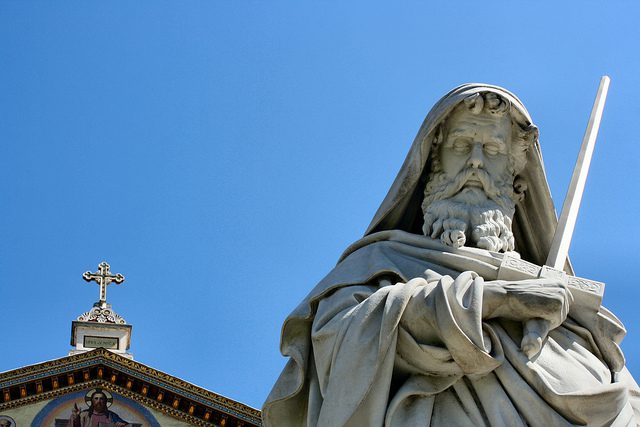
Photo Credit: Megan Allen.
There are lots of reasons why I decided, as an otherwise happy Evangelical Protestant, to become a Roman Catholic. Among these reasons were aesthetic and spiritual appeals—the beauty of the liturgy and the plethora of centuries old spiritual practices—and these were, indeed, powerful motivators.
But alongside the sometimes esoteric motivations were some fundamentally, concretely intellectual reasons to join the ranks of the ancient Catholic Church.
Chief among the intellectual appeals stand the towering figures of the Early Church Fathers.
Christians who lived, and wrote, some of them contemporary with the writings of the New Testament.
Many of them, in the earliest Fathers known as the Ante-Nicene Fathers, were taught themselves by the apostles.
It was the strong appeal and clear theology of these, some of the earliest and most foundational Christians, that contributed strongly to my intellectual conversion to Catholicism. To do anything otherwise, I’ll argue, would be utterly foolish.
The Clarity of the Church Fathers
I’ve written before, in a tongue-and-cheek article, that a surefire way to avoid becoming a Catholic is to avoid, altogether, reading from the Church Fathers.
The reason is simple. If you do venture a risk at reading the ancient Church Fathers something becomes alarmingly apparent fairly quickly in the history of the Church: the clarity of some very, particularly Catholic doctrine.
Take two examples: the Eucharist and Baptism.
The Church Fathers on Baptism
In the Catholic Church, along with the Anglicans and the Orthodox, these practices are Sacramental. That is, they hold the most special graces possible within the Church. In these acts, God does something specifically important.
In Catholicism, fundamentally, baptism saves.
This is, of course, contrary to my Evangelical upbringing. As an Evangelical baptism was merely an outward sign that I’ve accepted Christ. I was baptized years after becoming a Christian. My wife sometimes jokes that she was baptized—in a Baptist church—so she could get a job at the Church bookstore. Regardless, for the both of us baptism was an outward sign—that’s what we would’ve called it, “an outward sign,” symbolizing our acceptance of the mission and message of Christ.
While baptism is seen, nearly universally amongst Evangelicals, as a mere “outward sign” this is in complete and absolute contrast to the teaching of the Early Church Fathers.
Irenaeus, for example, writing in the 2nd century, is unequivocal,
For as we are lepers in sin, we are made clean, by means of the sacred water and the invocation of the Lord, from our old transgressions, being spiritually regenerated as newborn babes, even as the Lord has declared: ‘Except a man be born again through water and the Spirit, he shall not enter into the kingdom of heaven’.
Along with a myriad of other Early Church Fathers, Irenaeus speaks about the important saving power of baptism—and its necessity.
And, alongside the witness of the other Early Church Fathers, Irenaeus’s teaching on the necessity of baptism is in stark contrast to what was taught in the Evangelical communities I “grew up” in.
The Church Fathers on the Eucharist
Likewise, the Eucharist.
I’ve written several times before about the convincing and unambiguous witness of the Early Church Fathers about the Eucharist. In the mind of all of these Church Fathers, themselves disciples of the very first disciples of Christ, the Eucharist was the actual blood and body of Christ.
This doctrine, a true mystery and miracle, is referred to as transubstantiation in the Catholic Church and is held, in similar ways, by the Orthodox, Anglican, and Lutheran communities.
In these communities, the belief is that the elements of wine and bread, during Communion, actually become Jesus’ flesh and blood through a miraculous transformation. Something akin to the feeding of the five thousand (which interestingly enough precedes Jesus’ famous Eucharistic Discourse in John 6).
This idea, in contrast, is fundamentally opposed by the whole of Evangelical Christendom.
Some denominations, like the Pentecostal church I was baptized in as a teen, would go so far as to hold Catholics as idolators for their worship of the Communion elements.
But back up that truck—belief in the real presence was a cornerstone of Christian worship in the time of the Early Church; it was so widely held and well known that early Christians were accused of being cannibals.
So You Think You’re Smarter than the Church Fathers?
I think, ultimately, there are two elements at play here.
First, for those that read the Church Fathers—those outside of the Catholic, Orthodox, or Anglican faiths—it becomes a difficult balancing act. If we give the Church Fathers the full weight they deserve, as apostles of the apostles and the early founders of a Church which has maintained its identity and doctrine to today, then we need to do some serious thinking.
If baptism saved, if the bread and wine were believed to actually be Jesus in the time of the Early Church, why, and when, did we cease to maintain that belief?
The question to me, as an evangelical, was too great of an intellectual stumbling block to simply ignore.
Second, however, is that fact that so few of us read the Early Church Fathers to begin with—and that’s really the crux of the thing, isn’t it?
Would Protestantism proliferate 30,000 different denominations if we returned to the sources and, as a Christian people, read what the earliest Christians had to say?
The challenge of our times is one of rising above the status quo.
In the end, I suspect there are very few of us proposing to be smarter than the giants of the Early Christian Church. That would be a fool’s game. Instead, and sadly, I suspect the vast majority who cling to beliefs adopted in much more recent times don’t even know it—and haven’t read the ancient Christian sources or heard the incredible things they have to say.
No, I don’t think many of us think we’re smarter than the Church Fathers. I think most of us, sadly, haven’t bothered to read them, and find out.
Previous Post

June 27, 2015
Keep Calm And Carry On: How We Respond to Same-Sex Marriage
Next Post

July 20, 2015 Why Welcoming is Key to the New Evangelization
Browse Our Archives
Select a Category Appearances Christian Living Explaining the Faith Podcast Tough Questions Uncategorized Why I'm Catholic
Select a Month January 2024 December 2023 November 2023 July 2023 June 2023 May 2023 April 2023 March 2023 February 2023 January 2023 December 2022 November 2022 October 2022 September 2022 August 2022 July 2022 June 2022 May 2022 April 2022 March 2022 February 2022 January 2022 December 2021 November 2021 October 2021 September 2021 August 2021 July 2021 June 2021 May 2021 April 2021 March 2021 February 2021 January 2021 December 2020 November 2020 October 2020 September 2020 August 2020 July 2020 June 2020 May 2020 April 2020 March 2020 February 2020 January 2020 December 2019 November 2019 October 2019 September 2019 August 2019 July 2019 June 2019 May 2019 April 2019 March 2019 February 2019 January 2019 December 2018 November 2018 October 2018 September 2018 August 2018 July 2018 June 2018 May 2018 April 2018 March 2018 February 2018 January 2018 December 2017 October 2017 September 2017 July 2017 May 2017 April 2017 March 2017 February 2017 January 2017 December 2016 November 2016 October 2016 September 2016 August 2016 July 2016 June 2016 May 2016 April 2016 March 2016 February 2016 January 2016 December 2015 November 2015 October 2015 September 2015 August 2015 July 2015 June 2015 May 2015 April 2015 March 2015 February 2015 January 2015 December 2014 November 2014 October 2014
Follow Us!
TAKE THE
Religious Wisdom Quiz
Who was lowered through a roof to be healed by Jesus?
Select your answer to see how you score.
A paralyzed man A leper Jairus' daughter A blind man
Support this
Column


Related posts from The Cordial Catholic

229: Can Catholics and Evangelicals Agree on How...

227: What was Medieval Catholicism Really Like? (w/...
158: Purgatory for Evangelicals (w/ Dr. Brett Salkeld)
157: Tackling Objections to the Papacy (w/ Suan...
TRENDING AT PATHEOS Catholic

Rejecting Doom: Christian Hope And Human Action
Christianity is a religion of hope. We are to have hope and...

It’s What Comes From Within Which Matters
One of the most difficult things for us to understand is why...

Why I Choose the Eucharist Over the Sermon
Choose the Eucharist, Not the Sermon What are we supposed to get...

5 Design Elements Found in Spiritually Rooted Homes
Putting Spirituality Into Home Decor Our homes are more than our living...

Credo: A Story of God Told with the...
About 10 years ago, I began to imagine a personal "Credo" that...

The Anatomy of Divine Revelation in Catholic Thought
The claim that God has made Himself known to human beings is...
view all Catholic blogs
Ad-Free & Subscriber Log-In Subscription Support
- About Us
- 2026 Calendar
- Videos
- Podcasts
- Library of World Religions
- Faith In Media Tracker
- Advertise With Us
- Write for Us
- Privacy Policy
- Terms of Service
- Do Not Sell My Data
- Contact Us
- Radiant Digital
- Manage Newsletter Subscriptions
- Unsubscribe From Notifications
- Sitemap
Copyright 2008-2026, Patheos. All rights reserved.
Subscription Support Ad-Free & Subscriber Log-In
Follow Patheos