
BuddhistCatholicContemplativeEvangelicalGeneral ChristianHinduJewishLatter-day SaintMuslimNew VisionsProgressive Christian
Beliefs
- Buddhist
- Catholic
- Contemplative
- Evangelical
- General Christian
- Hindu
- Jewish
- Latter-day Saint
- More Voices
- Muslim
- New Visions
- Pagan
- Progressive Christian
Topics
- Religion News
- Food and Religion
- Sports and Religion
- Religious Art
- Religious Music and Entertainment
- Religious Events
- History and Religion
- Style and Religion
- Politics and Religion
- Women in Religion
- Recreation Outdoors and Religion
- Business Finance and Religion
- Careers Workplace and Religion
- Education and Religion
- Family Parenting and Religion
- Health Fitness and Religion
- Home and Religion
- Relationships and Religion
- Technology and Religion
- Travel and Religion
Columnists
- Buddhist Columnists
- Business Finance and Religion Columnists
- Careers Workplace and Religion Columnists
- Catholic Columnists
- Contemplative Columnists
- Education and Religion Columnists
- Evangelists Columnists
- Family Parenting and Religion Columnists
- General Christian Columnists
- Health Fitness and Religion Columnists
- Hindu Columnists
- History and Religion Columnists
- Home and Religion Columnists
- Jewish Columnists
- More Voices Columnists
- Latter Day Columnists
- Muslim Columnists
- New Visions Columnists
- Nonreligious Columnists
- Pagan Columnists
- Politics and Religion Columnists
- Progressive Columnists
- Recreation Outdoors and Religion Columnists
- Relationships and Religion Columnists
- Religion News Columnists
- Religious Art Columnists
- Religious Events Columnists
- Religious Music and Entertainment Columnists
- Sports and Religion Columnists
- Style and Religion Columnists
- Technology and Religion Columnists
- Travel and Religion Columnists
- Women in Religion Columnists
Resource Library
- 2026 Calendar
- Library of World Religions
- The 100 Most Holy Places on Earth
- Patheos Answers
- Podcasts
- Videos
- Faith Leaders Database
- Anglican Episcopalian
- Bahai
- Baptist
- Buddhism
- Christianity
- Confucianism
- Eastern Orthodoxy
- Hinduism
- Holiness and Pentecostal
- ISKCON
- Islam
- Judaism
- Lutheran
- Methodist
- The Church of Jesus Christ of Latter-day Saints
- New Age
- Paganism
- Presbytarian and Reformed
- Protestantism
- Religion Behind the Scenes
- Roman Catholic
- Scientology
- Shia Islam
- Sikhism
- Sufism
- Sunni Islam
- Taoism
- Zen
- See all religions
Research Tools
 Ad-Free & Subscriber Log-In Subscription Support
Ad-Free & Subscriber Log-In Subscription Support
Follow Patheos 

- Trending:
- Forgiveness
- |
- Marriage
- |
- Consciousness
- |
- Death Penalty
- |
- Election
- |
- Halloween
 The Cordial Catholic
- Home
- Catholic
- The Rhythm of the Saints
The Rhythm of the Saints
Last updated on: August 3, 2015 at 4:02 pm by K. Albert Little
The Rhythm of the Saints 2015-08-03T16:02:35-04:00 K. Albert Little
Patheos Explore the world's faith through different perspectives on religion and spirituality! Patheos has the views of the prevalent religions and spiritualities of the world.
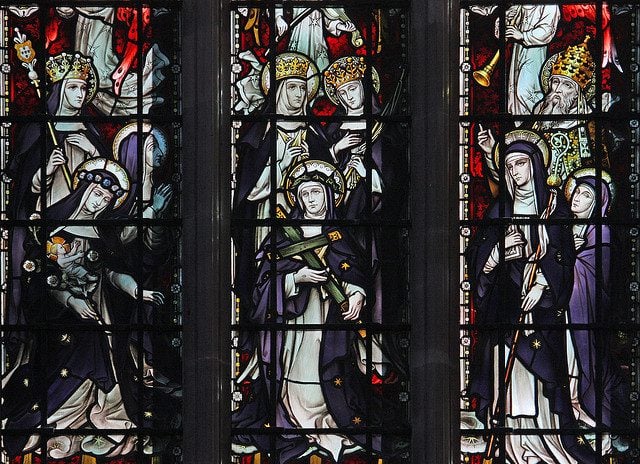
Photo Credit: Fr. Lawrence, OP.
So I’ve been writing about my conversion experience and what’s been drawing me in to the Catholic Church and the bulk of it, in the beginning, was theological, historical, and intellectual.
It began with notions of sola scriptura, the Protestant belief of the Bible as the sole authority in the Christian’s life. For me, it fell apart, and I found the teaching authority of the Catholic Church to make a lot more sense. And the more I learned about the Catholic Church the more all of its teaching began to make sense—the more some of the unanswered (or inadequately answered) questions I had as a Protestant were soundly answered.
But it hasn’t been a merely intellectual exercise, and it hasn’t been merely negative aspects of Protestant that has driven me away from it.
In reality, there are far more positive, incredibly beautiful aspects of Catholicism that are drawing me in. This is a common experience in Protestant converts to the Catholic Church and it’s commonly described as finding a “hidden treasure,” much like the parable of the Pearl of Great Price. In the case of this post, and one of the first hidden treasures that I found, were the saints.
I don’t want to spend too much time explaining the theology of the saints, I’d like to go into that later, in a more in-depth post, but some needs to be said, upfront, to clear the air.
A common misconception, and one that I soundly held as a Protestant, was that Catholics pray to saints in the same way that they pray to God. An even worse misconception is that Catholics worship saints in the same way that they worship God. Neither of these is true. Do some confused Catholics pray to saints in the same way they would to God? Definitely, but what Catholic doctrine teaches is abundantly clear (and there are confused people in all religious practices).
In brief, the saints are deceased Christians who the Catholic Church has investigated and determined to be individuals whose lives pointed to Jesus Christ. Drawn from a tradition that dates back to the earliest Christian writings including the New Testament the Catholic Church has taught that those closest to God, in Heaven, can hear our prayers and pray for us.
What I came to understand as I began to explore Catholicism is that the Church believes itself to exist not just here and now on earth but with deep historical and spiritual roots. In other words, a follower of Jesus Christ, in Heaven, is still equally a part of the Church.
This is the Communion of Saints and this, to me, was an absolute hidden treasure to discover.
One f those nagging questions that I always had as a Protestant was what was meant by a passage like the one in Hebrews which refers to the saints in Heaven; the witnesses who look down on us as we run our race. As a Protestant it always sounded bizarre and all explanations fell flat. The Catholic explanation—an explanation with historical proofs clearly on its side—makes complete sense, to me, of what the inspired author of Hebrews was talking about.
The saints can pray for us because the saints, like any other Christian, exist right now in the Church, they are simply the Church in Heaven—but the same Church. This is the hidden treasure I discovered: That in the same way I can ask my friend Andrew to pray for me, I can ask a saint, in Heaven, to do the same.
As a Protestant I might send a quick e-mail to a friend, “Hey, I’m going through a difficult day at work can you pray for me?”
As a Catholic I can do the same but, likewise, I could also fire off a quick prayer, “St. Albert, pray for me and this difficult situation at work.”
I’m not praying for St. Albert to solve the problem for me, that’s the role of God, I’m asking St. Albert to pray for me the same way I’d ask my friend. Because the saints are equally part of the same Catholic church they can pray for me in the exact same way. The fundamental difference being, of course, that the saints are in Heaven and that’s a pretty big difference (although my friend Andrew is certainly heading there too).
I can’t stress enough how incredible it was, for me, to discover the hidden treasure of the Communion of the Saints. Here, suddenly before me, are scores and scores of saints. Holy men and women (more women than men!) who’ve lived before me and experienced life and tried their best to honour God. These are real people whose lives point to Christ who I can emulate; examples to boldly follow. Real men and women, surrounding us in a great cloud of witnesses, who we can ask to pray for us. Who John, in Revelation, records as surrounding God and praying to him in his glimpse of Heaven. What kind of incredible, immediate access to prayer power is that?
As a teenager in the Pentecostal church in Southern Ontario I went to a few youth conventions. These conventions were, in every sense of the word, epic and when I think about the Communion of the Saints, and this beautifully rich teaching of the Catholic Church, I often think about those conventions. Imagine, as a teeanger, what it was like to have thousands of other young people fervently praying together in an amphitheatre—all praying for one intention. As an adult Protestant, first stumbling upon the Catholic notion of saints felt much the same. Suddenly, although they were there all along, here are more than 10,000 Christian saints who are ready and willing to pray for me, like friends.
And that’s what saints become, as funny as it sounds.
When I first heard it put that way, by a Catholic priest, I was genuinely bemused. I thought, how can I be friends with someone who never speaks back to me, who I don’t actually know. But what I’ve found, in the short time I’ve known about saints is that you can begin to know a saint and truly, really, develop a kind of kinship. As I learn about, and pray for help from St. Frances de Sales, a humble and soft spoken Catholic apologist priest who lived during the Reformation, I can begin to feel a bond develop. I ask for his prayers in particularly difficult times, or surrounding particular situations and he begins to feel familiar to me, and I begin to know him better.
The thing about saints is that all saints, with their lives and their prayers for us, point towards Jesus Christ, who is central. The Communion of the Saints, the Church in Heaven, is one of those things that I’m discovering, as a Protestant entering the Catholic Church, to be a hidden treasure of immeasurable value—and a richly beautiful enhancement to my faith life as I try to live like Christ.
Previous Post
November 19, 2014
A System Designed to Fail
Next Post
November 28, 2014 How Learning About the Eucharist Blew My Mind
Browse Our Archives
Select a Category Appearances Christian Living Explaining the Faith Podcast Tough Questions Uncategorized Why I'm Catholic
Select a Month January 2024 December 2023 November 2023 July 2023 June 2023 May 2023 April 2023 March 2023 February 2023 January 2023 December 2022 November 2022 October 2022 September 2022 August 2022 July 2022 June 2022 May 2022 April 2022 March 2022 February 2022 January 2022 December 2021 November 2021 October 2021 September 2021 August 2021 July 2021 June 2021 May 2021 April 2021 March 2021 February 2021 January 2021 December 2020 November 2020 October 2020 September 2020 August 2020 July 2020 June 2020 May 2020 April 2020 March 2020 February 2020 January 2020 December 2019 November 2019 October 2019 September 2019 August 2019 July 2019 June 2019 May 2019 April 2019 March 2019 February 2019 January 2019 December 2018 November 2018 October 2018 September 2018 August 2018 July 2018 June 2018 May 2018 April 2018 March 2018 February 2018 January 2018 December 2017 October 2017 September 2017 July 2017 May 2017 April 2017 March 2017 February 2017 January 2017 December 2016 November 2016 October 2016 September 2016 August 2016 July 2016 June 2016 May 2016 April 2016 March 2016 February 2016 January 2016 December 2015 November 2015 October 2015 September 2015 August 2015 July 2015 June 2015 May 2015 April 2015 March 2015 February 2015 January 2015 December 2014 November 2014 October 2014
Follow Us!
TAKE THE
Religious Wisdom Quiz
Who conquered Jerusalem and made it his capital?
Select your answer to see how you score.
Solomon David Hezekiah Saul
Support this
Column


Related posts from The Cordial Catholic
201: Eucharistic Miracles, Marian Apparitions, and More... (w/...
178: Responding to the Toughest Protestant Objections (w/...
153: Grace, Prudence, and Living the Virtues (w/...
151: The Mind-Blowing Sacramental Worldview (w/ Fr. Harrison...
TRENDING AT PATHEOS Catholic

Rejecting Doom: Christian Hope And Human Action
Christianity is a religion of hope. We are to have hope and...

It’s What Comes From Within Which Matters
One of the most difficult things for us to understand is why...

Why I Choose the Eucharist Over the Sermon
Choose the Eucharist, Not the Sermon What are we supposed to get...

5 Design Elements Found in Spiritually Rooted Homes
Putting Spirituality Into Home Decor Our homes are more than our living...

Credo: A Story of God Told with the...
About 10 years ago, I began to imagine a personal "Credo" that...

The Anatomy of Divine Revelation in Catholic Thought
The claim that God has made Himself known to human beings is...
view all Catholic blogs
Ad-Free & Subscriber Log-In Subscription Support
- About Us
- 2026 Calendar
- Videos
- Podcasts
- Library of World Religions
- Faith In Media Tracker
- Advertise With Us
- Write for Us
- Privacy Policy
- Terms of Service
- Do Not Sell My Data
- Contact Us
- Radiant Digital
- Manage Newsletter Subscriptions
- Unsubscribe From Notifications
- Sitemap
Copyright 2008-2026, Patheos. All rights reserved.
Subscription Support Ad-Free & Subscriber Log-In
Follow Patheos