
BuddhistCatholicContemplativeEvangelicalGeneral ChristianHinduJewishLatter-day SaintMuslimNew VisionsProgressive Christian
Beliefs
- Buddhist
- Catholic
- Contemplative
- Evangelical
- General Christian
- Hindu
- Jewish
- Latter-day Saint
- More Voices
- Muslim
- New Visions
- Pagan
- Progressive Christian
Topics
- Religion News
- Food and Religion
- Sports and Religion
- Religious Art
- Religious Music and Entertainment
- Religious Events
- History and Religion
- Style and Religion
- Politics and Religion
- Women in Religion
- Recreation Outdoors and Religion
- Business Finance and Religion
- Careers Workplace and Religion
- Education and Religion
- Family Parenting and Religion
- Health Fitness and Religion
- Home and Religion
- Relationships and Religion
- Technology and Religion
- Travel and Religion
Columnists
- Buddhist Columnists
- Business Finance and Religion Columnists
- Careers Workplace and Religion Columnists
- Catholic Columnists
- Contemplative Columnists
- Education and Religion Columnists
- Evangelists Columnists
- Family Parenting and Religion Columnists
- General Christian Columnists
- Health Fitness and Religion Columnists
- Hindu Columnists
- History and Religion Columnists
- Home and Religion Columnists
- Jewish Columnists
- More Voices Columnists
- Latter Day Columnists
- Muslim Columnists
- New Visions Columnists
- Nonreligious Columnists
- Pagan Columnists
- Politics and Religion Columnists
- Progressive Columnists
- Recreation Outdoors and Religion Columnists
- Relationships and Religion Columnists
- Religion News Columnists
- Religious Art Columnists
- Religious Events Columnists
- Religious Music and Entertainment Columnists
- Sports and Religion Columnists
- Style and Religion Columnists
- Technology and Religion Columnists
- Travel and Religion Columnists
- Women in Religion Columnists
Resource Library
- 2026 Calendar
- Library of World Religions
- The 100 Most Holy Places on Earth
- Patheos Answers
- Podcasts
- Videos
- Faith Leaders Database
- Anglican Episcopalian
- Bahai
- Baptist
- Buddhism
- Christianity
- Confucianism
- Eastern Orthodoxy
- Hinduism
- Holiness and Pentecostal
- ISKCON
- Islam
- Judaism
- Lutheran
- Methodist
- The Church of Jesus Christ of Latter-day Saints
- New Age
- Paganism
- Presbytarian and Reformed
- Protestantism
- Religion Behind the Scenes
- Roman Catholic
- Scientology
- Shia Islam
- Sikhism
- Sufism
- Sunni Islam
- Taoism
- Zen
- See all religions
Research Tools
 Ad-Free & Subscriber Log-In Subscription Support
Ad-Free & Subscriber Log-In Subscription Support
Follow Patheos 

- Trending:
- Forgiveness
- |
- Marriage
- |
- Consciousness
- |
- Death Penalty
- |
- Election
- |
- Halloween
 The Cordial Catholic
- Home
- Catholic
- A Protestant Deep in History
A Protestant Deep in History
Last updated on: August 3, 2015 at 4:02 pm by K. Albert Little
A Protestant Deep in History 2015-08-03T16:02:33-04:00 K. Albert Little
Patheos Explore the world's faith through different perspectives on religion and spirituality! Patheos has the views of the prevalent religions and spiritualities of the world.
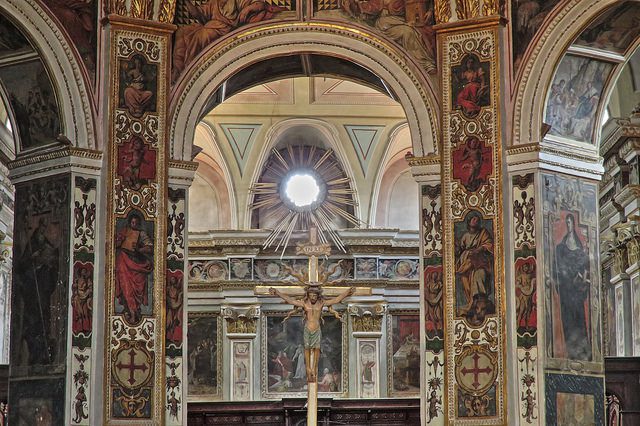
Photo Credit: Gianni del Bufalo.
In my day job I’m a Kindergarten teacher. I hang out with 3 and 4-year olds and sometimes learn a little bit along the way. Sometimes they learn a little bit, too. While talking about where babies come from (don’t worry!) I asked a couple of the kids, “Where were you born?” I was surprised by their incredulous looks, like I’d ask them to explain Pythagoras’s theorem.
“I don’t know,” each one, in turn, replied. It was a question, I could tell by their faces, that they didn’t even know how to begin to process, nevermind answer.
I was surprised.
Of course, I probably shouldn’t have been. To a 3 or 4-year old the question of where they were born must seem pretty irrelevant. They were born, they exist, they’re playing cops and robbers with their friends. That’s enough.
Likewise, that was enough for me, as a Protestant, for 15 years. Since I came to Christ as a high school student up until I started exploring the roots of the Christian Church it was enough to know I was born, I existed, I was a Christian.
Once I began digging deeper into those roots, to learn about where Christianity—my faith—was born I realized, like my tiny Kindergartners, how little I knew.
I was surprised to realize that my Kindergarten students didn’t know where they were born. But, as I thought about it, I was in the exact same position in my faith life. I didn’t know where I came from—where my faith, a central part of my life and identity, had its origins.
Sure, I knew about the Reformation. I knew about the church in the New Testament. I knew, roughly, the outline of history. I was a History major after all. But I didn’t know the details, and the details are important. I never took the time, or spent the energy, to learn about where (and how) my faith was born.
Blessed John Henry Cardinal Newman, a famous Anglican convert to Catholicism in the 19th century, made a pretty audacious claim about Protestants who read into the history of the Christian Church. He said,
To be deep in history is to cease to be Protestant.
Newman was arguing that those who looked deeply into Church history, the development of the Canon of Scriptures, the development of doctrine, the Fathers of the Church, and the catalysts of the Reformation would cease to be Protestant. The alternative, in his mind, was to become a Catholic.
As I journeyed on this road towards Rome I thought it would be prudent to read some historical texts about the Reformation. After scouring the Internet for suggestions I landed on The Reformation by Darmaid MacCulloch, a secular Scottish historian of some renown. My goal was to find as unbiased a source as possible covering the Reformation and the Catholic Counter-Reformation from a decent perspective. While MacCulloch’s own social ethics lens certainly coloured some of his commentary, The Reformation was incredibly thorough—and incredibly eye-opening.
I’ve told my Protestant friends this: If I wasn’t already on this journey towards becoming Catholic, after reading MacCulloch’s massive 864-page tome, I would find it very difficult to remain Protestant.
That’s the truth.
Because the truth is, in my reading, the Protestant movement began as a protest. A protest against corruption in the Church and its teachings but also as a product of its time.
The Church was corrupt. What I failed to grasp as a Protestant was that the Church is the first to admit that. The Church was doing some pretty ridiculous and those things needed to be reformed. But what started as a reform movement from within the Church quickly got out of hand. Interesting, MacCulloch argues that if there’s any one explanation for the Reformation (and the lack of a Reformation in the Eastern Orthodox churches) was because, suddenly, Europeans could read the Bible in a new language, Greek.
In fact it was a Church emerging out of the Dark Ages and discovering biblical literature, theology, and, indeed, ancient Greek manuscripts that prompted the Reformation as much as the corruption of the Church. It was a product of the times.
Suddenly, rich theological works that had been lost were being re-read and re-discovered. Suddenly, the Bible was being made available to the average layperson thanks, first of all, to the Catholic Church. But these Bibles, and their theology, needed an interpreter and this is where the Reformation quickly got out of hand.
In fact Martin Luther himself, the father of the Reformation and the Lutheran Church, tried desperately to get the Bible back out of the hands of the Protestant faithful once the movement began to splinter. Luther, like the Catholic Church for 1500 years, realized that the Bible was good but needed to be properly interpreted and taught from. In the hands of the people it wasn’t dangerous as a revolutionary tool, it was dangerous because it couldn’t be easily understood by the uneducated and under-educated masses. Those masses, at Mass, received their instruction and education.
Of course, that was the argument of the Catholic Church since the beginning. That argument, which is a compelling one to me, remains the case today. The Church is the sole interpreter of the Holy Scriptures. We can read and study them (and we should), the Spirit can speak through them, but the gift of God is that He gave us an authority to tell us what they mean.
As I read about the Reformation I realized that what began as reform from within the Church quickly spiraled out of control. With the right combinations of personality, zeitgeist, and technology (namely, the printing press) the situation went from reforming the one, truth, catholic and apostolic church into splintering off and, early on, establishing one’s own doctrine and theology based on one’s own preference, experience, and history.
A solid argument can be made, even, for Luther’s doctrine of salvation being based strongly on his own experiences with scrupulosity as a Augustinian friar.
What shocked me most, in learning about the Reformation, was that I didn’t know where my faith was born. I didn’t know where I’d come from, or what had come before me.
I didn’t know how tenuous the start of my Protestant faith was, or how the personalities of the reformers influenced and shaped their teaching (which in turn influenced and shaped the development of today’s 30,000 denominations). Or how a translation of the Bible into the vernacular, the language of the people, affected the European population—and not because the Church had been hiding anything (or making anything up) but because it was new and different and they often didn’t understand what they read.
The Church is the first to admit that it had things wrong but the Counter-Reformation in the Catholic Church worked to set those things right.
Here, Protestant theologian, and champion of Church unity Stanley Hauerwas says it best, speaking to modern-day Protestants. He’s worth quoting at length,
Protestantism is a reformed movement. When it becomes an end in itself it becomes unintelligible to itself. Protestants who don’t long for Christian unity are not Protestant. There is also the ongoing problem that Catholics have responded to the Protestant critique in a way that the Protestant critique no longer makes much sense. Accordingly, the question is: why do we continue to be kept apart?
What I’ve learned by reading about the birth of my faith is that its birth is decidedly shaky. If Catholics have reformed themselves what is there left to protest against?
Of course not everyone who reads Church history is going to become a Catholic. Cardinal Newman’s jab at Protestant historians isn’t mean to be a cardinal rule. It’s a possible outcome, a likely outcome according to Newman. If the history of the Church were that compelling than everyone would be a Catholic, or everyone would be a Protestant, or we’d all join the Eastern Orthodox church. Newman’s argument, however, and Hauerwas brings it home, is that if we look into the reasons why the Reformation took place, the heart of the Reformation, we’d have an awfully hard time hanging on to our current paradigm.
Previous Post
December 16, 2014
Papal Infallibility and Why Some Popes are Evil
Next Post
December 21, 2014 When the Priest Does the Dishes
Browse Our Archives
Select a Category Appearances Christian Living Explaining the Faith Podcast Tough Questions Uncategorized Why I'm Catholic
Select a Month January 2024 December 2023 November 2023 July 2023 June 2023 May 2023 April 2023 March 2023 February 2023 January 2023 December 2022 November 2022 October 2022 September 2022 August 2022 July 2022 June 2022 May 2022 April 2022 March 2022 February 2022 January 2022 December 2021 November 2021 October 2021 September 2021 August 2021 July 2021 June 2021 May 2021 April 2021 March 2021 February 2021 January 2021 December 2020 November 2020 October 2020 September 2020 August 2020 July 2020 June 2020 May 2020 April 2020 March 2020 February 2020 January 2020 December 2019 November 2019 October 2019 September 2019 August 2019 July 2019 June 2019 May 2019 April 2019 March 2019 February 2019 January 2019 December 2018 November 2018 October 2018 September 2018 August 2018 July 2018 June 2018 May 2018 April 2018 March 2018 February 2018 January 2018 December 2017 October 2017 September 2017 July 2017 May 2017 April 2017 March 2017 February 2017 January 2017 December 2016 November 2016 October 2016 September 2016 August 2016 July 2016 June 2016 May 2016 April 2016 March 2016 February 2016 January 2016 December 2015 November 2015 October 2015 September 2015 August 2015 July 2015 June 2015 May 2015 April 2015 March 2015 February 2015 January 2015 December 2014 November 2014 October 2014
Follow Us!
TAKE THE
Religious Wisdom Quiz
What did God make on the fourth day of creation?
Select your answer to see how you score.
Plants Sun, moon, and stars Man Fish and birds
Support this
Column


Related posts from The Cordial Catholic

235: Questions I Couldn't Answer (w/ John Martignoni)

234: The Mindblowing World of Sacramentals (w/ Shaun...

233: The Power of Good Catholic Witnesses (w/...

232: The Trajectory of Conversion (w/ Phillip Campbell)
TRENDING AT PATHEOS Catholic

Rejecting Doom: Christian Hope And Human Action
Christianity is a religion of hope. We are to have hope and...

It’s What Comes From Within Which Matters
One of the most difficult things for us to understand is why...

Why I Choose the Eucharist Over the Sermon
Choose the Eucharist, Not the Sermon What are we supposed to get...

5 Design Elements Found in Spiritually Rooted Homes
Putting Spirituality Into Home Decor Our homes are more than our living...

Credo: A Story of God Told with the...
About 10 years ago, I began to imagine a personal "Credo" that...

The Anatomy of Divine Revelation in Catholic Thought
The claim that God has made Himself known to human beings is...
view all Catholic blogs
Ad-Free & Subscriber Log-In Subscription Support
- About Us
- 2026 Calendar
- Videos
- Podcasts
- Library of World Religions
- Faith In Media Tracker
- Advertise With Us
- Write for Us
- Privacy Policy
- Terms of Service
- Do Not Sell My Data
- Contact Us
- Radiant Digital
- Manage Newsletter Subscriptions
- Unsubscribe From Notifications
- Sitemap
Copyright 2008-2026, Patheos. All rights reserved.
Subscription Support Ad-Free & Subscriber Log-In
Follow Patheos