
BuddhistCatholicContemplativeEvangelicalGeneral ChristianHinduJewishLatter-day SaintMuslimNew VisionsProgressive Christian
Beliefs
- Buddhist
- Catholic
- Contemplative
- Evangelical
- General Christian
- Hindu
- Jewish
- Latter-day Saint
- More Voices
- Muslim
- New Visions
- Pagan
- Progressive Christian
Topics
- Religion News
- Food and Religion
- Sports and Religion
- Religious Art
- Religious Music and Entertainment
- Religious Events
- History and Religion
- Style and Religion
- Politics and Religion
- Women in Religion
- Recreation Outdoors and Religion
- Business Finance and Religion
- Careers Workplace and Religion
- Education and Religion
- Family Parenting and Religion
- Health Fitness and Religion
- Home and Religion
- Relationships and Religion
- Technology and Religion
- Travel and Religion
Columnists
- Buddhist Columnists
- Business Finance and Religion Columnists
- Careers Workplace and Religion Columnists
- Catholic Columnists
- Contemplative Columnists
- Education and Religion Columnists
- Evangelists Columnists
- Family Parenting and Religion Columnists
- General Christian Columnists
- Health Fitness and Religion Columnists
- Hindu Columnists
- History and Religion Columnists
- Home and Religion Columnists
- Jewish Columnists
- More Voices Columnists
- Latter Day Columnists
- Muslim Columnists
- New Visions Columnists
- Nonreligious Columnists
- Pagan Columnists
- Politics and Religion Columnists
- Progressive Columnists
- Recreation Outdoors and Religion Columnists
- Relationships and Religion Columnists
- Religion News Columnists
- Religious Art Columnists
- Religious Events Columnists
- Religious Music and Entertainment Columnists
- Sports and Religion Columnists
- Style and Religion Columnists
- Technology and Religion Columnists
- Travel and Religion Columnists
- Women in Religion Columnists
Resource Library
- 2026 Calendar
- Library of World Religions
- The 100 Most Holy Places on Earth
- Patheos Answers
- Podcasts
- Videos
- Faith Leaders Database
- Anglican Episcopalian
- Bahai
- Baptist
- Buddhism
- Christianity
- Confucianism
- Eastern Orthodoxy
- Hinduism
- Holiness and Pentecostal
- ISKCON
- Islam
- Judaism
- Lutheran
- Methodist
- The Church of Jesus Christ of Latter-day Saints
- New Age
- Paganism
- Presbytarian and Reformed
- Protestantism
- Religion Behind the Scenes
- Roman Catholic
- Scientology
- Shia Islam
- Sikhism
- Sufism
- Sunni Islam
- Taoism
- Zen
- See all religions
Research Tools
 Ad-Free & Subscriber Log-In Subscription Support
Ad-Free & Subscriber Log-In Subscription Support
Follow Patheos 

- Trending:
- Forgiveness
- |
- Marriage
- |
- Consciousness
- |
- Death Penalty
- |
- Election
- |
- Halloween
 The Cordial Catholic
- Home
- Catholic
- Papal Infallibility and Why Some Popes are Evil
Papal Infallibility and Why Some Popes are Evil
Last updated on: February 10, 2016 at 7:44 am by K. Albert Little
Papal Infallibility and Why Some Popes are Evil 2016-02-10T07:44:48-04:00 K. Albert Little
Patheos Explore the world's faith through different perspectives on religion and spirituality! Patheos has the views of the prevalent religions and spiritualities of the world.
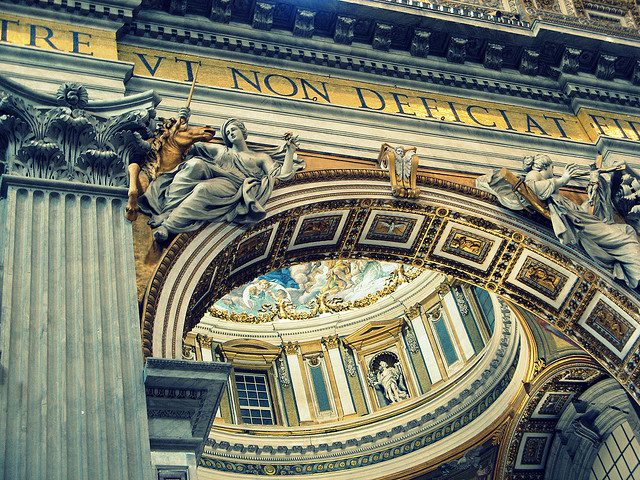
St. Peter’s Basicila, Vatican. Photo by: Randy, OHC.
The idea of papal infallibility is something that I’ve come to understand is widely misunderstood outside (and inside) the Catholic Church. After writing about why I love the Pope (and you can too!) I had a groundswell of reader feedback and questions about papal infallibility. What does it mean to be infallible? What did I mean when I said that infallibility doesn’t mean impeccability? Weren’t some Popes evil? If aliens existed, would the Pope baptise them?
On that last question, which didn’t really come from a reader, the answer is a resounding ‘yes’.
On the other questions—which, when I say groundswell, I mean one of my five readers had a question about it—allow me to cordially explain. I know at least one person is listening.
Infallibility doesn’t mean impeccability. This is a pretty important concept to get down right off the bat. What it mean is, just because the Pope, according to the Catholic Church, has been given the authority to infallibly teach doctrine doesn’t mean that he’s perfect. Papal infallibility, in essence, extends to only an extremely limited set of circumstances. In fact, the last time that the Pope spoke infallibly was to define to doctrine that Mary, the Mother of God, was assumed body and soul into Heaven (after her natural death). This was in the 1950’s after over a thousand years of this belief being held, arguably, and worked out by theologians and the laity.
The Pope’s infallibility is limited to times when he defines doctrine.
The claim of infallibility comes from Jesus’s charge to Peter, who I’ve explained before, is seen by the Catholic Church (and the Christian Church for at least the first 1,000 years) as the very first Pope. Mirroring Peter’s profession of who Jesus was, Jesus explains to Peter who he will be in the future Church. In doing so, Jesus gives Peter the keys, echoing the Old Testament, and the power to “bind and loose”. It’s in this, the giving of the keys and the power of binding and loosing, that Catholicism (and the church for at least 1,000 years) recognized the power of the papacy to define the beliefs of the Church without error.
Christ’s promise to Peter, as the first Pope, is that he could reliably teach the Church without making a mistake. Understanding this claim, the Pope, when he is infallibly defining Church teaching, speaks ex cathedra—literally “from the chair”. The chair, or seat, of Peter. (Yes, there is a literal chair although no claim is made as to who has sat on it, historically.)
But what about impeccability?
As far as the Catholic Church understands it—and, in my opinion, the historical and theological claims make sense—the Pope has the ability to speak, occasionally, to infallibly define Church teaching. This doesn’t mean he’s perfect, however. Infallibility doesn’t equate to impeccability. Some Popes are evil.
The Church has long held that Popes aren’t perfect, merely that they have the authority, if exercised, to teach perfectly. It’s remarkable, actually. Based on Jesus’ claim to Peter, and theology down through history, the Church claims that the Holy Spirit protects Popes (and assemblies of bishops, actually) from teaching in error. Even if a Pope is evil, or stark raving mad.
And there have been some evil Popes. The Church is the first to admit this.
Now I hear your objections already. That or it’s the voices in my head.
If the Pope can teach infallibly and the Holy Spirit can protect the Church against error why can’t that same Holy Spirit put someone half-way decent in charge?
Good question, and I don’t know.
What’s clear is that the Church, down through history, is marked by very human acts. It’s doctrine however, through divine providence and protection, has been sound even when it’s major actors were decidedly not so. And this is remarkable in and of itself. Even during dark times in history, under distinctly evil papal rule, the teachings of the Church itself did not waver. Remarkably, during a period in history when a vast majority of the Church’s hierarchy believed that Jesus was not divine the infallible teaching of the Church remained affixed to the straight and narrow.
A Pope can be evil, but his teaching will remain perfect. Consider, though, that the occurrences of Popes teaching ex cathedra are exceptionally limited anyway.
On my journey into the Catholic Church there have been two ways I’ve heard this concept put that have deeply resonated with me. Maybe I’m a soft sell, and easy target, but something just clicked when I had infallibility explained to me like I’m going to try to explain it to you. Track along with me, if you will.
(And of course, you say, I’m an easy sell. This guy’s halfway up the creek, you’re thinking.)
First, if the idea that a Pope can make mistakes but still teach infallibly doesn’t make sense then ask yourself this,
“What about Peter?”
Peter made mistakes. Peter, famously, denied Jesus three times. But, even more importantly, Peter is rebuked by Paul during the very early days of the Christian Church, for refusing to eat with gentiles—non-Jewish believers.
Follow me here, friends, because we don’t throw the epistles of Peter out of the New Testament canon, do we?
In the New Testament itself we see Peter making mistakes. Incredibly, we see Peter making mistakes regarding putting theology and doctrine into action (by refusing to eat with the gentiles). If we take infallibility to mean perfection then how can we come to grips with Peter’s letters? Peter wasn’t perfect but we hold that, somehow, his writing is.
Nevermind that Peter was also the first Pope, so Catholics say, and made these mistakes. Even the Protestant, who holds the New Testament Scriptures as infallible but doesn’t recognize the papacy, has to wrestle with the fact that Peter, in his actions, wasn’t perfect. If we expect infallibility to equal impeccability then even our New Testament canon fails under that weighty test.
I hope you’re still on board with me.
The second helpful way I’ve heard it put is this.
Although different Christian denominations believed it happened in different ways, Christians who believe that the Scriptures are infallible, believe that God must have, somehow, for a certain amount of time given someone, somewhere, the ability to infallibly define teaching.
That is, the authors of the books of the New Testament were given infallibility while they wrote. They were made infallible, for a certain length of time.
So why can’t God do that again?
In this light, the Catholic argument for infallibility seems like a fairly short logical leap. At least it did for me.
If Paul was given some sort of ability to record the infallible teachings of the Church in his instructions to the Corinthians why wouldn’t Pope Pius XII be afforded the same?
Why does God’s ability to grant infallibility end? And how do we know it does?
Instead, the Catholic Church argues that in the same way the apostles and authors of the books and letters that make up the New Testament were given the special grace of infallibility so too are Popes when speaking from that same place of authority.
Of course, I thought, when I first heard these two succinct explanations. Of course.
Of course, if the Catholic Church argues that it was the Church established by Jesus through the authority of Peter, would God give it the ability to speak infallibly—in the same way He gave it to the author’s of the New Testament. I mean, honestly, if you really get down to it the canon of the New Testament itself was only collected together based on that exact infallibility given to Peter.
(Those books were recognized as infallible based on the infallibility of the Pope and the councils of bishops.)
In the end, some Popes are evil. It sucks. But I’ve wrestled with and accepted the fact that infallibility makes sense. That Jesus left us a Church and a Pope as its leader and that Pope isn’t going to be perfect just like the earliest apostles of Jesus weren’t perfect. That’s human nature, and God’s decided to use humans to do His will. But the Pope, I believe, is given the ability to speak, on the rare occasion that its exercised, with the grace of infallibility. And, in the end, I think it’s rather beautiful—and exceptionally compelling—that the God who gave us perfect written teachings can still teach to us today, perfectly, through the office of the Pope.
Stay in touch! Like The Cordial Catholic on Facebook:
Previous Post
December 15, 2014
The Catholic as Pharisee
Next Post
December 20, 2014 A Protestant Deep in History
Browse Our Archives
Select a Category Appearances Christian Living Explaining the Faith Podcast Tough Questions Uncategorized Why I'm Catholic
Select a Month January 2024 December 2023 November 2023 July 2023 June 2023 May 2023 April 2023 March 2023 February 2023 January 2023 December 2022 November 2022 October 2022 September 2022 August 2022 July 2022 June 2022 May 2022 April 2022 March 2022 February 2022 January 2022 December 2021 November 2021 October 2021 September 2021 August 2021 July 2021 June 2021 May 2021 April 2021 March 2021 February 2021 January 2021 December 2020 November 2020 October 2020 September 2020 August 2020 July 2020 June 2020 May 2020 April 2020 March 2020 February 2020 January 2020 December 2019 November 2019 October 2019 September 2019 August 2019 July 2019 June 2019 May 2019 April 2019 March 2019 February 2019 January 2019 December 2018 November 2018 October 2018 September 2018 August 2018 July 2018 June 2018 May 2018 April 2018 March 2018 February 2018 January 2018 December 2017 October 2017 September 2017 July 2017 May 2017 April 2017 March 2017 February 2017 January 2017 December 2016 November 2016 October 2016 September 2016 August 2016 July 2016 June 2016 May 2016 April 2016 March 2016 February 2016 January 2016 December 2015 November 2015 October 2015 September 2015 August 2015 July 2015 June 2015 May 2015 April 2015 March 2015 February 2015 January 2015 December 2014 November 2014 October 2014
Follow Us!
TAKE THE
Religious Wisdom Quiz
Which woman was the judge and prophetess who led Israel?
Select your answer to see how you score.
Miriam Deborah Jael Esther
Support this
Column


Related posts from The Cordial Catholic

232: The Trajectory of Conversion (w/ Phillip Campbell)

229: Can Catholics and Evangelicals Agree on How...

227: What was Medieval Catholicism Really Like? (w/...
212: Evangelicals, Here's How to Look for a...
TRENDING AT PATHEOS Catholic

Rejecting Doom: Christian Hope And Human Action
Christianity is a religion of hope. We are to have hope and...

It’s What Comes From Within Which Matters
One of the most difficult things for us to understand is why...

Why I Choose the Eucharist Over the Sermon
Choose the Eucharist, Not the Sermon What are we supposed to get...

5 Design Elements Found in Spiritually Rooted Homes
Putting Spirituality Into Home Decor Our homes are more than our living...

Credo: A Story of God Told with the...
About 10 years ago, I began to imagine a personal "Credo" that...

The Anatomy of Divine Revelation in Catholic Thought
The claim that God has made Himself known to human beings is...
view all Catholic blogs
Ad-Free & Subscriber Log-In Subscription Support
- About Us
- 2026 Calendar
- Videos
- Podcasts
- Library of World Religions
- Faith In Media Tracker
- Advertise With Us
- Write for Us
- Privacy Policy
- Terms of Service
- Do Not Sell My Data
- Contact Us
- Radiant Digital
- Manage Newsletter Subscriptions
- Unsubscribe From Notifications
- Sitemap
Copyright 2008-2026, Patheos. All rights reserved.
Subscription Support Ad-Free & Subscriber Log-In
Follow Patheos