
BuddhistCatholicContemplativeEvangelicalGeneral ChristianHinduJewishLatter-day SaintMuslimNew VisionsProgressive Christian
Beliefs
- Buddhist
- Catholic
- Contemplative
- Evangelical
- General Christian
- Hindu
- Jewish
- Latter-day Saint
- More Voices
- Muslim
- New Visions
- Pagan
- Progressive Christian
Topics
- Religion News
- Food and Religion
- Sports and Religion
- Religious Art
- Religious Music and Entertainment
- Religious Events
- History and Religion
- Style and Religion
- Politics and Religion
- Women in Religion
- Recreation Outdoors and Religion
- Business Finance and Religion
- Careers Workplace and Religion
- Education and Religion
- Family Parenting and Religion
- Health Fitness and Religion
- Home and Religion
- Relationships and Religion
- Technology and Religion
- Travel and Religion
Columnists
- Buddhist Columnists
- Business Finance and Religion Columnists
- Careers Workplace and Religion Columnists
- Catholic Columnists
- Contemplative Columnists
- Education and Religion Columnists
- Evangelists Columnists
- Family Parenting and Religion Columnists
- General Christian Columnists
- Health Fitness and Religion Columnists
- Hindu Columnists
- History and Religion Columnists
- Home and Religion Columnists
- Jewish Columnists
- More Voices Columnists
- Latter Day Columnists
- Muslim Columnists
- New Visions Columnists
- Nonreligious Columnists
- Pagan Columnists
- Politics and Religion Columnists
- Progressive Columnists
- Recreation Outdoors and Religion Columnists
- Relationships and Religion Columnists
- Religion News Columnists
- Religious Art Columnists
- Religious Events Columnists
- Religious Music and Entertainment Columnists
- Sports and Religion Columnists
- Style and Religion Columnists
- Technology and Religion Columnists
- Travel and Religion Columnists
- Women in Religion Columnists
Resource Library
- 2026 Calendar
- Library of World Religions
- The 100 Most Holy Places on Earth
- Patheos Answers
- Podcasts
- Videos
- Faith Leaders Database
- Anglican Episcopalian
- Bahai
- Baptist
- Buddhism
- Christianity
- Confucianism
- Eastern Orthodoxy
- Hinduism
- Holiness and Pentecostal
- ISKCON
- Islam
- Judaism
- Lutheran
- Methodist
- The Church of Jesus Christ of Latter-day Saints
- New Age
- Paganism
- Presbytarian and Reformed
- Protestantism
- Religion Behind the Scenes
- Roman Catholic
- Scientology
- Shia Islam
- Sikhism
- Sufism
- Sunni Islam
- Taoism
- Zen
- See all religions
Research Tools
 Ad-Free & Subscriber Log-In Subscription Support
Ad-Free & Subscriber Log-In Subscription Support
Follow Patheos 

- Trending:
- Forgiveness
- |
- Marriage
- |
- Consciousness
- |
- Death Penalty
- |
- Election
- |
- Halloween
 The Cordial Catholic
- Home
- Catholic
- The Physical, Tangible Catholic Church
The Physical, Tangible Catholic Church
Last updated on: August 3, 2015 at 3:59 pm by K. Albert Little
The Physical, Tangible Catholic Church 2015-08-03T15:59:36-04:00 K. Albert Little
Patheos Explore the world's faith through different perspectives on religion and spirituality! Patheos has the views of the prevalent religions and spiritualities of the world.
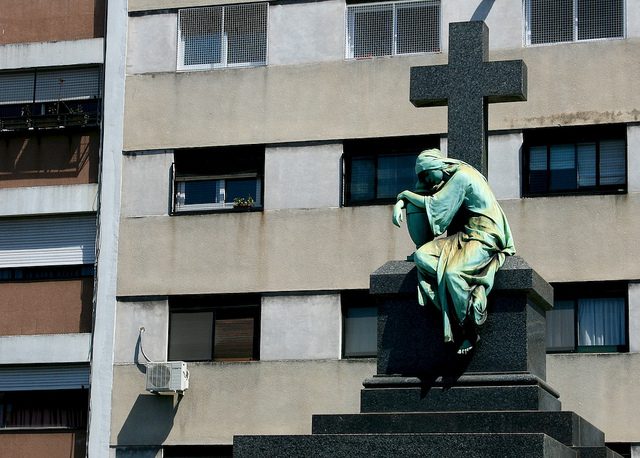
Photo Credit: @Doug88888.
When I originally set out on this journey from Protestantism to Catholicism I didn’t know exactly what to expect. At a certain point, however, I became Catholic. At a certain point in the journey I found the claims and practices of the Catholic Christian faith to be, as I put it, historically, intellectually, and spiritually compelling. I told this to a Catholic friend I met a couple of months ago and he suggested, politely, that I consider adding aesthetically compelling as well.
I see, only a couple months later, as I continue to live the Catholic life, exactly what he means.
He means that the Catholic life, in its physical trappings, is a profoundly rich life. He means the environment the faith creates, in its churches, in its plethora of devotions, in its tradition of icons and statues and works of sacred art reaches the senses in a unique and incredible way. He means, in the mere language of the Church, there is a beauty of Heaven on earth—a beauty which brings the spiritual world into the natural.
And it’s completely captivated me.
A good friend of mine, much to the playful chagrin of my wife, gave me a small statue of the Blessed Mother that he found in the back garden of the house he moved into with his wife a couple of years ago. He thought I would give it a respectful home, instead of throwing it away, and he was right. Mary sits on a ledge in our front entryway and every time I come it’s the first thing that catches my attention—everytime I go, it’s the last thing I see. The statue of Mary says, with a real physical urgency, “Here I am and I’m praying for your intentions.” It’s a beautiful, poignant thing. That statue represents something real: Mary, the Mother of God, who asked her Son to turn water into wine and He did. Who, on the cross, Jesus gave to us as our mother.
It’s just a dirty, slightly broken statue, but every time I enter the house and every time I’m about to leave I’m reminded that whatever is in my heart, whatever I’m thinking of or praying about that day, Mary is joining with me.
It’s something physical to remind me of the presence of the saints—that great cloud of witnesses—and Mary, who said, “Yes,” to God, foremost among them.
The rosary is the same way. With the beads and the crucifix I am praying with my body as well as my soul and there’s something profoundly rich in that, for me, and something profoundly different than my experiences with prayer as a Pentecostal.
I was thinking, and working on this article, while away from home this weekend. I had the opportunity and privilege to take in Mass at a parish that wasn’t my own and this is always, in my experiences so far, a pretty incredible experience. This particular Sunday, however, was an especially poignant experience and it’s down to aesthetics, to be sure. And it’s down to, again, why I’m falling in love with the Catholic Church.
It was the deacon of this particular parish who gave the homily—and it was wonderful—but the priest who celebrated the Communion part of the Mass (the Liturgy of the Eucharist). But, it was the deacon who stole the show then too. It was the deacon who, with such profound reverence, knelt beside and slightly behind the priest as he prayed over the Communion elements and as they became, according to Catholic theology, the real blood and body of Christ. It was the deacon, a grown man of fifty, who knelt there with his eyes fixed on the Communion wafer as the priest raised it over his head. And then again, on the chalice of wine, as the priest raised that over his head too.
The sight of a grown man, a strong mature individual, kneeling in absolute reverence and so fixed on the blood and body of Christ is enough to bring another grown man (although much less mature) nearly to tears.
Following the Reformation, and in the traditions that sprung up as a result, Protestant denominations cleared out their churches, and their lives, of physical representations of the God we love and serve and His people. There are, and were, lots of reasons—some theological, and some not. Many mainline churches, those closest to the tradition of the early reformers like the Lutherans, have taken steps back towards that which they originally jettisoned. The Lutheran church where my own non-denominational church meets and shares space in looks not much different from the Catholic church I attend for Mass.
But most Protestant churches, the evangelical churches rooted in North American Puritanism, are largely empty spaces. And I can see the argument from both sides. There have been times, certainly, when I would’ve argued that a blank canvas, a space of worship free from clutter and design, is less distracting and in those spaces I’m more able to connect with God.
But I wouldn’t say that anymore.
I’ve fallen in love with the Catholic Church. I’ve found it to be intellectually, historically, and spiritually satisfying. But I’ve also found it to be, deeply, aesthetically satisfying too. I’ve found incredible comfort, joy, and edification in the tangible things of the Catholic Church. In the statues that remind me of the saints who are praying for me (no, Catholics don’t worship them—statues or the saints they represent). In the tangible devotions like the rosary.
And, of course, in the beautiful practice of Eucharistic Adoration and the fact that, like that holy deacon recognized, we can tangibly believe, and know, that Jesus Christ is really with us. Here and now, forever and ever. Amen.
Previous Post

February 1, 2015
The Lord's Supper, Literally
Next Post

February 7, 2015 Let's Talk About Mary, Mother of God
Browse Our Archives
Select a Category Appearances Christian Living Explaining the Faith Podcast Tough Questions Uncategorized Why I'm Catholic
Select a Month January 2024 December 2023 November 2023 July 2023 June 2023 May 2023 April 2023 March 2023 February 2023 January 2023 December 2022 November 2022 October 2022 September 2022 August 2022 July 2022 June 2022 May 2022 April 2022 March 2022 February 2022 January 2022 December 2021 November 2021 October 2021 September 2021 August 2021 July 2021 June 2021 May 2021 April 2021 March 2021 February 2021 January 2021 December 2020 November 2020 October 2020 September 2020 August 2020 July 2020 June 2020 May 2020 April 2020 March 2020 February 2020 January 2020 December 2019 November 2019 October 2019 September 2019 August 2019 July 2019 June 2019 May 2019 April 2019 March 2019 February 2019 January 2019 December 2018 November 2018 October 2018 September 2018 August 2018 July 2018 June 2018 May 2018 April 2018 March 2018 February 2018 January 2018 December 2017 October 2017 September 2017 July 2017 May 2017 April 2017 March 2017 February 2017 January 2017 December 2016 November 2016 October 2016 September 2016 August 2016 July 2016 June 2016 May 2016 April 2016 March 2016 February 2016 January 2016 December 2015 November 2015 October 2015 September 2015 August 2015 July 2015 June 2015 May 2015 April 2015 March 2015 February 2015 January 2015 December 2014 November 2014 October 2014
Follow Us!
TAKE THE
Religious Wisdom Quiz
Who was visited by an angel to announce his wife would have John the Baptist?
Select your answer to see how you score.
Caiaphas Simon Zechariah Joseph
Support this
Column


Related posts from The Cordial Catholic
134: How the Early Church Evangelized (w/ Mike...
Would the Early Christians Be Welcomed by Evangelicals?

A Catholic Response to Evangelical De-Conversions
The Incredible Power of "In Persona Christi"
TRENDING AT PATHEOS Catholic

Rejecting Doom: Christian Hope And Human Action
Christianity is a religion of hope. We are to have hope and...

It’s What Comes From Within Which Matters
One of the most difficult things for us to understand is why...

Why I Choose the Eucharist Over the Sermon
Choose the Eucharist, Not the Sermon What are we supposed to get...

5 Design Elements Found in Spiritually Rooted Homes
Putting Spirituality Into Home Decor Our homes are more than our living...

Credo: A Story of God Told with the...
About 10 years ago, I began to imagine a personal "Credo" that...

The Anatomy of Divine Revelation in Catholic Thought
The claim that God has made Himself known to human beings is...
view all Catholic blogs
Ad-Free & Subscriber Log-In Subscription Support
- About Us
- 2026 Calendar
- Videos
- Podcasts
- Library of World Religions
- Faith In Media Tracker
- Advertise With Us
- Write for Us
- Privacy Policy
- Terms of Service
- Do Not Sell My Data
- Contact Us
- Radiant Digital
- Manage Newsletter Subscriptions
- Unsubscribe From Notifications
- Sitemap
Copyright 2008-2026, Patheos. All rights reserved.
Subscription Support Ad-Free & Subscriber Log-In
Follow Patheos