
BuddhistCatholicContemplativeEvangelicalGeneral ChristianHinduJewishLatter-day SaintMuslimNew VisionsProgressive Christian
Beliefs
- Buddhist
- Catholic
- Contemplative
- Evangelical
- General Christian
- Hindu
- Jewish
- Latter-day Saint
- More Voices
- Muslim
- New Visions
- Pagan
- Progressive Christian
Topics
- Religion News
- Food and Religion
- Sports and Religion
- Religious Art
- Religious Music and Entertainment
- Religious Events
- History and Religion
- Style and Religion
- Politics and Religion
- Women in Religion
- Recreation Outdoors and Religion
- Business Finance and Religion
- Careers Workplace and Religion
- Education and Religion
- Family Parenting and Religion
- Health Fitness and Religion
- Home and Religion
- Relationships and Religion
- Technology and Religion
- Travel and Religion
Columnists
- Buddhist Columnists
- Business Finance and Religion Columnists
- Careers Workplace and Religion Columnists
- Catholic Columnists
- Contemplative Columnists
- Education and Religion Columnists
- Evangelists Columnists
- Family Parenting and Religion Columnists
- General Christian Columnists
- Health Fitness and Religion Columnists
- Hindu Columnists
- History and Religion Columnists
- Home and Religion Columnists
- Jewish Columnists
- More Voices Columnists
- Latter Day Columnists
- Muslim Columnists
- New Visions Columnists
- Nonreligious Columnists
- Pagan Columnists
- Politics and Religion Columnists
- Progressive Columnists
- Recreation Outdoors and Religion Columnists
- Relationships and Religion Columnists
- Religion News Columnists
- Religious Art Columnists
- Religious Events Columnists
- Religious Music and Entertainment Columnists
- Sports and Religion Columnists
- Style and Religion Columnists
- Technology and Religion Columnists
- Travel and Religion Columnists
- Women in Religion Columnists
Resource Library
- 2026 Calendar
- Library of World Religions
- The 100 Most Holy Places on Earth
- Patheos Answers
- Podcasts
- Videos
- Faith Leaders Database
- Anglican Episcopalian
- Bahai
- Baptist
- Buddhism
- Christianity
- Confucianism
- Eastern Orthodoxy
- Hinduism
- Holiness and Pentecostal
- ISKCON
- Islam
- Judaism
- Lutheran
- Methodist
- The Church of Jesus Christ of Latter-day Saints
- New Age
- Paganism
- Presbytarian and Reformed
- Protestantism
- Religion Behind the Scenes
- Roman Catholic
- Scientology
- Shia Islam
- Sikhism
- Sufism
- Sunni Islam
- Taoism
- Zen
- See all religions
Research Tools
 Ad-Free & Subscriber Log-In Subscription Support
Ad-Free & Subscriber Log-In Subscription Support
Follow Patheos 

- Trending:
- Forgiveness
- |
- Marriage
- |
- Consciousness
- |
- Death Penalty
- |
- Election
- |
- Halloween
 The Cordial Catholic
- Home
- Catholic
- On Reformation Day, I Remain a Catholic
On Reformation Day, I Remain a Catholic
Last updated on: November 6, 2019 at 1:40 pm by K. Albert Little
On Reformation Day, I Remain a Catholic 2019-11-06T13:40:32-04:00 K. Albert Little
Patheos Explore the world's faith through different perspectives on religion and spirituality! Patheos has the views of the prevalent religions and spiritualities of the world.
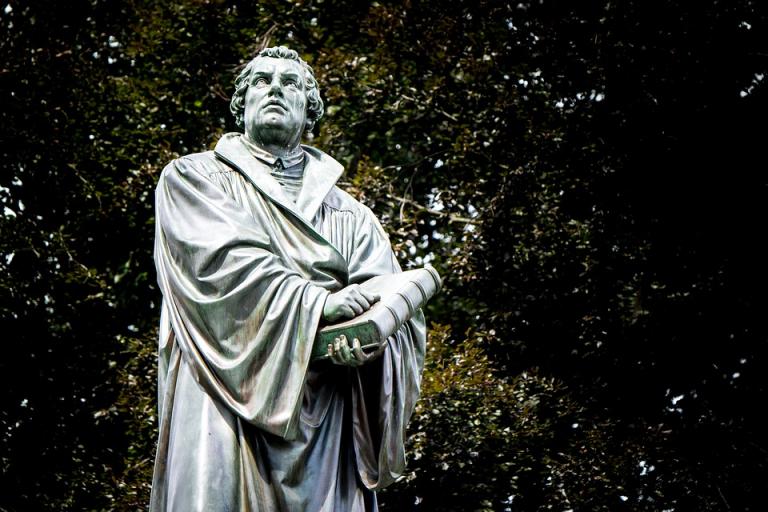
In an article appearing recently in First Things magazine, ardent reformer Carl R. Trueman reflects eloquently about why he is Protestant on Reformation Day. As a non-denominational, evangelical convert to the Catholic faith I feel compelled to respond.
Trueman is, in a fact, someone very important to my own conversion. It was his quote, in a rather obscure location, which made a number of cameos during my own journey into pre-Reformation, ancient Christianity. It was, rather, Trueman’s assertion and challenge, that we needed good reasons to remain Protestant when the Reformation was long over, that really convinced me to take a hard look at my non-denominational, evangelical faith—a faith so far from the ancient Church that the apostles likely wouldn’t have recognized it; a faith which was a historical inevitability created by that aforementioned Reformation.
At any rate we have a long, albeit one-sided history together, so when Trueman writes something I read it. He’s a razor-sharp challenge to both Protestants and Catholics although, in this case, his proffered proposition falls short.
First, Trueman makes the claim that being a Protestant, for him, has become easier and easier under the Pope Francis pontificate. A pontificate which, he fairly observes, seems to be moving parts of the Catholic practice of the faith more toward a liberal or progressive expression. He’s not wrong, but his purview is wildly limited. Here I need to do nothing more than to point to St. Mary of the Seven Sorrows, mere blocks away from where I sit, where the number of families attending their 3p.m. Latin Mass swells with each passing week.
At the same time, my own parish, with faithfully celebrates Mass in the vernacular four times every weekend, is equally bursting at the seams. The attached St. John Paul II Student Centre, was so filled to the brim for their mid-week family meal that they had to relocate downstairs to the parish centre. Tonight their gathering includes a lecture on the Theology of the Body by a world renown speaker; it will be well-attended despite being in the middle of mid-terms.
But while Trueman is not wrong that the Francis pontificate is dividing the Catholic Church in a way that we haven’t seen in memory, he is wrong about the power of the papacy to begin with.
Because we have had bad popes. We have had divisions far worse than the hairline fractures which are beginning to develop under the current Holy Father. And Catholics have survived; Catholics thrived by clinging tightly to the Magisterial teachings of the Church and our own deeply seated practice of the faith, handed down since the beginning of the Church.
Yes, we have a pope, and for that all Catholics are grateful but a pope does not make or break the Church and if we believe, as Catholics do, that the Holy Spirit is a firm hand on the tiller, then we sometimes must simply go plowing. After all the alternative, as pictured by Trueman himself, is no better worse for wear.
Indeed, as Trueman points out, there are problems with Protestant piety as well. While he is critical of the current papacy and the state of Christian unity in the Catholic world I’d ask him to raise his head from a moment, from his place in the pew, to look around and his fellow co-religious. Because the Protestant Church is a mess.
Granted, he can point to his own little corner of Protestant Christianity which is faithfully preaching, celebrating the sacraments, and speaking out against the erosion of long-held Christian social norms, this is, as he readily admits, just one little corner of the faith. The ground, as it were, is rapidly slipping away beneath the feet of believers like Trueman because, fundamentally, the system which underpins their beliefs is flawed from the beginning. It is a system which has wrenched the Bible from its proper mooring within the Church and the Apostolic Tradition that, as it evidenced by the experience of Protestant Christianity, it is not a sustainable one.
After all, what’s to say that the reading and understanding of Trueman’s church on enormously important issues like baptism, salvation, and Christian marriage is anymore correct that those mega-churches down the street? There is no metric, no system laid out in Protestant Christianity, by which all Protestants can agree. It becomes, as Trueman himself seems to admit, a contest of egos. Which theologian seems to have it best figured out? Which reading of the Scriptures is the most plain sense? And in that system, who becomes the arbiter but me and you?
Lastly, Trueman is critical of Catholic Christianity for playing up elements of its history as a kind of pious nostalgia. Cardinal Newman, he writes, was speaking about one particular time in Catholic history when he wrote, “To be deep in history is to cease to be Protestant.”
Here, Trueman misses the point altogether. When St. John Henry Newman penned his now famous line he was writing at the end of a long look at the history of Christianity. The quotation comes, after all, in An Essay on the Development of Doctrine. Newman is not, as Trueman seems to suggest, comparing the Roman Catholic Church of the 19th century with one particular snapshot of the Early Church, circumscribing all of the history, decent and indecent, which came in between. Not at all.
Newman coined that prophetic quote after a clear-eyed consideration of the history of the Church throughout all time, not anymore nostalgic for the blood-soaked martyrs of the Great Persecution anymore than he was allergic to the hard reality of the Avignon Papacy. No, what Newman saw was a Church which lived, thrived, and marched on down through the ages in spite of everything which threatened to shake its sometimes tenuous claim as the Bride of Christ throughout all time.
What Trueman fails, I think, to understand is that Catholic Christianity sees the whole timeline of history as its own. We can confidently say, Look! There is the Catholic Church! In times when popes were putting their dead predecessors on trial just as we can say it when we imagine St. Thomas Aquinas, prostrate before the altar, uttering famously, “Domine, non nisi Te.”
Why I am Catholic on Reformation Day when a pious reformer like Trueman is not?
Because in shame and sanctity the Church is greater than the sum of its individual members, even when those members sit in St. Peter’s chair. Because the Catholic Church is, at times, stumbling along but it is the Catholic Church and it survives in a long, continuous, sometimes twisting and turning line all the way back to Jesus Christ, His apostles, and a promise that had something to do with the gates of Hades which, I’m told, will never prevail.
Next Post

November 7, 2019 Mass is the Spiritual Workout God Knows You Need
Browse Our Archives
Select a Category Appearances Christian Living Explaining the Faith Podcast Tough Questions Uncategorized Why I'm Catholic
Select a Month January 2024 December 2023 November 2023 July 2023 June 2023 May 2023 April 2023 March 2023 February 2023 January 2023 December 2022 November 2022 October 2022 September 2022 August 2022 July 2022 June 2022 May 2022 April 2022 March 2022 February 2022 January 2022 December 2021 November 2021 October 2021 September 2021 August 2021 July 2021 June 2021 May 2021 April 2021 March 2021 February 2021 January 2021 December 2020 November 2020 October 2020 September 2020 August 2020 July 2020 June 2020 May 2020 April 2020 March 2020 February 2020 January 2020 December 2019 November 2019 October 2019 September 2019 August 2019 July 2019 June 2019 May 2019 April 2019 March 2019 February 2019 January 2019 December 2018 November 2018 October 2018 September 2018 August 2018 July 2018 June 2018 May 2018 April 2018 March 2018 February 2018 January 2018 December 2017 October 2017 September 2017 July 2017 May 2017 April 2017 March 2017 February 2017 January 2017 December 2016 November 2016 October 2016 September 2016 August 2016 July 2016 June 2016 May 2016 April 2016 March 2016 February 2016 January 2016 December 2015 November 2015 October 2015 September 2015 August 2015 July 2015 June 2015 May 2015 April 2015 March 2015 February 2015 January 2015 December 2014 November 2014 October 2014
Follow Us!
TAKE THE
Religious Wisdom Quiz
Who was the tax collector who climbed a tree to see Jesus?
Select your answer to see how you score.
Nicodemus Zacchaeus Matthew Philip
Support this
Column


Related posts from The Cordial Catholic

232: The Trajectory of Conversion (w/ Phillip Campbell)
231: Becoming Catholic in a Church Crisis (w/...

229: Can Catholics and Evangelicals Agree on How...

227: What was Medieval Catholicism Really Like? (w/...
TRENDING AT PATHEOS Catholic

Rejecting Doom: Christian Hope And Human Action
Christianity is a religion of hope. We are to have hope and...

It’s What Comes From Within Which Matters
One of the most difficult things for us to understand is why...

Why I Choose the Eucharist Over the Sermon
Choose the Eucharist, Not the Sermon What are we supposed to get...

5 Design Elements Found in Spiritually Rooted Homes
Putting Spirituality Into Home Decor Our homes are more than our living...

Credo: A Story of God Told with the...
About 10 years ago, I began to imagine a personal "Credo" that...

The Anatomy of Divine Revelation in Catholic Thought
The claim that God has made Himself known to human beings is...
view all Catholic blogs
Ad-Free & Subscriber Log-In Subscription Support
- About Us
- 2026 Calendar
- Videos
- Podcasts
- Library of World Religions
- Faith In Media Tracker
- Advertise With Us
- Write for Us
- Privacy Policy
- Terms of Service
- Do Not Sell My Data
- Contact Us
- Radiant Digital
- Manage Newsletter Subscriptions
- Unsubscribe From Notifications
- Sitemap
Copyright 2008-2026, Patheos. All rights reserved.
Subscription Support Ad-Free & Subscriber Log-In
Follow Patheos