
BuddhistCatholicContemplativeEvangelicalGeneral ChristianHinduJewishLatter-day SaintMuslimNew VisionsProgressive Christian
Beliefs
- Buddhist
- Catholic
- Contemplative
- Evangelical
- General Christian
- Hindu
- Jewish
- Latter-day Saint
- More Voices
- Muslim
- New Visions
- Pagan
- Progressive Christian
Topics
- Religion News
- Food and Religion
- Sports and Religion
- Religious Art
- Religious Music and Entertainment
- Religious Events
- History and Religion
- Style and Religion
- Politics and Religion
- Women in Religion
- Recreation Outdoors and Religion
- Business Finance and Religion
- Careers Workplace and Religion
- Education and Religion
- Family Parenting and Religion
- Health Fitness and Religion
- Home and Religion
- Relationships and Religion
- Technology and Religion
- Travel and Religion
Columnists
- Buddhist Columnists
- Business Finance and Religion Columnists
- Careers Workplace and Religion Columnists
- Catholic Columnists
- Contemplative Columnists
- Education and Religion Columnists
- Evangelists Columnists
- Family Parenting and Religion Columnists
- General Christian Columnists
- Health Fitness and Religion Columnists
- Hindu Columnists
- History and Religion Columnists
- Home and Religion Columnists
- Jewish Columnists
- More Voices Columnists
- Latter Day Columnists
- Muslim Columnists
- New Visions Columnists
- Nonreligious Columnists
- Pagan Columnists
- Politics and Religion Columnists
- Progressive Columnists
- Recreation Outdoors and Religion Columnists
- Relationships and Religion Columnists
- Religion News Columnists
- Religious Art Columnists
- Religious Events Columnists
- Religious Music and Entertainment Columnists
- Sports and Religion Columnists
- Style and Religion Columnists
- Technology and Religion Columnists
- Travel and Religion Columnists
- Women in Religion Columnists
Resource Library
- 2026 Calendar
- Library of World Religions
- The 100 Most Holy Places on Earth
- Patheos Answers
- Podcasts
- Videos
- Faith Leaders Database
- Anglican Episcopalian
- Bahai
- Baptist
- Buddhism
- Christianity
- Confucianism
- Eastern Orthodoxy
- Hinduism
- Holiness and Pentecostal
- ISKCON
- Islam
- Judaism
- Lutheran
- Methodist
- The Church of Jesus Christ of Latter-day Saints
- New Age
- Paganism
- Presbytarian and Reformed
- Protestantism
- Religion Behind the Scenes
- Roman Catholic
- Scientology
- Shia Islam
- Sikhism
- Sufism
- Sunni Islam
- Taoism
- Zen
- See all religions
Research Tools
 Ad-Free & Subscriber Log-In Subscription Support
Ad-Free & Subscriber Log-In Subscription Support
Follow Patheos 

- Trending:
- Forgiveness
- |
- Marriage
- |
- Consciousness
- |
- Death Penalty
- |
- Election
- |
- Halloween
 The Cordial Catholic
- Home
- Catholic
- No, Religion is Not “Bad.” You’re Wrong.
No, Religion is Not “Bad.” You’re Wrong.
Last updated on: October 12, 2015 at 9:39 am by K. Albert Little
No, Religion is Not “Bad.” You’re Wrong. 2015-10-12T09:39:25-04:00 K. Albert Little
Patheos Explore the world's faith through different perspectives on religion and spirituality! Patheos has the views of the prevalent religions and spiritualities of the world.
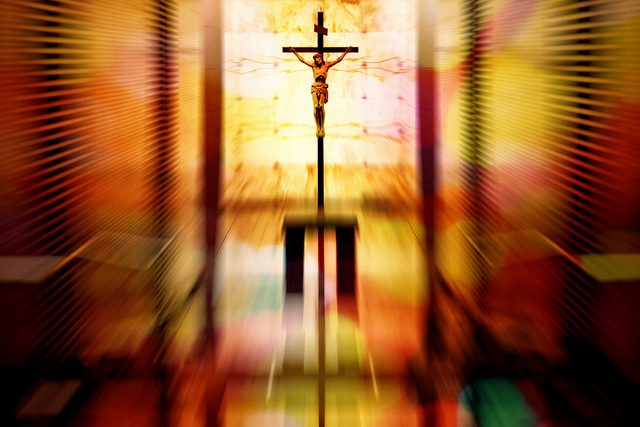
Photo Credit: Thomas Hawk.
As a younger Evangelical I would’ve marched, proudly, in the Parade to End Religion. If such a thing existed.
To me, and to many of my Pentecostal brethren, religion equated to a musty old out-dated mantra—the empty piety of a dank old cathedral. The broken beads of a tangled-up rosary, something found stuffed in a bureau drawer.
In fact, when I first read Scott Hahn’s Rome Sweet Home his terse attitude towards religion, and Catholicism in particular, was deeply resonate. Hahn, who found and destroyed his grandmother’s rosary, after her death, because it was too religious, only to become, himself, one of our century’s most famous converts.
I, like Hahn, mistakenly side-stepped religion as something inherently bad. Worse, Protestant Christians like Hahn and myself went a step further: We condemned religion.
I’ve since changed my mind.
But I do still grimace, in passing, when I hear blanket condemnations of religion—in phrases like, “let’s end religion.”
Because, no, religion is not bad. And the folks that will tell you otherwise are, flatly, dead wrong.
No, Jesus Didn’t Condemn Religion.
The main fuel which fed the fire of us religious-opposed was what we perceived as Jesus’ wholesale condemnation of religion.
It was clear, to us, that the Jesus of the New Testament time and time again put the Pharisees, the Jewish religious leaders of Jesus’ time, squarely in their place.
If Jesus condemned religion, we thought, then so should we.
But such a line of thinking was based on a complete misreading of Jesus’ numerous interactions with the religious leaders of his time.
As I’ve written before, a much better reading of Jesus’ interactions, one more squarely based in historical context, is that Jesus condemned their naked piety. Their false religion.
See, the Pharisees tried hard, and earnestly, to keep God’s commandments and do what was right and they weren’t, and shouldn’t, be condemned for such earnestness. They were condemned because their religiousness didn’t extend to their hearts.
Speaking about the Pharisees, Pope Francis, a model of Jesus’ mission on earth, said,
They were strong, but on the outside. They were in a cast. The heart was very week, they didn’t know what they believed. And because of this their life, the outer part of their life, was completely regulated, but the heart was otherwise: a weak heart, and a skin that was plastered over, strong, harsh. Jesus, on the other hand, teaches us that the Christian should have a strong heart, a firm heart, a heart built on the rock, that is Christ; and then, in the way it goes out, it goes out with prudence.
Jesus didn’t come to condemn religion, he came to condemn false religion.
I can’t underscore how important that is to understand everything that follows.
Yes, Jesus Founded a Religion.
Jesus came to establish a relationship with humankind, not a religion.
This, or something like this, was the mantra of many of the emergent authors I devoured in my university days as a budding theologian.
Jesus had no interest in establishing a people who practiced religion and ritual he merely wanted to get to know us, for us to know Him, and for us to find salvation in His sacrifice.
And while relationship ought to be, certainly, the cornerstone of any religious Christian expression, it is an argument that is inherently flawed.
Because Jesus did found a religion.
In the institution of Baptism and the Lord’s Supper, Jesus established new rituals very much like the religious Jewish rituals of His time. In the Sermon on the Mount and the Eucharistic Discourse He promulgated new norms very much like the religious regulations of the Jews.
And in the years immediately following His death and resurrection and in the beginning of the spread of Jesus’ message, a distinctly religious framework begins to emerge.
We see this in the Acts of the Apostles, in the letters of Peter and Paul, and in incredibly preserved documents like the first-century Didache which outlines in minute detail exactly how certain religious rituals like Baptism and Communion should be performed.
To stubbornly ignore the clearly religious implications of the first and second century Christian community is to do oneself a great disservice.
Christianity was a ‘Religion’ for 1,500 Years
But even if Jesus didn’t establish a religion, if even his most immediate apostles like Peter and Paul got it wholly wrong, then what emerged over the course of the next 1,500 years warrants some kind of explanation.
Because for 1,500 years of Christianity its expression was decidedly religious.
This begs the question: If religion is “bad” then what do we make of Christians for 1,500 years?
This profound argument is the same made by St. Francis de Sales writing to Luther, Calvin, and the other Reformers at the height of the Protestant Reformation.
If Christianity wasn’t meant to be a ‘religion’ then Christianity for 1,500 years went wrong.
And the Protestant Reformers rediscovered it?
Yet even while these Reformers objected to some of the teachings of the modern religious leadership none argued for Christianity as a mere relationship.
It seems preposterous, at best, to argue that religion is bad when Christianity existed as something very much religious for 1,500 years.
A condemnation of religion, in that case, is a wholesale condemnation of Christians for the first millennium and a half.
Does it really make sense to argue that Jesus began a movement on the backs of his apostles only to have them lose the plot almost immediately? A plot that wouldn’t be picked up again until the 16th century?
Recognize that Condemnation of Religion Occurs in a Bubble
In any case, condemnation of ‘religion’ as bad is a fundamentally dangerous game to play. Namely, in the face of billions (with a ‘b’) of Christians worldwide who subscribe to what would be considered a ‘religious’ expression of their faith.
Catholics, Orthodox, and high church Anglicans would not only be incredibly offended but would baulk at the notion that there’s something wrong with their expression of faith.
That Jesus wants an end to the religion in which they find great solace, and power and enjoy a decidedly personal relationship with Him.
Those that condemn bad religion do so in an enormous bubble—a with a fundamentally narrow worldview.
If religion is bad then why is Catholicism the fastest growing religion in Africa? Why is it such a profound force in Latin America? Why is it doing so much tangible good in the world?
It’s an incredibly North American-centric point of view that says we should do away with religion, that religion is bad, and that we’re better off focusing merely on a relationship.
As if the North American, puritan experience of relationships is the only way these sorts of things can be expressed. As if, in other cultures around the world, relationships (like love, for example) don’t have ritual expressions.
Recognize that Condemnation of Religion is Divisive
Following this, it’s safe to say that condemnation of religion is fundamentally divisive.
Rather than focusing on the relationship with Christ that Catholics, Orthodox, and Anglicans have and emphasizing how these genuine believers can better their faith walk, an argument which simply asserts that religion must end creates divisions in the Body of Christ rather than building it up.
To what end?
Are the untold billions of religious believers practising the true Christian faith wrong? Are their souls in peril? And are a handful of Protestant theologians going to save them?
It seems short-sighted, narrow-minded, and fundamentally flawed to try and divide the Body of Christ in order to unite it under a new banner. To stamp out religion in order to lead us all to a better relationship with Christ.
Certainly, one could successfully argue that religious ritual can crowd out a genuine relationship with Christ but, likewise, someone else could easily argue the same for boiling down our understanding of Christ to merely a relationship.
Especially in our modern day North American understanding of relationship.
From My Own Experience…
Finally, there’s this: my own experience.
Take it with a grain of salt.
But as I began my journey towards Catholicism I experienced a number of profound and powerful paradigm shifts. I went from believing that religion is bad to understanding the beauty and strength that can be derived therein.
And once I understood what a religion like Catholicism had to offer, I was absolutely taken.
For me, becoming a Catholic hasn’t—as some would argue—gotten in the way of my relationship with Christ but, rather, profoundly deepened it in ways which I could’ve never imagined.
Not in a million years.
I’ve come to understand and appreciate beautiful and profoundly religious rituals and experiences and I’ve come to see how those only serve to draw me closer into Christ. Fully “Catholic things” like the Rosary, Eucharistic Adoration, the Divine Office, Novenas, and the beauty of the Liturgy.
Heck, even the use of incense in a worship service has brought me to tears.
These “religious” things which I would’ve once dismissed as getting in the way of Christ all point, profoundly, to Christ Himself.
It only took me understanding them.
So, no, in my experience and, in my opinion, in the history of Christianity it’s wrong to say that religion is bad.
You’re wrong.
Because it’s not.
For me, for billions of other Christians around the world, and for Christians throughout most of the history of Christianity, religion has drawn us ever closer into relationship with Christ. And it will continue to do so, God willing, until He comes again.
Previous Post

September 30, 2015
No, You Don't Know The Pope
Next Post

October 23, 2015 I Hate My Neighbour
Browse Our Archives
Select a Category Appearances Christian Living Explaining the Faith Podcast Tough Questions Uncategorized Why I'm Catholic
Select a Month January 2024 December 2023 November 2023 July 2023 June 2023 May 2023 April 2023 March 2023 February 2023 January 2023 December 2022 November 2022 October 2022 September 2022 August 2022 July 2022 June 2022 May 2022 April 2022 March 2022 February 2022 January 2022 December 2021 November 2021 October 2021 September 2021 August 2021 July 2021 June 2021 May 2021 April 2021 March 2021 February 2021 January 2021 December 2020 November 2020 October 2020 September 2020 August 2020 July 2020 June 2020 May 2020 April 2020 March 2020 February 2020 January 2020 December 2019 November 2019 October 2019 September 2019 August 2019 July 2019 June 2019 May 2019 April 2019 March 2019 February 2019 January 2019 December 2018 November 2018 October 2018 September 2018 August 2018 July 2018 June 2018 May 2018 April 2018 March 2018 February 2018 January 2018 December 2017 October 2017 September 2017 July 2017 May 2017 April 2017 March 2017 February 2017 January 2017 December 2016 November 2016 October 2016 September 2016 August 2016 July 2016 June 2016 May 2016 April 2016 March 2016 February 2016 January 2016 December 2015 November 2015 October 2015 September 2015 August 2015 July 2015 June 2015 May 2015 April 2015 March 2015 February 2015 January 2015 December 2014 November 2014 October 2014
Follow Us!
TAKE THE
Religious Wisdom Quiz
What does the name "Israel" mean?
Select your answer to see how you score.
God Provides The Lord Saves Chosen One Struggles with God
Support this
Column


Related posts from The Cordial Catholic

229: Can Catholics and Evangelicals Agree on How...

227: What was Medieval Catholicism Really Like? (w/...
196: The African Roots of Catholicism (w/ Mike...

158: Purgatory for Evangelicals (w/ Dr. Brett Salkeld)
TRENDING AT PATHEOS Catholic

Rejecting Doom: Christian Hope And Human Action
Christianity is a religion of hope. We are to have hope and...

It’s What Comes From Within Which Matters
One of the most difficult things for us to understand is why...

Why I Choose the Eucharist Over the Sermon
Choose the Eucharist, Not the Sermon What are we supposed to get...

5 Design Elements Found in Spiritually Rooted Homes
Putting Spirituality Into Home Decor Our homes are more than our living...

Credo: A Story of God Told with the...
About 10 years ago, I began to imagine a personal "Credo" that...

The Anatomy of Divine Revelation in Catholic Thought
The claim that God has made Himself known to human beings is...
view all Catholic blogs
Ad-Free & Subscriber Log-In Subscription Support
- About Us
- 2026 Calendar
- Videos
- Podcasts
- Library of World Religions
- Faith In Media Tracker
- Advertise With Us
- Write for Us
- Privacy Policy
- Terms of Service
- Do Not Sell My Data
- Contact Us
- Radiant Digital
- Manage Newsletter Subscriptions
- Unsubscribe From Notifications
- Sitemap
Copyright 2008-2026, Patheos. All rights reserved.
Subscription Support Ad-Free & Subscriber Log-In
Follow Patheos