
BuddhistCatholicContemplativeEvangelicalGeneral ChristianHinduJewishLatter-day SaintMuslimNew VisionsProgressive Christian
Beliefs
- Buddhist
- Catholic
- Contemplative
- Evangelical
- General Christian
- Hindu
- Jewish
- Latter-day Saint
- More Voices
- Muslim
- New Visions
- Pagan
- Progressive Christian
Topics
- Religion News
- Food and Religion
- Sports and Religion
- Religious Art
- Religious Music and Entertainment
- Religious Events
- History and Religion
- Style and Religion
- Politics and Religion
- Women in Religion
- Recreation Outdoors and Religion
- Business Finance and Religion
- Careers Workplace and Religion
- Education and Religion
- Family Parenting and Religion
- Health Fitness and Religion
- Home and Religion
- Relationships and Religion
- Technology and Religion
- Travel and Religion
Columnists
- Buddhist Columnists
- Business Finance and Religion Columnists
- Careers Workplace and Religion Columnists
- Catholic Columnists
- Contemplative Columnists
- Education and Religion Columnists
- Evangelists Columnists
- Family Parenting and Religion Columnists
- General Christian Columnists
- Health Fitness and Religion Columnists
- Hindu Columnists
- History and Religion Columnists
- Home and Religion Columnists
- Jewish Columnists
- More Voices Columnists
- Latter Day Columnists
- Muslim Columnists
- New Visions Columnists
- Nonreligious Columnists
- Pagan Columnists
- Politics and Religion Columnists
- Progressive Columnists
- Recreation Outdoors and Religion Columnists
- Relationships and Religion Columnists
- Religion News Columnists
- Religious Art Columnists
- Religious Events Columnists
- Religious Music and Entertainment Columnists
- Sports and Religion Columnists
- Style and Religion Columnists
- Technology and Religion Columnists
- Travel and Religion Columnists
- Women in Religion Columnists
Resource Library
- 2026 Calendar
- Library of World Religions
- The 100 Most Holy Places on Earth
- Patheos Answers
- Podcasts
- Videos
- Faith Leaders Database
- Anglican Episcopalian
- Bahai
- Baptist
- Buddhism
- Christianity
- Confucianism
- Eastern Orthodoxy
- Hinduism
- Holiness and Pentecostal
- ISKCON
- Islam
- Judaism
- Lutheran
- Methodist
- The Church of Jesus Christ of Latter-day Saints
- New Age
- Paganism
- Presbytarian and Reformed
- Protestantism
- Religion Behind the Scenes
- Roman Catholic
- Scientology
- Shia Islam
- Sikhism
- Sufism
- Sunni Islam
- Taoism
- Zen
- See all religions
Research Tools
 Ad-Free & Subscriber Log-In Subscription Support
Ad-Free & Subscriber Log-In Subscription Support
Follow Patheos 

- Trending:
- Forgiveness
- |
- Marriage
- |
- Consciousness
- |
- Death Penalty
- |
- Election
- |
- Halloween
 The Cordial Catholic
- Home
- Catholic
- My First Christmas as a Catholic
My First Christmas as a Catholic
Last updated on: December 24, 2015 at 9:05 am by K. Albert Little
My First Christmas as a Catholic 2015-12-24T09:05:48-04:00 K. Albert Little
Patheos Explore the world's faith through different perspectives on religion and spirituality! Patheos has the views of the prevalent religions and spiritualities of the world.
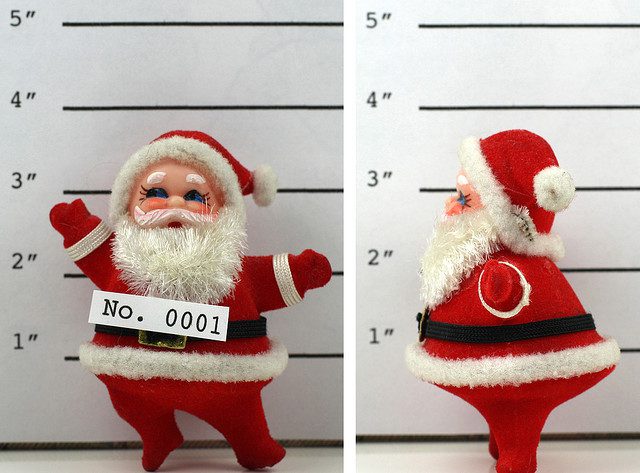
Wanted Santa. Photo: Kevin Dooley.
I never, for even a second, want to diminish my spiritual journey as a Protestant. It’s been, as they say, fifteen good years. I appreciate every minute of it. It was all a learning experience and I’ve learned a lot. And of course there’s value in where I was—in where I’ve been—the only difference is that I’m finding more value, at least for myself, in where I’m going. That’s, of course, why I’m going there.
It’s difficult to move away from something and not make it sound like it wasn’t good enough, or that something had gone wrong with it. For me, I’ve found something more, and I’m not alone, but not everyone finds fulfillment in what I find fulfillment in. It won’t make sense for everyone like it’s made sense for me. If there was really no debate and no difficulties with Catholicism then we would all be Catholics—likewise for Protestantism or the Eastern Orthodox tradition.
I never, ever, want to put my previous faith traditions down, or anyone else’s. But I do want to say, with breathless excitement, what I’ve experienced in my first Catholic Christmas, as a Protestant.
I’ve been walking through Catholic Christmas celebrations this year, as a Protestant, and it’s been incredible. I join the Catholic Church at Easter, barring any widespread apocalyptic scenario, so my participation has been a different sort than it would be as a full member of the Catholic Church but it’s been no less exciting, and fascinating, and mind-bogglingly more rich and rewarding than I imagined it could’ve been.
Growing up in my faith we didn’t have a lot of Christmas traditions. We were Pentecostal, practising more like Baptists, and although we did have a Christmas Eve service like any good Bapticostal church, Christmas wasn’t the same kind of anticipatory, penitential season as it is in the Catholic Church. Unlike more traditional, mainline churches, we sang Christmas carols beginning on December 1st. Our annual Christmas musical, a dramatic, song-filled retelling of the birth of Jesus, was held in mid-December. The season was Christmas and it was a month long, ending precisely on December 26.
My experience of Christmas has been a bit different, more recently, as the non-denominational church we attend, and love, has embraced a more traditional take on the season. We celebrate Advent in a way similar to other mainline churches with an Advent Wreath and a moratorium on Christmas carols until Christmas Eve. We follow the Common Lectionary too, which I obviously love, and the readings follow the common thread, the rhythm, of the season of Advent.
Recently then, Christmas, and Advent, have been more of the sort of anticipatory season I imagined it being within the Catholic Church so I was amazed, and excited, by the even deeper meaning and richness I’ve found now that I’ve slipped through the doors and snuck into the pews of Catholic churches.
In the Catholic Church Advent, the time leading up to Christmas, in addition to being an anticipatory season is also a kind of penitential season, like Lent. It’s a time to examine ourselves and live within the awareness that Christ is coming, in the form of a helpless baby, to redeem us from ourselves. I absolutely love the phrase in O Holy Night, “A thrill of hope, the weary world rejoices.”
We are, as Christians, part and parcel of this “weary world.” We’re in this weary world but not of it and so we, in a special way, await the coming of the Christ child (and His return again) to redeem the desperate and disappointed creation all around us. The weary world.
Advent is a season for solemn reflection, and breathless anticipation, and Catholics do it right. The readings, the structure of the Mass on a Sunday, the increased opportunities for confession and penitential services all set the tone for the coming of Christ. We a broken. We are excited to be fixed.
Then there’s a story.
I’m learning this: That there is a distinct and beautiful rhythm to the Catholic liturgical year. There are seasons and, in the time of Advent, Christmas, and the days beyond, there is rich and meaningful story. I should say, poetry, woven into the daily life of the practising Catholic.
Christmas, for the Catholic, is more than just one day. Liturgically speaking (and oh how I love to speak liturgically, lately, to anyone who will listen) the season of Christmas is actually an octave, which is eight days long. I think, unofficially, it ends later than that, 12 days, I believe, at the Feast of the Epiphany. And here’s what I mean by story.
The readings, the prayers, the hymns and music, and the priest’s homily follow the story of Christmas. Leading up to Christmas, during Advent, we read from the gospels accounts of Mary and Elizabeth, John the Baptist and the prophesies concerning Jesus. It’s a time of anticipation and then, like the striking of a match in a dark room, the Mass on Christmas Eve (or Christmas Day) opens with this text, from Isaiah 9:2,
The people who walked in darkness
have seen a great light.
The match is struck. Powerful stuff.
But the story continues. In the Christmas octave, and beyond, we trace Jesus’ presentation at the Temple, we remember King Herod’s slaughter of the innocents in his quest to kill the newborn “King of the Jews,” and we end up at the Epiphany, when God revealed the newborn Jesus to the world through the Wise Men from the East.
At each turn, like a wave upon a wave, the readings and prayers and homilies during this season reflect the ongoing narrative. The life and the prayer of the Church, then, serves as a beautiful mirror of the story of the life of Christ. A living reminder.
And one more thing.
As a Protestant, peeking in the curtain at the Catholic Church at Christmas there was something else that struck me in a powerful way and that’s the closeness of the Christmas story. Here’s what I mean.
In the Catholic Church’s understanding of the Communion of the Saints, it’s held that the saints are with us, among us, like great witnesses who are, also, praying at the altar in Heaven. This is pictured in Relevation which isn’t, to the Catholic theologian, just a book about the end of the world. Catholics believe that saints are in Heaven, in prayer, and that they want to pray for us. We can join our prayers with those who have gone before us—those who are, presently, in the incredible presence of God.
That right there is, like, wow for me.
But in all seriousness this is another aspect that struck me, deeply, about Christmas for the Catholic. If the saints are with us and among us, especially when we’re celebrating the Lord’s Supper, then that means those we talk about, read about, and hear about during the Christmas season are with us in prayer. Get out of town.
Catholics can join in prayer with Mary, Joseph, Elizabeth, Zechariah, John the Baptist—the whole cast of characters!
For the Catholic, Christmas isn’t simply commemorating the birth of Jesus in a really interesting and rich way. The Catholic, I’ve learned first hand, can truly be taking part in the whole narrative in a way that I could never dream of, nor would I have, as a Protestant. Catholics don’t believe that the cast of characters associated with Jesus’ miraculous birth—the coming of the God Man—are simply dead and gone but they are living, through Christ, in Heaven, and surround the altar of God joining their prayers with ours, like incense wafting up from the earth.
The living narrative being retold for two thousand years is wholly close, and real, in the union of prayer that we can have with those who were right there, and lived it out. The weary world, rejoicing.
This article was originally published on my personal blog in January of 2015.
Previous Post
December 15, 2015
Why Are Demons Afraid of Mary?
Next Post
December 29, 2015 When Jesus Said, "This is my Body," He Meant It
Browse Our Archives
Select a Category Appearances Christian Living Explaining the Faith Podcast Tough Questions Uncategorized Why I'm Catholic
Select a Month January 2024 December 2023 November 2023 July 2023 June 2023 May 2023 April 2023 March 2023 February 2023 January 2023 December 2022 November 2022 October 2022 September 2022 August 2022 July 2022 June 2022 May 2022 April 2022 March 2022 February 2022 January 2022 December 2021 November 2021 October 2021 September 2021 August 2021 July 2021 June 2021 May 2021 April 2021 March 2021 February 2021 January 2021 December 2020 November 2020 October 2020 September 2020 August 2020 July 2020 June 2020 May 2020 April 2020 March 2020 February 2020 January 2020 December 2019 November 2019 October 2019 September 2019 August 2019 July 2019 June 2019 May 2019 April 2019 March 2019 February 2019 January 2019 December 2018 November 2018 October 2018 September 2018 August 2018 July 2018 June 2018 May 2018 April 2018 March 2018 February 2018 January 2018 December 2017 October 2017 September 2017 July 2017 May 2017 April 2017 March 2017 February 2017 January 2017 December 2016 November 2016 October 2016 September 2016 August 2016 July 2016 June 2016 May 2016 April 2016 March 2016 February 2016 January 2016 December 2015 November 2015 October 2015 September 2015 August 2015 July 2015 June 2015 May 2015 April 2015 March 2015 February 2015 January 2015 December 2014 November 2014 October 2014
Follow Us!
TAKE THE
Religious Wisdom Quiz
Jesus raised whose daughter from the dead?
Select your answer to see how you score.
Jairus Thaddeus Bartholomew Darius
Support this
Column


Related posts from The Cordial Catholic

232: The Trajectory of Conversion (w/ Phillip Campbell)

229: Can Catholics and Evangelicals Agree on How...
212: Evangelicals, Here's How to Look for a...
210: I Was Going to be an Anglican...
TRENDING AT PATHEOS Catholic

Rejecting Doom: Christian Hope And Human Action
Christianity is a religion of hope. We are to have hope and...

It’s What Comes From Within Which Matters
One of the most difficult things for us to understand is why...

Why I Choose the Eucharist Over the Sermon
Choose the Eucharist, Not the Sermon What are we supposed to get...

5 Design Elements Found in Spiritually Rooted Homes
Putting Spirituality Into Home Decor Our homes are more than our living...

Credo: A Story of God Told with the...
About 10 years ago, I began to imagine a personal "Credo" that...

The Anatomy of Divine Revelation in Catholic Thought
The claim that God has made Himself known to human beings is...
view all Catholic blogs
Ad-Free & Subscriber Log-In Subscription Support
- About Us
- 2026 Calendar
- Videos
- Podcasts
- Library of World Religions
- Faith In Media Tracker
- Advertise With Us
- Write for Us
- Privacy Policy
- Terms of Service
- Do Not Sell My Data
- Contact Us
- Radiant Digital
- Manage Newsletter Subscriptions
- Unsubscribe From Notifications
- Sitemap
Copyright 2008-2026, Patheos. All rights reserved.
Subscription Support Ad-Free & Subscriber Log-In
Follow Patheos