
BuddhistCatholicContemplativeEvangelicalGeneral ChristianHinduJewishLatter-day SaintMuslimNew VisionsProgressive Christian
Beliefs
- Buddhist
- Catholic
- Contemplative
- Evangelical
- General Christian
- Hindu
- Jewish
- Latter-day Saint
- More Voices
- Muslim
- New Visions
- Pagan
- Progressive Christian
Topics
- Religion News
- Food and Religion
- Sports and Religion
- Religious Art
- Religious Music and Entertainment
- Religious Events
- History and Religion
- Style and Religion
- Politics and Religion
- Women in Religion
- Recreation Outdoors and Religion
- Business Finance and Religion
- Careers Workplace and Religion
- Education and Religion
- Family Parenting and Religion
- Health Fitness and Religion
- Home and Religion
- Relationships and Religion
- Technology and Religion
- Travel and Religion
Columnists
- Buddhist Columnists
- Business Finance and Religion Columnists
- Careers Workplace and Religion Columnists
- Catholic Columnists
- Contemplative Columnists
- Education and Religion Columnists
- Evangelists Columnists
- Family Parenting and Religion Columnists
- General Christian Columnists
- Health Fitness and Religion Columnists
- Hindu Columnists
- History and Religion Columnists
- Home and Religion Columnists
- Jewish Columnists
- More Voices Columnists
- Latter Day Columnists
- Muslim Columnists
- New Visions Columnists
- Nonreligious Columnists
- Pagan Columnists
- Politics and Religion Columnists
- Progressive Columnists
- Recreation Outdoors and Religion Columnists
- Relationships and Religion Columnists
- Religion News Columnists
- Religious Art Columnists
- Religious Events Columnists
- Religious Music and Entertainment Columnists
- Sports and Religion Columnists
- Style and Religion Columnists
- Technology and Religion Columnists
- Travel and Religion Columnists
- Women in Religion Columnists
Resource Library
- 2026 Calendar
- Library of World Religions
- The 100 Most Holy Places on Earth
- Patheos Answers
- Podcasts
- Videos
- Faith Leaders Database
- Anglican Episcopalian
- Bahai
- Baptist
- Buddhism
- Christianity
- Confucianism
- Eastern Orthodoxy
- Hinduism
- Holiness and Pentecostal
- ISKCON
- Islam
- Judaism
- Lutheran
- Methodist
- The Church of Jesus Christ of Latter-day Saints
- New Age
- Paganism
- Presbytarian and Reformed
- Protestantism
- Religion Behind the Scenes
- Roman Catholic
- Scientology
- Shia Islam
- Sikhism
- Sufism
- Sunni Islam
- Taoism
- Zen
- See all religions
Research Tools
 Ad-Free & Subscriber Log-In Subscription Support
Ad-Free & Subscriber Log-In Subscription Support
Follow Patheos 

- Trending:
- Forgiveness
- |
- Marriage
- |
- Consciousness
- |
- Death Penalty
- |
- Election
- |
- Halloween
 The Cordial Catholic
- Home
- Catholic
- The Reformation Was Stupid
The Reformation Was Stupid
Last updated on: September 13, 2017 at 12:28 pm by K. Albert Little
The Reformation Was Stupid 2017-09-13T12:28:12-04:00 K. Albert Little
Patheos Explore the world's faith through different perspectives on religion and spirituality! Patheos has the views of the prevalent religions and spiritualities of the world.
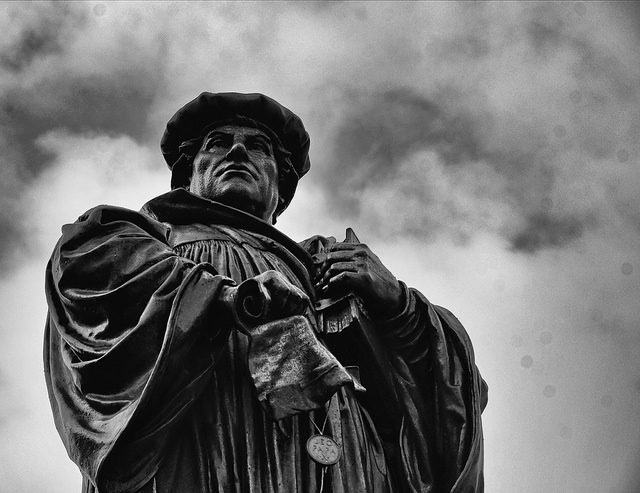
Photo Credit: Michael.
For many Protestants the 500th anniversary of the Reformation is cause for some celebration.
In many circles I know, it’s an opportunity to celebrate the time that a hero of Christianity freed the Bible, and the faith, from the bad theology and evil clutches of the monolithic Catholic Church. Wrestling control over our destinies from the hands of the corrupt papal authorities and restoring a belief system and way of life that had been lost under centuries of Roman tyranny.
(Or maybe that’s a bit extreme.)
But the narrative attached to the Reformation, and our understanding of Christian history, plays perhaps the largest role in shaping our faith lives and our understanding of who God is and what is plan for salvation is in our lives.
To say it another way: How we understand our own history shapes almost everything about how we live out our faith today.
A proper understanding, then, is kind of a big deal.
And here, the commonly espoused idea of the Reformation as a re-establishing of some kind of true, lost faith is a claim worth a genuine investigation.
A meaningful study of Old Testament covenants reveals plainly that God’s chosen people—the nation of Israel—screwed things up more than a handful of times. God promised good things to those that followed His meager requirements only to mourn, again and again, as His people fell in league with sin, and broke the simple agreements they made.
Laws and guidelines which God established to differentiate them from their pagan neighbours, to keep them safe, to help them prosper—time and again even the most holiest of the God-appointed leaders and priests stumbled, fell, and a nation crumbled.
Time and again their sins took them to the brink.
Time and again God was moved, in mercy, to re-establish their broken relationship.
But even Protestants would acknowledge that the new covenant is something different.
When Christ established his new people under the new covenant he called those people his Church and named them his Bride. A Bride who would not need to re-establish her wedding vows every time she slip and fell from grace—unlike God’s people of the old covenants.
Jesus’ sacrifice, we all agree, is a “once, for all” situation. Unlike the Jewish nation who fell away and needed to be re-restored, Jesus doesn’t need to suffer crucifixion every time one of His followers commits a sin—or gets a finer point of theology wrong.
It’s over and done.
When Martin Luther lodged his formal complaints against the Catholic Church he likely never intended to start over again, he simply wanted reform. But the Reformation, in that sense, is entirely misnamed. Because in the end it wasn’t a Reformation—as the movement grew and then began to spiral out of control of the original Reformers, it became a restoration, something it was never intended to be.
Something which is impossible to imagine.
Because unlike the Jewish believers of the Old Testament a new prophet, a new covenant, a new movement was not required. Jesus had died; our new covenant is written, and signed, in His blood. If the Church, established by Jesus at His death, had gotten something wrong then she needed to be corrected—not dismantled, not circumvented, not bowled over in favour of something else.
But that something else is what we’ve ended up with.
Contrary to what I believed as an Evangelical, the Church was never a fragmented, invisible collection of believers when it was established by Christ in the Upper Room two thousand years ago. It’s clear from Acts, Paul’s epistles, and the Early Church Fathers that the first apostles and their successors immediately understood themselves to be operating under a specific, authoritative structure. The physical Church, with the trappings of the Mass, the Bishops, and even priestly celibacy can be traced back with the utmost precision to the very Early Church.
To those very first days and directly, in a straight line, back to the promises of Christ.
But the Reformers, with many of the best intentions, jettisoned 1,500 years of Church history to say they’d found a better way. That they were there to restore the Church which had been lost in all that Catholic stuff.
That, somehow, the bishops and popes had gotten it wrong—but they’d discovered the truth.
It just doesn’t work.
In humility, the Catholic Church is the first to admit that it sometimes got it wrong in practice. It gets it wrong in practice still because its members are not perfect but its heart cannot be moved because it is fixed on Christ—because it was established by Christ in the very words recorded for us in Scripture.
Words that appear in Protestant Bibles, too.
Jesus told us, in no uncertain terms, that the Church he established would never be overcome.
Not that it’d be great at first but then meander for about 1,500 years until it was discovered again. And, oh, by the way, that’s how it was supposed to be all along (forget the pope and bishops and all that incense stuff).
That’s just stupid.
Previous Post

September 5, 2017
We Don't Need No Nashville Statement
Next Post
September 18, 2017 I Have the Laziest Prayer Life Ever (and It's Awesome!)
Browse Our Archives
Select a Category Appearances Christian Living Explaining the Faith Podcast Tough Questions Uncategorized Why I'm Catholic
Select a Month January 2024 December 2023 November 2023 July 2023 June 2023 May 2023 April 2023 March 2023 February 2023 January 2023 December 2022 November 2022 October 2022 September 2022 August 2022 July 2022 June 2022 May 2022 April 2022 March 2022 February 2022 January 2022 December 2021 November 2021 October 2021 September 2021 August 2021 July 2021 June 2021 May 2021 April 2021 March 2021 February 2021 January 2021 December 2020 November 2020 October 2020 September 2020 August 2020 July 2020 June 2020 May 2020 April 2020 March 2020 February 2020 January 2020 December 2019 November 2019 October 2019 September 2019 August 2019 July 2019 June 2019 May 2019 April 2019 March 2019 February 2019 January 2019 December 2018 November 2018 October 2018 September 2018 August 2018 July 2018 June 2018 May 2018 April 2018 March 2018 February 2018 January 2018 December 2017 October 2017 September 2017 July 2017 May 2017 April 2017 March 2017 February 2017 January 2017 December 2016 November 2016 October 2016 September 2016 August 2016 July 2016 June 2016 May 2016 April 2016 March 2016 February 2016 January 2016 December 2015 November 2015 October 2015 September 2015 August 2015 July 2015 June 2015 May 2015 April 2015 March 2015 February 2015 January 2015 December 2014 November 2014 October 2014
Follow Us!
TAKE THE
Religious Wisdom Quiz
Which king was known for his extravagant building projects and many wives?
Select your answer to see how you score.
Hezekiah David Solomon Ahab
Support this
Column


Related posts from The Cordial Catholic

235: Questions I Couldn't Answer (w/ John Martignoni)

234: The Mindblowing World of Sacramentals (w/ Shaun...

233: The Power of Good Catholic Witnesses (w/...

232: The Trajectory of Conversion (w/ Phillip Campbell)
TRENDING AT PATHEOS Catholic

Rejecting Doom: Christian Hope And Human Action
Christianity is a religion of hope. We are to have hope and...

It’s What Comes From Within Which Matters
One of the most difficult things for us to understand is why...

Why I Choose the Eucharist Over the Sermon
Choose the Eucharist, Not the Sermon What are we supposed to get...

5 Design Elements Found in Spiritually Rooted Homes
Putting Spirituality Into Home Decor Our homes are more than our living...

Credo: A Story of God Told with the...
About 10 years ago, I began to imagine a personal "Credo" that...

The Anatomy of Divine Revelation in Catholic Thought
The claim that God has made Himself known to human beings is...
view all Catholic blogs
Ad-Free & Subscriber Log-In Subscription Support
- About Us
- 2026 Calendar
- Videos
- Podcasts
- Library of World Religions
- Faith In Media Tracker
- Advertise With Us
- Write for Us
- Privacy Policy
- Terms of Service
- Do Not Sell My Data
- Contact Us
- Radiant Digital
- Manage Newsletter Subscriptions
- Unsubscribe From Notifications
- Sitemap
Copyright 2008-2026, Patheos. All rights reserved.
Subscription Support Ad-Free & Subscriber Log-In
Follow Patheos