
BuddhistCatholicContemplativeEvangelicalGeneral ChristianHinduJewishLatter-day SaintMuslimNew VisionsProgressive Christian
Beliefs
- Buddhist
- Catholic
- Contemplative
- Evangelical
- General Christian
- Hindu
- Jewish
- Latter-day Saint
- More Voices
- Muslim
- New Visions
- Pagan
- Progressive Christian
Topics
- Religion News
- Food and Religion
- Sports and Religion
- Religious Art
- Religious Music and Entertainment
- Religious Events
- History and Religion
- Style and Religion
- Politics and Religion
- Women in Religion
- Recreation Outdoors and Religion
- Business Finance and Religion
- Careers Workplace and Religion
- Education and Religion
- Family Parenting and Religion
- Health Fitness and Religion
- Home and Religion
- Relationships and Religion
- Technology and Religion
- Travel and Religion
Columnists
- Buddhist Columnists
- Business Finance and Religion Columnists
- Careers Workplace and Religion Columnists
- Catholic Columnists
- Contemplative Columnists
- Education and Religion Columnists
- Evangelists Columnists
- Family Parenting and Religion Columnists
- General Christian Columnists
- Health Fitness and Religion Columnists
- Hindu Columnists
- History and Religion Columnists
- Home and Religion Columnists
- Jewish Columnists
- More Voices Columnists
- Latter Day Columnists
- Muslim Columnists
- New Visions Columnists
- Nonreligious Columnists
- Pagan Columnists
- Politics and Religion Columnists
- Progressive Columnists
- Recreation Outdoors and Religion Columnists
- Relationships and Religion Columnists
- Religion News Columnists
- Religious Art Columnists
- Religious Events Columnists
- Religious Music and Entertainment Columnists
- Sports and Religion Columnists
- Style and Religion Columnists
- Technology and Religion Columnists
- Travel and Religion Columnists
- Women in Religion Columnists
Resource Library
- 2026 Calendar
- Library of World Religions
- The 100 Most Holy Places on Earth
- Patheos Answers
- Podcasts
- Videos
- Faith Leaders Database
- Anglican Episcopalian
- Bahai
- Baptist
- Buddhism
- Christianity
- Confucianism
- Eastern Orthodoxy
- Hinduism
- Holiness and Pentecostal
- ISKCON
- Islam
- Judaism
- Lutheran
- Methodist
- The Church of Jesus Christ of Latter-day Saints
- New Age
- Paganism
- Presbytarian and Reformed
- Protestantism
- Religion Behind the Scenes
- Roman Catholic
- Scientology
- Shia Islam
- Sikhism
- Sufism
- Sunni Islam
- Taoism
- Zen
- See all religions
Research Tools
 Ad-Free & Subscriber Log-In Subscription Support
Ad-Free & Subscriber Log-In Subscription Support
Follow Patheos 

- Trending:
- Forgiveness
- |
- Marriage
- |
- Consciousness
- |
- Death Penalty
- |
- Election
- |
- Halloween
 The Cordial Catholic
- Home
- Catholic
- Why I Love the Pope (and You Can Too!)
Why I Love the Pope (and You Can Too!)
Last updated on: August 26, 2015 at 8:38 am by K. Albert Little
Why I Love the Pope (and You Can Too!) 2015-08-26T08:38:52-04:00 K. Albert Little
Patheos Explore the world's faith through different perspectives on religion and spirituality! Patheos has the views of the prevalent religions and spiritualities of the world.
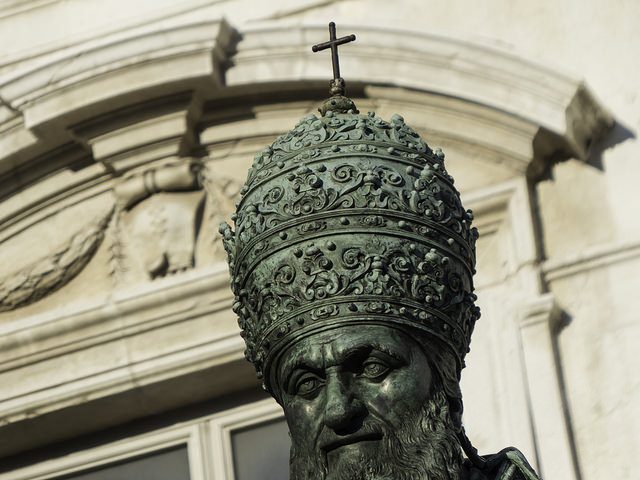
Photo Credit: Rick.
It shouldn’t come as a surprise to you to learn that I love the Pope. You, my dear readers and friends, are a long-suffering bunch and nothing should really come as a surprise to you anymore. But, I do love the Pope, and I’m going to tell you why.
The Pope is an audacious person. The present Pope, perhaps not so much, but the office of the Pope in and of itself is an affront to our modern culture and sensibilities. A man, first of all, a man, claiming to represent all Catholics everywhere. Nevermind that, but he’s making the historically ludicrous claim that he’s stands in an unbroken line of apostles going back to Peter, who Catholics say is the very first Pope.
And don’t forget, the Pope claims the authority to speak infallibly. That is, he claims to have the authority to make decisions which are binding on all Catholic Christians—and have the weight of the authority of God behind them.
So, why am I crazy enough to love the Pope? And why would you?
The Historic Papacy
Catholics claims about the Pope are pretty audacious, yes, but the more I began to dig into Catholic theology and, indeed, the theology of Christianity up until the Reformation, I discovered that these claims are, incredibly, well founded. Remarkably, the idea that the Pope isn’t the head of the global Christian church is the rather novel, not the other way around.
Without pretending that the Pope was always and forever recognized as the sole decider of the Catholic Church, it’s safe to say that the authority of the office of Peter, and the position of the Pope, was always a significant arbiter in the Christian Church up to the Reformation. Even for the Early Church, for the councils that got together to decide on doctrine, theology, and the biblical canon, it was the presence (or the recognition) of the Popes that made them infallibly binding. Councils that did not have the papal nod did not receive the infallible distinction. This is vital to understanding the authority of the Pope even to the early Christian Church.
The Protestant who doesn’t recognize that the Pope was granted authority from God has a very difficult road ahead of himself in explaining how the Bible came to be.
Following the Reformation the papacy became even more important in response to the Protestant schism. In large part, local distinctions within the Church began to be smoothed out and the centralization of decision-making power (back) to the papacy, the Bishop of Rome, was a natural response to Church division.
The Papacy in Typology
Ultimately, Catholicism asserts, the Pope has authority, based on the charge of Jesus to build His Church on Peter, who He calls the rock. Peter was the first Pope and like the apostles in the New Testament, and the bishops that followed them, the office of Peter was always intended to be passed on and not pass away. This, Catholic theologians argue, is evident in the way the words of Jesus echo the words used in Isaiah referring to the steward of the kingdom of David. This steward held the keys to the Davidic kingdom and was given authority likewise.
This illusion to the Hebrew Scriptures, Catholic theologians argue, would’ve been obvious to any pious Jew in Jesus’s time—and to the early Christians as they chose Peter’s successor. Certainly, in the centuries following the Reformation this was an oft-used appeal by Catholics for keeping the Christian Church together, under the Pope.
But what’s even more, Catholics can, with mind-boggling certainty, trace the apostolic chain of command right from Peter to Pope Francis himself. A line of apostolic succession. In fact the earliest preserved writings of the Church Fathers include those of Clement, who is seen as Catholics to be the Bishop of Rome and the third Pope. Pope Linus, regarded as the Pope who succeeded Peter, is mentioned along with Clement in the canonical New Testament but doesn’t appear to have written anything down. The strong silent type.
The Practicality of the Pope
So why do I love the Pope, and why would you?
Because as audacious and ludicrous the claim might be it makes sense.
It makes sense to me that God would leave for us a representative, the Vicar of Christ, with the ultimate authority to teach us how to live and what the Word of God means. And to represent God to us. In the same way that it makes sense, to me, that God would leave us a Church to help us live and interpret His will.
As a Protestant there is no one that comes close to credibly making the claim of the Pope. Those that do are radicals, or maniacs. For a Protestant, in the low church tradition I grew up in, the closest we could come to a Pope would be our pastor. If we really stretched it perhaps our regional denomination president. In any case, neither of these otherwise holy men were making any claim of authority. Neither of these men stood so audaciously and said, “Look at me, act like me. I will keep the keys until Christ’s return.” They would’ve been ushered out the back door, quietly.
The Pope stands, uniquely, as a pointer to Christ. He makes a powerful and beautiful claim to power.
I’ve come to love the saints in the same way. I’ve come to love statues, stories, and devotions of this nature precisely because they point to Christ, and remind me of how to live a holy and upright life. In the midst of the busy day I can recall and remember a particular saint that’s praying for me. A real person that lived that says, “I relied on Jesus too, He is God; I’ve been there, and I’ll pray for you.” All saints and devotions to them point towards Christ.
In the same way, the Pope actively points to Christ. The Pope kisses babies, waves in St. Peter’s square, heads church councils and meetings, oversees reform and church law, and serves the poor in place of Christ. He is, in a very real sense, the hands and feet of Christ that we’re all urged to become. And I love the Pope when He does this stuff.
And I love God that He gave us this incredible gift: the gift of a person who can be his Vicar, the Servant of all Christian servants. A diplomat. An envoy. An ambassador.
Sure, the office of the Pope can be abused. It has been abused and it will probably be abused again. It’s a topic for another, fuller time, but just because Popes may speak infallibly doesn’t necessarily equate to impeccability. Some Popes are awful; some Popes are evil. But if God gave us the Catholic Church and a Pope at its head than it can be, and is, a beautiful thing. It’s a gift, like the Church itself, that points to Christ and His return.
Previous Post

December 11, 2014
A Fish in Water
Next Post
December 15, 2014 The Catholic as Pharisee
Browse Our Archives
Select a Category Appearances Christian Living Explaining the Faith Podcast Tough Questions Uncategorized Why I'm Catholic
Select a Month January 2024 December 2023 November 2023 July 2023 June 2023 May 2023 April 2023 March 2023 February 2023 January 2023 December 2022 November 2022 October 2022 September 2022 August 2022 July 2022 June 2022 May 2022 April 2022 March 2022 February 2022 January 2022 December 2021 November 2021 October 2021 September 2021 August 2021 July 2021 June 2021 May 2021 April 2021 March 2021 February 2021 January 2021 December 2020 November 2020 October 2020 September 2020 August 2020 July 2020 June 2020 May 2020 April 2020 March 2020 February 2020 January 2020 December 2019 November 2019 October 2019 September 2019 August 2019 July 2019 June 2019 May 2019 April 2019 March 2019 February 2019 January 2019 December 2018 November 2018 October 2018 September 2018 August 2018 July 2018 June 2018 May 2018 April 2018 March 2018 February 2018 January 2018 December 2017 October 2017 September 2017 July 2017 May 2017 April 2017 March 2017 February 2017 January 2017 December 2016 November 2016 October 2016 September 2016 August 2016 July 2016 June 2016 May 2016 April 2016 March 2016 February 2016 January 2016 December 2015 November 2015 October 2015 September 2015 August 2015 July 2015 June 2015 May 2015 April 2015 March 2015 February 2015 January 2015 December 2014 November 2014 October 2014
Follow Us!
TAKE THE
Religious Wisdom Quiz
Who prayed for rain after a long drought and sent his servant to look seven times?
Select your answer to see how you score.
Elijah Isaiah Hosea Samuel
Support this
Column


Related posts from The Cordial Catholic

227: What was Medieval Catholicism Really Like? (w/...
205: Why You Should Love Mary More, and...
198: Why We Left Catholicism – and Why...
196: The African Roots of Catholicism (w/ Mike...
TRENDING AT PATHEOS Catholic

Rejecting Doom: Christian Hope And Human Action
Christianity is a religion of hope. We are to have hope and...

It’s What Comes From Within Which Matters
One of the most difficult things for us to understand is why...

Why I Choose the Eucharist Over the Sermon
Choose the Eucharist, Not the Sermon What are we supposed to get...

5 Design Elements Found in Spiritually Rooted Homes
Putting Spirituality Into Home Decor Our homes are more than our living...

Credo: A Story of God Told with the...
About 10 years ago, I began to imagine a personal "Credo" that...

The Anatomy of Divine Revelation in Catholic Thought
The claim that God has made Himself known to human beings is...
view all Catholic blogs
Ad-Free & Subscriber Log-In Subscription Support
- About Us
- 2026 Calendar
- Videos
- Podcasts
- Library of World Religions
- Faith In Media Tracker
- Advertise With Us
- Write for Us
- Privacy Policy
- Terms of Service
- Do Not Sell My Data
- Contact Us
- Radiant Digital
- Manage Newsletter Subscriptions
- Unsubscribe From Notifications
- Sitemap
Copyright 2008-2026, Patheos. All rights reserved.
Subscription Support Ad-Free & Subscriber Log-In
Follow Patheos