
BuddhistCatholicContemplativeEvangelicalGeneral ChristianHinduJewishLatter-day SaintMuslimNew VisionsProgressive Christian
Beliefs
- Buddhist
- Catholic
- Contemplative
- Evangelical
- General Christian
- Hindu
- Jewish
- Latter-day Saint
- More Voices
- Muslim
- New Visions
- Pagan
- Progressive Christian
Topics
- Religion News
- Food and Religion
- Sports and Religion
- Religious Art
- Religious Music and Entertainment
- Religious Events
- History and Religion
- Style and Religion
- Politics and Religion
- Women in Religion
- Recreation Outdoors and Religion
- Business Finance and Religion
- Careers Workplace and Religion
- Education and Religion
- Family Parenting and Religion
- Health Fitness and Religion
- Home and Religion
- Relationships and Religion
- Technology and Religion
- Travel and Religion
Columnists
- Buddhist Columnists
- Business Finance and Religion Columnists
- Careers Workplace and Religion Columnists
- Catholic Columnists
- Contemplative Columnists
- Education and Religion Columnists
- Evangelists Columnists
- Family Parenting and Religion Columnists
- General Christian Columnists
- Health Fitness and Religion Columnists
- Hindu Columnists
- History and Religion Columnists
- Home and Religion Columnists
- Jewish Columnists
- More Voices Columnists
- Latter Day Columnists
- Muslim Columnists
- New Visions Columnists
- Nonreligious Columnists
- Pagan Columnists
- Politics and Religion Columnists
- Progressive Columnists
- Recreation Outdoors and Religion Columnists
- Relationships and Religion Columnists
- Religion News Columnists
- Religious Art Columnists
- Religious Events Columnists
- Religious Music and Entertainment Columnists
- Sports and Religion Columnists
- Style and Religion Columnists
- Technology and Religion Columnists
- Travel and Religion Columnists
- Women in Religion Columnists
Resource Library
- 2026 Calendar
- Library of World Religions
- The 100 Most Holy Places on Earth
- Patheos Answers
- Podcasts
- Videos
- Faith Leaders Database
- Anglican Episcopalian
- Bahai
- Baptist
- Buddhism
- Christianity
- Confucianism
- Eastern Orthodoxy
- Hinduism
- Holiness and Pentecostal
- ISKCON
- Islam
- Judaism
- Lutheran
- Methodist
- The Church of Jesus Christ of Latter-day Saints
- New Age
- Paganism
- Presbytarian and Reformed
- Protestantism
- Religion Behind the Scenes
- Roman Catholic
- Scientology
- Shia Islam
- Sikhism
- Sufism
- Sunni Islam
- Taoism
- Zen
- See all religions
Research Tools
 Ad-Free & Subscriber Log-In Subscription Support
Ad-Free & Subscriber Log-In Subscription Support
Follow Patheos 

- Trending:
- Forgiveness
- |
- Marriage
- |
- Consciousness
- |
- Death Penalty
- |
- Election
- |
- Halloween
 The Cordial Catholic
- Home
- Catholic
- Let’s Talk About Prima Scriptura
Let’s Talk About Prima Scriptura
Last updated on: August 3, 2015 at 3:59 pm by K. Albert Little
Let’s Talk About Prima Scriptura 2015-08-03T15:59:37-04:00 K. Albert Little
Patheos Explore the world's faith through different perspectives on religion and spirituality! Patheos has the views of the prevalent religions and spiritualities of the world.
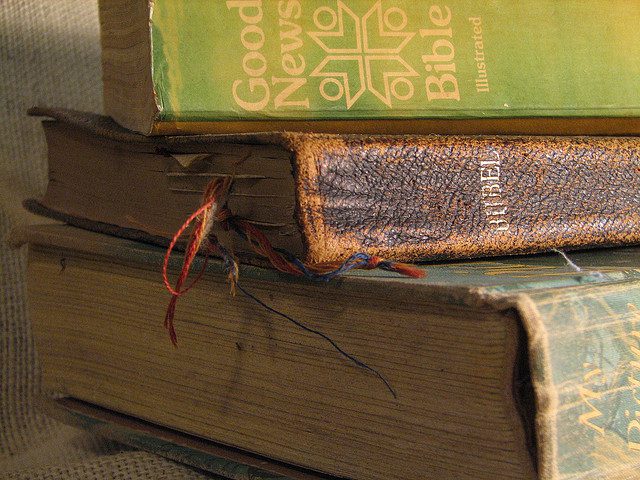
Photo Credit: Donna.
I’ve written a lot about sola scriptura, the Reformation belief that Scripture—the Bible—is the ultimate authority on matters of faith. I’ve written a lot about it because it’s been one of the primary drivers of my journey towards Catholicism.
In a nutshell, I don’t believe that a God who is who He says He is would leave each individual up to their own interpretation. (Yes, He left us the Holy Spirit but we still end up with a multitude of differing private interpretations.)
But, what about prima scriptura, the notion that Scripture is the most authoritative source on our faith but not the only authoritative source?
That’s an idea I can get behind, and one that the Catholic Church can, too.
A brief preface before the meat of the thing.
I would assert, cordially, of course, that you must have an interpreter of Scripture. Scripture, because it is written down, must be interpreted in some way. If I say to you, “The Blue Jays are the best team in baseball,” you could ask me myriad of follow-up questions (and probably come to the conclusion that I am, sadly, incorrect). Not so with the Scriptures. Since the Scriptures are written down and not expressed to you by their authors directly you cannot ask those authors follow-up questions. As much as we can daydream about being able to speak to Paul about precisely what he meant by his framework for justification we, sadly, cannot.
We interpret.
Most of us, but not all of us, do our best to interpret based on a number of factors and considerations. Some of the best Bible scholars, like N.T. Wright, set about a framework for interpretation that’s really quite robust. But, it’s a created interpretive framework, created by us.
The notion of sola scriptura is that the Bible is the sole authority on matters of faith. In its original context, Martin Luther imagined this taking place in the authoritative community of his church, the Lutheran Church, as it began. Later interpretations of sola scriptura led reformers to understand that interpretation could be, and should be, down to each individual person. The Holy Spirit helps in the interpretation but no authority, none whatsoever, should be place above the Bible.
If a particular preacher or pastor wasn’t teaching from an interpretation of the Bible that I held to it was my right to leave that community and find, or even found, a new one.
It’s important to understand that this idea of sola scriptura is much more recent than that of the early reformers and has its origins tied more closely to the Puritans than the Reformers.
Prima scriptura, on the other hand, asserts that the Word of God, as received through the writers of the Old Testament, the Gospels, and the epistles, is the full and total sum of the deposit of faith. That is, the source of our unchanging faith is found in the Bible, which was recognized and put together by the Church.
The traditions of the Catholic Church, therein, are founded and grounded in the deposit of faith that’s found in the Bible. The Church does not necessarily teach new things but those things have their ultimate root in Scripture.
Jesus Christ came and lived and taught. The sum total of His teaching was transmitted, orally, to the disciples He chose who then chose new disciples and passed on this oral teaching. This much, so far, is found in the New Testament. There are clear lines of succession of apostles and the establishing of bishops; there are clear lines of authority that echo down through the Early Church Fathers, too. It is clear that early Christians understood Jesus to have founded a physical church, and they acted accordingly.
These disciples eventually, some sooner than later, wrote down the teachings of Jesus; others wrote letters of instruction to their own apostles, churches, or communities. These teachings, in written form, were preserved by the apostles and their subsequent successors and communities and, eventually, collected together into the Bible. The Church leaders, who were direct, appointed successors of the earliest disciples of Jesus, discerned with the help of the Holy Spirit, which of the collected writings that had been passed down were God-breathed and which weren’t. Those that were deemed to be orthodox and inspired were collected into the Bible we have today.
This Bible, originally transmitted, then written, and collected all under the same apostolic authority, is the ultimate guide to our faith.
This concept of prima scriptura is not without its challengers within the Catholic Church and is not without it problems but, ultimately, it’s a picture of the authority of Scripture that works and a picture of authority, I think, that puts Protestants and Catholics on much more ecumenical footing. The job of the Catholic Church has been to protect and transmit the message of Jesus—the deposit of faith—which was collected under its guidance in the Scriptures. The Tradition, capital T, built up through history finds its roots firmly in Scripture.
The significant difference, as I see it, in a Protestant and Catholic understanding of prima scriptura is the Catholic Church, alone, claims the authority of apostolic succession. It was the appointed disciples of Jesus who then selected successors, who then selected successors, who then selected successors, down through history, who protected and transmitted the Bible. The Bible is the sole rule of faith, but it’s in the authority and the tradition of the Catholic Church that this rule of faith is protected and interpreted.
Ultimately, prima scriptura is one way to understand the role of Scripture’s authority. Is it the normal means for recognizing Scriptures authority within the Catholic Church? There’s some debate about that. In the end, I have, as a Protestant, come to the conclusion that if Scripture is the sole rule of our faith then there must be an interpreter. I’m banking, rightly or wrongly, on the interpreter that claims, historically, to be in apostolic succession from the first apostles.
It’s the Catholic Church that has the authority, given by Jesus, to interpret what Scripture means unless, somewhere along the line, Jesus rescinded the promise He made to protect His church for all time. The physical church he established with the disciples, who then appointed successors, who then appointed successors…
Previous Post
January 21, 2015
Jesus, Divine and Human: A Juxtaposition
Next Post
January 26, 2015 A New Way of Thinking
Browse Our Archives
Select a Category Appearances Christian Living Explaining the Faith Podcast Tough Questions Uncategorized Why I'm Catholic
Select a Month January 2024 December 2023 November 2023 July 2023 June 2023 May 2023 April 2023 March 2023 February 2023 January 2023 December 2022 November 2022 October 2022 September 2022 August 2022 July 2022 June 2022 May 2022 April 2022 March 2022 February 2022 January 2022 December 2021 November 2021 October 2021 September 2021 August 2021 July 2021 June 2021 May 2021 April 2021 March 2021 February 2021 January 2021 December 2020 November 2020 October 2020 September 2020 August 2020 July 2020 June 2020 May 2020 April 2020 March 2020 February 2020 January 2020 December 2019 November 2019 October 2019 September 2019 August 2019 July 2019 June 2019 May 2019 April 2019 March 2019 February 2019 January 2019 December 2018 November 2018 October 2018 September 2018 August 2018 July 2018 June 2018 May 2018 April 2018 March 2018 February 2018 January 2018 December 2017 October 2017 September 2017 July 2017 May 2017 April 2017 March 2017 February 2017 January 2017 December 2016 November 2016 October 2016 September 2016 August 2016 July 2016 June 2016 May 2016 April 2016 March 2016 February 2016 January 2016 December 2015 November 2015 October 2015 September 2015 August 2015 July 2015 June 2015 May 2015 April 2015 March 2015 February 2015 January 2015 December 2014 November 2014 October 2014
Follow Us!
TAKE THE
Religious Wisdom Quiz
According to Hebrews, for what purpose did Jesus taste death?
Select your answer to see how you score.
For his disciples For everyone For Israel For the righteous
Support this
Column


Related posts from The Cordial Catholic

235: Questions I Couldn't Answer (w/ John Martignoni)
204: The Great Big Protestant Problem with Scripture...
200: Reasons to Doubt Sola Scriptura (w/ Jimmy...
166: How the Early Church Read the Bible...
TRENDING AT PATHEOS Catholic

Rejecting Doom: Christian Hope And Human Action
Christianity is a religion of hope. We are to have hope and...

It’s What Comes From Within Which Matters
One of the most difficult things for us to understand is why...

Why I Choose the Eucharist Over the Sermon
Choose the Eucharist, Not the Sermon What are we supposed to get...

5 Design Elements Found in Spiritually Rooted Homes
Putting Spirituality Into Home Decor Our homes are more than our living...

Credo: A Story of God Told with the...
About 10 years ago, I began to imagine a personal "Credo" that...

The Anatomy of Divine Revelation in Catholic Thought
The claim that God has made Himself known to human beings is...
view all Catholic blogs
Ad-Free & Subscriber Log-In Subscription Support
- About Us
- 2026 Calendar
- Videos
- Podcasts
- Library of World Religions
- Faith In Media Tracker
- Advertise With Us
- Write for Us
- Privacy Policy
- Terms of Service
- Do Not Sell My Data
- Contact Us
- Radiant Digital
- Manage Newsletter Subscriptions
- Unsubscribe From Notifications
- Sitemap
Copyright 2008-2026, Patheos. All rights reserved.
Subscription Support Ad-Free & Subscriber Log-In
Follow Patheos