
BuddhistCatholicContemplativeEvangelicalGeneral ChristianHinduJewishLatter-day SaintMuslimNew VisionsProgressive Christian
Beliefs
- Buddhist
- Catholic
- Contemplative
- Evangelical
- General Christian
- Hindu
- Jewish
- Latter-day Saint
- More Voices
- Muslim
- New Visions
- Pagan
- Progressive Christian
Topics
- Religion News
- Food and Religion
- Sports and Religion
- Religious Art
- Religious Music and Entertainment
- Religious Events
- History and Religion
- Style and Religion
- Politics and Religion
- Women in Religion
- Recreation Outdoors and Religion
- Business Finance and Religion
- Careers Workplace and Religion
- Education and Religion
- Family Parenting and Religion
- Health Fitness and Religion
- Home and Religion
- Relationships and Religion
- Technology and Religion
- Travel and Religion
Columnists
- Buddhist Columnists
- Business Finance and Religion Columnists
- Careers Workplace and Religion Columnists
- Catholic Columnists
- Contemplative Columnists
- Education and Religion Columnists
- Evangelists Columnists
- Family Parenting and Religion Columnists
- General Christian Columnists
- Health Fitness and Religion Columnists
- Hindu Columnists
- History and Religion Columnists
- Home and Religion Columnists
- Jewish Columnists
- More Voices Columnists
- Latter Day Columnists
- Muslim Columnists
- New Visions Columnists
- Nonreligious Columnists
- Pagan Columnists
- Politics and Religion Columnists
- Progressive Columnists
- Recreation Outdoors and Religion Columnists
- Relationships and Religion Columnists
- Religion News Columnists
- Religious Art Columnists
- Religious Events Columnists
- Religious Music and Entertainment Columnists
- Sports and Religion Columnists
- Style and Religion Columnists
- Technology and Religion Columnists
- Travel and Religion Columnists
- Women in Religion Columnists
Resource Library
- 2026 Calendar
- Library of World Religions
- The 100 Most Holy Places on Earth
- Patheos Answers
- Podcasts
- Videos
- Faith Leaders Database
- Anglican Episcopalian
- Bahai
- Baptist
- Buddhism
- Christianity
- Confucianism
- Eastern Orthodoxy
- Hinduism
- Holiness and Pentecostal
- ISKCON
- Islam
- Judaism
- Lutheran
- Methodist
- The Church of Jesus Christ of Latter-day Saints
- New Age
- Paganism
- Presbytarian and Reformed
- Protestantism
- Religion Behind the Scenes
- Roman Catholic
- Scientology
- Shia Islam
- Sikhism
- Sufism
- Sunni Islam
- Taoism
- Zen
- See all religions
Research Tools
 Ad-Free & Subscriber Log-In Subscription Support
Ad-Free & Subscriber Log-In Subscription Support
Follow Patheos 

- Trending:
- Forgiveness
- |
- Marriage
- |
- Consciousness
- |
- Death Penalty
- |
- Election
- |
- Halloween
 The Cordial Catholic
- Home
- Catholic
- Let’s Talk About Mary, Mother of God
Let’s Talk About Mary, Mother of God
Last updated on: August 3, 2015 at 3:59 pm by K. Albert Little
Let’s Talk About Mary, Mother of God 2015-08-03T15:59:36-04:00 K. Albert Little
Patheos Explore the world's faith through different perspectives on religion and spirituality! Patheos has the views of the prevalent religions and spiritualities of the world.
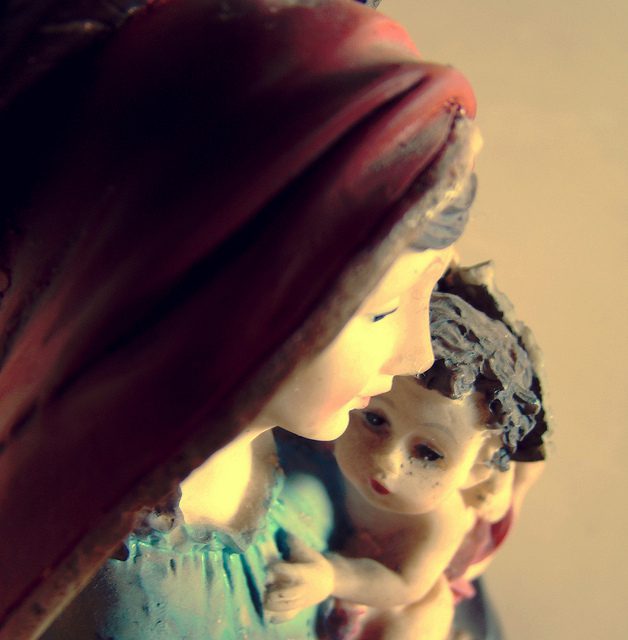
Photo Credit: aphotoshooter.
It goes nearly without saying that the prime objection of the Protestant to Catholicism is a fourteen year-old Jewish girl who said, “Yes,” and became the bearer of God. Rather, the prime objection of the Protestant to Catholicism is exactly what Catholicism has done with that 14-year old Jewish girl who gave birth to Jesus Christ—and that is to give her supreme esteem, an honour, and love. And that, on the face of it, sounds like a pretty decent thing to do.
As I began to become a Catholic there were certain refrains, largely from anonymous Protestants in dusty corners of Internet message boards, that become wholly cliche. You’ve heard them, too. Catholics worship Mary. Mary is an idol. Mary is the mother of God. While these cliches were voiced, sometimes loudly, on only certain dusty corners of the Internet they’re not held only by a select few. You’ve probably heard these beliefs—maybe you hold some of these beliefs—and likely, reader, you’ve never even darkened those dusty Internet message boards I was referring to.
But, nonetheless, we hold these beliefs. Or, rather, we believe things about what Catholics believe and, as Protestants, we often get it wrong. I often got it wrong and, in the end, had very little idea what the Catholic church actually taught about Mary. And, in the end, like so many aspects of Catholic theology once I realized what the Church actually taught—not just what I imagined it to teach—I found myself compelled further along the Roman road.
I want to touch, in this article, on Mary as Mother of God.
There is, in fact, a tremendous amount to unpack about Mary as a whole precisely because what the Church believes about her has been believed for a very long time, since nearly the very beginning, and that’s something remarkable in and of itself because one of the very popular and oft-repeated beliefs about Marian theology is that it’s something new, something invented by the Catholic Church only quite recently.
Well, it’s true, actually.
In a sense.
The Assumption of Mary, which I’ll write about at length later, was dogmatically defined by Pope Pius XII on November 1, 1950. This was also the last time the Pope spoke infallibly, using the authority that the Catholic Church sees itself being given by Christ.
Important for our understanding of Mary, however, is an understanding of how Catholic doctrine and dogma is defined. How and, rather, when it’s defined. On the topic of Mary’s Assumption, for example, overwhelming evidence of it being a strongly held belief by Christian Catholics can be found as early as the 4th century, growing stronger in the 5th century, and then being celebrated as an official Church feast in the 8th century.
Important to understand is that Catholic doctrine and dogma isn’t hastily defined and often it’s officially defined until it’s challenged. The Assumption of Mary wasn’t created out of thin air—although this is certainly what I used to think—but rather carefully and thoroughly developed, debated, and defined.
The Catholic Church believes that it has the deposit of faith and it is, indeed, very careful what it does with it.
I’ve met good, well-meaning and faithful Protestants who balk at referring to Mary as Mother of God and that, to me, has become kind of funny. It isn’t a term you hear very often in most evangelical Protestant circles, at least not in the ones that I’ve run in, and it sounds scary and Catholic so I can’t blame them.
But an understanding of Mary as Mother of God, the definition of her under that title, is nothing short of ancient.
See in the very Early Church, within the very first centuries, Christians grasped at a wide smattering of beliefs. You can see evidence of this in New Testament. The epistles of Paul, Peter, James, and the lot are almost always angled at building up the earliest Christian communities but also, sometimes in very strong terms, correcting their mistaken beliefs. Confusions over doctrine and theology didn’t cease with the death of the apostles and the full sum total of what Christians believed wasn’t fully and magically settled then either. It was, instead, in these early centuries that Christians had to hammer out exactly what they believed, based on the tradition that had been handed down to them from the apostles, on any number of things.
The nature of Jesus’s divinity was one of these chief things to be figured out.
I said, earlier, that I found it kind of funny when Protestants object to Mary as Mother of God (and I lump myself in here, too). It’s funny because in 431AD at one of the earliest Church councils, the Council of Ephesus, two doctrines are authoritatively defined. First, in response to misunderstandings within the body of Christian believers the nature of the divinity of Jesus is defined. Jesus is fully God and fully man; the dual natures of Christ.
The other doctrine is Mary as Mother of God.
I don’t know exactly how these things happen. I suppose it’s centuries of suspicious and mistrust and bad feelings but, like I said, I find it funny that the Council of Ephesus defined two doctrine. One, the divinity of Jesus, that nearly every Protestant on the face of the earth would, whole-heartedly, believe in. The other, Mary as Mother of God, which many Protestants who, roundly, object to.
Do you see the problem that I saw? How can the council be right on one hand and wrong on the other?
Mary is, precisely, the Mother of God because she bore Jesus’s whole self into the world: the human and the divine. The divinity of Jesus wasn’t imparted to him only after he was born, he was conceived by the Holy Spirit. So, ergo, Mary is the Mother of all of Jesus, divine and human.
St. Athanasius, a pillar of the Early Church, wrote sixty-six years before the Council of Ephesus what was already widely held by the Early Christians,
The Word begotten of the Father from on high, inexpressibly, inexplicably, incomprehensibly, and eternally, is he that is born in time here below of the Virgin Mary, the Mother of God.
But calling a 14-year old Jewish girl the Mother of God has certain implications—implications that, as a Protestant, I had never explored.
We call Mary the Mother of God because she was. In Eastern Orthodox tradition, Mary is poetically referred to as Theotokos, the “God-bearer.” She has a special place in Catholicism, Eastern Orthodoxy, and all of Christianity for the first 1,500 years, and beyond, precisely because of her special role. It might come as a surprise that Martin Luther, the earliest of the Protestant reformers held Mary to be the Mother of God and wrote strongly in defense of this theology. John Calvin, another prominent reformer, is largely seen to have agreed.
I admit that it’s true, when we acknowledge Mary as Mother of God it does something to us and our way of thinking about her. I acknowledge that it is, indeed, a little bit alarming. It means a change in perspective. It means an examination of self. It means a chance to re-think what you thought.
It means to see Mary as a young girl who said, “Yes,” to God’s saving grace. It means acknowledging that by this young girl’s affirmation, by her willingness to cooperate with God’s plan for salvation, we are all saved. No, Mary didn’t do the saving, but Catholics venerate—which means honour—Mary because she allowed God’s will to be done in and through her, literally. In the same was, a Protestants, we’re grateful when we can read the words of our Lord recorded, infallibly, by Matthew, Mark, Luke, and John we should be grateful for the woman—the girl—who bore our Lord. She should have a special place because of her special role, shouldn’t she?
As I continue my journey into the Catholic Church I’ve taken certain things to be true. I’ve taken these things after extensive study and reflection historical and theological perspectives—and from practically living these things out. One of these things, the Communion of the Saints, I find incredibly beautiful, powerful, and grace-filled. And I pray for Mary’s intercession, on a daily, sometimes hourly basis. I do not pray to Mary in the way I pray to Jesus, but I ask Mary, because she was chosen by God to bear His Son, because she is important and special as a result—because she must be—to pray for me.
For me, and for untold billions of people through all time and history, understanding, discovering, or rediscovering the doctrine of Mary as Mother of God means an deeper, richer, and more beautiful understanding of the role of Mary, who always points to her Son, Jesus Christ.
Previous Post
February 3, 2015
The Physical, Tangible Catholic Church
Next Post
February 9, 2015 The Amnesiac Church and the Modern Heresy
Browse Our Archives
Select a Category Appearances Christian Living Explaining the Faith Podcast Tough Questions Uncategorized Why I'm Catholic
Select a Month January 2024 December 2023 November 2023 July 2023 June 2023 May 2023 April 2023 March 2023 February 2023 January 2023 December 2022 November 2022 October 2022 September 2022 August 2022 July 2022 June 2022 May 2022 April 2022 March 2022 February 2022 January 2022 December 2021 November 2021 October 2021 September 2021 August 2021 July 2021 June 2021 May 2021 April 2021 March 2021 February 2021 January 2021 December 2020 November 2020 October 2020 September 2020 August 2020 July 2020 June 2020 May 2020 April 2020 March 2020 February 2020 January 2020 December 2019 November 2019 October 2019 September 2019 August 2019 July 2019 June 2019 May 2019 April 2019 March 2019 February 2019 January 2019 December 2018 November 2018 October 2018 September 2018 August 2018 July 2018 June 2018 May 2018 April 2018 March 2018 February 2018 January 2018 December 2017 October 2017 September 2017 July 2017 May 2017 April 2017 March 2017 February 2017 January 2017 December 2016 November 2016 October 2016 September 2016 August 2016 July 2016 June 2016 May 2016 April 2016 March 2016 February 2016 January 2016 December 2015 November 2015 October 2015 September 2015 August 2015 July 2015 June 2015 May 2015 April 2015 March 2015 February 2015 January 2015 December 2014 November 2014 October 2014
Follow Us!
TAKE THE
Religious Wisdom Quiz
What does "Immanuel" mean in Hebrew?
Select your answer to see how you score.
God with us The Lord reigns Prince of Peace The Anointed One
Support this
Column


Related posts from The Cordial Catholic
205: Why You Should Love Mary More, and...
201: Eucharistic Miracles, Marian Apparitions, and More... (w/...
200: Reasons to Doubt Sola Scriptura (w/ Jimmy...
191: The Mind Blowing Miracles of Lourdes (w/...
TRENDING AT PATHEOS Catholic

Rejecting Doom: Christian Hope And Human Action
Christianity is a religion of hope. We are to have hope and...

It’s What Comes From Within Which Matters
One of the most difficult things for us to understand is why...

Why I Choose the Eucharist Over the Sermon
Choose the Eucharist, Not the Sermon What are we supposed to get...

5 Design Elements Found in Spiritually Rooted Homes
Putting Spirituality Into Home Decor Our homes are more than our living...

Credo: A Story of God Told with the...
About 10 years ago, I began to imagine a personal "Credo" that...

The Anatomy of Divine Revelation in Catholic Thought
The claim that God has made Himself known to human beings is...
view all Catholic blogs
Ad-Free & Subscriber Log-In Subscription Support
- About Us
- 2026 Calendar
- Videos
- Podcasts
- Library of World Religions
- Faith In Media Tracker
- Advertise With Us
- Write for Us
- Privacy Policy
- Terms of Service
- Do Not Sell My Data
- Contact Us
- Radiant Digital
- Manage Newsletter Subscriptions
- Unsubscribe From Notifications
- Sitemap
Copyright 2008-2026, Patheos. All rights reserved.
Subscription Support Ad-Free & Subscriber Log-In
Follow Patheos