
BuddhistCatholicContemplativeEvangelicalGeneral ChristianHinduJewishLatter-day SaintMuslimNew VisionsProgressive Christian
Beliefs
- Buddhist
- Catholic
- Contemplative
- Evangelical
- General Christian
- Hindu
- Jewish
- Latter-day Saint
- More Voices
- Muslim
- New Visions
- Pagan
- Progressive Christian
Topics
- Religion News
- Food and Religion
- Sports and Religion
- Religious Art
- Religious Music and Entertainment
- Religious Events
- History and Religion
- Style and Religion
- Politics and Religion
- Women in Religion
- Recreation Outdoors and Religion
- Business Finance and Religion
- Careers Workplace and Religion
- Education and Religion
- Family Parenting and Religion
- Health Fitness and Religion
- Home and Religion
- Relationships and Religion
- Technology and Religion
- Travel and Religion
Columnists
- Buddhist Columnists
- Business Finance and Religion Columnists
- Careers Workplace and Religion Columnists
- Catholic Columnists
- Contemplative Columnists
- Education and Religion Columnists
- Evangelists Columnists
- Family Parenting and Religion Columnists
- General Christian Columnists
- Health Fitness and Religion Columnists
- Hindu Columnists
- History and Religion Columnists
- Home and Religion Columnists
- Jewish Columnists
- More Voices Columnists
- Latter Day Columnists
- Muslim Columnists
- New Visions Columnists
- Nonreligious Columnists
- Pagan Columnists
- Politics and Religion Columnists
- Progressive Columnists
- Recreation Outdoors and Religion Columnists
- Relationships and Religion Columnists
- Religion News Columnists
- Religious Art Columnists
- Religious Events Columnists
- Religious Music and Entertainment Columnists
- Sports and Religion Columnists
- Style and Religion Columnists
- Technology and Religion Columnists
- Travel and Religion Columnists
- Women in Religion Columnists
Resource Library
- 2026 Calendar
- Library of World Religions
- The 100 Most Holy Places on Earth
- Patheos Answers
- Podcasts
- Videos
- Faith Leaders Database
- Anglican Episcopalian
- Bahai
- Baptist
- Buddhism
- Christianity
- Confucianism
- Eastern Orthodoxy
- Hinduism
- Holiness and Pentecostal
- ISKCON
- Islam
- Judaism
- Lutheran
- Methodist
- The Church of Jesus Christ of Latter-day Saints
- New Age
- Paganism
- Presbytarian and Reformed
- Protestantism
- Religion Behind the Scenes
- Roman Catholic
- Scientology
- Shia Islam
- Sikhism
- Sufism
- Sunni Islam
- Taoism
- Zen
- See all religions
Research Tools
 Ad-Free & Subscriber Log-In Subscription Support
Ad-Free & Subscriber Log-In Subscription Support
Follow Patheos 

- Trending:
- Forgiveness
- |
- Marriage
- |
- Consciousness
- |
- Death Penalty
- |
- Election
- |
- Halloween
 The Cordial Catholic
- Home
- Catholic
- Let’s Talk about Mary as Perpetual Virgin
Let’s Talk about Mary as Perpetual Virgin
Last updated on: August 3, 2015 at 3:59 pm by K. Albert Little
Let’s Talk about Mary as Perpetual Virgin 2015-08-03T15:59:29-04:00 K. Albert Little
Patheos Explore the world's faith through different perspectives on religion and spirituality! Patheos has the views of the prevalent religions and spiritualities of the world.
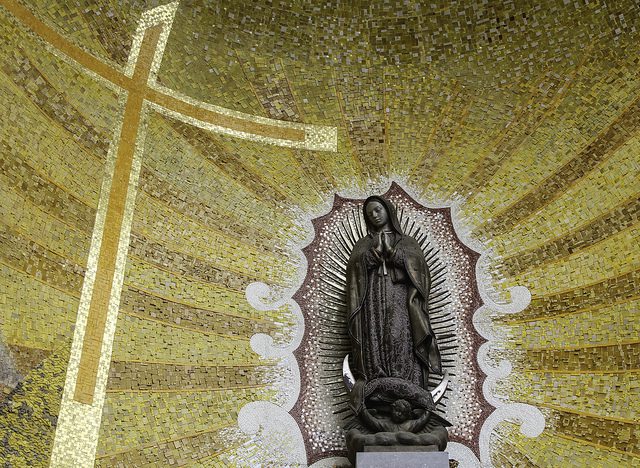
Photo Credit: Fr. Lawrence, OP.
As an evangelical Protestant it would’ve surprised me, greatly, to learn that some Christians believe Mary was “ever virgin.” Maybe I was sheltered, but I would’ve reacted with equal credulity if you had told me that Joseph, her spouse, was believed to be a unicorn.
The perpetual virginity of Mary just wasn’t on my radar.
But, as I began to explore the Catholic Church and to dig into its rich treasury of Marian doctrine the discovery of her alleged perpetual virginity seemed, by then, to be both an easy claim to defend and an easy criticism to deflect.
Far cry from unicorns.
After all, even a cursory scratching of the surface led me to discover that the doctrine of the perpetual virginity of Mary was held persistently by the Church and later, during the Reformation, it was actually defended by Martin Luther and the early reformers. Zwingli even included the Hail Mary in his earliest books of common prayer.
Objections to the Perpetual Virginity of Mary
I’ve encountered a number of cradle Catholics who find it very hard to understand the Protestant objection to anything that whiffs of Marian theology. Frankly, I have a difficult time understanding it too. But as an evangelical it was ingrained in me, from early on in my rather piecemeal theological education, that idolatry was simply the worst kind of sin imaginable.
But the perpetual virginity of Mary touches nowhere on idolatry, in reality, and, in the end, Catholics don’t worship Mary. Still, our fear of getting anywhere close to anything that smells like idol worship might scare a great many earnest, honest evangelicals away from looking deeper into Marian theology.
Primarily, as a Protestant, I would’ve objected to Mary’s perpetual virginity on two accounts. First, the New Testament (at least the English translations I’ve read) clearly indicate that Jesus had brothers. And, second, Matthew is clear in his gospel that Joseph didn’t know Mary “until” Christ was born.
It’s clear, I would’ve argued, that Mary and Joseph had subsequent relations and that Jesus had siblings.
Clear as mud.
In fact, on the first objection, Catholic scholars argue that the term “brothers” as translated from the original text could also mean “cousins.” Or, as another popular theory runs, it could indicate Joseph’s children from a previous marriage. This would explain why, later in the gospel accounts, some of Jesus’s so-called brothers rebuke him, an act which would’ve been incredibly inappropriate for devout Jews of Jesus time (to rebuke their older sibling, even half-sibling).
The second objection, equally, is fairly simply addressed by examining how the word “until” is used elsewhere in the Bible or in plain language. If I write, “Penny was a good dog until she died,” it isn’t to imply that after her death she suddenly became a pooch out of control.
Likewise, to say that Joseph didn’t know Mary “until Christ was born” doesn’t automatically presume that after he was born, Joseph and her had relations. In fact, there is good evidence to indicate that Mary’s surprise at Gabriel annunciation indicates she had actually pledged to be a virgin even after marriage.
But, good contextual research is fruitful as well. 1 Corinthians 15:25 says,
For he must reign until he has put all his enemies under his feet.
Could any right-thinking Christian make a legitimate claim that what Paul is saying in this context is that Christ will suddenly cease His reign as soon as his enemies are subdued?
By no means!
Perpetual Support for the Perpetual Virgin
But even if we hasten to dig into the objections to Mary’s perpetual virginity the true fruit of this theology lies in its rich history of support and what, eventually, convinced me firmly of Mary’s perpetual virginity is the long, long line of Christians who have roundly subscribed to her unending virginity.
In fact, remarkably, it was as early as the 4th century when the Church—remember, this is the united Christian Church—condemned attacks on Mary’s perpetual virginity which were brought based on the very same objections we discussed above.
As early as the 4th century, a theology of Mary’s perpetual virginity was so concrete that attacks against it were roundly and universally defended.
From there, in the 5th century, St. Augustine, beloved by Catholics and Protestants alike spoke of Mary saying,
A Virgin conceiving, a Virgin bearing, a Virgin pregnant, a Virgin bringing forth, a Virgin perpetual. Why do you wonder at this, O man?
Did Augustine know something we don’t know, or knew something we’ve forgotten?
Truly.
But what’s most remarkable, and a true testament to just how wide-spread the believe of an “ever virgin” Mary was, is in the response of the Early Protestant Reformers. A group that, universally, accepted this theology and—in the case of Martin Luther—defended it strongly.
Indeed, amongst these Early Reformers all of Luther, Calvin, Zwingli, and John Wesley came out in clear support of Mary’s perpetual virginity even while shedding other seemingly objectionable elements of the Christian Church they were separating themselves from.
Incredibly, while the spiritual and theological fathers of modern day evangelical Protestantism held and even defended the perpetual virginity of Mary the notion—as it was for me—was the furthest thing I could’ve imagined as a devout evangelical.
But it’s right there, in the pages of history.
What We Lost, And What Wasn’t Invented
Too often as an evangelical Protestant I would’ve objected to Catholic theology—especially Marian doctrine—on the grounds that it had been “invented” by the Church.
In reality, nothing could be further from the truth.
The belief that Mary remained a virgin after the birth of Christ was widely held by the Christian Church well before there was any distinction between Catholic and Protestant—well before, even, the distinction between Catholic and Orthodox and first split the Church.
Mary’s status as “ever virgin” was so roundly held that in the 4th century those that would challenge it, based on the very same arguments that are batted around today were condemned as heretics.
The united Christian Church condemned as heretics those that thought Mary may have ever had relations.
But it was once I began to read about Catholicism from Catholics authors themselves that the pieces began to fall into place, on Mary and on any number of questions and concerns I’d had about the faith. In the case of Mary, belief in her perpetual virginity had been, itself, perpetually held from the early days of the Christian Church.
Not only that, it was held even by the Early Reformers at the time of the Protestant Reformation. None of them wanted to jettison it at all and if we’re to be Christians firmly rooted in our collective history, in reality, than neither should we.
Previous Post
May 11, 2015
The Catholic Church is a Powerhouse of Prayer
Next Post
May 18, 2015 Stop Staring at the Clouds, and Get Out There
Browse Our Archives
Select a Category Appearances Christian Living Explaining the Faith Podcast Tough Questions Uncategorized Why I'm Catholic
Select a Month January 2024 December 2023 November 2023 July 2023 June 2023 May 2023 April 2023 March 2023 February 2023 January 2023 December 2022 November 2022 October 2022 September 2022 August 2022 July 2022 June 2022 May 2022 April 2022 March 2022 February 2022 January 2022 December 2021 November 2021 October 2021 September 2021 August 2021 July 2021 June 2021 May 2021 April 2021 March 2021 February 2021 January 2021 December 2020 November 2020 October 2020 September 2020 August 2020 July 2020 June 2020 May 2020 April 2020 March 2020 February 2020 January 2020 December 2019 November 2019 October 2019 September 2019 August 2019 July 2019 June 2019 May 2019 April 2019 March 2019 February 2019 January 2019 December 2018 November 2018 October 2018 September 2018 August 2018 July 2018 June 2018 May 2018 April 2018 March 2018 February 2018 January 2018 December 2017 October 2017 September 2017 July 2017 May 2017 April 2017 March 2017 February 2017 January 2017 December 2016 November 2016 October 2016 September 2016 August 2016 July 2016 June 2016 May 2016 April 2016 March 2016 February 2016 January 2016 December 2015 November 2015 October 2015 September 2015 August 2015 July 2015 June 2015 May 2015 April 2015 March 2015 February 2015 January 2015 December 2014 November 2014 October 2014
Follow Us!
TAKE THE
Religious Wisdom Quiz
How many chapters are in Isaiah?
Select your answer to see how you score.
72 50 40 66
Support this
Column


Related posts from The Cordial Catholic

229: Can Catholics and Evangelicals Agree on How...

227: What was Medieval Catholicism Really Like? (w/...
205: Why You Should Love Mary More, and...
201: Eucharistic Miracles, Marian Apparitions, and More... (w/...
TRENDING AT PATHEOS Catholic

Rejecting Doom: Christian Hope And Human Action
Christianity is a religion of hope. We are to have hope and...

It’s What Comes From Within Which Matters
One of the most difficult things for us to understand is why...

Why I Choose the Eucharist Over the Sermon
Choose the Eucharist, Not the Sermon What are we supposed to get...

5 Design Elements Found in Spiritually Rooted Homes
Putting Spirituality Into Home Decor Our homes are more than our living...

Credo: A Story of God Told with the...
About 10 years ago, I began to imagine a personal "Credo" that...

The Anatomy of Divine Revelation in Catholic Thought
The claim that God has made Himself known to human beings is...
view all Catholic blogs
Ad-Free & Subscriber Log-In Subscription Support
- About Us
- 2026 Calendar
- Videos
- Podcasts
- Library of World Religions
- Faith In Media Tracker
- Advertise With Us
- Write for Us
- Privacy Policy
- Terms of Service
- Do Not Sell My Data
- Contact Us
- Radiant Digital
- Manage Newsletter Subscriptions
- Unsubscribe From Notifications
- Sitemap
Copyright 2008-2026, Patheos. All rights reserved.
Subscription Support Ad-Free & Subscriber Log-In
Follow Patheos