
BuddhistCatholicContemplativeEvangelicalGeneral ChristianHinduJewishLatter-day SaintMuslimNew VisionsProgressive Christian
Beliefs
- Buddhist
- Catholic
- Contemplative
- Evangelical
- General Christian
- Hindu
- Jewish
- Latter-day Saint
- More Voices
- Muslim
- New Visions
- Pagan
- Progressive Christian
Topics
- Religion News
- Food and Religion
- Sports and Religion
- Religious Art
- Religious Music and Entertainment
- Religious Events
- History and Religion
- Style and Religion
- Politics and Religion
- Women in Religion
- Recreation Outdoors and Religion
- Business Finance and Religion
- Careers Workplace and Religion
- Education and Religion
- Family Parenting and Religion
- Health Fitness and Religion
- Home and Religion
- Relationships and Religion
- Technology and Religion
- Travel and Religion
Columnists
- Buddhist Columnists
- Business Finance and Religion Columnists
- Careers Workplace and Religion Columnists
- Catholic Columnists
- Contemplative Columnists
- Education and Religion Columnists
- Evangelists Columnists
- Family Parenting and Religion Columnists
- General Christian Columnists
- Health Fitness and Religion Columnists
- Hindu Columnists
- History and Religion Columnists
- Home and Religion Columnists
- Jewish Columnists
- More Voices Columnists
- Latter Day Columnists
- Muslim Columnists
- New Visions Columnists
- Nonreligious Columnists
- Pagan Columnists
- Politics and Religion Columnists
- Progressive Columnists
- Recreation Outdoors and Religion Columnists
- Relationships and Religion Columnists
- Religion News Columnists
- Religious Art Columnists
- Religious Events Columnists
- Religious Music and Entertainment Columnists
- Sports and Religion Columnists
- Style and Religion Columnists
- Technology and Religion Columnists
- Travel and Religion Columnists
- Women in Religion Columnists
Resource Library
- 2026 Calendar
- Library of World Religions
- The 100 Most Holy Places on Earth
- Patheos Answers
- Podcasts
- Videos
- Faith Leaders Database
- Anglican Episcopalian
- Bahai
- Baptist
- Buddhism
- Christianity
- Confucianism
- Eastern Orthodoxy
- Hinduism
- Holiness and Pentecostal
- ISKCON
- Islam
- Judaism
- Lutheran
- Methodist
- The Church of Jesus Christ of Latter-day Saints
- New Age
- Paganism
- Presbytarian and Reformed
- Protestantism
- Religion Behind the Scenes
- Roman Catholic
- Scientology
- Shia Islam
- Sikhism
- Sufism
- Sunni Islam
- Taoism
- Zen
- See all religions
Research Tools
 Ad-Free & Subscriber Log-In Subscription Support
Ad-Free & Subscriber Log-In Subscription Support
Follow Patheos 

- Trending:
- Forgiveness
- |
- Marriage
- |
- Consciousness
- |
- Death Penalty
- |
- Election
- |
- Halloween
 The Cordial Catholic
- Home
- Catholic
- Lent: My Final Forty Days as a Protestant
Lent: My Final Forty Days as a Protestant
Last updated on: February 9, 2016 at 11:50 pm by K. Albert Little
Lent: My Final Forty Days as a Protestant 2016-02-09T23:50:31-04:00 K. Albert Little
Patheos Explore the world's faith through different perspectives on religion and spirituality! Patheos has the views of the prevalent religions and spiritualities of the world.
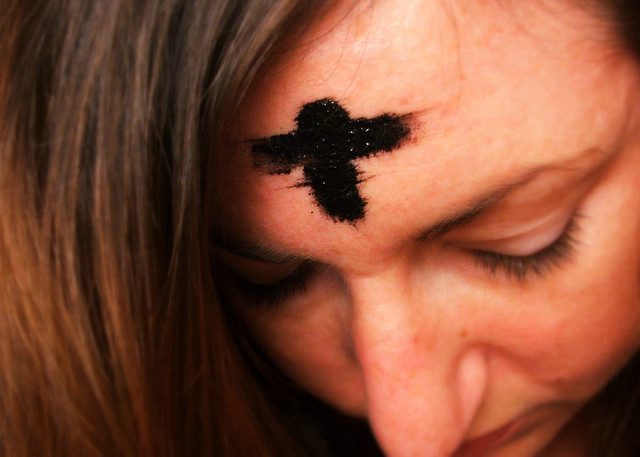
Photo Credit: Sarah (Rosenau) Korf.
This year my Lenten experience is going to be weird.
At Easter, baring supernatural intervention, I’ll be joining the Catholic Church.
That means this is my last Lent as a Protestant. My final forty days.
For myself, if no one else, I need to stop right here and let that sink in.
Lent, Lent, as a Protestant
For the last several years, Lent has been a more or less important devotional season. Our non-denominational church, as I’ve written before, is very conscious and respectful of many traditional Christian practices and Lent is one of them. Like at Advent, when we light a candle on the Advent Wreath each Sunday, Lent is observed with a similar respect and piety although in a way that’s slightly truncated, and, being stripped out of its liturgical framework, not nearly as rich.
Nonetheless, I’ve done Lent before, and I’ve done it pretty well. Usually I give up candy or snacks and make it the whole way. Once my wife and I gave up both dairy and gluten. I lost 10 pounds, remarkably, but we didn’t plan very well enough in advance and ended up starving most of the time. If I recall correctly we didn’t quite make it through the full Lenten fast.
Still, it’s been important to me, in varying degrees.
Someone the other day asked me, as I turn down the home stretch towards my conversion to the Catholic Church, what makes Lent, for Catholics, different than what we’d practiced before. Coming from a non-denominational background, well, there’s a lot. And a lot of what makes Lent different in a Catholic Church is what makes worship different in a Catholic Church and is also the same thing that makes the Catholic Church so appealing to me. It’s the richness.
Lent is richer in the Catholic Church because so much changes.
What’s So Great About Catholic Lent?
First of all, it’s the liturgical season of Lent. In our non-denominational church, for better or for worse, our beloved pastor doesn’t change his clothes specifically for Lent. Don’t get me wrong, he changes his clothes but he doesn’t get garbed up in specific duds for the Lenten season. Despite following the Lectionary we aren’t liturgical in that sense. In the Catholic Church, however, the priest—all priests, everywhere, and even the Pope—dress differently. Their vestments say, “Folks, it’s Lent. Reeeeepent!” In soothing purple, mind you.
And then there’s the liturgy itself, which changes. To underscore the penitential tone of the season—a time of preparation for Easter—parts of what usually make up the regular liturgy are removed, omitted, and their presence is a stark reminder of the purpose of the season of Lent. Additionally, flowers, in large part, are usually removed from the church and on the fifth Sunday of Lent crosses in lots of Catholic Churches will be symbolically covered up.
And Catholics fast. On Ash Wednesday it’s one meal (and two smaller snacks). On Fridays during Lent it’s no meat. These are not fasts of incredible piety to increase ones holiness or chance at salvation. These are physical, penitential actions to remind us of the coming of Easter and the importance of the work of Jesus on the cross. These are tangible feats that remind us of our own humanity, our brokenness, our spiritual hunger, and our dependence on God who gave His people manna to eat in the desert—and Jesus to eat in the Lord’s Supper.
Lent is a rich experience in the Catholic Church because of the rich symbolism and because of the rich communal experience. The liturgy, the readings, the symbolism, and the fasts communally link the vast global Catholic Church together and underscore the importance of the season. These things all work together. The fasts, the readings, the symbolism—any of these things taken by themselves lose so much of their meaning. This year, for the very first time, I’m finding them all in tandem, and in unity, in the Roman Catholic Church.
My Last Lent as a Protestant
And this is my last Lent as a Protestant.
At Easter I’ll join the Catholic Church.
This journey, which stretches out over nearly a decade, seems to have crescendoed so suddenly, and so incredibly.
And so quickly.
When I started writing, in earnest, four months ago about my journey I could’ve hardly imagined being at this point and here we are. Here I am. On the cusp of Lent, which counts down to my entering into the Catholic Church. Tonight, at R.C.I.A., we practiced for the Rite of Election which will take place on Sunday morning. A Rite which says to us, our sponsors, and the whole Church community that God chose us long before we chose him. That God called us down this path long before we ever realized.
That’s pretty poetic. I like it. And I really couldn’t have imagined.
I’d say, “How long ago did God know about this—my wild conversion to the Catholic Church?” But, of course, He knew from forever. He knew when he first knit me together, no? He knew when I first heard the voice of a podcasting priest from the Netherlands that this would be a kind of awakening. He knew way back when I had that fateful conversation with a Protestant pastor who asked me, “Who put the Bible together?” That those words would forever change my life. He knew from when I read the very first words of Rome Sweet Home by Scott and Kimberly Hahn that it would be the beginning of the end.
These, my final forty days as a Protestant, will certainly be momentous, and unique. They’ll be shaded a particular colour—maybe purple will do best.
Lent, and the Fullness of the Catholic Church
As I think back on my journey—and I’m far, far from being done writing about it—I think about what led me here and what’s convinced me so deeply. Someone the other day asked, “Why Catholicism?” And my coy answer should be, “Read my blog!” But I’m supposed to be cordial, right? So I say, “Jesus.” And it’s true, although also coy, I suppose!
Jesus.
In the fullness of the Catholic Church.
And I mean it like this…
I mean it in that the Catholic Church claims Jesus, embodied in the Eucharist. Really there. And it isn’t magic; it’s a miracle taken right from His very words in Scripture.
I mean it in that the Catholic Church claims Jesus as their founder. Not the founder of the Christian movement, or the spiritual, non-physical Christian Church of believers, but as an actual physical institution with bishops, priests, and deacons as cogs in the machine. With a Pope. And when I read the New Testament, and the Early Church Fathers, I find this to be right there, too.
And the Catholic Church claims Jesus, or rather the Holy Spirit, which is one and the same, as a great protector and aid.
I mean that the Catholic Church, alone, claims to have the keys to bind and loose. Something that, again, I find clearly in the Scriptures. The Catholic Church claims to have that ability, through the apostolic succession it enjoys historically, and through the authority given to it by Christ, to define moral teaching and doctrine, to interpret Jesus’s words and the tradition passed down to us by the apostles, and to, on behalf of Jesus, forgive our sins and baptize His people.
Jesus is there—in a way I find him nowhere else. In a way that no one else claims to have Him.
A Countdown to Catholicism
So, yeah, it’s a weird Lenten season for me. Because on one hand, it’s my final forty days as a Protestant. The final leg of a long, spirit-led journey. A putting on of something new. And on the other hand, it’s a season of penitence, or repenting and preparing for the incredible celebration of Easter. And, if you’ll indulge me here, dear reader, on the other hand it’s one of the most exciting times in my life. It’s the countdown to Catholicism. The countdown to being in full communion with the Church and being able to fully participate in the Catholic life. That is an incredible gift underscoring the approach of Easter. But it’s also a time of great penitence, see?
A time of, “Lord, how am I worthy to be called to the Catholic Church? How did You orchestrate this? How did we get here?” And, “Thank you, thank you, thank you.”
Like we say at every single Mass before we approach the Eucharist, it’s forty days of repeating a refrain like, “Lord, I’m not worthy that you should enter under my roof, but only say the word and my soul shall be healed.”
I’m not worthy but I am awestruck that, somehow, I am accepted anyway.
Oh, and before you write in, I know technically Lent is more than forty days. But you take my point, right?
I hope so!
Stay in touch! Like The Cordial Catholic on Facebook:
Previous Post
February 12, 2015
Why I Stopped Debating and Started Living Like a Catholic
Next Post
February 20, 2015 How God Works: Making Sense of the Sacramental Life
Browse Our Archives
Select a Category Appearances Christian Living Explaining the Faith Podcast Tough Questions Uncategorized Why I'm Catholic
Select a Month January 2024 December 2023 November 2023 July 2023 June 2023 May 2023 April 2023 March 2023 February 2023 January 2023 December 2022 November 2022 October 2022 September 2022 August 2022 July 2022 June 2022 May 2022 April 2022 March 2022 February 2022 January 2022 December 2021 November 2021 October 2021 September 2021 August 2021 July 2021 June 2021 May 2021 April 2021 March 2021 February 2021 January 2021 December 2020 November 2020 October 2020 September 2020 August 2020 July 2020 June 2020 May 2020 April 2020 March 2020 February 2020 January 2020 December 2019 November 2019 October 2019 September 2019 August 2019 July 2019 June 2019 May 2019 April 2019 March 2019 February 2019 January 2019 December 2018 November 2018 October 2018 September 2018 August 2018 July 2018 June 2018 May 2018 April 2018 March 2018 February 2018 January 2018 December 2017 October 2017 September 2017 July 2017 May 2017 April 2017 March 2017 February 2017 January 2017 December 2016 November 2016 October 2016 September 2016 August 2016 July 2016 June 2016 May 2016 April 2016 March 2016 February 2016 January 2016 December 2015 November 2015 October 2015 September 2015 August 2015 July 2015 June 2015 May 2015 April 2015 March 2015 February 2015 January 2015 December 2014 November 2014 October 2014
Follow Us!
TAKE THE
Religious Wisdom Quiz
Who mocked Nehemiah and the Jews, saying a fox could break their wall?
Select your answer to see how you score.
Eliashib Geshem Sanballat Tobiah
Support this
Column


Related posts from The Cordial Catholic

235: Questions I Couldn't Answer (w/ John Martignoni)

234: The Mindblowing World of Sacramentals (w/ Shaun...

233: The Power of Good Catholic Witnesses (w/...

232: The Trajectory of Conversion (w/ Phillip Campbell)
TRENDING AT PATHEOS Catholic

Rejecting Doom: Christian Hope And Human Action
Christianity is a religion of hope. We are to have hope and...

It’s What Comes From Within Which Matters
One of the most difficult things for us to understand is why...

Why I Choose the Eucharist Over the Sermon
Choose the Eucharist, Not the Sermon What are we supposed to get...

5 Design Elements Found in Spiritually Rooted Homes
Putting Spirituality Into Home Decor Our homes are more than our living...

Credo: A Story of God Told with the...
About 10 years ago, I began to imagine a personal "Credo" that...

The Anatomy of Divine Revelation in Catholic Thought
The claim that God has made Himself known to human beings is...
view all Catholic blogs
Ad-Free & Subscriber Log-In Subscription Support
- About Us
- 2026 Calendar
- Videos
- Podcasts
- Library of World Religions
- Faith In Media Tracker
- Advertise With Us
- Write for Us
- Privacy Policy
- Terms of Service
- Do Not Sell My Data
- Contact Us
- Radiant Digital
- Manage Newsletter Subscriptions
- Unsubscribe From Notifications
- Sitemap
Copyright 2008-2026, Patheos. All rights reserved.
Subscription Support Ad-Free & Subscriber Log-In
Follow Patheos