
BuddhistCatholicContemplativeEvangelicalGeneral ChristianHinduJewishLatter-day SaintMuslimNew VisionsProgressive Christian
Beliefs
- Buddhist
- Catholic
- Contemplative
- Evangelical
- General Christian
- Hindu
- Jewish
- Latter-day Saint
- More Voices
- Muslim
- New Visions
- Pagan
- Progressive Christian
Topics
- Religion News
- Food and Religion
- Sports and Religion
- Religious Art
- Religious Music and Entertainment
- Religious Events
- History and Religion
- Style and Religion
- Politics and Religion
- Women in Religion
- Recreation Outdoors and Religion
- Business Finance and Religion
- Careers Workplace and Religion
- Education and Religion
- Family Parenting and Religion
- Health Fitness and Religion
- Home and Religion
- Relationships and Religion
- Technology and Religion
- Travel and Religion
Columnists
- Buddhist Columnists
- Business Finance and Religion Columnists
- Careers Workplace and Religion Columnists
- Catholic Columnists
- Contemplative Columnists
- Education and Religion Columnists
- Evangelists Columnists
- Family Parenting and Religion Columnists
- General Christian Columnists
- Health Fitness and Religion Columnists
- Hindu Columnists
- History and Religion Columnists
- Home and Religion Columnists
- Jewish Columnists
- More Voices Columnists
- Latter Day Columnists
- Muslim Columnists
- New Visions Columnists
- Nonreligious Columnists
- Pagan Columnists
- Politics and Religion Columnists
- Progressive Columnists
- Recreation Outdoors and Religion Columnists
- Relationships and Religion Columnists
- Religion News Columnists
- Religious Art Columnists
- Religious Events Columnists
- Religious Music and Entertainment Columnists
- Sports and Religion Columnists
- Style and Religion Columnists
- Technology and Religion Columnists
- Travel and Religion Columnists
- Women in Religion Columnists
Resource Library
- 2026 Calendar
- Library of World Religions
- The 100 Most Holy Places on Earth
- Patheos Answers
- Podcasts
- Videos
- Faith Leaders Database
- Anglican Episcopalian
- Bahai
- Baptist
- Buddhism
- Christianity
- Confucianism
- Eastern Orthodoxy
- Hinduism
- Holiness and Pentecostal
- ISKCON
- Islam
- Judaism
- Lutheran
- Methodist
- The Church of Jesus Christ of Latter-day Saints
- New Age
- Paganism
- Presbytarian and Reformed
- Protestantism
- Religion Behind the Scenes
- Roman Catholic
- Scientology
- Shia Islam
- Sikhism
- Sufism
- Sunni Islam
- Taoism
- Zen
- See all religions
Research Tools
 Ad-Free & Subscriber Log-In Subscription Support
Ad-Free & Subscriber Log-In Subscription Support
Follow Patheos 

- Trending:
- Forgiveness
- |
- Marriage
- |
- Consciousness
- |
- Death Penalty
- |
- Election
- |
- Halloween
 The Cordial Catholic
- Home
- Catholic
- I Have the Laziest Prayer Life Ever (and It’s Awesome!)
I Have the Laziest Prayer Life Ever (and It’s Awesome!)
Last updated on: September 22, 2017 at 12:09 pm by K. Albert Little
I Have the Laziest Prayer Life Ever (and It’s Awesome!) 2017-09-22T12:09:05-04:00 K. Albert Little
Patheos Explore the world's faith through different perspectives on religion and spirituality! Patheos has the views of the prevalent religions and spiritualities of the world.
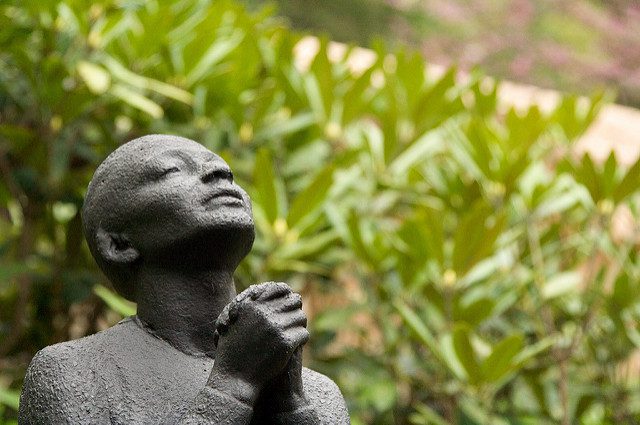
Photo Credit: Via Tsuji.
As a young Evangelical I was taught that rote prayer was the devil. And, guys, it was bad.
I can remember, clearly, sitting in class as part of our Sunday School Education Hour for Adults and learning that even to repeat the Lord’s Prayer should be considered vain repetition. To be effective, to be godly, prayer had to be spontaneous and original. Right from the heart, out through the lips.
Repeated, written prayers were the sort of stuff just one shade shy of evil.
Like the fallen faith of the Pharisees.
Of course, the worst of the lot of vain repeaters were Catholics. With their rosaries and novenas and various devotions these Catholics were in league with the devil—repeating non-sense over and over again with no sense of faith in it at all.
They weren’t praying they were repeating. No more holy than doing the dishes: wash, rinse, repeat.
I’ve come a long way since then. Through reading, learning, and, of all things, prayer, I’ve come to see the Catholic Church in an entirely new light. And, I’ve become Catholic. And, of all things, my prayer life has never been more on point. Never been so rich, so full, and so utterly lazy.
And never been so awesome.
One of the incredible, grace-filled things about the Catholic Church is the enormity of tradition in which its steeped. In a previous lifetime, I would’ve seen tradition as something stodgy, sinful, and to be utterly avoided. But that narrow view collapsed under the weight of a genuine exploration of the faith.
And with that, has come an appreciate for written prayers.
My doubt about the evilness of written prayers began simply enough: why re-invent the wheel, I wondered. Why do we have to pray in our own, unique, spontaneous ways? What makes this approach more Biblical or more right? What makes the written prayers of the ancient Church inherently wrong? The answer, I found, was nothing.
Most definitely we’re to pray spontaneously and the Bible makes that clear, as does the teaching of the Church down through the ages. But there’s nothing better about praying in that way. As an evangelical I learned that rote prayers were wrong because we believed that what made the Pharisees ungodly was their penchant for repeating prayers over and over again—not the contents of their heart, and their faith.
On that point, we were wrong.
Like the Pharisees, we condemned faith practices that valued written, repeated prayers because we thought that the mistake of the Pharisees was to do the same thing over and over again. In actual fact, the Pharisees error—for which Jesus often condemned them—was a lack of faith, and judgement of others. It wasn’t their prayers but the way they were praying, and this was a crucial difference.
In fact, rote prayers were a deeply embedded practice in Jewish faith life—and this faith life was not condemned by Jesus but affirmed, and brought to fulfillment. The Jewish way of praying, more to the point, continued on in the Christian Church and has been adopted and built upon by praying Christians down through the ages.
And this brings me to how I pray.
I’ve prayed a lot of different ways in my Christian life, some more successful than others.
As a younger evangelical I fastidiously kept a prayer journal. Recording requests for prayer and prayer intentions along with a section optimistically titled Prayers Answered which was largely left blank—God works in mysterious ways after all.
As I’ve grown up, both in faith and age, I’ve prayed in different ways since but mostly spontaneously and mostly in fits and starts. The time I’d often schedule for prayer fell at the very end of the day and I was often—excuse alert!—too tired to make it all the way through. As a young married couple, our prayers before meals were about as non-existent as meals at our supper table; eating in front of the TV became a bad habit and if you don’t sit to eat at a table you probably won’t pray before you eat either.
At any rate, one of the enormous graces of becoming Catholic has been exposure to a whole new world of prayer: the written prayer, and more specifically, the Liturgy of the Hours.
The Divine Office.
Continuing in the Jewish tradition of praying at set hours of the day, the Divine Office is a big old book of prayers handed down by the Catholic Church since nearly the beginning of the faith itself.
And it’s awesome.
While all clergy are obligated to pray The Office, the Second Vatican Council encouraged laity to begin to pray it too.
In my eagerness to try out new and exciting Catholic things I gave the Divine Office a whirl—and I haven’t looked back.
Praying fixed, written prayers twice a day (I pray the Morning and Evening Offices, which is the Church’s recommended route for the laity) seemed like a daunting task at first. Carving out fixed time to pray, about fifteen minutes for each office, seemed difficult—at times too difficult but it was also almost immediately rewarding and having pushed through, having made it into a daily routine, I can unreservedly say that it’s been an incredible, life-changing exercise of faith.
The laziest, yet most awesome prayer life ever.
See, on one hand, I don’t need to make up my prayers. As the father of a toddler, with another on the way, this is honestly a huge burden off my back. And I understand now more fully what the Scriptures say about prayer sometimes being a groaning of the spirit. I don’t need to know what to pray; the Office has it right there for me, in black and white and there’s a special kind of grace in that.
Praying through the words of the ancient authors of the psalms or the words penned by St. Paul or St. Peter two thousand years ago is a very meaningful, prayerful experience. To join my groanings to theirs. And rather than these rote, written prayers feeling languid or half-hearted I’ve found it to be the complete opposite. The Office is full of life and vigor; it’s collection of psalms and written prayers are vibrant and life-giving.
And to know that thousands of Catholics (and Anglicans and Orthodox!) are praying the same prayers, all over the world—to know that Christians down through the ages have prayed these same fixed prayers too—is a very grounding and affirming thing indeed.
It reminds me that my sufferings, my prayer intentions, are not only my own but something we all carry, together, and that’s beautiful.
The difference it makes in my faith life is palpable.
Never before have I prayed so often, so regularly, and never before has it been so easy. In a beautiful and ironic way, praying the Divine Office has turned my prayer life into the laziest, most rewarding faith experience I’ve ever known.
Previous Post

September 11, 2017
The Reformation Was Stupid
Next Post
September 27, 2017 The Catholic Church Makes Sense, Because I Don't Know Best
Browse Our Archives
Select a Category Appearances Christian Living Explaining the Faith Podcast Tough Questions Uncategorized Why I'm Catholic
Select a Month January 2024 December 2023 November 2023 July 2023 June 2023 May 2023 April 2023 March 2023 February 2023 January 2023 December 2022 November 2022 October 2022 September 2022 August 2022 July 2022 June 2022 May 2022 April 2022 March 2022 February 2022 January 2022 December 2021 November 2021 October 2021 September 2021 August 2021 July 2021 June 2021 May 2021 April 2021 March 2021 February 2021 January 2021 December 2020 November 2020 October 2020 September 2020 August 2020 July 2020 June 2020 May 2020 April 2020 March 2020 February 2020 January 2020 December 2019 November 2019 October 2019 September 2019 August 2019 July 2019 June 2019 May 2019 April 2019 March 2019 February 2019 January 2019 December 2018 November 2018 October 2018 September 2018 August 2018 July 2018 June 2018 May 2018 April 2018 March 2018 February 2018 January 2018 December 2017 October 2017 September 2017 July 2017 May 2017 April 2017 March 2017 February 2017 January 2017 December 2016 November 2016 October 2016 September 2016 August 2016 July 2016 June 2016 May 2016 April 2016 March 2016 February 2016 January 2016 December 2015 November 2015 October 2015 September 2015 August 2015 July 2015 June 2015 May 2015 April 2015 March 2015 February 2015 January 2015 December 2014 November 2014 October 2014
Follow Us!
TAKE THE
Religious Wisdom Quiz
Who mocked Nehemiah and the Jews, saying a fox could break their wall?
Select your answer to see how you score.
Eliashib Geshem Sanballat Tobiah
Support this
Column


Related posts from The Cordial Catholic

235: Questions I Couldn't Answer (w/ John Martignoni)

234: The Mindblowing World of Sacramentals (w/ Shaun...

233: The Power of Good Catholic Witnesses (w/...

232: The Trajectory of Conversion (w/ Phillip Campbell)
TRENDING AT PATHEOS Catholic

Rejecting Doom: Christian Hope And Human Action
Christianity is a religion of hope. We are to have hope and...

It’s What Comes From Within Which Matters
One of the most difficult things for us to understand is why...

Why I Choose the Eucharist Over the Sermon
Choose the Eucharist, Not the Sermon What are we supposed to get...

5 Design Elements Found in Spiritually Rooted Homes
Putting Spirituality Into Home Decor Our homes are more than our living...

Credo: A Story of God Told with the...
About 10 years ago, I began to imagine a personal "Credo" that...

The Anatomy of Divine Revelation in Catholic Thought
The claim that God has made Himself known to human beings is...
view all Catholic blogs
Ad-Free & Subscriber Log-In Subscription Support
- About Us
- 2026 Calendar
- Videos
- Podcasts
- Library of World Religions
- Faith In Media Tracker
- Advertise With Us
- Write for Us
- Privacy Policy
- Terms of Service
- Do Not Sell My Data
- Contact Us
- Radiant Digital
- Manage Newsletter Subscriptions
- Unsubscribe From Notifications
- Sitemap
Copyright 2008-2026, Patheos. All rights reserved.
Subscription Support Ad-Free & Subscriber Log-In
Follow Patheos