
BuddhistCatholicContemplativeEvangelicalGeneral ChristianHinduJewishLatter-day SaintMuslimNew VisionsProgressive Christian
Beliefs
- Buddhist
- Catholic
- Contemplative
- Evangelical
- General Christian
- Hindu
- Jewish
- Latter-day Saint
- More Voices
- Muslim
- New Visions
- Pagan
- Progressive Christian
Topics
- Religion News
- Food and Religion
- Sports and Religion
- Religious Art
- Religious Music and Entertainment
- Religious Events
- History and Religion
- Style and Religion
- Politics and Religion
- Women in Religion
- Recreation Outdoors and Religion
- Business Finance and Religion
- Careers Workplace and Religion
- Education and Religion
- Family Parenting and Religion
- Health Fitness and Religion
- Home and Religion
- Relationships and Religion
- Technology and Religion
- Travel and Religion
Columnists
- Buddhist Columnists
- Business Finance and Religion Columnists
- Careers Workplace and Religion Columnists
- Catholic Columnists
- Contemplative Columnists
- Education and Religion Columnists
- Evangelists Columnists
- Family Parenting and Religion Columnists
- General Christian Columnists
- Health Fitness and Religion Columnists
- Hindu Columnists
- History and Religion Columnists
- Home and Religion Columnists
- Jewish Columnists
- More Voices Columnists
- Latter Day Columnists
- Muslim Columnists
- New Visions Columnists
- Nonreligious Columnists
- Pagan Columnists
- Politics and Religion Columnists
- Progressive Columnists
- Recreation Outdoors and Religion Columnists
- Relationships and Religion Columnists
- Religion News Columnists
- Religious Art Columnists
- Religious Events Columnists
- Religious Music and Entertainment Columnists
- Sports and Religion Columnists
- Style and Religion Columnists
- Technology and Religion Columnists
- Travel and Religion Columnists
- Women in Religion Columnists
Resource Library
- 2026 Calendar
- Library of World Religions
- The 100 Most Holy Places on Earth
- Patheos Answers
- Podcasts
- Videos
- Faith Leaders Database
- Anglican Episcopalian
- Bahai
- Baptist
- Buddhism
- Christianity
- Confucianism
- Eastern Orthodoxy
- Hinduism
- Holiness and Pentecostal
- ISKCON
- Islam
- Judaism
- Lutheran
- Methodist
- The Church of Jesus Christ of Latter-day Saints
- New Age
- Paganism
- Presbytarian and Reformed
- Protestantism
- Religion Behind the Scenes
- Roman Catholic
- Scientology
- Shia Islam
- Sikhism
- Sufism
- Sunni Islam
- Taoism
- Zen
- See all religions
Research Tools
 Ad-Free & Subscriber Log-In Subscription Support
Ad-Free & Subscriber Log-In Subscription Support
Follow Patheos 

- Trending:
- Forgiveness
- |
- Marriage
- |
- Consciousness
- |
- Death Penalty
- |
- Election
- |
- Halloween
 The Cordial Catholic
- Home
- Catholic
- Keep Calm And Carry On: How We Respond to Same-Sex Marriage
Keep Calm And Carry On: How We Respond to Same-Sex Marriage
Last updated on: August 3, 2015 at 3:59 pm by K. Albert Little
Keep Calm And Carry On: How We Respond to Same-Sex Marriage 2015-08-03T15:59:26-04:00 K. Albert Little
Patheos Explore the world's faith through different perspectives on religion and spirituality! Patheos has the views of the prevalent religions and spiritualities of the world.
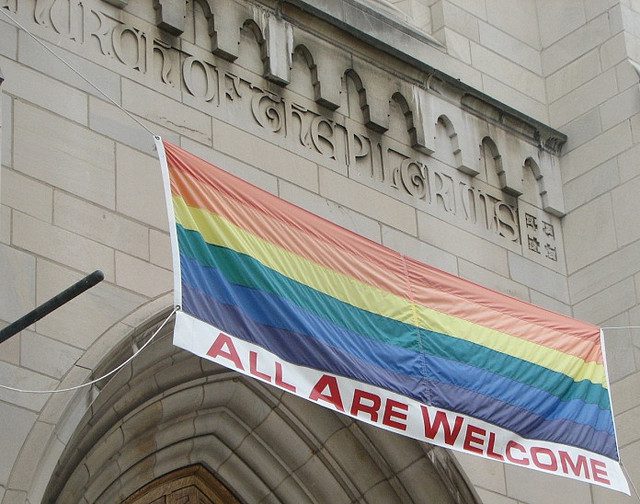
Photo Credit: Drama Queen.
In Canada, we’ve had legalized same-sex marriage for sometime now. It’s become taken for granted, but the decision yesterday by the highest court of the world’s largest superpower has reignited the discussion around the entire globe.
When I became a Catholic, a convert from Evangelical Protestantism, I wrote about the appeal of the Rock in Shifting Seas. Like many washouts from the emergent church movement I was attracted by a church which spoke clearly about Her beliefs.
I left a decidedly wishy-washy Evangelical church for a greater standard of truth. And that’s not to criticize, what I mean is: I left a church which made a conscious decision not to speak out about many truths (like same-sex unions) for a church which held truth to a standard in which it was clearly and confidently arrived at and spoken about.
All that to say, I chose Catholicism and it would be unfair, and lacking cordiality, to hide behind it and to not lay claim to the beliefs that I chose.
And one of those beliefs is an affirmation of the traditional, sacramental definition of marriage.
So how do we, how do I, respond in the face of a decision to redefine the marriage institution. How ought we Christians—we Catholics—orient ourselves in the ongoing discussion?
I have some ideas.
We Must Respond with Love
In my opinion, a proper Christian response has to keep in mind two things.
The first is love.
St. Paul, in his first epistle to the Corinthians extols us to show love above all else. Our acts of goodness, our preaching and teaching, our gifts given and received and, indeed, our persecution and martyrdom in the name of truth means nothing if we don’t have love.
Our response, then, in the face of same-sex marriage needs to be, first and foremost, one of Christian love. We are not a people of hate; they will know we are Christian by our love. They will know God by our love. Our primary outward facing response must be to show our neighbours love.
But some people may object: St. Paul was writing to the Corinthians not only to extol virtues but to correct wrongdoings in the church at Corinth. After all, merely a chapter later St. Paul is admonishing women (in a not too generous way) for speaking in church. Don’t we, the Christian faithful, have a duty to admonish those who pretend to give and receive themselves in same-sex marriage?
Don’t forget that St. Paul was writing to an audience of Christians in a church over which he held authority to teach. His audience already professed to share in the Christian faith.
And this is where we must make certain distinctions because—and this is the second thing to keep in mind—the Sacrament of Marriage has not changed.
Marriage and Marriage
When my wife and I were married in an Evangelical church we made particular intentions to be married by “banns of marriage” instead of by requesting a marriage license from the government. In our province, churches have the ability to declare a couple to be married by reading out their “marriage banns” on a Sunday morning in front of the congregation. The provincial government then, in hindsight, acknowledges that the couple is married on their actual wedding day.
We were church married, and it was an intentional choice.
Ultimately, the state cannot dictate what is and what isn’t sacramental marriage. As a Catholic, my marriage is sacramental, it’s the same marriage that the Christian church has professed, in continuity with the purpose and plan of God since the beginning of time.
I’m sacramentally married, so what’s the big deal with the government changing what marriage means to them?
Because maybe this is the point in history when, finally, on a more global scale, the definition of marriage is different. And, in a sense, it’s semantics.
Marriage, as the Church calls it, is different than marriage as the state calls it. And that’s fine.
Some may, and certainly will, get bent out of shape by the gay agenda stealing our word but it’s only a word after all and I think we can let it go.
And, surely, as we continue to step away from the plan and purpose that God intended for the world we can’t, and shouldn’t, ignore the increasingly deteriorating social fabric. It’s collateral damage on a path that leads away from the revealed truth of the Church and the Bible, but it’s a path we’ve been on for a long, long time and writing a column, giving a talk, or engaging in a debate likely isn’t going to suddenly reverse that course.
So what am I advocating? Do we give up?
By no means.
Our Clear Path Forward
Our path forward, as Christians—as Catholics—has never been more simple. We keep calm and carry on.
We respond in love because secular society isn’t held to the same standards as we are as Christians. No more would I expect the secular world to adhere to the Good Friday fast than I would expect them to respect my definition of marriage.
This is first and foremost.
Next, we recognize that we’re not speaking the same language. My marriage, created by God and administered by the Church, is a sacramental marriage. It is, in my opinion, how God intended it to be. But the wider world does not see it that way. They call marriage something different and that’s fine. When we say marriage we know what we mean.
Finally, we get our act together. The Catholic Church needs to reinvigorate married couples to be a witness to the calling of sacramental marriage. We need strong, loving, Christian families to increasingly witness to a fallen world. Surely we’re called to be a City on a Hill but we aren’t called to storm the doors of City Hall. Relax, the battle for marriage (which was likely lost half a century ago anyway) is over and in many ways that’s a relief. Now it’s time to live out our married lives as a testament to our calling.
The United States Conference of Catholic Bishops, not always known as a baston of clear leadership, issued a brilliant statement on the Supreme Court’s decision. In its conclusion it asks American Catholics to move forward—to keep calm and carry on—with a full measure of faith, hope, and love. Yes, what marriage is, to the secular world, has fundamentally changed. But no, marriage in the Catholic Church has not.
Certainly, there are days to come when the class of Christians who affirmed the traditional definition of marriage will be labelled as hateful discriminators and bigots but we’re called to do what Christians have been called to do since the beginning of the Church: to witness with love. The era of the “Christian” Western World—if it ever really existed—is surely in its twilight but what’s wrong with that?
We needn’t bemoan the end of Western Christianity with a collapse of our definition of marriage. We need to affirm, with love, what we really mean by marriage and show grace, mercy, and overwhelming kindness to our fellow sojourners who call it something different.
Previous Post
June 23, 2015
Laudato Si: Why the Church Must Speak to Environmental Issues
Next Post
July 9, 2015 So You Think You're Smarter than the Church Fathers?
Browse Our Archives
Select a Category Appearances Christian Living Explaining the Faith Podcast Tough Questions Uncategorized Why I'm Catholic
Select a Month January 2024 December 2023 November 2023 July 2023 June 2023 May 2023 April 2023 March 2023 February 2023 January 2023 December 2022 November 2022 October 2022 September 2022 August 2022 July 2022 June 2022 May 2022 April 2022 March 2022 February 2022 January 2022 December 2021 November 2021 October 2021 September 2021 August 2021 July 2021 June 2021 May 2021 April 2021 March 2021 February 2021 January 2021 December 2020 November 2020 October 2020 September 2020 August 2020 July 2020 June 2020 May 2020 April 2020 March 2020 February 2020 January 2020 December 2019 November 2019 October 2019 September 2019 August 2019 July 2019 June 2019 May 2019 April 2019 March 2019 February 2019 January 2019 December 2018 November 2018 October 2018 September 2018 August 2018 July 2018 June 2018 May 2018 April 2018 March 2018 February 2018 January 2018 December 2017 October 2017 September 2017 July 2017 May 2017 April 2017 March 2017 February 2017 January 2017 December 2016 November 2016 October 2016 September 2016 August 2016 July 2016 June 2016 May 2016 April 2016 March 2016 February 2016 January 2016 December 2015 November 2015 October 2015 September 2015 August 2015 July 2015 June 2015 May 2015 April 2015 March 2015 February 2015 January 2015 December 2014 November 2014 October 2014
Follow Us!
TAKE THE
Religious Wisdom Quiz
Who said, "My punishment is greater than I can bear"?
Select your answer to see how you score.
Judas Esau Saul Cain
Support this
Column


Related posts from The Cordial Catholic

232: The Trajectory of Conversion (w/ Phillip Campbell)

229: Can Catholics and Evangelicals Agree on How...
212: Evangelicals, Here's How to Look for a...
210: I Was Going to be an Anglican...
TRENDING AT PATHEOS Catholic

Rejecting Doom: Christian Hope And Human Action
Christianity is a religion of hope. We are to have hope and...

It’s What Comes From Within Which Matters
One of the most difficult things for us to understand is why...

Why I Choose the Eucharist Over the Sermon
Choose the Eucharist, Not the Sermon What are we supposed to get...

5 Design Elements Found in Spiritually Rooted Homes
Putting Spirituality Into Home Decor Our homes are more than our living...

Credo: A Story of God Told with the...
About 10 years ago, I began to imagine a personal "Credo" that...

The Anatomy of Divine Revelation in Catholic Thought
The claim that God has made Himself known to human beings is...
view all Catholic blogs
Ad-Free & Subscriber Log-In Subscription Support
- About Us
- 2026 Calendar
- Videos
- Podcasts
- Library of World Religions
- Faith In Media Tracker
- Advertise With Us
- Write for Us
- Privacy Policy
- Terms of Service
- Do Not Sell My Data
- Contact Us
- Radiant Digital
- Manage Newsletter Subscriptions
- Unsubscribe From Notifications
- Sitemap
Copyright 2008-2026, Patheos. All rights reserved.
Subscription Support Ad-Free & Subscriber Log-In
Follow Patheos