
BuddhistCatholicContemplativeEvangelicalGeneral ChristianHinduJewishLatter-day SaintMuslimNew VisionsProgressive Christian
Beliefs
- Buddhist
- Catholic
- Contemplative
- Evangelical
- General Christian
- Hindu
- Jewish
- Latter-day Saint
- More Voices
- Muslim
- New Visions
- Pagan
- Progressive Christian
Topics
- Religion News
- Food and Religion
- Sports and Religion
- Religious Art
- Religious Music and Entertainment
- Religious Events
- History and Religion
- Style and Religion
- Politics and Religion
- Women in Religion
- Recreation Outdoors and Religion
- Business Finance and Religion
- Careers Workplace and Religion
- Education and Religion
- Family Parenting and Religion
- Health Fitness and Religion
- Home and Religion
- Relationships and Religion
- Technology and Religion
- Travel and Religion
Columnists
- Buddhist Columnists
- Business Finance and Religion Columnists
- Careers Workplace and Religion Columnists
- Catholic Columnists
- Contemplative Columnists
- Education and Religion Columnists
- Evangelists Columnists
- Family Parenting and Religion Columnists
- General Christian Columnists
- Health Fitness and Religion Columnists
- Hindu Columnists
- History and Religion Columnists
- Home and Religion Columnists
- Jewish Columnists
- More Voices Columnists
- Latter Day Columnists
- Muslim Columnists
- New Visions Columnists
- Nonreligious Columnists
- Pagan Columnists
- Politics and Religion Columnists
- Progressive Columnists
- Recreation Outdoors and Religion Columnists
- Relationships and Religion Columnists
- Religion News Columnists
- Religious Art Columnists
- Religious Events Columnists
- Religious Music and Entertainment Columnists
- Sports and Religion Columnists
- Style and Religion Columnists
- Technology and Religion Columnists
- Travel and Religion Columnists
- Women in Religion Columnists
Resource Library
- 2026 Calendar
- Library of World Religions
- The 100 Most Holy Places on Earth
- Patheos Answers
- Podcasts
- Videos
- Faith Leaders Database
- Anglican Episcopalian
- Bahai
- Baptist
- Buddhism
- Christianity
- Confucianism
- Eastern Orthodoxy
- Hinduism
- Holiness and Pentecostal
- ISKCON
- Islam
- Judaism
- Lutheran
- Methodist
- The Church of Jesus Christ of Latter-day Saints
- New Age
- Paganism
- Presbytarian and Reformed
- Protestantism
- Religion Behind the Scenes
- Roman Catholic
- Scientology
- Shia Islam
- Sikhism
- Sufism
- Sunni Islam
- Taoism
- Zen
- See all religions
Research Tools
 Ad-Free & Subscriber Log-In Subscription Support
Ad-Free & Subscriber Log-In Subscription Support
Follow Patheos 

- Trending:
- Forgiveness
- |
- Marriage
- |
- Consciousness
- |
- Death Penalty
- |
- Election
- |
- Halloween
 The Cordial Catholic
- Home
- Catholic
- Is the Mass Just Empty Ritual? Or a Great Spiritual Comfort?
Is the Mass Just Empty Ritual? Or a Great Spiritual Comfort?
Last updated on: August 17, 2018 at 9:36 am by K. Albert Little
Is the Mass Just Empty Ritual? Or a Great Spiritual Comfort? 2018-08-17T09:36:00-04:00 K. Albert Little
Patheos Explore the world's faith through different perspectives on religion and spirituality! Patheos has the views of the prevalent religions and spiritualities of the world.
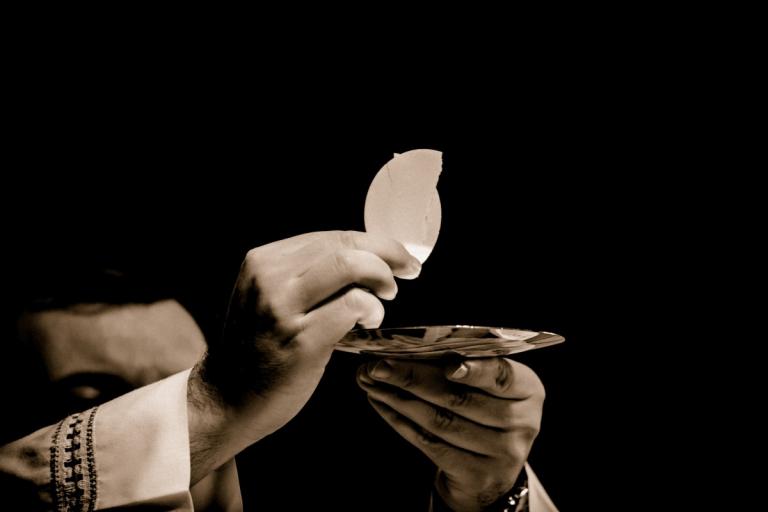
Photo Credit: Public Domain.
So I have this weird affinity for rough towels.
Hear me out.
Ever since I was a kid, my ever thrifty mother loved her clothesline. She loved hanging clothes to dry. Some days if we’d hadn’t seen mom around the house for a while my sister or I would ask, out loud, “Where’s mom?”
The answer, inevitably, was the same, “Out back with the clothesline again.”
So I grew up, understandably, with rough towels. If you’ve ever had a mother like mine, who hung towels out to dry on the line, you know what I mean. They just don’t dry the same as in a clothes dryer. They’re hard and stiff and rough and liable to peel a layer of skin off your face if you’re not expecting it.
When my wife and I bought our first house I was excited to start to dry clothes outside and save the roughly twenty-five cents it costs to run the dryer (frugality is hereditary and we both came by it honestly). After pulling the first towel from the linen closet and proceeding to scrap a layer of skin away from her face, my wife declared that from now on towels would not be hung on the clothesline.
As in any good marriage we struck a compromise: all of the towels now go in the dryer.
All of this to say, I have a particular nostalgia for the way a towel feels when it’s been hung up to dry. It’s weird, I know, but not too different from the kind of nostalgia many of us carry around for the things we grew up with and around. For those of us lucky enough to grow up in stable, loving families these are things we remember fondly.
And it is, most often, these sensory elements, the touch or taste or smell of something that brings us right back to when we were young. The motion or movement of something we used to love to do.
(If you’re my age and grew up in the late 80’s you could, most likely, pick up a Nintendo controller and it’d be like you never put it down. The feeling of that weird rectangle in your hand would be comforting and familiar.)
This is the same with the Mass.
I remember, as an Evangelical, encountering older Christians—mentors who I’d look up to—who’d describe themselves as former Catholics. They’d talk casually about how awful the Mass was; how it was laden with ritual and rite but was largely just going through the motions. It was an empty religion, they’d remark, in contrast to the more relational focus of the Evangelicalism they’d encountered and embraced.
On balance, they were right. Catholics who were poorly catechized can hardly be blamed for failing to understand the deep meaning behind the liturgy but not all Catholics are former Catholics and not all Catholics are turned off from the smells, the bells, and the motions of the Sacred Liturgy unfolding at Mass.
Instead there are some, like me, who prefer their towels rough. Who are deeply moved by the motions of the Mass. Who love ritual and the rites so far as to become a Catholic. But, why?
For many Catholics, the term “Vatican II” is synonymous for all things wrong with the Catholic faith. It’s true that, for the most part, an entire generation of Catholics were basically opted out of learning about their faith; it wasn’t seen as important, which was not at all what Vatican II intended. But, nonetheless, the generation growing up following Vatican II, in large measure, were simply not taught about what was happening at Mass or the value of their faith.
The increasing secularization of culture was another factor though too. When all of your neighbours in your little village or neighbourhood are Catholics like you, your religious education is robust, multi-faucted, and happens all the time. It’s immersion, which, ask anyone, is the best way to learn a language. In this case, it was the language of the faith. You learned the value of prayer from Mr. Jones in the vegetable garden; you encountered your first saint in Mrs. Sunita’s kitchen; you assisted at Mass every other Saturday because, in your neighbourhood, that’s what all the boys did.
In the end, the erosion of Catholic education and of Catholic cultures led to a predictable lack of understanding of the rituals and rites of the Church; a lack of understanding of what was happening in the Mass and its value. And an emptying out of our churches.
The Mass was called an empty ritual by former Catholics because it was never understood to be anything more. They were wrong, of course, but only because they’d never learned the rite.
The Mass, as intended, is more like that rough towel from my childhood than an empty set of routines.
Those things we love from our childhood, and beyond into today, are beloved because they comfort us. They remind us of something else—something deeper—and something we love very much. Like the rough towels I used all summer long—whenever towels could be dried outdoors in our Canadian climate—the Mass is something we are intended to experience over and over and over again, no matter the weather, actually.
The smells and bells and motions are intended to point us to Christ and the liturgy of the Mass itself is supposed to work on our souls like an exercise regime, to strengthen our spiritual muscles, and to inculturate us to the culture of Heaven. So that we can begin to prepare for Heaven, right here on earth.
That is the Mass.
The Mass, like those comforts of childhood, is supposed to feel like something we grow into, long for, and approach with a deep fondness. This is the divine mystery of the Mass: That it should feel as familiar as pulling on an old, beloved sweater while also taking us to the spiritually transcendent.
At its core the Mass is a ritual. But a ritual, when properly understood and celebrated, is something deeply, spiritually profound. And while we do need to deepen our Catholic education (yes indeed!) in order to understand what’s happening in the Mass—the point and purpose—we also need to stop worrying so much about “empty religion.”
Because what’s empty about that love and longing for the smells, bells, and motions of the Mass? It is, after all, a longing for Heaven.
Previous Post

August 16, 2018
In Light of Abuse, Should I Stop Being Catholic?
Next Post

August 20, 2018 Good Priests and Bishops Must Speak Out Now
Browse Our Archives
Select a Category Appearances Christian Living Explaining the Faith Podcast Tough Questions Uncategorized Why I'm Catholic
Select a Month January 2024 December 2023 November 2023 July 2023 June 2023 May 2023 April 2023 March 2023 February 2023 January 2023 December 2022 November 2022 October 2022 September 2022 August 2022 July 2022 June 2022 May 2022 April 2022 March 2022 February 2022 January 2022 December 2021 November 2021 October 2021 September 2021 August 2021 July 2021 June 2021 May 2021 April 2021 March 2021 February 2021 January 2021 December 2020 November 2020 October 2020 September 2020 August 2020 July 2020 June 2020 May 2020 April 2020 March 2020 February 2020 January 2020 December 2019 November 2019 October 2019 September 2019 August 2019 July 2019 June 2019 May 2019 April 2019 March 2019 February 2019 January 2019 December 2018 November 2018 October 2018 September 2018 August 2018 July 2018 June 2018 May 2018 April 2018 March 2018 February 2018 January 2018 December 2017 October 2017 September 2017 July 2017 May 2017 April 2017 March 2017 February 2017 January 2017 December 2016 November 2016 October 2016 September 2016 August 2016 July 2016 June 2016 May 2016 April 2016 March 2016 February 2016 January 2016 December 2015 November 2015 October 2015 September 2015 August 2015 July 2015 June 2015 May 2015 April 2015 March 2015 February 2015 January 2015 December 2014 November 2014 October 2014
Follow Us!
TAKE THE
Religious Wisdom Quiz
What does Hebrews say is living and active?
Select your answer to see how you score.
The word of God Prayer The church Faith
Support this
Column


Related posts from The Cordial Catholic
192: Making the Mass Meaningful for Our Kids...
188: Pitfalls for New Catholic Converts (w/ Keith...

186: So You Want to Be a Reverent...
182: The Catholic Guide to Death, Dying, and...
TRENDING AT PATHEOS Catholic

Rejecting Doom: Christian Hope And Human Action
Christianity is a religion of hope. We are to have hope and...

It’s What Comes From Within Which Matters
One of the most difficult things for us to understand is why...

Why I Choose the Eucharist Over the Sermon
Choose the Eucharist, Not the Sermon What are we supposed to get...

5 Design Elements Found in Spiritually Rooted Homes
Putting Spirituality Into Home Decor Our homes are more than our living...

Credo: A Story of God Told with the...
About 10 years ago, I began to imagine a personal "Credo" that...

The Anatomy of Divine Revelation in Catholic Thought
The claim that God has made Himself known to human beings is...
view all Catholic blogs
Ad-Free & Subscriber Log-In Subscription Support
- About Us
- 2026 Calendar
- Videos
- Podcasts
- Library of World Religions
- Faith In Media Tracker
- Advertise With Us
- Write for Us
- Privacy Policy
- Terms of Service
- Do Not Sell My Data
- Contact Us
- Radiant Digital
- Manage Newsletter Subscriptions
- Unsubscribe From Notifications
- Sitemap
Copyright 2008-2026, Patheos. All rights reserved.
Subscription Support Ad-Free & Subscriber Log-In
Follow Patheos