
BuddhistCatholicContemplativeEvangelicalGeneral ChristianHinduJewishLatter-day SaintMuslimNew VisionsProgressive Christian
Beliefs
- Buddhist
- Catholic
- Contemplative
- Evangelical
- General Christian
- Hindu
- Jewish
- Latter-day Saint
- More Voices
- Muslim
- New Visions
- Pagan
- Progressive Christian
Topics
- Religion News
- Food and Religion
- Sports and Religion
- Religious Art
- Religious Music and Entertainment
- Religious Events
- History and Religion
- Style and Religion
- Politics and Religion
- Women in Religion
- Recreation Outdoors and Religion
- Business Finance and Religion
- Careers Workplace and Religion
- Education and Religion
- Family Parenting and Religion
- Health Fitness and Religion
- Home and Religion
- Relationships and Religion
- Technology and Religion
- Travel and Religion
Columnists
- Buddhist Columnists
- Business Finance and Religion Columnists
- Careers Workplace and Religion Columnists
- Catholic Columnists
- Contemplative Columnists
- Education and Religion Columnists
- Evangelists Columnists
- Family Parenting and Religion Columnists
- General Christian Columnists
- Health Fitness and Religion Columnists
- Hindu Columnists
- History and Religion Columnists
- Home and Religion Columnists
- Jewish Columnists
- More Voices Columnists
- Latter Day Columnists
- Muslim Columnists
- New Visions Columnists
- Nonreligious Columnists
- Pagan Columnists
- Politics and Religion Columnists
- Progressive Columnists
- Recreation Outdoors and Religion Columnists
- Relationships and Religion Columnists
- Religion News Columnists
- Religious Art Columnists
- Religious Events Columnists
- Religious Music and Entertainment Columnists
- Sports and Religion Columnists
- Style and Religion Columnists
- Technology and Religion Columnists
- Travel and Religion Columnists
- Women in Religion Columnists
Resource Library
- 2026 Calendar
- Library of World Religions
- The 100 Most Holy Places on Earth
- Patheos Answers
- Podcasts
- Videos
- Faith Leaders Database
- Anglican Episcopalian
- Bahai
- Baptist
- Buddhism
- Christianity
- Confucianism
- Eastern Orthodoxy
- Hinduism
- Holiness and Pentecostal
- ISKCON
- Islam
- Judaism
- Lutheran
- Methodist
- The Church of Jesus Christ of Latter-day Saints
- New Age
- Paganism
- Presbytarian and Reformed
- Protestantism
- Religion Behind the Scenes
- Roman Catholic
- Scientology
- Shia Islam
- Sikhism
- Sufism
- Sunni Islam
- Taoism
- Zen
- See all religions
Research Tools
 Ad-Free & Subscriber Log-In Subscription Support
Ad-Free & Subscriber Log-In Subscription Support
Follow Patheos 

- Trending:
- Forgiveness
- |
- Marriage
- |
- Consciousness
- |
- Death Penalty
- |
- Election
- |
- Halloween
 The Cordial Catholic
- Home
- Catholic
- If the Bible Is Infallible Then So Is the Church
If the Bible Is Infallible Then So Is the Church
Last updated on: September 6, 2017 at 1:22 pm by K. Albert Little
If the Bible Is Infallible Then So Is the Church 2017-09-06T13:22:58-04:00 K. Albert Little
Patheos Explore the world's faith through different perspectives on religion and spirituality! Patheos has the views of the prevalent religions and spiritualities of the world.
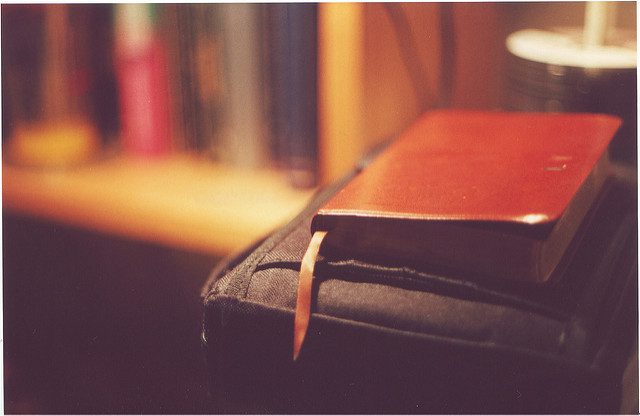
Photo Credit: Dwight Stone.
A paradigm shift occurs when the number of compelling facts and figures from a competing world view other than your own forces you to concede your position—and adopt another.
It happens like this.
Facts and information enter your radar which you perhaps hadn’t considered before. They challenge your perspective, opinions, and ultimately, your view of the world. As more and more of these new arguments and ideas pile up the lens through which you’ve previously understood much of reality begins to look a bit foggy—the edges aren’t as crisply in focus as they used to be.
And on and on.
Eventually—and this may take a lifetime—the enormous pile of facts in the other, competing worldview appear to be more compelling. They make more sense; offer a more robust explanation of what you understand to be the world and you make a radical leap.
A paradigm shift.
This is what happens when an Evangelical Christian becomes a Catholic.
For me, one of those crucial pieces of information, which began as a question, orbited around the idea of an infallible Bible. Where did we get the Bible? And how did it get put together?
And what made us so sure it was the infallible Word of God?
This began, for me, the fateful journey towards a paradigm shift in my own life.
A journey into the Catholic Church.
In my early twenties, having been “saved” in the Evangelical church at the age of fifteen, I was embarrassed to not have an answer to that first question: Where did we get the Bible?
Sadly, up to that point in my life, it wasn’t even a question I’d considered. But, to be fair, it’d never been put to me either.
In my large Pentecostal church—where I clocked a good amount of Sunday mornings and Friday nights—the historical understanding of the timeline of the Bible ended with the final punctuation mark in the Book of Revelation and began again somewhere in the 1960’s (which was about when the oldest book in our church library would’ve been written).
There was, as there often is in Evangelical circles, a giant gaping hole in the middle of Church history.
As if nothing happened between the last book of the Bible being written and the preacher grasping it in his sweaty palms on a Sunday morning.
So it never occurred to me to ask either where we got it or how it was put together and when it was, finally, asked of me I had not discernable answer.
And that was worrying.
Digging around in familiar Protestant sources failed to make it any more clear.
The Bible, from a Protestant perspective, was hard to square.
Where exactly these books came from was fairly clear. In many cases the author identifies himself and their identity can be linked directly to the apostles and Jesus’s ministry. But why these particular books were included and others, as I learned, were intentionally left out was a complete mystery.
How do we, as Evangelicals, affirm these books to be infallible while declaring others to be not.
How do we know?
I was no closer to an answer, so I kept digging.
I learned that the biblical canon became relatively stable around about 400AD. The Protestant sources I read argued that these books, clearly, were collected together and considered canonical because they were the most read in and, thus, the most respected.
But why were they the most read while others weren’t?
As I dug deeper no satisfying answers emerged and even the best Protestant scholars admitted that the thesis of these particular books standing out of their own merit was weak.
Instead, it was the Church which affirmed these books as worthy to read, copy, and pass around amongst congregations. Congregations under the unequivocal authority of bishops who drew in a successive line tracing back to the apostles.
In other words, it was bishops like Augustine (who affirms a canon in his early writings) who authoritatively declared which books and letters, out of those being circulated, should carry weight.
And, finally, when these same bishops got together to make early pronouncements on the biblical canon in the 400’s it was through the authoritative mechanism of a Church Council. The same mechanism that Peter, Paul, et. al. used to sort out the earliest theological scramblings in Jerusalem (see Acts 15).
As I dug deep into the formation of the biblical canon I was flabbergasted because even the most robust of the Protestant theologians, R.J. Sproul, admits that the unless we afford some authority to the Catholic Church (we he doesn’t) we must admit that the Bible is, ultimately, “an fallible collection of infallible books.”
You can see my difficulties.
Unless we are to admit that the Catholic Church, with its hierarchy of bishops et cetera, held some kind of God-given authority and infallibility to collect up the Bible into its current form then we must be comfortable in admitting that maybe we got it wrong.
How can we trust that?
Because there is no infallible Table of Contents and nothing in the New or Old Testaments gives us a clue as to what should be in there.
Martin Luther, first-leg runner of the Reformation, actually wanted to remove certain pieces (like Hebrews and James) because they didn’t fit with what his interpretation of the salvation looked like. We know from history that these same sorts of disagreements happened in the first 400 years of the Church when there was no fixed canon.
Who’s to say that some letters and books weren’t removed then?
No one.
Unless we trust the Church.
I want to end with this,
In the first 400 years of Christian history, without a fixed canon, it had to have been the Church, guided by the Holy Spirit, which maintained unity and helped its people to discern right, wrong, and understand its theology and teachings. Nevermind that most couldn’t read and even with a Bible it wouldn’t be much good; the Holy Spirit guided the authoritative teachers of the Church, first the apostles, and then their successors, in helping to discern important pieces of theology and identity.
It was in the first 400 years, before the serious concretization of the biblical canon, that important pieces of the Christian worldview like our understanding of the Trinity and the Person of Jesus were developed. These were developed and defended passionately by the Church at the time—before the Bible was canonized.
These developments happened within the context of a Church with an authority structure which also made decisions on how we can, and do, pray for the dead, the important place of the Blessed Virgin, the power and necessity of Baptism so save, and the unequivocal Real Presence of Christ in the Communion elements.
If we trust the Bible we have, how can we avoid trusting the Church?
In other words, if the Bible is infallible it can only be because it was put together by an infallible authority which is the Catholic Church.
The same Church which exists today, authoritatively governed by bishops who succeeded the men who collected the Bible, because Christ Himself said nothing would overcome it.
And, truly, if we trust the Bible but throw out everything else that the Church affirmed and taught prior to canonization than we’re doing nothing more than snacking as we please at a theological buffet. Established doctrinal norms like the Trinity and the Personhood of Jesus are not any more “evident in Scripture” than the Eucharist as Real Presence, the necessity of Baptism, and a Catholic understanding of the Communion of the Saints.
Like the canon of the Bible, these doctrines were affirmed by authority and rely, ultimately, on an extra-biblical source.
It was these struggles, as an Evangelical, which amounted merely to more information heaped onto an ever-growing pile of other compelling evidence. Answers without satisfactory questions; and the most I asked and received answers the more another way began to become more appealing.
These questions did have incredibly satisfying answers, I learned, found in the historic Church. A Church which claims continuity and historical pedigree stretching back to Jesus laying hands on a fisherman named Peter. And I’ve found, much to my delight, a spirituality, a historical grounding, and depth of faith and grace in this historic Church beyond anything I could’ve imagined before.
Previous Post
February 2, 2017
The Reformation is Over So Why Aren't You Catholic?
Next Post

February 8, 2017 The Evangelical Church is Broken (A Love Letter)
Browse Our Archives
Select a Category Appearances Christian Living Explaining the Faith Podcast Tough Questions Uncategorized Why I'm Catholic
Select a Month January 2024 December 2023 November 2023 July 2023 June 2023 May 2023 April 2023 March 2023 February 2023 January 2023 December 2022 November 2022 October 2022 September 2022 August 2022 July 2022 June 2022 May 2022 April 2022 March 2022 February 2022 January 2022 December 2021 November 2021 October 2021 September 2021 August 2021 July 2021 June 2021 May 2021 April 2021 March 2021 February 2021 January 2021 December 2020 November 2020 October 2020 September 2020 August 2020 July 2020 June 2020 May 2020 April 2020 March 2020 February 2020 January 2020 December 2019 November 2019 October 2019 September 2019 August 2019 July 2019 June 2019 May 2019 April 2019 March 2019 February 2019 January 2019 December 2018 November 2018 October 2018 September 2018 August 2018 July 2018 June 2018 May 2018 April 2018 March 2018 February 2018 January 2018 December 2017 October 2017 September 2017 July 2017 May 2017 April 2017 March 2017 February 2017 January 2017 December 2016 November 2016 October 2016 September 2016 August 2016 July 2016 June 2016 May 2016 April 2016 March 2016 February 2016 January 2016 December 2015 November 2015 October 2015 September 2015 August 2015 July 2015 June 2015 May 2015 April 2015 March 2015 February 2015 January 2015 December 2014 November 2014 October 2014
Follow Us!
TAKE THE
Religious Wisdom Quiz
Who helped David escape Saul by lowering him through a window?
Select your answer to see how you score.
Ahinoam Abigail Bathsheba Michal
Support this
Column


Related posts from The Cordial Catholic
231: Becoming Catholic in a Church Crisis (w/...

229: Can Catholics and Evangelicals Agree on How...

227: What was Medieval Catholicism Really Like? (w/...
212: Evangelicals, Here's How to Look for a...
TRENDING AT PATHEOS Catholic

Rejecting Doom: Christian Hope And Human Action
Christianity is a religion of hope. We are to have hope and...

It’s What Comes From Within Which Matters
One of the most difficult things for us to understand is why...

Why I Choose the Eucharist Over the Sermon
Choose the Eucharist, Not the Sermon What are we supposed to get...

5 Design Elements Found in Spiritually Rooted Homes
Putting Spirituality Into Home Decor Our homes are more than our living...

Credo: A Story of God Told with the...
About 10 years ago, I began to imagine a personal "Credo" that...

The Anatomy of Divine Revelation in Catholic Thought
The claim that God has made Himself known to human beings is...
view all Catholic blogs
Ad-Free & Subscriber Log-In Subscription Support
- About Us
- 2026 Calendar
- Videos
- Podcasts
- Library of World Religions
- Faith In Media Tracker
- Advertise With Us
- Write for Us
- Privacy Policy
- Terms of Service
- Do Not Sell My Data
- Contact Us
- Radiant Digital
- Manage Newsletter Subscriptions
- Unsubscribe From Notifications
- Sitemap
Copyright 2008-2026, Patheos. All rights reserved.
Subscription Support Ad-Free & Subscriber Log-In
Follow Patheos