
BuddhistCatholicContemplativeEvangelicalGeneral ChristianHinduJewishLatter-day SaintMuslimNew VisionsProgressive Christian
Beliefs
- Buddhist
- Catholic
- Contemplative
- Evangelical
- General Christian
- Hindu
- Jewish
- Latter-day Saint
- More Voices
- Muslim
- New Visions
- Pagan
- Progressive Christian
Topics
- Religion News
- Food and Religion
- Sports and Religion
- Religious Art
- Religious Music and Entertainment
- Religious Events
- History and Religion
- Style and Religion
- Politics and Religion
- Women in Religion
- Recreation Outdoors and Religion
- Business Finance and Religion
- Careers Workplace and Religion
- Education and Religion
- Family Parenting and Religion
- Health Fitness and Religion
- Home and Religion
- Relationships and Religion
- Technology and Religion
- Travel and Religion
Columnists
- Buddhist Columnists
- Business Finance and Religion Columnists
- Careers Workplace and Religion Columnists
- Catholic Columnists
- Contemplative Columnists
- Education and Religion Columnists
- Evangelists Columnists
- Family Parenting and Religion Columnists
- General Christian Columnists
- Health Fitness and Religion Columnists
- Hindu Columnists
- History and Religion Columnists
- Home and Religion Columnists
- Jewish Columnists
- More Voices Columnists
- Latter Day Columnists
- Muslim Columnists
- New Visions Columnists
- Nonreligious Columnists
- Pagan Columnists
- Politics and Religion Columnists
- Progressive Columnists
- Recreation Outdoors and Religion Columnists
- Relationships and Religion Columnists
- Religion News Columnists
- Religious Art Columnists
- Religious Events Columnists
- Religious Music and Entertainment Columnists
- Sports and Religion Columnists
- Style and Religion Columnists
- Technology and Religion Columnists
- Travel and Religion Columnists
- Women in Religion Columnists
Resource Library
- 2026 Calendar
- Library of World Religions
- The 100 Most Holy Places on Earth
- Patheos Answers
- Podcasts
- Videos
- Faith Leaders Database
- Anglican Episcopalian
- Bahai
- Baptist
- Buddhism
- Christianity
- Confucianism
- Eastern Orthodoxy
- Hinduism
- Holiness and Pentecostal
- ISKCON
- Islam
- Judaism
- Lutheran
- Methodist
- The Church of Jesus Christ of Latter-day Saints
- New Age
- Paganism
- Presbytarian and Reformed
- Protestantism
- Religion Behind the Scenes
- Roman Catholic
- Scientology
- Shia Islam
- Sikhism
- Sufism
- Sunni Islam
- Taoism
- Zen
- See all religions
Research Tools
 Ad-Free & Subscriber Log-In Subscription Support
Ad-Free & Subscriber Log-In Subscription Support
Follow Patheos 

- Trending:
- Forgiveness
- |
- Marriage
- |
- Consciousness
- |
- Death Penalty
- |
- Election
- |
- Halloween
 The Cordial Catholic
- Home
- Catholic
- If God is Good Why is Christianity So Confusing?
If God is Good Why is Christianity So Confusing?
Last updated on: August 20, 2015 at 11:09 am by K. Albert Little
If God is Good Why is Christianity So Confusing? 2015-08-20T11:09:07-04:00 K. Albert Little
Patheos Explore the world's faith through different perspectives on religion and spirituality! Patheos has the views of the prevalent religions and spiritualities of the world.
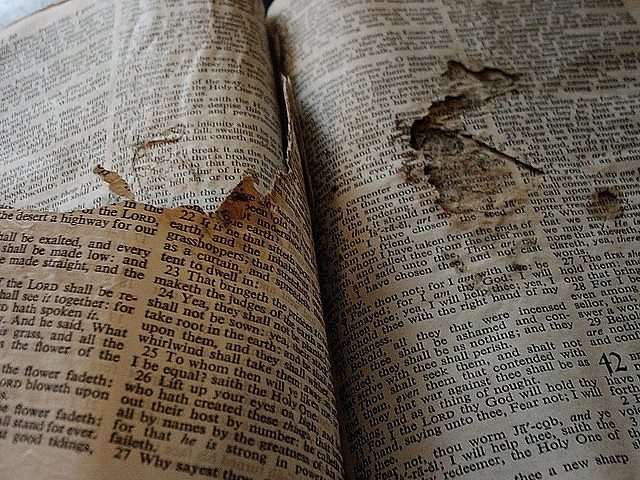
Photo Credit: Felicia Atkinson.
As an Evangelical Protestant, I didn’t think about the disparate state of the Christian Church very much. It wasn’t on my radar. I was, for a while, a nominal Pentecostal. Then I found a charismatic Pentecostal community. Then, a bit later on, I joined an quasi-Baptist church (which was shortly thereafter ejected from the denomination, or departed).
I ended my career as an Evangelical in a phenomenal non-denominational church.
Then I became Catholic.
And, while I didn’t think much about the plethora of Protestant denominations early on in my faith journey, when I began to consider questions about the Bible, tradition, and authority I began to take another look at the landscape of the Christian Church.
The Bible is the Standard of Truth
As an Evangelical, I held the Bible to be my highest authority of Truth.
The Bible was it.
We believed and followed what the Bible taught. We lived according to that standard.
And it seemed to make sense. After all, the Bible was the record of the very words of Christ and His apostles, His prophets and forerunners in the Old Testament, and His revelation of the end of the world, as recorded by the Apostle John.
It was the Word of God, and we treated it as such.
But in setting up the Word of God as the standard by which we must live we Protestants created an enormous problem: Who interprets the Bible?
My Spiritual Lineage
As a nominal Pentecostal we believed in the parts of the New Testament that refer to what we called the gifts of the Spirit we just didn’t believe they were that big of a deal. Occasionally, on a Sunday morning, one of the older ladies in the congregation would get up and begin feverishly speaking in tongues but she was, most often, quietly subdued by one of the elders in the church.
As a charismatic Pentecostal, speaking in tongues was a regular occurrence on a Sunday morning, Sunday night, or Wednesday at the mid-week prayer service. It wasn’t subdued, it was encouraged. And those who hadn’t yet spoken in tongues—those who hadn’t received the gift—hadn’t yet been “baptized by fire,” and weren’t to be considered truly Christian. Not just yet anyway.
As a quasi-Baptist, our church was seeker-friendly and emphasized the forgiving message of Jesus. Sunday mornings were intentionally accessible and friendly. When the leadership team decided, based on their interpretation of Scripture, to begin to elect women to the board of elders tensions with the larger denomination grew and, if I recall right, the church eventually left the denominational fold which originally commissioned them.
Finally, as a non-denominational Christian, I was part of a loving and welcoming church which emphasized the importance of tradition alongside social justice causes and building genuine community. As a leadership team, the church chose to emphasize very little in the way of doctrine and lets most members of the congregation decide for themselves. As a result, beliefs on issues of same-sex marriage, abortion, the nature of Scripture, and prayer, are held in a diversity of opinions amongst the congregation.
This is my spiritual lineage.
Interpretation Divides Us
At the time, moving from church to church over the course of a decade and a half, I didn’t see much of a problem. I wasn’t, like some Protestants, loyal to a particular denomination. We’re all part of the Church of Christ after all, right? (Not to be confused with the denomination that calls itself the Church of Christ, mind you.)
But exactly why are there so many different Protestant denominations?
The difficulty, I realized, arises from interpretations of Scripture.
In my nominally Pentecostal church, leadership interpreted the gifts of the spirit to have a role in the church community but not one of substantial emphasis. In my charismatic Pentecostal community the emphasis was paramount; the notion of “baptism of fire” was a central teaching. In the quasi-Baptist church I attended, division split the church and denominational over interpretations of the role of women in leadership. And, in the non-denominational church, fault lines between interpretations over same-sex marriage and abortion divide the church within itself.
Why are there so many Christian denominations?
Because there are so many biblical interpretations: gifts of the Spirit are paramount; or they’re not. Women should be in Church leadership; or they shouldn’t. Jesus condones same-sex marriage; or he doesn’t. Abortion is a human right; or it’s murder.
These issues, and scores more, divide the Protestant church, even within Protestant denominations, and all sides have Scripture to back up their perspectives.
But who is right?
Agreeing in Principle, Or Not
I began to ask this question, and began to trace the problem to the authority and interpretation of Scripture and I began feel a nagging sense of doom.
If God is good, like he says he is, then why is Christianity so confusing?
Why is it so difficult to read my Bible? Is there any absolute standard of truth?
As Christians, we assert that there is, but sussing it out seems incredibly difficult. If my examples above don’t suffice there are many, many more.
As an Evangelical I’d dismiss differences between, say, the charismatic church and my non-denominational one as small sticking points. Unimportant bits of doctrine in a large Christian Church.
We’re divided. It’s unfortunate but it’s OK. We agree, in principle, on what really matters.
But what happens when we don’t?
Isn’t the right of a human being to be born a fundamental right? Or a woman’s right to choose?
Isn’t the right of a person to marry whomever they want, or the assertion that God created marriage only one certain way, fundamental points of view?
What about the infallibility of Scripture? The nature of the Trinity? The role of the Holy Spirit?
Digging down, as an Evangelical, I found that we don’t, actually, agree in principle on what matters. On what matters, we held many different opinions.
The Catholic Church with the Authority to Interpret
My wandering in the desert of my Evangelical faith led me back, again and again, to that nagging question.
If God is so good why is Christianity so confusing?
It seemed like an awfully small target to hit, finding the exact right denomination that interpreted the Bible correctly.
Because if there is absolute truth then there must be a correct way to interpret Scripture, right?
At this junction is where Catholicism began to make sense to me.
Instead of presenting a Scripture Alone view of Christianity, Catholicism asserts that Christ founded a Church and left it with the authority to teach and interpret Scripture. A leader, in the Pope, and bishops. Teachers.
This began to make more sense in a historical context.
The average Christian couldn’t read, actually, for the majority of the history of the Church.
Even if the average Christian could read, the printing press didn’t make the Bible accessible until the 16th century.
Nevermind that the Scriptures, as we know them, weren’t officially collected until a few hundred years after the death and resurrection of Christ.
On and on.
What I found in the Catholic Church made sense.
If God really intended us to know Him and learn how to follow Him through Scripture alone then why was it so difficult? Why doesn’t the Holy Spirit lead us all to the same interpretations? Why are there so many different opinions and perspectives? And which one is right?
Is This What Was Meant to Be?
God is good.
God didn’t leave us alone with a book, He gave us a Church. A Church with the authority to tell us what Scripture means and to guide us in living it out.
This, to me, makes far more sense than each and every Christian being expected to decide, and make sense of Scripture, for themselves. Because look where that has gotten us.
Don’t get me wrong. I have never been more grateful for my spiritual lineage than I am now, as a Catholic. Ironically, my Evangelical past has given me a robust knowledge of the Bible. And a thirst for God. But it’s also given me a perspective on the Church and a conviction.
Do we really think the non-Christian world sees Christians and thinks, for the most part, “There’s a bunch who’ve got it figured out.”
Do they, like Jesus prayed, know we’re Christians by our unity?
It is, surely, a long and arduous road back but it needs to be tread by all of us.
It began for me, in part, but looking around and making a stark discovery. If God is good then why is Christianity so confusing?
Is this what it was meant to be?
Previous Post
August 18, 2015
This One Quote Convinced Me to Be a Catholic
Next Post

August 21, 2015 What Should We Do With Bad Catholics?
Browse Our Archives
Select a Category Appearances Christian Living Explaining the Faith Podcast Tough Questions Uncategorized Why I'm Catholic
Select a Month January 2024 December 2023 November 2023 July 2023 June 2023 May 2023 April 2023 March 2023 February 2023 January 2023 December 2022 November 2022 October 2022 September 2022 August 2022 July 2022 June 2022 May 2022 April 2022 March 2022 February 2022 January 2022 December 2021 November 2021 October 2021 September 2021 August 2021 July 2021 June 2021 May 2021 April 2021 March 2021 February 2021 January 2021 December 2020 November 2020 October 2020 September 2020 August 2020 July 2020 June 2020 May 2020 April 2020 March 2020 February 2020 January 2020 December 2019 November 2019 October 2019 September 2019 August 2019 July 2019 June 2019 May 2019 April 2019 March 2019 February 2019 January 2019 December 2018 November 2018 October 2018 September 2018 August 2018 July 2018 June 2018 May 2018 April 2018 March 2018 February 2018 January 2018 December 2017 October 2017 September 2017 July 2017 May 2017 April 2017 March 2017 February 2017 January 2017 December 2016 November 2016 October 2016 September 2016 August 2016 July 2016 June 2016 May 2016 April 2016 March 2016 February 2016 January 2016 December 2015 November 2015 October 2015 September 2015 August 2015 July 2015 June 2015 May 2015 April 2015 March 2015 February 2015 January 2015 December 2014 November 2014 October 2014
Follow Us!
TAKE THE
Religious Wisdom Quiz
What does the Sword of the Spirit represent?
Select your answer to see how you score.
The Word of God Faith The Holy Spirit The power of prayer
Support this
Column


Related posts from The Cordial Catholic

235: Questions I Couldn't Answer (w/ John Martignoni)
204: The Great Big Protestant Problem with Scripture...
200: Reasons to Doubt Sola Scriptura (w/ Jimmy...
166: How the Early Church Read the Bible...
TRENDING AT PATHEOS Catholic

Rejecting Doom: Christian Hope And Human Action
Christianity is a religion of hope. We are to have hope and...

It’s What Comes From Within Which Matters
One of the most difficult things for us to understand is why...

Why I Choose the Eucharist Over the Sermon
Choose the Eucharist, Not the Sermon What are we supposed to get...

5 Design Elements Found in Spiritually Rooted Homes
Putting Spirituality Into Home Decor Our homes are more than our living...

Credo: A Story of God Told with the...
About 10 years ago, I began to imagine a personal "Credo" that...

The Anatomy of Divine Revelation in Catholic Thought
The claim that God has made Himself known to human beings is...
view all Catholic blogs
Ad-Free & Subscriber Log-In Subscription Support
- About Us
- 2026 Calendar
- Videos
- Podcasts
- Library of World Religions
- Faith In Media Tracker
- Advertise With Us
- Write for Us
- Privacy Policy
- Terms of Service
- Do Not Sell My Data
- Contact Us
- Radiant Digital
- Manage Newsletter Subscriptions
- Unsubscribe From Notifications
- Sitemap
Copyright 2008-2026, Patheos. All rights reserved.
Subscription Support Ad-Free & Subscriber Log-In
Follow Patheos