
BuddhistCatholicContemplativeEvangelicalGeneral ChristianHinduJewishLatter-day SaintMuslimNew VisionsProgressive Christian
Beliefs
- Buddhist
- Catholic
- Contemplative
- Evangelical
- General Christian
- Hindu
- Jewish
- Latter-day Saint
- More Voices
- Muslim
- New Visions
- Pagan
- Progressive Christian
Topics
- Religion News
- Food and Religion
- Sports and Religion
- Religious Art
- Religious Music and Entertainment
- Religious Events
- History and Religion
- Style and Religion
- Politics and Religion
- Women in Religion
- Recreation Outdoors and Religion
- Business Finance and Religion
- Careers Workplace and Religion
- Education and Religion
- Family Parenting and Religion
- Health Fitness and Religion
- Home and Religion
- Relationships and Religion
- Technology and Religion
- Travel and Religion
Columnists
- Buddhist Columnists
- Business Finance and Religion Columnists
- Careers Workplace and Religion Columnists
- Catholic Columnists
- Contemplative Columnists
- Education and Religion Columnists
- Evangelists Columnists
- Family Parenting and Religion Columnists
- General Christian Columnists
- Health Fitness and Religion Columnists
- Hindu Columnists
- History and Religion Columnists
- Home and Religion Columnists
- Jewish Columnists
- More Voices Columnists
- Latter Day Columnists
- Muslim Columnists
- New Visions Columnists
- Nonreligious Columnists
- Pagan Columnists
- Politics and Religion Columnists
- Progressive Columnists
- Recreation Outdoors and Religion Columnists
- Relationships and Religion Columnists
- Religion News Columnists
- Religious Art Columnists
- Religious Events Columnists
- Religious Music and Entertainment Columnists
- Sports and Religion Columnists
- Style and Religion Columnists
- Technology and Religion Columnists
- Travel and Religion Columnists
- Women in Religion Columnists
Resource Library
- 2026 Calendar
- Library of World Religions
- The 100 Most Holy Places on Earth
- Patheos Answers
- Podcasts
- Videos
- Faith Leaders Database
- Anglican Episcopalian
- Bahai
- Baptist
- Buddhism
- Christianity
- Confucianism
- Eastern Orthodoxy
- Hinduism
- Holiness and Pentecostal
- ISKCON
- Islam
- Judaism
- Lutheran
- Methodist
- The Church of Jesus Christ of Latter-day Saints
- New Age
- Paganism
- Presbytarian and Reformed
- Protestantism
- Religion Behind the Scenes
- Roman Catholic
- Scientology
- Shia Islam
- Sikhism
- Sufism
- Sunni Islam
- Taoism
- Zen
- See all religions
Research Tools
 Ad-Free & Subscriber Log-In Subscription Support
Ad-Free & Subscriber Log-In Subscription Support
Follow Patheos 

- Trending:
- Forgiveness
- |
- Marriage
- |
- Consciousness
- |
- Death Penalty
- |
- Election
- |
- Halloween
 The Cordial Catholic
- Home
- Catholic
- I Love Being Catholic (But I Don’t Always Like It)
I Love Being Catholic (But I Don’t Always Like It)
Last updated on: April 9, 2018 at 2:02 pm by K. Albert Little
I Love Being Catholic (But I Don’t Always Like It) 2018-04-09T14:02:24-04:00 K. Albert Little
Patheos Explore the world's faith through different perspectives on religion and spirituality! Patheos has the views of the prevalent religions and spiritualities of the world.
When my wife and I began marriage preparation classes almost 10 years ago one of the first questions we were asked was, “Do you think you’ll be more or less ‘in love’ after 10 years of marriage?”
I’ll save you from wondering and tell you, right away, that I answered wrong.
“Well of course we’ll be at least a little bit less in love,” I said, far too quickly.
I assumed, back then, that those heady early days of marriage would be full of romance, passion (sorry Mom), and mutual feelings of unending love. We were forging new territory, breaking new ground—exploring a brand new country called ‘marriage’ and surely that feeling wouldn’t last forever.
Surely those strong feelings would fade.
Yeah, so… I answered wrong.
What, I think, any decent marriage counselor will tell you is what he told us next.
Your love should grow deeper. (Couples in great marriages know this is true.)
See, those romantic, honeymoon feelings might change but your marriage should become a relationship of mutual admiration, of respect, of deeply-seated love that only grows as you get to know your spouse better. As you exist in the same physical space, with the same physical person, on a day-to-day basis you begin to learn what makes them the happiest (and they learn this about you), you begin to appreciate and understand their hurts and hang-ups, you grow to know them deeper and deeper to the point of not knowing, really, how you’d do life in any other way.
This is why Christ calls marriage the joining of “one flesh,” and why of all the pictures of what God is like, marriage is the one which he has chosen to highlight from the beginning (Adam and Even in Genesis) to the end (the marriage supper of the Lamb in Revelation).
It’s also an apt picture of our faith life.
I can say, without reservation, that I love being Catholic.
In the physical Catholic faith, in the sacraments and the theology, in the rich spiritual traditions and practices I have found something which I can hardly put into words. It’s stunningly beautiful.
A worldview with such depth and clarity and scope that it enriches every aspect of my life that it touches (and it touches every aspect).
I love being Catholic, but I don’t always like it.
Here, we can compare our faith to marriage.
On a day-to-day basis I won’t always like my wife.
(I should say, I give her more cause not to like me, not the other way around.)
This is reasonable, this is human because two people can’t always get along 100% of the time. It’s life. We’ll get into an argument, say, or not agree on how something will be done and I’ll get frustrated and mope. That’s usually how it goes at least.
We don’t swear, we don’t (hardly) yell, we’ve put a lot of effort into communicating appropriately and effectively but like every other couple in the world we don’t always agree and although we try very hard, all the time, to live a Christ-like marriage we don’t always succeed and in that unsuccess we sometimes don’t like each other.
But our love is so much stronger.
See love is a committment not simply a feeling, and therein lies the extremely important distinction: I may not always like the things my wife says or does but I will always commit to loving her because that’s a commitment we made. And even when I may not feel like liking her our love is so much more deeply-seated than that.
Same for faith.
Now it’s not like I’m never allowed to stop loving my faith anymore than I’m not allowed to stop loving my spouse. If my wife or my priest or a radical sect of Spanish Inquisitors held me down and forced me to love my wife that would be no more true loving than if I were told I must be a Catholic or I’d be killed at the stake.
I commit because *I want to—*both to love and faith. But make no mistake, it’s a commitment and it takes recommiting every day.
As a Catholic, some things bug me a lot. Some Catholics with ideologies bent towards a certain direction rub me the wrong way. Some Catholics with no ideology at all rub me the wrong way. And one time Trent Horn lambasted an article that I wrote on a radio show and I think his analogy was totally wrong (anyway, he’s a great guy).
But I still love being Catholic.
Do I always like the practice of my faith, the Catholic blogosphere, and the sacrifices I sometimes have to make? Heck, no.
I don’t want to eat fish ever.
But my love for Catholicism is deeper than these surface-level likes. And the roots of the Catholic faith go much deeper, too. Much deeper than the current Pope, our college of cardinals, and our local bishops. Like them or not. Much deeper than the current crop of Catholic authors, apologists, and theologians. Much deeper, thank God, than the current vanguard of bloggers like myself.
In the end I think it’s obvious why God, in his wisdom, chose marriage as the ultimate example of our faith. And, like any good marriage, it sometimes takes work (go figure). And on the days, hopefully few and far between, when we sometimes don’t feel like liking our spouse or our marriage or our faith it is possible, if we choose, to commit anyway.
After all, there is an ancient tradition in the Catholic faith called the “dark night of the soul” and its reality stretches back all the way to Job. That bad things might happen. That sometimes we might not like God. That we may find ourselves walking in “the dark” for days, weeks, or years on end is a reality of living the Christian faith.
And the reality is, we may not always like what we ought to love—but we can love nonetheless.
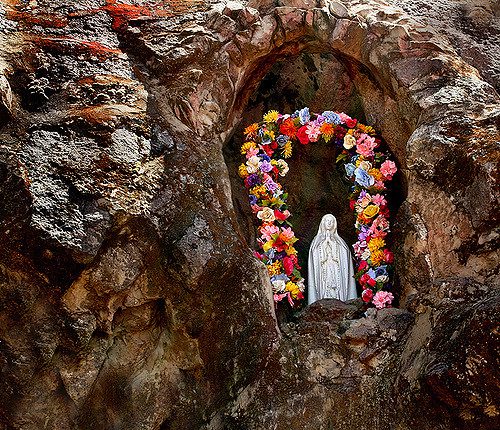
Photo courtesy of michellehurwitz (flickr).
Previous Post

April 7, 2018
The Incredible Biblical Basis for Relics
Next Post
April 16, 2018 Why Does the Priest Do The Dishes?
Browse Our Archives
Select a Category Appearances Christian Living Explaining the Faith Podcast Tough Questions Uncategorized Why I'm Catholic
Select a Month January 2024 December 2023 November 2023 July 2023 June 2023 May 2023 April 2023 March 2023 February 2023 January 2023 December 2022 November 2022 October 2022 September 2022 August 2022 July 2022 June 2022 May 2022 April 2022 March 2022 February 2022 January 2022 December 2021 November 2021 October 2021 September 2021 August 2021 July 2021 June 2021 May 2021 April 2021 March 2021 February 2021 January 2021 December 2020 November 2020 October 2020 September 2020 August 2020 July 2020 June 2020 May 2020 April 2020 March 2020 February 2020 January 2020 December 2019 November 2019 October 2019 September 2019 August 2019 July 2019 June 2019 May 2019 April 2019 March 2019 February 2019 January 2019 December 2018 November 2018 October 2018 September 2018 August 2018 July 2018 June 2018 May 2018 April 2018 March 2018 February 2018 January 2018 December 2017 October 2017 September 2017 July 2017 May 2017 April 2017 March 2017 February 2017 January 2017 December 2016 November 2016 October 2016 September 2016 August 2016 July 2016 June 2016 May 2016 April 2016 March 2016 February 2016 January 2016 December 2015 November 2015 October 2015 September 2015 August 2015 July 2015 June 2015 May 2015 April 2015 March 2015 February 2015 January 2015 December 2014 November 2014 October 2014
Follow Us!
TAKE THE
Religious Wisdom Quiz
Who said, "Faith without works is dead"?
Select your answer to see how you score.
James Paul Peter John
Support this
Column


Related posts from The Cordial Catholic

232: The Trajectory of Conversion (w/ Phillip Campbell)

229: Can Catholics and Evangelicals Agree on How...
212: Evangelicals, Here's How to Look for a...
210: I Was Going to be an Anglican...
TRENDING AT PATHEOS Catholic

Rejecting Doom: Christian Hope And Human Action
Christianity is a religion of hope. We are to have hope and...

It’s What Comes From Within Which Matters
One of the most difficult things for us to understand is why...

Why I Choose the Eucharist Over the Sermon
Choose the Eucharist, Not the Sermon What are we supposed to get...

5 Design Elements Found in Spiritually Rooted Homes
Putting Spirituality Into Home Decor Our homes are more than our living...

Credo: A Story of God Told with the...
About 10 years ago, I began to imagine a personal "Credo" that...

The Anatomy of Divine Revelation in Catholic Thought
The claim that God has made Himself known to human beings is...
view all Catholic blogs
Ad-Free & Subscriber Log-In Subscription Support
- About Us
- 2026 Calendar
- Videos
- Podcasts
- Library of World Religions
- Faith In Media Tracker
- Advertise With Us
- Write for Us
- Privacy Policy
- Terms of Service
- Do Not Sell My Data
- Contact Us
- Radiant Digital
- Manage Newsletter Subscriptions
- Unsubscribe From Notifications
- Sitemap
Copyright 2008-2026, Patheos. All rights reserved.
Subscription Support Ad-Free & Subscriber Log-In
Follow Patheos