
BuddhistCatholicContemplativeEvangelicalGeneral ChristianHinduJewishLatter-day SaintMuslimNew VisionsProgressive Christian
Beliefs
- Buddhist
- Catholic
- Contemplative
- Evangelical
- General Christian
- Hindu
- Jewish
- Latter-day Saint
- More Voices
- Muslim
- New Visions
- Pagan
- Progressive Christian
Topics
- Religion News
- Food and Religion
- Sports and Religion
- Religious Art
- Religious Music and Entertainment
- Religious Events
- History and Religion
- Style and Religion
- Politics and Religion
- Women in Religion
- Recreation Outdoors and Religion
- Business Finance and Religion
- Careers Workplace and Religion
- Education and Religion
- Family Parenting and Religion
- Health Fitness and Religion
- Home and Religion
- Relationships and Religion
- Technology and Religion
- Travel and Religion
Columnists
- Buddhist Columnists
- Business Finance and Religion Columnists
- Careers Workplace and Religion Columnists
- Catholic Columnists
- Contemplative Columnists
- Education and Religion Columnists
- Evangelists Columnists
- Family Parenting and Religion Columnists
- General Christian Columnists
- Health Fitness and Religion Columnists
- Hindu Columnists
- History and Religion Columnists
- Home and Religion Columnists
- Jewish Columnists
- More Voices Columnists
- Latter Day Columnists
- Muslim Columnists
- New Visions Columnists
- Nonreligious Columnists
- Pagan Columnists
- Politics and Religion Columnists
- Progressive Columnists
- Recreation Outdoors and Religion Columnists
- Relationships and Religion Columnists
- Religion News Columnists
- Religious Art Columnists
- Religious Events Columnists
- Religious Music and Entertainment Columnists
- Sports and Religion Columnists
- Style and Religion Columnists
- Technology and Religion Columnists
- Travel and Religion Columnists
- Women in Religion Columnists
Resource Library
- 2026 Calendar
- Library of World Religions
- The 100 Most Holy Places on Earth
- Patheos Answers
- Podcasts
- Videos
- Faith Leaders Database
- Anglican Episcopalian
- Bahai
- Baptist
- Buddhism
- Christianity
- Confucianism
- Eastern Orthodoxy
- Hinduism
- Holiness and Pentecostal
- ISKCON
- Islam
- Judaism
- Lutheran
- Methodist
- The Church of Jesus Christ of Latter-day Saints
- New Age
- Paganism
- Presbytarian and Reformed
- Protestantism
- Religion Behind the Scenes
- Roman Catholic
- Scientology
- Shia Islam
- Sikhism
- Sufism
- Sunni Islam
- Taoism
- Zen
- See all religions
Research Tools
 Ad-Free & Subscriber Log-In Subscription Support
Ad-Free & Subscriber Log-In Subscription Support
Follow Patheos 

- Trending:
- Forgiveness
- |
- Marriage
- |
- Consciousness
- |
- Death Penalty
- |
- Election
- |
- Halloween
 The Cordial Catholic
- Home
- Catholic
- I Am the Pope (And So Are You!)
I Am the Pope (And So Are You!)
Last updated on: September 22, 2015 at 7:00 pm by K. Albert Little
I Am the Pope (And So Are You!) 2015-09-22T19:00:19-04:00 K. Albert Little
Patheos Explore the world's faith through different perspectives on religion and spirituality! Patheos has the views of the prevalent religions and spiritualities of the world.
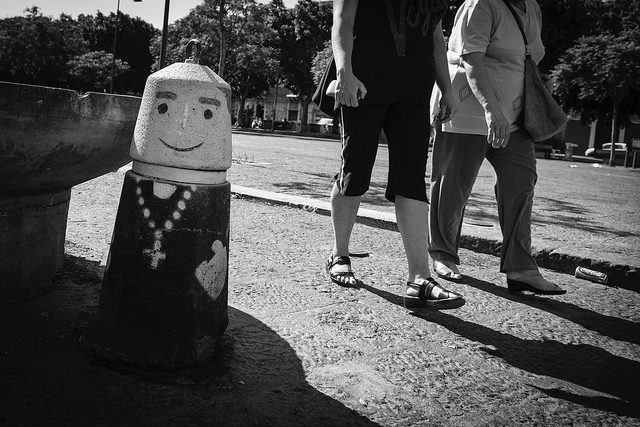
Photo Credit: Raffaele Esposito.
Over on his critically acclaimed blog Standing on My Head, Anglican priest turned Catholic pastor Dwight Longenecker is blowing some new wind into the sails of the sola Scriptura sucks ship.
And the ship is sailin’.
Although that’s not to say that Fr. Longenecker is full of hot air.
Because he’s absolutely right.
As an Evangelical, I came from a tradition that believes that all we need is the Bible—and a good interpretation of it—in order to understand how to be a Christian.
I almost said, “I came from a long-standing tradition” but that wouldn’t be fair, or accurate.
Actually, the Bible Alone theology, which just about every Evangelical wittingly or unwittingly subscribes to is not a “long-standing tradition” but one of alarming recency.
I think few of us Evangelicals ever considered this, or knew it. I certainly had no idea.
But it’s true.
Historically, even Luther and Calvin, the Fathers of the Protestant Reformation, believed that Scripture needed to be interpreted in the context of their own church communities. For Luther, the Lutheran Church. For Calvin, the Reformed. It was these churches which had, and held, the most correct interpretation of Scripture.
The idea that each and every person can interpret the Bible for themselves—and that this was the normative Christian experience—would’ve been utterly shocking to the Early Reformers.
In fact, shockingly, the idea of “Bible Alone” as meaning “me and my Bible” is an idea that is more modern than gunpowder.
Gunpowder.
That’s, uh, fairly recent by my estimation.
As an Evangelical, at this point in my life, I was a bit flummoxed to discover that my normative approach to being a Christian wasn’t normative until about 200 years ago.
And then there’s the problem of biblical interpretation in and of itself. Fr. Longenecker writes,
It is not a single, consistent, cross referenced, totally precise document. It is not a constitution or a legal contract. It is not an agreed rule book for the game or a set of instructions. It is not a neat owner’s manual or a company handbook complete with a set of protocols for every situation.
Problem is: it’s often read that way.
As an Evangelical, when encountering a difficult piece of Scripture that I didn’t understand—say, on the consumption of alcohol, for example—I was told, and believed, that the Holy Spirit would help me in my interpretation.
The Spirit would guide me towards the most accurate understanding of what St. Paul was talking about in his epistles.
But, in practicality, that never happened because amongst my friends and I we held—in those tumultuous and heady days of high school—a myriad of different interpretations.
Despite our best attempts, prayers, and feverish biblical exegesis, we simply couldn’t agree.
And that’s only one example.
For me, the shocking realization that my version of sola Scriptura was actually incredibly recent, coupled with our universal struggles with biblical interpretation, led me to reconsidering my entire outlook on Christianity.
And the floodgates opened.
If “Bible Alone” was intended as the normative approach to the Scriptures then why wasn’t it practiced for nearly 1,800 years?
If “Bible Alone” is the normative approach to Scriptural interpretation why are there so many different interpretations?
If “Bible Alone” was always intended to be how Christians followed Christ what about those that couldn’t, and can’t, read?
And so on, and so on.
When Fr. Longenecker says that Protestants are destroying Christianity he’s certainly got a point. Because when you remove the interpretation of Scripture from the authoritative context in which it was, for the majority of human history, authoritatively interpreted, you got a hodgepodge of competing interpretations.
This is exactly what my Evangelical Christianity did.
But it’s impossible to rightly interpret the Bible on my own—or even with friends.
Even if I become a biblical scholar and spend a lifetime studying context, languages, history, and literary criticism the minute I make what I think is the only possible interpretation of a selection of Scripture out of the woodwork would come an army of equally capable, credentialed, and confident biblical scholars to offer their alternative perspectives.
The thing I ultimately came to understand is that there must be an authoritative faculty that’s able to interpret the Bible. There must be an ultimate authority.
And, no surprise, this is exactly what Jesus left us.
Because He gave, if you recall, the ability to bind and loose, to St. Peter, in particular, and then all of his apostles, in general.
Jesus didn’t leave us a Bible alone with the Holy Spirit as interpreter; Jesus left us with an authoritative body to aid in the understanding of how to live a Christian life. And, not shocking, He promise it would endure until the end of time.
How easily, as an Evangelical, I brushed off these crucial passages and continued to struggle, on my own, to understand my Bible.
But there’s a better way.
Ultimately, it came down to this: If I’m able to interpret my Bible, with the help of the Holy Spirit alone, then I am the Pope.
I am the Pope.
Isn’t that exactly what happens? We make ourselves the infallible interpreter of God’s Word and there’s never what He intended.
Because if I’m the Pope then you’re the Pope, too. Because whose interpretation is correct?
No thanks.
Because for the overwhelming majority of our Christian history the Pope and the Church Councils were the interpreters of Scripture. In a history which traced itself back through the Church Fathers to the very words of Christ—this was the mechanism for understanding our Bibles and our faiths.
Even beyond the Reformation, in the way in which the Early Reformers like Luther and Calvin understood Scripture there was a clear and delineated place for the interpretation of Scripture: in the Church Community.
Our own, modern take on sola Scriptura is fatally flawed and never what was intended by the Reformation. Instead of a meaningful criticism of the power structure of the Catholic Church—which the Reformation was intended to be—we’ve, unfortunately, ended up with a Christianity so fractured that it would be barely recognizable to the Early Reformers, I’m sure.
I don’t, by any means, intend here to heap coals on my time as an Evangelical only to say this: That our understanding of Bible Alone needs to be honestly and painfully examined under the microscope. For me, such a rigorous examination put me on a very particular path. And it’s been incredible.
Previous Post

September 16, 2015
Don't Worry Catholics, Your Church Will Be OK
Next Post

September 30, 2015 No, You Don't Know The Pope
Browse Our Archives
Select a Category Appearances Christian Living Explaining the Faith Podcast Tough Questions Uncategorized Why I'm Catholic
Select a Month January 2024 December 2023 November 2023 July 2023 June 2023 May 2023 April 2023 March 2023 February 2023 January 2023 December 2022 November 2022 October 2022 September 2022 August 2022 July 2022 June 2022 May 2022 April 2022 March 2022 February 2022 January 2022 December 2021 November 2021 October 2021 September 2021 August 2021 July 2021 June 2021 May 2021 April 2021 March 2021 February 2021 January 2021 December 2020 November 2020 October 2020 September 2020 August 2020 July 2020 June 2020 May 2020 April 2020 March 2020 February 2020 January 2020 December 2019 November 2019 October 2019 September 2019 August 2019 July 2019 June 2019 May 2019 April 2019 March 2019 February 2019 January 2019 December 2018 November 2018 October 2018 September 2018 August 2018 July 2018 June 2018 May 2018 April 2018 March 2018 February 2018 January 2018 December 2017 October 2017 September 2017 July 2017 May 2017 April 2017 March 2017 February 2017 January 2017 December 2016 November 2016 October 2016 September 2016 August 2016 July 2016 June 2016 May 2016 April 2016 March 2016 February 2016 January 2016 December 2015 November 2015 October 2015 September 2015 August 2015 July 2015 June 2015 May 2015 April 2015 March 2015 February 2015 January 2015 December 2014 November 2014 October 2014
Follow Us!
TAKE THE
Religious Wisdom Quiz
How many children did Job lose in the disasters at the beginning of the book?
Select your answer to see how you score.
Twelve Ten Five Seven
Support this
Column


Related posts from The Cordial Catholic

235: Questions I Couldn't Answer (w/ John Martignoni)
204: The Great Big Protestant Problem with Scripture...
200: Reasons to Doubt Sola Scriptura (w/ Jimmy...
166: How the Early Church Read the Bible...
TRENDING AT PATHEOS Catholic

Rejecting Doom: Christian Hope And Human Action
Christianity is a religion of hope. We are to have hope and...

It’s What Comes From Within Which Matters
One of the most difficult things for us to understand is why...

Why I Choose the Eucharist Over the Sermon
Choose the Eucharist, Not the Sermon What are we supposed to get...

5 Design Elements Found in Spiritually Rooted Homes
Putting Spirituality Into Home Decor Our homes are more than our living...

Credo: A Story of God Told with the...
About 10 years ago, I began to imagine a personal "Credo" that...

The Anatomy of Divine Revelation in Catholic Thought
The claim that God has made Himself known to human beings is...
view all Catholic blogs
Ad-Free & Subscriber Log-In Subscription Support
- About Us
- 2026 Calendar
- Videos
- Podcasts
- Library of World Religions
- Faith In Media Tracker
- Advertise With Us
- Write for Us
- Privacy Policy
- Terms of Service
- Do Not Sell My Data
- Contact Us
- Radiant Digital
- Manage Newsletter Subscriptions
- Unsubscribe From Notifications
- Sitemap
Copyright 2008-2026, Patheos. All rights reserved.
Subscription Support Ad-Free & Subscriber Log-In
Follow Patheos