
BuddhistCatholicContemplativeEvangelicalGeneral ChristianHinduJewishLatter-day SaintMuslimNew VisionsProgressive Christian
Beliefs
- Buddhist
- Catholic
- Contemplative
- Evangelical
- General Christian
- Hindu
- Jewish
- Latter-day Saint
- More Voices
- Muslim
- New Visions
- Pagan
- Progressive Christian
Topics
- Religion News
- Food and Religion
- Sports and Religion
- Religious Art
- Religious Music and Entertainment
- Religious Events
- History and Religion
- Style and Religion
- Politics and Religion
- Women in Religion
- Recreation Outdoors and Religion
- Business Finance and Religion
- Careers Workplace and Religion
- Education and Religion
- Family Parenting and Religion
- Health Fitness and Religion
- Home and Religion
- Relationships and Religion
- Technology and Religion
- Travel and Religion
Columnists
- Buddhist Columnists
- Business Finance and Religion Columnists
- Careers Workplace and Religion Columnists
- Catholic Columnists
- Contemplative Columnists
- Education and Religion Columnists
- Evangelists Columnists
- Family Parenting and Religion Columnists
- General Christian Columnists
- Health Fitness and Religion Columnists
- Hindu Columnists
- History and Religion Columnists
- Home and Religion Columnists
- Jewish Columnists
- More Voices Columnists
- Latter Day Columnists
- Muslim Columnists
- New Visions Columnists
- Nonreligious Columnists
- Pagan Columnists
- Politics and Religion Columnists
- Progressive Columnists
- Recreation Outdoors and Religion Columnists
- Relationships and Religion Columnists
- Religion News Columnists
- Religious Art Columnists
- Religious Events Columnists
- Religious Music and Entertainment Columnists
- Sports and Religion Columnists
- Style and Religion Columnists
- Technology and Religion Columnists
- Travel and Religion Columnists
- Women in Religion Columnists
Resource Library
- 2026 Calendar
- Library of World Religions
- The 100 Most Holy Places on Earth
- Patheos Answers
- Podcasts
- Videos
- Faith Leaders Database
- Anglican Episcopalian
- Bahai
- Baptist
- Buddhism
- Christianity
- Confucianism
- Eastern Orthodoxy
- Hinduism
- Holiness and Pentecostal
- ISKCON
- Islam
- Judaism
- Lutheran
- Methodist
- The Church of Jesus Christ of Latter-day Saints
- New Age
- Paganism
- Presbytarian and Reformed
- Protestantism
- Religion Behind the Scenes
- Roman Catholic
- Scientology
- Shia Islam
- Sikhism
- Sufism
- Sunni Islam
- Taoism
- Zen
- See all religions
Research Tools
 Ad-Free & Subscriber Log-In Subscription Support
Ad-Free & Subscriber Log-In Subscription Support
Follow Patheos 

- Trending:
- Forgiveness
- |
- Marriage
- |
- Consciousness
- |
- Death Penalty
- |
- Election
- |
- Halloween
 The Cordial Catholic
- Home
- Catholic
- How First Confession Blew My Mind
How First Confession Blew My Mind
Last updated on: August 3, 2015 at 3:59 pm by K. Albert Little
How First Confession Blew My Mind 2015-08-03T15:59:33-04:00 K. Albert Little
Patheos Explore the world's faith through different perspectives on religion and spirituality! Patheos has the views of the prevalent religions and spiritualities of the world.
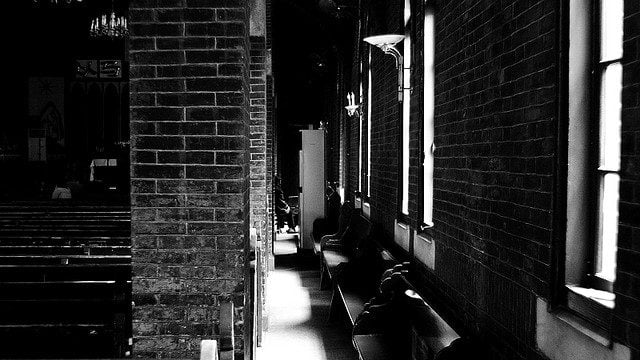
Confession. Photo Credit: Joel Ye.
I’m convinced, utterly, that confession is the single greatest gift God gave this weary world.
A gift that’s found solely in the Catholic Church.
A gift that, as a Protestant converting to the Catholic faith, has completely blown me away.
I began my journey into the Catholic Church nearly a decade ago but I began the final leg, in earnest, this Fall, when I enrolled in RCIA (Rite of Christian Initiation for Adults) at my local parish. I’ve had mixed experiences, to be sure. I’ve realized that not all parishes are created equal. I’ve realized that it’s not all about me. But I’ve also experienced God’s grace in incredible ways and through my own frustrations, arrogance, and pride I’ve found God in whole new ways. I’ve been deeply enriched.
But for all the book knowledge I’ve acquired and all the helpful folks I’ve spoke to nothing prepared me for my first experience of the Sacrament of Reconciliation, and it’s completely changed my life.
Reconciliation with God
To understand the Sacrament of Reconciliation requires a little bit of legwork up front.
First, although it’s commonly called confession I think it’s best understood, especially by non-Catholics (like myself), by it’s proper name. It’s the Sacrament of Reconciliation, and that’s important because it’s the sacrament which God has chosen to use to reconcile us to him. That’s the first thing that’s important to understand.
As a Protestant Christian I had a skewed understand of the Catholic view of forgiveness.
God, as I thought that Catholics understood Him to be, was angry and vengeful and Catholics had to confess their sins in fear and trembling lest the Lord smite them. He was a vindictive God who made Catholics drag their shame out into the light for a priest, of all people, to forgive. On the flip side, as a Protestant, I knew I was saved by grace and didn’t need to worry about what I did wrong. I had to confess it in my private prayers, of course, and make at least a token effort at repentance, but I didn’t need to worry. I didn’t need to drag about that so-called Catholic guilt. I was forgiven and needed no one to tell me so.
I understand things a bit different now.
Confession, actually, has always been a big question mark for me.
We’re Commanded to Confess
I remember reading Donald Miller’s seminal Blue Like Jazz
Confession is, clear as day, something we’re commanded to do in the New Testament.
And as evangelical Protestants, we don’t.
And that has always bugged me.
To the Catholic Church—and the Christian Church for the first 1,500 years—is was simple. Jesus gave His apostles the power to forgive. Although it was Jesus’s ultimate sacrifice on the cross that provided us with forgiveness, and reconciled us with God, it was His decision to dispense that forgiveness through men. Men he chose.
This is where I, as a Protestant, went wrong. This is where, I think, lots of us Protestants go wrong: It’s not the priest forgiving, not of his own power at least.
Confession’s Roots in the Early Church
No one, Protestant or Catholic, would argue that the apostles forgave sins in their own names. The apostles forgave sins in Jesus’s name, by the power of Jesus—power that He gave them, clearly, in Scripture.
The early Christians, in fact the earliest Christians we have record of, clearly understood the system that Jesus established. Jesus gave His apostles, whom He directly chose and appointed, the power to forgive sins. He gave this power in His name. When an apostle died a new apostle was appointed. When church communities began the apostles appointed leaders over those communities. The power to forgive sins—a power given by Jesus Himself—was passed on.
Incredible to me, as a Protestant, was that even the most cursory reading of the Early Church Fathers, the disciples who were taught by the apostles themselves, the second generation of Christians, clearly understood this succession. St. Clement of Rome, for example, was directly appointed by an apostle to succeed them in their ministry. St. Clement, then, naturally understood the power and authority that was given to him. Part of that power was the power to forgive, in Jesus’s name.
Remarkable to me, as a Protestant, was to learn that the Catholic Church merely carries on the practice of this power. A power given, clear as day, by Jesus Himself to his apostles. A power the apostles clearly practiced and, in turn, passed on. The line, incredibly, is unbroken throughout the history of the Christian Church until the Protestant Reformation—when the early reformers broke off from the body of the Catholic Church. This succession of power was not in dispute in the Early Christian Church and the earliest Christians, right up until the 16th century reformation, continued to practice confession of sins to appointed priests.
The Extraordinary Gift of Confession
If there’s one thing I’ve learned about the Sacrament of Reconciliation, after experiencing it first-hand, is that it’s the most extraordinary gift from God.
And that it makes sense.
I’ve shared before that God giving us grace through man makes a lot of sense to me. It’s not that God needs priest to dispense His grace. Ultimately, all of our grace comes from Jesus’s incredible act on the cross—make no mistake about that. But, in Catholic theology—and the theology of the Christian Church for the first 1,500 years—God has chosen to work through man.
And this is an incredible gift.
As a Protestant, I often struggled to feel forgiven. I knew I’d sinned, I’d done something wrong, and I needed to make right. I needed to confess, so I’d pray, privately, and ask God for forgiveness.
Now don’t get me wrong, there’s nothing wrong with this. We should be, privately, asking God for forgiveness all the time. We do stupid stuff. Paul was the chief sinner, he said and Peter, regardless of what you think about him, was certainly the chief apostle and he denied Christ. These were people hand-picked by Jesus, and they screwed up. Nevermind the Patriachs and Prophets of the Old Testament.
But the struggle for me, as a Protestant, was to feel forgiven and if there’s any area of the Christian life where head knowledge and heart knowledge collide it’s in the notion of forgiveness. It’s one thing to know I’m forgiven by Jesus’s ultimate sacrifice but it’s another thing entirely to stop holding onto the hurt, and to let it go.
And then I confessed to a man.
My Incredible First Confession
Confession—the Sacrament of Reconciliation—is amazing, and God designed it this way. I’m convinced.
Because how much more powerful is it to hear the words, “You’re forgiven,” from the lips of an actual human being than it is to imagine them in your head and your heart. Think that over, again, because it bears repeating.
I can know intellectually that I’m forgiven. I can have read and studied and turned it around in my brain every which way but to actually feel forgiven and have that forgiveness move into your heart is a whole other thing.
That’s why Jesus intended us to receive forgiveness from His appointed priests. Priests who have their authority in succession from the apostles. Leaders who can trace the power they have to “forgive sins” right back to the very first command Jesus gave after his resurrection. Think about that, too: the very first command that Jesus gave His apostles.
To confess all the frustrating things I’ve done in my life and hear someone say, “You’re forgiven,” and to know that I am really forgiven is the most incredible gift I’ve experienced. To actually hear those words instead of trying my best to muster up the feeling (to go along with the knowledge).
Re-branding the Catholic Church
If I were in charge of marketing the Catholic Church—and I might take a run at the job if it opens up—I would put the Sacrament of Reconciliation on the top of the list of things to “sell.” I’d put up billboards across the country touting the amazing power of forgiveness that exists in the Catholic Church’s practice of confession. A remarkable power—and power remarkably different from anything I’ve ever experienced as a Protestant.
I’d advertise confession as a gift.
Because I’m convinced that the sacrament is the most under-valued gift. One of the greatest hidden treasures of the Catholic Church. And something that’s completely blown my mind and convinced me, beyond a shadow of a doubt, that this is how God intended Christ’s sacrifice to have worked.
To actually be able to hear that I’m forgiven, to know that I’m truly reconciled with God—that our relationship is repaired—is absolutely mind-blowing.
Next Post

March 28, 2015 How to Not Become a Catholic, A Convert's Guide
Browse Our Archives
Select a Category Appearances Christian Living Explaining the Faith Podcast Tough Questions Uncategorized Why I'm Catholic
Select a Month January 2024 December 2023 November 2023 July 2023 June 2023 May 2023 April 2023 March 2023 February 2023 January 2023 December 2022 November 2022 October 2022 September 2022 August 2022 July 2022 June 2022 May 2022 April 2022 March 2022 February 2022 January 2022 December 2021 November 2021 October 2021 September 2021 August 2021 July 2021 June 2021 May 2021 April 2021 March 2021 February 2021 January 2021 December 2020 November 2020 October 2020 September 2020 August 2020 July 2020 June 2020 May 2020 April 2020 March 2020 February 2020 January 2020 December 2019 November 2019 October 2019 September 2019 August 2019 July 2019 June 2019 May 2019 April 2019 March 2019 February 2019 January 2019 December 2018 November 2018 October 2018 September 2018 August 2018 July 2018 June 2018 May 2018 April 2018 March 2018 February 2018 January 2018 December 2017 October 2017 September 2017 July 2017 May 2017 April 2017 March 2017 February 2017 January 2017 December 2016 November 2016 October 2016 September 2016 August 2016 July 2016 June 2016 May 2016 April 2016 March 2016 February 2016 January 2016 December 2015 November 2015 October 2015 September 2015 August 2015 July 2015 June 2015 May 2015 April 2015 March 2015 February 2015 January 2015 December 2014 November 2014 October 2014
Follow Us!
TAKE THE
Religious Wisdom Quiz
What animal is mentioned in Proverbs as having little strength but great wisdom?
Select your answer to see how you score.
Lion Ox Ant Bear
Support this
Column


Related posts from The Cordial Catholic
203: A Protestant Pastor, his Wife, and Their...
200: Reasons to Doubt Sola Scriptura (w/ Jimmy...
180: An Evangelical Exodus? (w/ Dr. Douglas Beaumont)
178: Responding to the Toughest Protestant Objections (w/...
TRENDING AT PATHEOS Catholic

Rejecting Doom: Christian Hope And Human Action
Christianity is a religion of hope. We are to have hope and...

It’s What Comes From Within Which Matters
One of the most difficult things for us to understand is why...

Why I Choose the Eucharist Over the Sermon
Choose the Eucharist, Not the Sermon What are we supposed to get...

5 Design Elements Found in Spiritually Rooted Homes
Putting Spirituality Into Home Decor Our homes are more than our living...

Credo: A Story of God Told with the...
About 10 years ago, I began to imagine a personal "Credo" that...

The Anatomy of Divine Revelation in Catholic Thought
The claim that God has made Himself known to human beings is...
view all Catholic blogs
Ad-Free & Subscriber Log-In Subscription Support
- About Us
- 2026 Calendar
- Videos
- Podcasts
- Library of World Religions
- Faith In Media Tracker
- Advertise With Us
- Write for Us
- Privacy Policy
- Terms of Service
- Do Not Sell My Data
- Contact Us
- Radiant Digital
- Manage Newsletter Subscriptions
- Unsubscribe From Notifications
- Sitemap
Copyright 2008-2026, Patheos. All rights reserved.
Subscription Support Ad-Free & Subscriber Log-In
Follow Patheos