
BuddhistCatholicContemplativeEvangelicalGeneral ChristianHinduJewishLatter-day SaintMuslimNew VisionsProgressive Christian
Beliefs
- Buddhist
- Catholic
- Contemplative
- Evangelical
- General Christian
- Hindu
- Jewish
- Latter-day Saint
- More Voices
- Muslim
- New Visions
- Pagan
- Progressive Christian
Topics
- Religion News
- Food and Religion
- Sports and Religion
- Religious Art
- Religious Music and Entertainment
- Religious Events
- History and Religion
- Style and Religion
- Politics and Religion
- Women in Religion
- Recreation Outdoors and Religion
- Business Finance and Religion
- Careers Workplace and Religion
- Education and Religion
- Family Parenting and Religion
- Health Fitness and Religion
- Home and Religion
- Relationships and Religion
- Technology and Religion
- Travel and Religion
Columnists
- Buddhist Columnists
- Business Finance and Religion Columnists
- Careers Workplace and Religion Columnists
- Catholic Columnists
- Contemplative Columnists
- Education and Religion Columnists
- Evangelists Columnists
- Family Parenting and Religion Columnists
- General Christian Columnists
- Health Fitness and Religion Columnists
- Hindu Columnists
- History and Religion Columnists
- Home and Religion Columnists
- Jewish Columnists
- More Voices Columnists
- Latter Day Columnists
- Muslim Columnists
- New Visions Columnists
- Nonreligious Columnists
- Pagan Columnists
- Politics and Religion Columnists
- Progressive Columnists
- Recreation Outdoors and Religion Columnists
- Relationships and Religion Columnists
- Religion News Columnists
- Religious Art Columnists
- Religious Events Columnists
- Religious Music and Entertainment Columnists
- Sports and Religion Columnists
- Style and Religion Columnists
- Technology and Religion Columnists
- Travel and Religion Columnists
- Women in Religion Columnists
Resource Library
- 2026 Calendar
- Library of World Religions
- The 100 Most Holy Places on Earth
- Patheos Answers
- Podcasts
- Videos
- Faith Leaders Database
- Anglican Episcopalian
- Bahai
- Baptist
- Buddhism
- Christianity
- Confucianism
- Eastern Orthodoxy
- Hinduism
- Holiness and Pentecostal
- ISKCON
- Islam
- Judaism
- Lutheran
- Methodist
- The Church of Jesus Christ of Latter-day Saints
- New Age
- Paganism
- Presbytarian and Reformed
- Protestantism
- Religion Behind the Scenes
- Roman Catholic
- Scientology
- Shia Islam
- Sikhism
- Sufism
- Sunni Islam
- Taoism
- Zen
- See all religions
Research Tools
 Ad-Free & Subscriber Log-In Subscription Support
Ad-Free & Subscriber Log-In Subscription Support
Follow Patheos 

- Trending:
- Forgiveness
- |
- Marriage
- |
- Consciousness
- |
- Death Penalty
- |
- Election
- |
- Halloween
 The Cordial Catholic
- Home
- Catholic
- How Do We Participate in the Mass?
How Do We Participate in the Mass?
Last updated on: August 7, 2018 at 2:30 pm by K. Albert Little
How Do We Participate in the Mass? 2018-08-07T14:30:34-04:00 K. Albert Little
Patheos Explore the world's faith through different perspectives on religion and spirituality! Patheos has the views of the prevalent religions and spiritualities of the world.
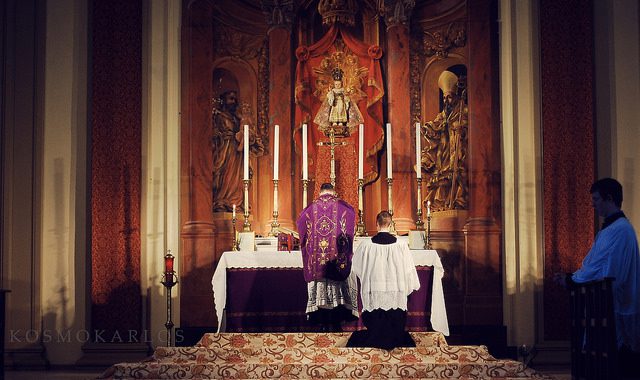
Photo Credit: KosmoKarlos Photograph (flickr).
Let’s play a word association game. When I say, “Vatican II,” what do you think of?
Often times, for Catholics of a certain generation, the term Vatican II can send shudders up the spine. For others, its a source of bitter division between the traditional rites and liturgies of the Catholic Church and the new, modernized Mass that was established following the reforms that have come to be known simply as Vatican II.
But the Second Vatican Council was actually a series of enormous, ecumenical meetings which sought, above all else, to foster a more active participation in the very rites and liturgies which made up the life of the Catholic Church.
In other words, the whole point and purpose of Vatican II was to help all Catholics to better understand and participate in their faith.
This is, indeed, a holy and laudable goal.
But while the Fathers of Vatican II—the cardinals, bishops, priests, and theologians who drafted and wrote the documents—were clear and concise in their goals the practical interpretation, on the ground, was often less then successful. As a result, the reforms of Vatican II left an entire generation of Catholics rather poorly grounded in their faith and confused about what their role was on any given Sunday.
Thankfully, a movement is afoot to re-examine the reforms of Vatican II in light of what the documents actually said and what the theologians and clergy involved behind the scenes intended. The result is bearing much fruit.
At its core, Vatican II aimed to foster active participation in the life of the Church and, in particular, at Mass. What does active participation mean? It means we Catholics understand and actively participate in our faith. We are not merely spectator Catholics but intentional disciples, as author Sherry Weddell says. We learn about our faith. We choose to be Catholics. And we live it out in a daily, active way through prayers, acts of charity, and a worldview in harmony with the teachings of the Christ through His Church.
This sounds awesome, right? And maybe rather unlike a lot of Catholics you know.
Active participation in the Mass, then, is simply an extension of our faith life as Catholics and takes shape in a very similar way.
First, we should understand what’s happening in the Mass in order to participate more fully. If we fully grasp the incredible nature of the perpetual, once-for-all sacrifice of Christ that’s being dramatized during Mass we will, naturally, approach it with a better attitude, a deeper appreciation and understanding, and experience a whole new wellspring of grace every Sunday morning.
Second, we should choose to participate in the Mass. In the chaos of our everyday lives our presence at Mass should be intentional. When the priest prays, “My sacrifice and yours,” we should have something in mind to bring before God. When we pray we should be listening carefully to the needs of our parish community so that when we say, “Lord, hear our prayer,” we can mean it. When we move forward to receive our Lord in the Blessed Sacrament we should strive to do so as reverently as possible, showing God the unfathomable deference that He deserves. When we sing, we should sing as enthusiastically as the hymn demands, even when the musical accompaniment leaves much to be deserved (nevermind our actual singing!).
Finally, active participation in the Mass means living out the Mass even when the Sunday morning celebration is over. We are, as Weddell says, intentional disciples. We are not merely spectators or even just participants. Indeed, the Mass is more akin to exercising at the gym than anything else. We need to work out; to become engaged in our faith, in the Mass, in order to bring the grace of God out to all of his people. To the waitress we might meet at the restaurant at lunch. To the people we encounter at the grocery store on the way home. To our friends and family and, yes, even the colleagues we see on Monday morning at work.
Our active participation in the Mass, and the life of the Church, does not end when Father processes out of the nave.
In the end, if we make the effort to learn more about our faith, if we choose to intentionally engaged on a Sunday morning, and if we live out the Mass beyond the weekend and well into our daily lives what we will see is what the authors, the Fathers, of the Vatican II reforms really intended. Not, ultimately, to change the nature of the Mass, the Church, and its sacraments to water them down but to encourage a deeper participation of all Catholics—to draw the Catholic faithful into a deeper relationship with Christ, our centre, and to send us out, too.
Previous Post

July 17, 2018
No, the Catholic Church Isn't Anti-Sex
Next Post

August 16, 2018 In Light of Abuse, Should I Stop Being Catholic?
Browse Our Archives
Select a Category Appearances Christian Living Explaining the Faith Podcast Tough Questions Uncategorized Why I'm Catholic
Select a Month January 2024 December 2023 November 2023 July 2023 June 2023 May 2023 April 2023 March 2023 February 2023 January 2023 December 2022 November 2022 October 2022 September 2022 August 2022 July 2022 June 2022 May 2022 April 2022 March 2022 February 2022 January 2022 December 2021 November 2021 October 2021 September 2021 August 2021 July 2021 June 2021 May 2021 April 2021 March 2021 February 2021 January 2021 December 2020 November 2020 October 2020 September 2020 August 2020 July 2020 June 2020 May 2020 April 2020 March 2020 February 2020 January 2020 December 2019 November 2019 October 2019 September 2019 August 2019 July 2019 June 2019 May 2019 April 2019 March 2019 February 2019 January 2019 December 2018 November 2018 October 2018 September 2018 August 2018 July 2018 June 2018 May 2018 April 2018 March 2018 February 2018 January 2018 December 2017 October 2017 September 2017 July 2017 May 2017 April 2017 March 2017 February 2017 January 2017 December 2016 November 2016 October 2016 September 2016 August 2016 July 2016 June 2016 May 2016 April 2016 March 2016 February 2016 January 2016 December 2015 November 2015 October 2015 September 2015 August 2015 July 2015 June 2015 May 2015 April 2015 March 2015 February 2015 January 2015 December 2014 November 2014 October 2014
Follow Us!
TAKE THE
Religious Wisdom Quiz
Which Christian group worships mainly on Saturday, not Sunday?
Select your answer to see how you score.
Orthodox Catholic Methodist Seventh-day Adventist
Support this
Column


Related posts from The Cordial Catholic
231: Becoming Catholic in a Church Crisis (w/...

229: Can Catholics and Evangelicals Agree on How...

227: What was Medieval Catholicism Really Like? (w/...
201: Eucharistic Miracles, Marian Apparitions, and More... (w/...
TRENDING AT PATHEOS Catholic

Rejecting Doom: Christian Hope And Human Action
Christianity is a religion of hope. We are to have hope and...

It’s What Comes From Within Which Matters
One of the most difficult things for us to understand is why...

Why I Choose the Eucharist Over the Sermon
Choose the Eucharist, Not the Sermon What are we supposed to get...

5 Design Elements Found in Spiritually Rooted Homes
Putting Spirituality Into Home Decor Our homes are more than our living...

Credo: A Story of God Told with the...
About 10 years ago, I began to imagine a personal "Credo" that...

The Anatomy of Divine Revelation in Catholic Thought
The claim that God has made Himself known to human beings is...
view all Catholic blogs
Ad-Free & Subscriber Log-In Subscription Support
- About Us
- 2026 Calendar
- Videos
- Podcasts
- Library of World Religions
- Faith In Media Tracker
- Advertise With Us
- Write for Us
- Privacy Policy
- Terms of Service
- Do Not Sell My Data
- Contact Us
- Radiant Digital
- Manage Newsletter Subscriptions
- Unsubscribe From Notifications
- Sitemap
Copyright 2008-2026, Patheos. All rights reserved.
Subscription Support Ad-Free & Subscriber Log-In
Follow Patheos