
BuddhistCatholicContemplativeEvangelicalGeneral ChristianHinduJewishLatter-day SaintMuslimNew VisionsProgressive Christian
Beliefs
- Buddhist
- Catholic
- Contemplative
- Evangelical
- General Christian
- Hindu
- Jewish
- Latter-day Saint
- More Voices
- Muslim
- New Visions
- Pagan
- Progressive Christian
Topics
- Religion News
- Food and Religion
- Sports and Religion
- Religious Art
- Religious Music and Entertainment
- Religious Events
- History and Religion
- Style and Religion
- Politics and Religion
- Women in Religion
- Recreation Outdoors and Religion
- Business Finance and Religion
- Careers Workplace and Religion
- Education and Religion
- Family Parenting and Religion
- Health Fitness and Religion
- Home and Religion
- Relationships and Religion
- Technology and Religion
- Travel and Religion
Columnists
- Buddhist Columnists
- Business Finance and Religion Columnists
- Careers Workplace and Religion Columnists
- Catholic Columnists
- Contemplative Columnists
- Education and Religion Columnists
- Evangelists Columnists
- Family Parenting and Religion Columnists
- General Christian Columnists
- Health Fitness and Religion Columnists
- Hindu Columnists
- History and Religion Columnists
- Home and Religion Columnists
- Jewish Columnists
- More Voices Columnists
- Latter Day Columnists
- Muslim Columnists
- New Visions Columnists
- Nonreligious Columnists
- Pagan Columnists
- Politics and Religion Columnists
- Progressive Columnists
- Recreation Outdoors and Religion Columnists
- Relationships and Religion Columnists
- Religion News Columnists
- Religious Art Columnists
- Religious Events Columnists
- Religious Music and Entertainment Columnists
- Sports and Religion Columnists
- Style and Religion Columnists
- Technology and Religion Columnists
- Travel and Religion Columnists
- Women in Religion Columnists
Resource Library
- 2026 Calendar
- Library of World Religions
- The 100 Most Holy Places on Earth
- Patheos Answers
- Podcasts
- Videos
- Faith Leaders Database
- Anglican Episcopalian
- Bahai
- Baptist
- Buddhism
- Christianity
- Confucianism
- Eastern Orthodoxy
- Hinduism
- Holiness and Pentecostal
- ISKCON
- Islam
- Judaism
- Lutheran
- Methodist
- The Church of Jesus Christ of Latter-day Saints
- New Age
- Paganism
- Presbytarian and Reformed
- Protestantism
- Religion Behind the Scenes
- Roman Catholic
- Scientology
- Shia Islam
- Sikhism
- Sufism
- Sunni Islam
- Taoism
- Zen
- See all religions
Research Tools
 Ad-Free & Subscriber Log-In Subscription Support
Ad-Free & Subscriber Log-In Subscription Support
Follow Patheos 

- Trending:
- Forgiveness
- |
- Marriage
- |
- Consciousness
- |
- Death Penalty
- |
- Election
- |
- Halloween
 The Cordial Catholic
- Home
- Catholic
- How an Evangelical Learned to Love the Saints
How an Evangelical Learned to Love the Saints
Last updated on: March 28, 2017 at 6:06 am by K. Albert Little
How an Evangelical Learned to Love the Saints 2017-03-28T06:06:33-04:00 K. Albert Little
Patheos Explore the world's faith through different perspectives on religion and spirituality! Patheos has the views of the prevalent religions and spiritualities of the world.
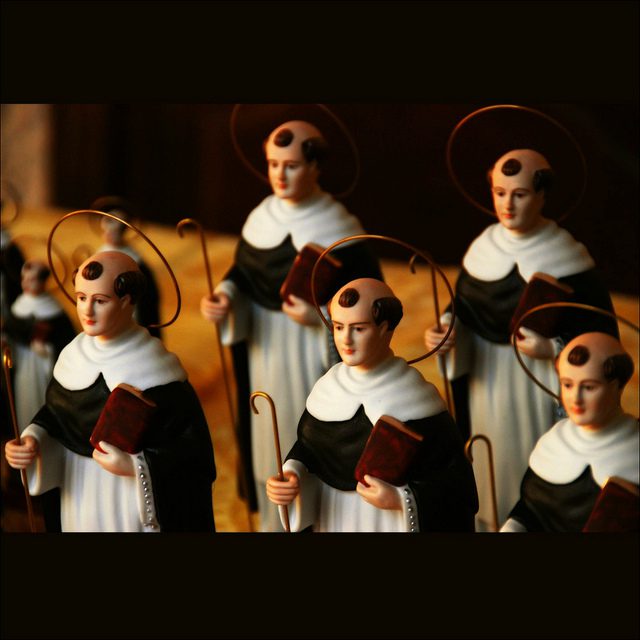
Photo Credit: jurek d.
I didn’t know about the saints until my thirties but I came by my ignorance honestly.
As an Evangelical we didn’t talk about the saints. If we did, it was to condemn those idol-worshiping Catholics who named and adorned their places of worship with statues of these long dead heretics.
Who prayed to mere men and women in the place of Christ.
Who worshiped the dead.
(We were rather crude in our assessment.)
Now, as a Catholic, I find myself enamored with the holy men and women who came before me. Not only have the saints become an endless source of fascination and admiration—they’ve become kin.
Digging Into the History of the Saints
What happened first was a journey into the history of the Church’s understanding of the saints.
To my surprise it turned out that a belief in the ability of deceased Christians to pray for us dates back to some of the earliest Christian writings we have: the Early Church Fathers. These writers, many of whom were taught by the apostles themselves, write extensively about this practice, already well established in the Church of the first century.
What’s more, many of the earliest churches themselves were built on the spot where some of first Christian martyrs met their untimely deaths. There was something sacred about those exact spots; something which connected the living to the dead—a belief in the union of their prayers.
We see this, too, in the Book of Revelation.
Prayer for the dead, and the ability of the dead to pray for us, is a long-established practice in the Church.
Practicing Prayer with the Saints
But all my reading, and research, about the practice itself could only take me so far. I’ve come, now, much further, by living with the saints, too.
As an newly-minted Catholic I knew very little about the saints and came at them in a rather haphazard way.
I’d heard about this saint, or that saint, and threw up tender shoots of prayer in their direction.
“St. Albert, pray for me.” I’d try, and knew that since we shared a name he’d certainly be listening.
Then it was St. Francis de Sales—I was enamoured with his writing during the Counter-Reformation and asked that he’d pray for me and my own prose, this blog, and its readership.
And then I encountered St. Gianna Molla and asked for her intercession late into the night as our teething toddler cried and cried and cried. (These days she remains my go to midnight intercessor.)
And I realized, gradually, that one can form a relationship with a saint in much the same way one can form a relationship with a living, breathing Christian on earth. And this is kind of magical.
Through stories about St. Martin de Porres I can learn about his life, his character, and relate his struggles to mine.
Through the written interviews, books, and encyclicals of St. John Paul II I can more clearly juxtapose his experiences with mine.
Through the incredible journals left behind by St. Teresa of Calcutta I can get a glimpse into her heart, her journey, and how mine is reflected therein.
And I can know that they know what I’m going through; and I can count on their prayers.
I’ve learned too, through experience, that as I turn to St. Gianna Molla in the middle of the night, again, it’s a kind of comfort in the same way that calling up my friend to ask for his prayers brings me a great relief too.
I’m sure, though, that he is personally relieved that someone else is getting that “call” at three in the morning instead of him.
Reading About Life with the Saints
In learning to live with the saints, Fr. James Martin’s aptly-titled book My Life with the Saints has come into my life at exactly the right time.
Despite being a cradle Catholic, Fr. Martin knew about as much about the saints as I did coming into it. His book is one-part memoir, one-part biography and traces his own vocation story and the saints he encountered along the way. Typical of Fr. Martin, he is witty, informative, and surprisingly candid.
That’s to say, in My Life with the Saints, I can see much of myself and that’s been a blessing.
First, to encounter Fr. Martin’s favourite saints in the same way I’ve encountered mine: organically and serendipitously and exactly when I needed them.
And, secondly, to confirm, through someone else’s story, just how incredible life with the saints can be.
How Dorothy Day swept in, through the legacy of her work and writing, at exactly the right time for Fr. Martin—when working just down the street from her famous stomping ground.
Or, how the simple story of St. Peter and his infamous betrayal of Christ, served as a picture of redemption and struggle at exactly the moment with Fr. Martin needed to learn those lessons.
These experiences are my own, and reflected beautifully.
Like Fr. Martin, as I’ve learned to live with the saints, as I’ve been blessed with the holy friendship of so many more Christians than I ever knew possible.
I’ve also been frequently humbled at exactly how God works through their prayers.
In my own life, again and again, the power of the prayers of the saints is affirmed—sometimes powerfully, like a situation suddenly turning around on its head after asking for the prayers of St. Michael; sometimes quietly, like finding an envelope with the return address of my grandmother, several years deceased, in a random stack of papers just after I’d been praying for her that very morning.
What are the odds?
What learning about prayer to the saints, actually praying to the saints, and living amongst the saints has taught me—if nothing else—is just how much bigger God is than I’d ever imagined. How much more capable He is in working through the ordinary and the mundane of life—and through the incredible and holy, too.
Previous Post
March 15, 2017
Shouldn't Christian Unity Be More Important Than We Make It?
Next Post

March 30, 2017 If the Church is a Field Hospital, Lent is Our Medicine
Browse Our Archives
Select a Category Appearances Christian Living Explaining the Faith Podcast Tough Questions Uncategorized Why I'm Catholic
Select a Month January 2024 December 2023 November 2023 July 2023 June 2023 May 2023 April 2023 March 2023 February 2023 January 2023 December 2022 November 2022 October 2022 September 2022 August 2022 July 2022 June 2022 May 2022 April 2022 March 2022 February 2022 January 2022 December 2021 November 2021 October 2021 September 2021 August 2021 July 2021 June 2021 May 2021 April 2021 March 2021 February 2021 January 2021 December 2020 November 2020 October 2020 September 2020 August 2020 July 2020 June 2020 May 2020 April 2020 March 2020 February 2020 January 2020 December 2019 November 2019 October 2019 September 2019 August 2019 July 2019 June 2019 May 2019 April 2019 March 2019 February 2019 January 2019 December 2018 November 2018 October 2018 September 2018 August 2018 July 2018 June 2018 May 2018 April 2018 March 2018 February 2018 January 2018 December 2017 October 2017 September 2017 July 2017 May 2017 April 2017 March 2017 February 2017 January 2017 December 2016 November 2016 October 2016 September 2016 August 2016 July 2016 June 2016 May 2016 April 2016 March 2016 February 2016 January 2016 December 2015 November 2015 October 2015 September 2015 August 2015 July 2015 June 2015 May 2015 April 2015 March 2015 February 2015 January 2015 December 2014 November 2014 October 2014
Follow Us!
TAKE THE
Religious Wisdom Quiz
What was rebuilt in Jerusalem under Zerubbabel and Joshua the high priest?
Select your answer to see how you score.
The palace The city gates The altar and Temple The wall
Support this
Column


Related posts from The Cordial Catholic

235: Questions I Couldn't Answer (w/ John Martignoni)

234: The Mindblowing World of Sacramentals (w/ Shaun...

233: The Power of Good Catholic Witnesses (w/...

232: The Trajectory of Conversion (w/ Phillip Campbell)
TRENDING AT PATHEOS Catholic

Rejecting Doom: Christian Hope And Human Action
Christianity is a religion of hope. We are to have hope and...

It’s What Comes From Within Which Matters
One of the most difficult things for us to understand is why...

Why I Choose the Eucharist Over the Sermon
Choose the Eucharist, Not the Sermon What are we supposed to get...

5 Design Elements Found in Spiritually Rooted Homes
Putting Spirituality Into Home Decor Our homes are more than our living...

Credo: A Story of God Told with the...
About 10 years ago, I began to imagine a personal "Credo" that...

The Anatomy of Divine Revelation in Catholic Thought
The claim that God has made Himself known to human beings is...
view all Catholic blogs
Ad-Free & Subscriber Log-In Subscription Support
- About Us
- 2026 Calendar
- Videos
- Podcasts
- Library of World Religions
- Faith In Media Tracker
- Advertise With Us
- Write for Us
- Privacy Policy
- Terms of Service
- Do Not Sell My Data
- Contact Us
- Radiant Digital
- Manage Newsletter Subscriptions
- Unsubscribe From Notifications
- Sitemap
Copyright 2008-2026, Patheos. All rights reserved.
Subscription Support Ad-Free & Subscriber Log-In
Follow Patheos