
BuddhistCatholicContemplativeEvangelicalGeneral ChristianHinduJewishLatter-day SaintMuslimNew VisionsProgressive Christian
Beliefs
- Buddhist
- Catholic
- Contemplative
- Evangelical
- General Christian
- Hindu
- Jewish
- Latter-day Saint
- More Voices
- Muslim
- New Visions
- Pagan
- Progressive Christian
Topics
- Religion News
- Food and Religion
- Sports and Religion
- Religious Art
- Religious Music and Entertainment
- Religious Events
- History and Religion
- Style and Religion
- Politics and Religion
- Women in Religion
- Recreation Outdoors and Religion
- Business Finance and Religion
- Careers Workplace and Religion
- Education and Religion
- Family Parenting and Religion
- Health Fitness and Religion
- Home and Religion
- Relationships and Religion
- Technology and Religion
- Travel and Religion
Columnists
- Buddhist Columnists
- Business Finance and Religion Columnists
- Careers Workplace and Religion Columnists
- Catholic Columnists
- Contemplative Columnists
- Education and Religion Columnists
- Evangelists Columnists
- Family Parenting and Religion Columnists
- General Christian Columnists
- Health Fitness and Religion Columnists
- Hindu Columnists
- History and Religion Columnists
- Home and Religion Columnists
- Jewish Columnists
- More Voices Columnists
- Latter Day Columnists
- Muslim Columnists
- New Visions Columnists
- Nonreligious Columnists
- Pagan Columnists
- Politics and Religion Columnists
- Progressive Columnists
- Recreation Outdoors and Religion Columnists
- Relationships and Religion Columnists
- Religion News Columnists
- Religious Art Columnists
- Religious Events Columnists
- Religious Music and Entertainment Columnists
- Sports and Religion Columnists
- Style and Religion Columnists
- Technology and Religion Columnists
- Travel and Religion Columnists
- Women in Religion Columnists
Resource Library
- 2026 Calendar
- Library of World Religions
- The 100 Most Holy Places on Earth
- Patheos Answers
- Podcasts
- Videos
- Faith Leaders Database
- Anglican Episcopalian
- Bahai
- Baptist
- Buddhism
- Christianity
- Confucianism
- Eastern Orthodoxy
- Hinduism
- Holiness and Pentecostal
- ISKCON
- Islam
- Judaism
- Lutheran
- Methodist
- The Church of Jesus Christ of Latter-day Saints
- New Age
- Paganism
- Presbytarian and Reformed
- Protestantism
- Religion Behind the Scenes
- Roman Catholic
- Scientology
- Shia Islam
- Sikhism
- Sufism
- Sunni Islam
- Taoism
- Zen
- See all religions
Research Tools
 Ad-Free & Subscriber Log-In Subscription Support
Ad-Free & Subscriber Log-In Subscription Support
Follow Patheos 

- Trending:
- Forgiveness
- |
- Marriage
- |
- Consciousness
- |
- Death Penalty
- |
- Election
- |
- Halloween
 The Cordial Catholic
- Home
- Catholic
- How God Works: Making Sense of the Sacramental Life
How God Works: Making Sense of the Sacramental Life
Last updated on: August 3, 2015 at 3:59 pm by K. Albert Little
How God Works: Making Sense of the Sacramental Life 2015-08-03T15:59:35-04:00 K. Albert Little
Patheos Explore the world's faith through different perspectives on religion and spirituality! Patheos has the views of the prevalent religions and spiritualities of the world.
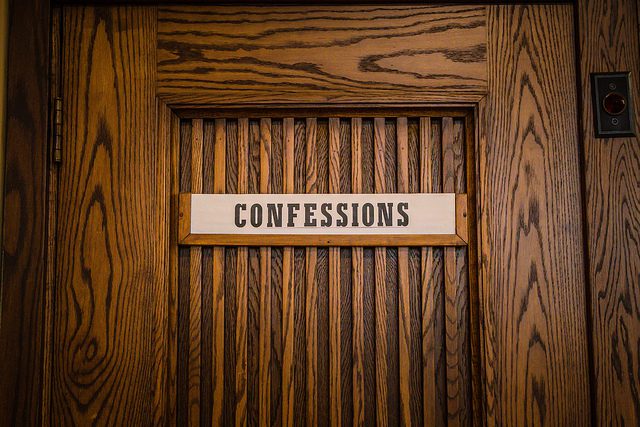
Confessions. Photo Credit: ransomtech.
The Catholic life is a sacramental life. The means, at its core, that Catholicism teaches that God’s graces and goodness are mediated out through the sacraments, through humans. Through the Eucharist, chief amongst the sacraments, we receive the very body and blood of our Lord. Through matrimony, confession, the anointing of the sick, baptism, confirmation, and through office of the priesthood God gives us his grace in various degrees.
Meditating on the sacraments, however, is a bit of a daunting exercise for the average evangelical. I admit, when I first started reading about the Catholic Church I wouldn’t have had the foggiest notion of what a sacrament was. God gave me grace, when He wanted to, because I prayed for it. Or because He thought I needed some. Or, because.
Once I understood what the Catholic Church meant about sacraments and the grace of God it only served, at first, to get my back up and my spine all out of joint.
You mean, I have to receive God’s grace mediated out through man?
Surely that goes against every fiber of my Evangelical Protestant being. There’s only one mediator between man and God and that’s Jesus, right?
Well, yes. And, no.
What I’ve learned about what the Catholic Church teaches on the sacraments, and the grace of God, is that it actually makes sense. It doesn’t contradict Paul’s teaching in his letter to Timothy. And, even more compelling, is that it’s how God has always worked.
How God Works
God has always worked through man. It’s His modus operandi and it’s clear from even a cursory reading or understanding of the Christian story, as spelled out through the Old and New Testaments. From Moses to David. From John the Baptist to the apostles to the divinely-inspired authors of the New Testament. To the bishops of early Church councils, who recognized the divinely-inspired parts of the New Testament and defined our sacred theology.
To the priesthood, the modern day bishops, and the Pope.
God has chosen His main means of dispensing grace—and calling His people back to Him—to be to work through people. Ordinary, disappointing, sinful people. Look at David. Look at the apostles—Peter denied Christ!
Is God bound by the sacraments? Certainly not. God created them for us. But the Catholic Church teaches that these are the normal means in which God gives us grace—the mysterious and beautiful system that Jesus left for us, His Church.
God uses people.
So it shouldn’t be a surprise, not at all, that God established a sacramental system of faith life that works through people.
Was there an alternative? Certainly!
God could’ve revealed everything we needed to know through a system of divine revelation. He didn’t need to use people, but He did. God could’ve given us everything we needed to know about Him and our eternal purpose when we were born, by imparting that knowledge automatically and letting us decide at that very instant, but He didn’t. God chose to use people.
For 1,500 years this is what Christians believed. In fact, believing that God used people to dispense His graces was, in a way, one of the chief catalysts for the Reformation itself. In parts of Europe, wealthy aristocrats hired personal family priests to say Masses on their behalfs, often in private chapels—to dispense grace like an ATM. The early reformers rightly protested against such detestable behaviour but just because some bad apples used the sacred system poorly doesn’t mean it was poorly built from the beginning.
David fell, hard, but God used Him still to establish a Royal Priesthood that would never pass away.
God has always worked through humankind, which is why the sacramental life makes sense to me.
Confession: A Case Study
The Sacrament of Confession is a prime example.
As a young evangelical reading my Bible I couldn’t figure out, for the very life of me, why we didn’t practice confession. It was right there, starkly, in the New Testament. We were called to confess our sins to one another but nobody I knew was doing it. Except the Catholic Church—and back then I thought the Catholic Church was the devil.
But the Catholic Church got it right!
The Sacrament of Confession is the ultimate grace that God gave us. See, as a Protestant I sin all the time and the best I can do is pray for forgiveness. Pray to God who, in spite of all the faith I have that He’s listening, doesn’t necessarily, and normally, answer back. As a Protestant I am left to assume I’ve been given the grace of forgiveness. I can assume that, and billions do, and many folks who are particuarly blessed might even feel like they’ve been forgiven but many more, the majority, don’t. Most, in my experience, feel nothing. Other than the intellectual knowledge of knowing, academically, that they’ve been forgiven.
On the contrary, what a grace the Church has been given in the Sacrament of Confession. Taking its theology straight from the pages of the New Testament and in a continuous line of belief and practice right from the apostles, through the Church Fathers, up until today Catholics believe you can confess your sins to a priest, and be forgiven.
God using man? What precedent is there for that?
The priest, empowered by Jesus’s words to “bind and loose” and the command of the apostles to confess our sins to each other, have the God-given ability to proclaim my sins are forgiven. Make no mistake, the priest has no magical powers to forgive sins but, rather, God has given us a system which means His forgiveness and, ultimately, His graces, can be dispensed through that priest. The priest, standing on the foundation of the New Testament and the very words of Jesus, can safely say that He, God, forgives our sins.
How much more powerful to hear, “You’re forgiven,” from a human being, standing in for Jesus, than to merely imagine these words in my head, or try to muster up the emotion to feel them in my heart. I need no mustering here: the tears flow freely when those words are truly spoken out loud by a fellow traveller like me.
Like Pope Francis said this morning on Twitter,
The Sacraments are the manifestation of the Father’s tenderness and love towards each of us.
It couldn’t be more true.
The Messy, Sacramental Life
But it sure makes for a mess.
The Sacramental Life is messy because human beings are messy. The apostles themselves were a mess. So was Moses, Jonah, Noah, and I’ve already mentioned David. But this is the system which, to me, God has clearly chosen. At least, the apostles thought so and so did the Church Fathers and Christians like you and me right down through the ages.
But it’s still a messy system. It makes me vulnerable to the people in my community and, despite the name of this blog, I don’t like a lot of people, all the time. I’m grumpy, too, and sometimes I want my graces and my faith life to be my own and only my own. It takes a certain degree of humility—and, ah, there’s the rub!—to accept a sacramental faith, a faith dependent on other people. Especially in this post-post-modern world of me. It’s so counter-cultural.
The Sacramental Life is, ultimately, another beautifully compelling aspect of the Catholic Church, in my opinion. It not only, to me, makes sense with what we know about God and His character but it makes sense with what we know about humans and ourselves. It makes sense with what I know about me. Because I don’t feel forgiven. I don’t feel grace-filled. I don’t feel, sometimes, like God is even there. The great, incredible, and ultimate grace that God’s given us in the sacraments is that He is present, in the most tangible way possible, to say, like Moses heard from the voice of God in the burning bush, “I AM.”
Previous Post

February 17, 2015
Lent: My Final Forty Days as a Protestant
Next Post
February 25, 2015 On Lent and Letting Go of Grudges
Browse Our Archives
Select a Category Appearances Christian Living Explaining the Faith Podcast Tough Questions Uncategorized Why I'm Catholic
Select a Month January 2024 December 2023 November 2023 July 2023 June 2023 May 2023 April 2023 March 2023 February 2023 January 2023 December 2022 November 2022 October 2022 September 2022 August 2022 July 2022 June 2022 May 2022 April 2022 March 2022 February 2022 January 2022 December 2021 November 2021 October 2021 September 2021 August 2021 July 2021 June 2021 May 2021 April 2021 March 2021 February 2021 January 2021 December 2020 November 2020 October 2020 September 2020 August 2020 July 2020 June 2020 May 2020 April 2020 March 2020 February 2020 January 2020 December 2019 November 2019 October 2019 September 2019 August 2019 July 2019 June 2019 May 2019 April 2019 March 2019 February 2019 January 2019 December 2018 November 2018 October 2018 September 2018 August 2018 July 2018 June 2018 May 2018 April 2018 March 2018 February 2018 January 2018 December 2017 October 2017 September 2017 July 2017 May 2017 April 2017 March 2017 February 2017 January 2017 December 2016 November 2016 October 2016 September 2016 August 2016 July 2016 June 2016 May 2016 April 2016 March 2016 February 2016 January 2016 December 2015 November 2015 October 2015 September 2015 August 2015 July 2015 June 2015 May 2015 April 2015 March 2015 February 2015 January 2015 December 2014 November 2014 October 2014
Follow Us!
TAKE THE
Religious Wisdom Quiz
Who recognized Jesus as "the Christ" in the Temple as an infant?
Select your answer to see how you score.
Peter Zechariah Joseph Simeon
Support this
Column


Related posts from The Cordial Catholic
201: Eucharistic Miracles, Marian Apparitions, and More... (w/...
193: Saying Yes to Catholicism (w/ David Patterson)
191: The Mind Blowing Miracles of Lourdes (w/...
188: Pitfalls for New Catholic Converts (w/ Keith...
TRENDING AT PATHEOS Catholic

Rejecting Doom: Christian Hope And Human Action
Christianity is a religion of hope. We are to have hope and...

It’s What Comes From Within Which Matters
One of the most difficult things for us to understand is why...

Why I Choose the Eucharist Over the Sermon
Choose the Eucharist, Not the Sermon What are we supposed to get...

5 Design Elements Found in Spiritually Rooted Homes
Putting Spirituality Into Home Decor Our homes are more than our living...

Credo: A Story of God Told with the...
About 10 years ago, I began to imagine a personal "Credo" that...

The Anatomy of Divine Revelation in Catholic Thought
The claim that God has made Himself known to human beings is...
view all Catholic blogs
Ad-Free & Subscriber Log-In Subscription Support
- About Us
- 2026 Calendar
- Videos
- Podcasts
- Library of World Religions
- Faith In Media Tracker
- Advertise With Us
- Write for Us
- Privacy Policy
- Terms of Service
- Do Not Sell My Data
- Contact Us
- Radiant Digital
- Manage Newsletter Subscriptions
- Unsubscribe From Notifications
- Sitemap
Copyright 2008-2026, Patheos. All rights reserved.
Subscription Support Ad-Free & Subscriber Log-In
Follow Patheos