
BuddhistCatholicContemplativeEvangelicalGeneral ChristianHinduJewishLatter-day SaintMuslimNew VisionsProgressive Christian
Beliefs
- Buddhist
- Catholic
- Contemplative
- Evangelical
- General Christian
- Hindu
- Jewish
- Latter-day Saint
- More Voices
- Muslim
- New Visions
- Pagan
- Progressive Christian
Topics
- Religion News
- Food and Religion
- Sports and Religion
- Religious Art
- Religious Music and Entertainment
- Religious Events
- History and Religion
- Style and Religion
- Politics and Religion
- Women in Religion
- Recreation Outdoors and Religion
- Business Finance and Religion
- Careers Workplace and Religion
- Education and Religion
- Family Parenting and Religion
- Health Fitness and Religion
- Home and Religion
- Relationships and Religion
- Technology and Religion
- Travel and Religion
Columnists
- Buddhist Columnists
- Business Finance and Religion Columnists
- Careers Workplace and Religion Columnists
- Catholic Columnists
- Contemplative Columnists
- Education and Religion Columnists
- Evangelists Columnists
- Family Parenting and Religion Columnists
- General Christian Columnists
- Health Fitness and Religion Columnists
- Hindu Columnists
- History and Religion Columnists
- Home and Religion Columnists
- Jewish Columnists
- More Voices Columnists
- Latter Day Columnists
- Muslim Columnists
- New Visions Columnists
- Nonreligious Columnists
- Pagan Columnists
- Politics and Religion Columnists
- Progressive Columnists
- Recreation Outdoors and Religion Columnists
- Relationships and Religion Columnists
- Religion News Columnists
- Religious Art Columnists
- Religious Events Columnists
- Religious Music and Entertainment Columnists
- Sports and Religion Columnists
- Style and Religion Columnists
- Technology and Religion Columnists
- Travel and Religion Columnists
- Women in Religion Columnists
Resource Library
- 2026 Calendar
- Library of World Religions
- The 100 Most Holy Places on Earth
- Patheos Answers
- Podcasts
- Videos
- Faith Leaders Database
- Anglican Episcopalian
- Bahai
- Baptist
- Buddhism
- Christianity
- Confucianism
- Eastern Orthodoxy
- Hinduism
- Holiness and Pentecostal
- ISKCON
- Islam
- Judaism
- Lutheran
- Methodist
- The Church of Jesus Christ of Latter-day Saints
- New Age
- Paganism
- Presbytarian and Reformed
- Protestantism
- Religion Behind the Scenes
- Roman Catholic
- Scientology
- Shia Islam
- Sikhism
- Sufism
- Sunni Islam
- Taoism
- Zen
- See all religions
Research Tools
 Ad-Free & Subscriber Log-In Subscription Support
Ad-Free & Subscriber Log-In Subscription Support
Follow Patheos 

- Trending:
- Forgiveness
- |
- Marriage
- |
- Consciousness
- |
- Death Penalty
- |
- Election
- |
- Halloween
 The Cordial Catholic
- Home
- Catholic
- Five Things You Need to Know About the Protestant Reformation
Five Things You Need to Know About the Protestant Reformation
Last updated on: October 26, 2016 at 1:47 pm by K. Albert Little
Five Things You Need to Know About the Protestant Reformation 2016-10-26T13:47:03-04:00 K. Albert Little
Patheos Explore the world's faith through different perspectives on religion and spirituality! Patheos has the views of the prevalent religions and spiritualities of the world.
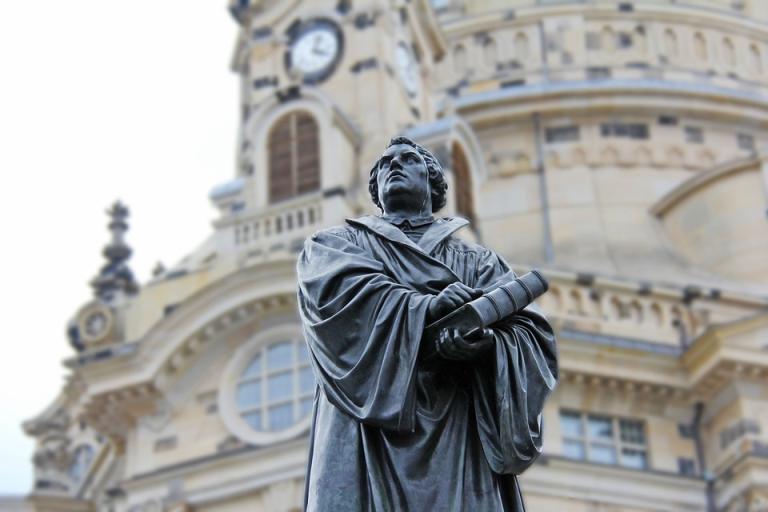
The Lutheran church down the street from our house has a sign that proudly proclaims,
Reformation Sunday
Celebrating 499 years of the Protestant Church
It makes me feel a bit nauseous every time I pass because there’s one thing we shouldn’t be doing as we consider the 499th anniversary of the Reformation it’s celebrating.
Now I know there are those—scores of them—that see the Reformation as the virtuous Christians ripping the true Christian Church out of the clutches of the evil and corrupt Catholics. Or, there are others, who see the Reformation as something necessary but benign—maybe their view of Catholics is more tame, less considered, or really not considered at all.
But whether pridefully in favour or faultlessly unaware of the history of the Protestant Reformation I’d argue that it’s something we all take time to pause and consider before going on with the rest of our day.
And especially before celebrating.
Here are five things you need to know.
1. Martin Luther Didn’t Intend to Start a New “Church”
Historians of all stripes readily agree that when he began writing against the Catholic Church Martin Luther, a Catholic priest himself, didn’t intend to start a whole new church.
Instead, Luther was writing to express his concerns and criticisms to the hierarchy of the Catholic Church. He began with the hope of reformation from within and never considered the idea of breaking off from communion with the Church that he himself considered to be founded by Christ.
But things rapidly spun out of control.
2. Martin Luther’s Personal Struggles Impeded His Perspective
Likewise, historians agree that Luther’s personal demons greatly influenced his theology—which greatly influenced the Reformation, and the Protestant denominations which it spawned.
Luther struggled with what the Catholic Church calls Scrupulosity, a psychological predilection to feeling guilt, distress, and depression regarding one’s moral state. In other words, Luther struggled, as a Christian, to feel truly forgiven for his sins after confessing them.
The practice of confessing sins to a priest was an ancient tradition in all of the Christian Church since the beginning, drawing authority from Christ’s charge to His apostles in John 20:23,
“If you forgive the sins of any, their sins have been forgiven them; if you retain the sins of any, they have been retained.”
But Luther struggled with feeling forgiven and so searched for a theological interpretation of Scripture which would allow for him to feel assured of his salvation and help him to stop worrying about whether he was truly and rightly forgiven.
What Luther found in his searching of the Bible was what he thought was a new way to understand exactly how it is that we’re saved and assured a place in Heaven. This personal quest, and the resulting theological discovery, would shape how almost all Protestant denominations would understand salvation.
3. The Printing Press Played an Important Role, But…
The invention of the printing press around the time of the Reformation caused two important things to happen.
First of all, it allowed for a more widespread dissemination of the Bible in print. Suddenly, Christians had access to the written Word of God at a level never possible before. Previously, a parish church might own a copy of a Bible which would’ve been painstakingly hand-copied from another edition at an incredibly high cost.
With the printing press, Christians were finally able to access the Bible for themselves and numerous translations of the Greek and Hebrew biblical texts began to proliferate.
But secondly, it’s important to recognize that while we, today, celebrate Luther’s emphasis on making the Bible accessible to the everyday Christian Luther himself lamented its widespread availability almost immediately.
Luther recognized, quickly, what the Catholic Church had understood all along. Not that the everyday Christian should be deprived of the Bible but that without some education, including basic literacy education, they wouldn’t understand what they’re reading.
Misinterpretations would abound.
And they did.
While, previously, the Bible was proclaimed within the context of the church by the priest or deacon it was now, suddenly, up to the individual Christian to understand what he or she was reading.
For the uneducated masses this was a huge problem.
4. Lack of Access to Early Church Documents Revived Old Mistakes
While the Catholic Church was unequivocal in its core teachings since early in its history, the Protestant Reformation, with its hands on the now readily available Scriptures, would take many fundamental doctrine back to the drawing board.
Doctrines which had been established by the Early Church and written about shortly after Jesus left the earth and ascended to Heaven.
In fact, it was a fundamental lack of historical context which caused Luther and the other Reformers to revive mistakes of interpretation which cropped up at the very beginning of the Christian Church—over a thousand years prior.
While Luther and his Reformers had access to the Bible, they lacked access to the documents which immediately proceeded it. Documents written by those disciples who were taught by the writers of the New Testament. Disciples, bishops, and martyrs who wrote about decisions the Christian Church was making in its early days—decisions on key pieces of doctrine like what it meant to be saved, baptism, and the Lord’s Supper.
Without these foundational documents Luther and the early Reformers necessarily skipped over a thousand years of Church history.
A cursory examination of how Protestants understand Church history even today reveals the same challenge still exists—as if from the time of the New Testament until the Reformation nothing at all happened in the history of the Church.
This is made even more confusing if one considers all the Christians who lived between the time of the Early Church and the 16th century Reformation.
If Luther truly discovered something in the Bible that was hitherto misinterpreted by the Catholic Church then what happened to all those Christians who died believe that they were in relationship with Christ and His Church.
It’s kind of shocking to consider.
5. If Jesus Prayed for Unity We Should Seriously Pursue It
Fundamental in an understanding of the Protestant Reformation, I think, is that Jesus prayed for unity.
In fact, He prophetically predicted Church schisms like the Reformation and His charge to us is plainly recorded in the Gospels in John 17:21,
“I pray that they will all be one, just as you and I are one—as you are in me, Father, and I am in you. And may they be in us so that the world will believe you sent me.”
In His last recorded prayer on earth, Jesus not only predicts the disfunction of the Church He was founding, but prays we may be united again.
So that the world might believe.
That’s how fundamental our unity is.
And that’s why I have such a hard time with celebrating the birth of the Protestant Church: because Jesus prayed that it wouldn’t be so; He prayed that we’d be one, not many.
I’ve written before about the importance of our unity and how we need to make more efforts to work together rather than do things on our own and if we’re not sure why we need to make this sort of thing a priority I’d say, simply, because Jesus said so.
As part of his last earthly remarks.
And that’s something to be taken seriously.
6. Consider This Perspective, and Pray
So when contemplating the Reformation, whether for the first time or the hundredth time, I’d pray that you consider this perspective for a moment.
That the Reformation was never intended to break apart the Christian Church; that it was, fundamentally, driven by the personal theology of its Reformers; that the printing press not only helped fuel reform but helped populate misinterpretations too; that many of the Reformers were directly at odds with the Early Church; and that Jesus, ultimately, prayed that we all just get back together again.
Of course, none of this is to speak ill of those that have followed in the footsteps of the Protestant Reformers—or even the Reformers themselves.
As an Evangelical Protestant, I was a spiritual descendent of the Anabaptist Reformers although I didn’t know it at the time. It took, for me, a deep study of the history of the Christian Church to help me decide that reuniting with the Church my ancient predecessors had left was the right thing to do.
And it was an intentional act of Christian unity for whatever small part I played.
It was important for me.
Because on the eve of Reformation Sunday, it’s important to recognize that many of us inherited a spiritual heritage that we knew, and know, very little about.
Consider, then, another perspective informed by history and historians and, most importantly, pray to understand your place in it and the small part that you, like me, can make in helping to honour Jesus’s most unequivocal prayer into a reality.
That we may be one.
And that the whole world might see.
Stay in touch! Like The Cordial Catholic on Facebook:
Previous Post

October 25, 2016
Why Does the Catholic Church Have So Many Rules?
Next Post
November 3, 2016 The Thing I Love About Padre Pio
Browse Our Archives
Select a Category Appearances Christian Living Explaining the Faith Podcast Tough Questions Uncategorized Why I'm Catholic
Select a Month January 2024 December 2023 November 2023 July 2023 June 2023 May 2023 April 2023 March 2023 February 2023 January 2023 December 2022 November 2022 October 2022 September 2022 August 2022 July 2022 June 2022 May 2022 April 2022 March 2022 February 2022 January 2022 December 2021 November 2021 October 2021 September 2021 August 2021 July 2021 June 2021 May 2021 April 2021 March 2021 February 2021 January 2021 December 2020 November 2020 October 2020 September 2020 August 2020 July 2020 June 2020 May 2020 April 2020 March 2020 February 2020 January 2020 December 2019 November 2019 October 2019 September 2019 August 2019 July 2019 June 2019 May 2019 April 2019 March 2019 February 2019 January 2019 December 2018 November 2018 October 2018 September 2018 August 2018 July 2018 June 2018 May 2018 April 2018 March 2018 February 2018 January 2018 December 2017 October 2017 September 2017 July 2017 May 2017 April 2017 March 2017 February 2017 January 2017 December 2016 November 2016 October 2016 September 2016 August 2016 July 2016 June 2016 May 2016 April 2016 March 2016 February 2016 January 2016 December 2015 November 2015 October 2015 September 2015 August 2015 July 2015 June 2015 May 2015 April 2015 March 2015 February 2015 January 2015 December 2014 November 2014 October 2014
Follow Us!
TAKE THE
Religious Wisdom Quiz
What was Paul's original name?
Select your answer to see how you score.
Levi Saul Simon Matthias
Support this
Column


Related posts from The Cordial Catholic

232: The Trajectory of Conversion (w/ Phillip Campbell)
231: Becoming Catholic in a Church Crisis (w/...

229: Can Catholics and Evangelicals Agree on How...

227: What was Medieval Catholicism Really Like? (w/...
TRENDING AT PATHEOS Catholic

Rejecting Doom: Christian Hope And Human Action
Christianity is a religion of hope. We are to have hope and...

It’s What Comes From Within Which Matters
One of the most difficult things for us to understand is why...

Why I Choose the Eucharist Over the Sermon
Choose the Eucharist, Not the Sermon What are we supposed to get...

5 Design Elements Found in Spiritually Rooted Homes
Putting Spirituality Into Home Decor Our homes are more than our living...

Credo: A Story of God Told with the...
About 10 years ago, I began to imagine a personal "Credo" that...

The Anatomy of Divine Revelation in Catholic Thought
The claim that God has made Himself known to human beings is...
view all Catholic blogs
Ad-Free & Subscriber Log-In Subscription Support
- About Us
- 2026 Calendar
- Videos
- Podcasts
- Library of World Religions
- Faith In Media Tracker
- Advertise With Us
- Write for Us
- Privacy Policy
- Terms of Service
- Do Not Sell My Data
- Contact Us
- Radiant Digital
- Manage Newsletter Subscriptions
- Unsubscribe From Notifications
- Sitemap
Copyright 2008-2026, Patheos. All rights reserved.
Subscription Support Ad-Free & Subscriber Log-In
Follow Patheos