
BuddhistCatholicContemplativeEvangelicalGeneral ChristianHinduJewishLatter-day SaintMuslimNew VisionsProgressive Christian
Beliefs
- Buddhist
- Catholic
- Contemplative
- Evangelical
- General Christian
- Hindu
- Jewish
- Latter-day Saint
- More Voices
- Muslim
- New Visions
- Pagan
- Progressive Christian
Topics
- Religion News
- Food and Religion
- Sports and Religion
- Religious Art
- Religious Music and Entertainment
- Religious Events
- History and Religion
- Style and Religion
- Politics and Religion
- Women in Religion
- Recreation Outdoors and Religion
- Business Finance and Religion
- Careers Workplace and Religion
- Education and Religion
- Family Parenting and Religion
- Health Fitness and Religion
- Home and Religion
- Relationships and Religion
- Technology and Religion
- Travel and Religion
Columnists
- Buddhist Columnists
- Business Finance and Religion Columnists
- Careers Workplace and Religion Columnists
- Catholic Columnists
- Contemplative Columnists
- Education and Religion Columnists
- Evangelists Columnists
- Family Parenting and Religion Columnists
- General Christian Columnists
- Health Fitness and Religion Columnists
- Hindu Columnists
- History and Religion Columnists
- Home and Religion Columnists
- Jewish Columnists
- More Voices Columnists
- Latter Day Columnists
- Muslim Columnists
- New Visions Columnists
- Nonreligious Columnists
- Pagan Columnists
- Politics and Religion Columnists
- Progressive Columnists
- Recreation Outdoors and Religion Columnists
- Relationships and Religion Columnists
- Religion News Columnists
- Religious Art Columnists
- Religious Events Columnists
- Religious Music and Entertainment Columnists
- Sports and Religion Columnists
- Style and Religion Columnists
- Technology and Religion Columnists
- Travel and Religion Columnists
- Women in Religion Columnists
Resource Library
- 2026 Calendar
- Library of World Religions
- The 100 Most Holy Places on Earth
- Patheos Answers
- Podcasts
- Videos
- Faith Leaders Database
- Anglican Episcopalian
- Bahai
- Baptist
- Buddhism
- Christianity
- Confucianism
- Eastern Orthodoxy
- Hinduism
- Holiness and Pentecostal
- ISKCON
- Islam
- Judaism
- Lutheran
- Methodist
- The Church of Jesus Christ of Latter-day Saints
- New Age
- Paganism
- Presbytarian and Reformed
- Protestantism
- Religion Behind the Scenes
- Roman Catholic
- Scientology
- Shia Islam
- Sikhism
- Sufism
- Sunni Islam
- Taoism
- Zen
- See all religions
Research Tools
 Ad-Free & Subscriber Log-In Subscription Support
Ad-Free & Subscriber Log-In Subscription Support
Follow Patheos 

- Trending:
- Forgiveness
- |
- Marriage
- |
- Consciousness
- |
- Death Penalty
- |
- Election
- |
- Halloween
 The Cordial Catholic
- Home
- Catholic
- Evangelicals, the Ancient Church, and the Liturgy as a Love Song
Evangelicals, the Ancient Church, and the Liturgy as a Love Song
Last updated on: April 27, 2018 at 2:47 pm by K. Albert Little
Evangelicals, the Ancient Church, and the Liturgy as a Love Song 2018-04-27T14:47:12-04:00 K. Albert Little
Patheos Explore the world's faith through different perspectives on religion and spirituality! Patheos has the views of the prevalent religions and spiritualities of the world.
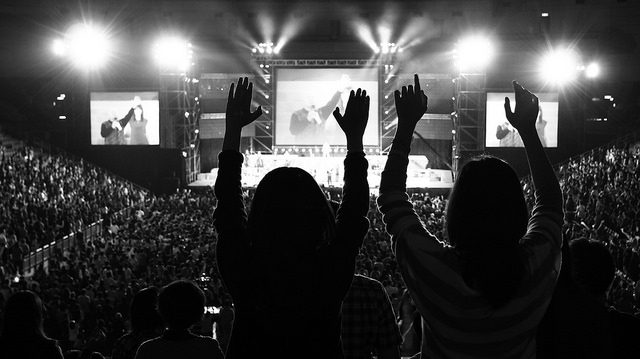
Photo Credit: Aikawa Ke (flickr)
As an Evangelical convert to Catholicism I’ve been deeply interesting in the growing movement within the Evangelical church back towards the ancient liturgies of the church. It is a longing, an urgency, which I felt strongly. It contributed a great deal to my decision to become Catholic.
The idea that worship is not something we need to reinvent; that worship isn’t something which we tailor to suit ourselves. That worship isn’t just singing but something which God clearly laid out for us in Scripture and Tradition following a plan that’s thousands of years old. A way of reaching up and out to God.
Something transcendent.
So when Evangelicals like James K. A. Smith and Jonathan Aigner, my colleague here at Patheos, call for a rejection of the way that some denominations worship I have to agree.
As an Evangelical, “worship” was the time in a Sunday morning service where we sang songs to God.
(Sometimes we sang songs to ourselves about God.)
(Sometimes we just sang songs about ourselves.)
Worship, at any rate, was a very particular part of a Sunday morning services; more or less important than the pastor’s sermon, depending on the denomination.
But in the ancient, liturgical church, worship has always meant much more then that—with roots reaching back into the Old Testament.
For the ancient Israelites, worship of God meant a high priest entering the Holy of Holies in the Temple. The priest would, in regular intervals, present items before the presence of God, items like bread or the blood of sacrificed animals, which would then be imbued with the presence of God.
The bread, coming face to face with God like Moses on the mountain, would shine with the presence of God.
But when Jesus died and the veil in the Temple was torn the wall between man and God’s presence was ruptured. No longer would priests be needed to go into the Holy of Holies and bring out God’s presence—that presence, the real presence of God—was now immediately accessible to all.
Thanks to Christ’s work on the cross.
No longer would the high priest need to wear a breastplate with twelve glowing gems—representing the twelve tribes of Israel—as he entered the Holy of Holies but the twelve tribes could enter themselves.
No longer would the bread shine with the presence of God but, through incredible act of mercy, the bread would become God to be carried out to the people.
In the ancient liturgies of the church this is properly understood. In the Catholic Church, our liturgies stretch back to this same Old Testament worship in the Temple while looking forward to the picture of Heaven St. John gives us in the Book of Revelation.
What the liturgies of the Church do, properly, is to unpack all of this for us.
What the liturgies intend to do is to conform us to best reflect God: the glowing bread. As people of the New Covenant, our liturgical worship is intended to help us to become more familial. To look more and more like our true selves as part of the Family of God. To become more and more swept up in this cosmic romance.
The ancient liturgies of the Church are meant to make us like Christ.
(And this is fundamentally different than just singing.)
In the Catholic tradition, as part of the Mystical Body of Christ, we are also participating in Christ’s work in Heaven. So when Revelation pictures Christ, at the right hand of God the Father, pleading for mercy for his people, we participate in this same act at every single Mass. When we pray, “May our sacrifice and yours being pleasing to you,” it may sound strange and ancient to our post-mondern ears—it may sound downright pagan to an Evangelical—but what we are saying, as members of Christ’s Body, is exactly what Christ in Heaven says to God the Father.
Christ is offering up Himself to Himself in perpetuity. It’s perfect self-giving love. And we are utterly blessed beyond belief to be participating in this same act as part of the same Body.
That is the purpose of the liturgy. And that is worship, at its core.
And that is, at its core, a love story.
The Catholic Church and its ancient liturgy understands worship as a kind of romance. Christ, in the Trinity, gave Himself up to Himself. That is the ultimate expression of love. And, as members of Christ’s Mystical Body, the Church understands that this is what we do in worship.
As Christ’s body we give ourselves up to God, through Christ’s sacrifice being re-presented over and over and over again before God. And in the same way that practicing charitable acts will slowly create in me more authentic feelings of charity, as we celebrate the liturgy we become, bit by bit, more fully incorporated into that self-giving, Trinitarian love triangle.
And this is fundamental to understand.
Because Evangelicals like Aigner are right: our worship shouldn’t be about mustering up feelings of emotional love towards an invisible God. Or even mustering up love towards one another. These feelings are fine but the ultimate purpose of worship is so much more.
Liturgical worship, as the ancient churches understood from the beginning, is a divine love song. It is the Mystical Body of Christ, of which we are blessed to be a part, presenting itself back to God in the ultimate act of love. It is teaching us to love. It is making us more and more like God by presenting us with both a mirror to look into and an example toward which to strive.
And, honestly, in a world as obsessed with self-love as ever God’s antidote—the liturgy of the Church—could not be more timely.
Previous Post

April 23, 2018
Pray and Listen: What Philosophers Are Saying About Evangelization
Next Post

May 1, 2018 There Was Something Wrong With How I Read My Bible
Browse Our Archives
Select a Category Appearances Christian Living Explaining the Faith Podcast Tough Questions Uncategorized Why I'm Catholic
Select a Month January 2024 December 2023 November 2023 July 2023 June 2023 May 2023 April 2023 March 2023 February 2023 January 2023 December 2022 November 2022 October 2022 September 2022 August 2022 July 2022 June 2022 May 2022 April 2022 March 2022 February 2022 January 2022 December 2021 November 2021 October 2021 September 2021 August 2021 July 2021 June 2021 May 2021 April 2021 March 2021 February 2021 January 2021 December 2020 November 2020 October 2020 September 2020 August 2020 July 2020 June 2020 May 2020 April 2020 March 2020 February 2020 January 2020 December 2019 November 2019 October 2019 September 2019 August 2019 July 2019 June 2019 May 2019 April 2019 March 2019 February 2019 January 2019 December 2018 November 2018 October 2018 September 2018 August 2018 July 2018 June 2018 May 2018 April 2018 March 2018 February 2018 January 2018 December 2017 October 2017 September 2017 July 2017 May 2017 April 2017 March 2017 February 2017 January 2017 December 2016 November 2016 October 2016 September 2016 August 2016 July 2016 June 2016 May 2016 April 2016 March 2016 February 2016 January 2016 December 2015 November 2015 October 2015 September 2015 August 2015 July 2015 June 2015 May 2015 April 2015 March 2015 February 2015 January 2015 December 2014 November 2014 October 2014
Follow Us!
TAKE THE
Religious Wisdom Quiz
Jesus raised whose daughter from the dead?
Select your answer to see how you score.
Jairus Thaddeus Bartholomew Darius
Support this
Column


Related posts from The Cordial Catholic

235: Questions I Couldn't Answer (w/ John Martignoni)

234: The Mindblowing World of Sacramentals (w/ Shaun...

233: The Power of Good Catholic Witnesses (w/...

232: The Trajectory of Conversion (w/ Phillip Campbell)
TRENDING AT PATHEOS Catholic

Rejecting Doom: Christian Hope And Human Action
Christianity is a religion of hope. We are to have hope and...

It’s What Comes From Within Which Matters
One of the most difficult things for us to understand is why...

Why I Choose the Eucharist Over the Sermon
Choose the Eucharist, Not the Sermon What are we supposed to get...

5 Design Elements Found in Spiritually Rooted Homes
Putting Spirituality Into Home Decor Our homes are more than our living...

Credo: A Story of God Told with the...
About 10 years ago, I began to imagine a personal "Credo" that...

The Anatomy of Divine Revelation in Catholic Thought
The claim that God has made Himself known to human beings is...
view all Catholic blogs
Ad-Free & Subscriber Log-In Subscription Support
- About Us
- 2026 Calendar
- Videos
- Podcasts
- Library of World Religions
- Faith In Media Tracker
- Advertise With Us
- Write for Us
- Privacy Policy
- Terms of Service
- Do Not Sell My Data
- Contact Us
- Radiant Digital
- Manage Newsletter Subscriptions
- Unsubscribe From Notifications
- Sitemap
Copyright 2008-2026, Patheos. All rights reserved.
Subscription Support Ad-Free & Subscriber Log-In
Follow Patheos