
BuddhistCatholicContemplativeEvangelicalGeneral ChristianHinduJewishLatter-day SaintMuslimNew VisionsProgressive Christian
Beliefs
- Buddhist
- Catholic
- Contemplative
- Evangelical
- General Christian
- Hindu
- Jewish
- Latter-day Saint
- More Voices
- Muslim
- New Visions
- Pagan
- Progressive Christian
Topics
- Religion News
- Food and Religion
- Sports and Religion
- Religious Art
- Religious Music and Entertainment
- Religious Events
- History and Religion
- Style and Religion
- Politics and Religion
- Women in Religion
- Recreation Outdoors and Religion
- Business Finance and Religion
- Careers Workplace and Religion
- Education and Religion
- Family Parenting and Religion
- Health Fitness and Religion
- Home and Religion
- Relationships and Religion
- Technology and Religion
- Travel and Religion
Columnists
- Buddhist Columnists
- Business Finance and Religion Columnists
- Careers Workplace and Religion Columnists
- Catholic Columnists
- Contemplative Columnists
- Education and Religion Columnists
- Evangelists Columnists
- Family Parenting and Religion Columnists
- General Christian Columnists
- Health Fitness and Religion Columnists
- Hindu Columnists
- History and Religion Columnists
- Home and Religion Columnists
- Jewish Columnists
- More Voices Columnists
- Latter Day Columnists
- Muslim Columnists
- New Visions Columnists
- Nonreligious Columnists
- Pagan Columnists
- Politics and Religion Columnists
- Progressive Columnists
- Recreation Outdoors and Religion Columnists
- Relationships and Religion Columnists
- Religion News Columnists
- Religious Art Columnists
- Religious Events Columnists
- Religious Music and Entertainment Columnists
- Sports and Religion Columnists
- Style and Religion Columnists
- Technology and Religion Columnists
- Travel and Religion Columnists
- Women in Religion Columnists
Resource Library
- 2026 Calendar
- Library of World Religions
- The 100 Most Holy Places on Earth
- Patheos Answers
- Podcasts
- Videos
- Faith Leaders Database
- Anglican Episcopalian
- Bahai
- Baptist
- Buddhism
- Christianity
- Confucianism
- Eastern Orthodoxy
- Hinduism
- Holiness and Pentecostal
- ISKCON
- Islam
- Judaism
- Lutheran
- Methodist
- The Church of Jesus Christ of Latter-day Saints
- New Age
- Paganism
- Presbytarian and Reformed
- Protestantism
- Religion Behind the Scenes
- Roman Catholic
- Scientology
- Shia Islam
- Sikhism
- Sufism
- Sunni Islam
- Taoism
- Zen
- See all religions
Research Tools
 Ad-Free & Subscriber Log-In Subscription Support
Ad-Free & Subscriber Log-In Subscription Support
Follow Patheos 

- Trending:
- Forgiveness
- |
- Marriage
- |
- Consciousness
- |
- Death Penalty
- |
- Election
- |
- Halloween
 The Cordial Catholic
- Home
- Catholic
- Where Else Can I Go? Becoming a Catholic, Or Not.
Where Else Can I Go? Becoming a Catholic, Or Not.
Last updated on: August 3, 2015 at 4:02 pm by K. Albert Little
Where Else Can I Go? Becoming a Catholic, Or Not. 2015-08-03T16:02:30-04:00 K. Albert Little
Patheos Explore the world's faith through different perspectives on religion and spirituality! Patheos has the views of the prevalent religions and spiritualities of the world.
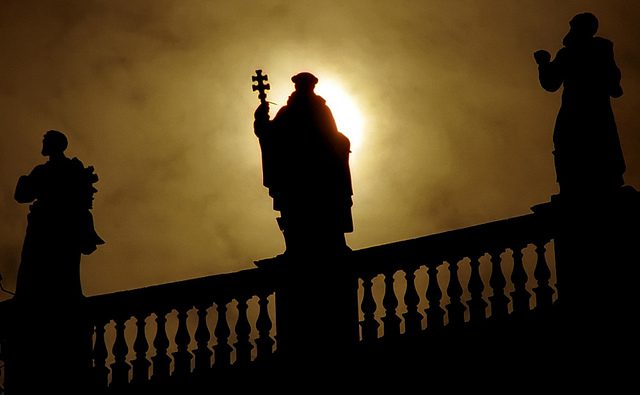
Photo Credit: David Ohmer.
Ask my wife, I’m not always altogether emotionally stable. It’s no secret. Sometimes I get a little bit intense, and sometimes I get a little bit depressed, and sometimes I struggle. I can honest about that, I’m a human being.
Recently, one of these struggles became an complete existential crisis.
It wasn’t the first time I was stopped in my tracks or the first time I’d harboured serious doubts about this faith journey that I’m on. Likely, it won’t be the last. But I’ve learned a lot of things and each set back has been an incredible opportunity for growth—often profound spiritual growth—so I wanted to share a bit of honest experience with you.
Sometimes I wonder if there’s even any point of continuing on my current trajectory. This was the tenor of the aforementioned existential crisis.
I stood in the backyard, in the dark, praying the rosary and waiting for a pot of soup to cool down in the snow. It was, obviously, an odd configuration of things.
Do I really want to be a Catholic? Do I need to be a Catholic?
These are the sorts of things I think of during existential crises.
I’ve had poor experiences with my RCIA classes. Classes meant to usher in the heathen masses into the most beautiful and profound narrative unfolding over all space and time: The Holy Catholic Church. In my own personal experiences, these classes have been less than edifying. What I mean is, they haven’t been edifying for *me—*they haven’t been at my pace or met my needs or been what I was hoping they’d be and that’s been a major setback. But I’ve taken it in stride. I’ve taken it as an opportunity, like I said, in the disguise of a setback. This has been God telling me something: It isn’t all about me.
I’m not the centre of the universe, go figure.
Timing is important, too. I’m sure I could rush my acceptance into the Church and beg a priest, anywhere, to admit me into Communion and I’m sure someone with a collar, somewhere, would go for it, but that would be my agenda and on my timeline. Instead, I trust the Lord knows what’s best and that I found this particular RCIA class at this particular Catholic parish for a reason. It’s constantly a setback, but it’s also, constantly, an opportunity for growth—and for faith, and trust, and humility (which I need most of all, amen).
I’ve also felt setback by the experience—the example—of other Catholics.
G.K. Chesterton, Catholic convert from Anglicanism, writes of this exact experience in The Catholic Church and Conversion a book that if you know me and read this blog you will know that I love dearly. Chesterton writes that at a certain point in a Protestant’s conversion the only thing that can really shake them from their path into the Church is, more often than not, the poor example (in words or deeds) of another Catholic.
That’s exactly it.
Hearing, reading, or observing things that those already inside the Church sometimes do, as I get closer to joining, has been a setback as well.
“If he’s a Catholic and that’s what he says about Islam why would I want to be a part of that Church?”
But for all the roadblocks, all the setbacks, all of the difficult circumstances and dark days the blessed words of St. Peter, on whom Catholics believe Christ founded the Church, keep ringing in my ears, “Where else can we go?”
Where else can I go?
I think of this when something sets me back, or stirs me up, or drags me down. If not the Catholic Church, where else could I go?
Because sometimes I wonder if there’s any point in going forward. Sometimes it’s difficult.
I couldn’t be happy as a Protestant, I know this much.
I’ve turned it over in my head every which way and I’m passed that point. I couldn’t do it. First things, my struggles with reconciling how Scripture is interpreted within Protestantism are too great. It doesn’t make sense to me that a loving God, who prayed, in the Person of Jesus, for Christian unity would’ve left us with a Bible that needs interpreting and, in the interpreting, we get so many different conclusions. I can’t figure my way out of that because Protestant denominations differ on enormous issues like the means of salvation and the sanctity of life.
The closest, admittedly, that I’ve come to a solution that seems workable, that seems acceptable, is that proposed by former Anglican bishop N.T. Wright. However, even in his case, when his formula of interpreting Scripture through thematic, contextual reading, community, and scholarship is actually applied it doesn’t work to prevent schism and discord—you need look no further than the desperate status of the Anglican Communion world-wide.
Plenty of groups of Christians can read Scripture contextually, consult scholars, and pray earnestly about it and still come to different conclusions. Thoughtfully applying Wright’s formula—as good as it is—doesn’t provide Protestants with a way out of the difficult, murky waters of Scriptural interpretation and authority.
Where else can I go?
Likewise, as a Protestant on the way to Catholicism I’ve been swept away by Catholic forms of worship and devotion. The beauty and reverence of the Mass is something I’ve never even close to experienced on a Protestant Sunday morning. The appeal and simple beauty of the rosary, the missal, lectionary, the liturgial calendar, the rich symbolism of worship, and the Liturgy of the Hours. It’s been precisely these things that have gotten me through dark times and difficult moments as I struggle along on this journey. It’s been a particularly moving Mass, at a particularly disappointing time, that has taught me that giving up would be foolish (and that pressing on is the answer). Ironically, it’s been Jesus moving through the Catholic stuff, in the midst of my doubts about Catholicism as a whole, that has brought me through.
Finally, it’s the uniquely Catholic theology that I’ve learned too much about, that resonates too strongly, to be able to abandon it at this stage of the game. It’s theology I was never able to understand or reconcile as a Protestant: Confession, the Communion of Saints, Jesus’ High Priestly Prayer, the Bread and Wine Discourse, Justification, and Paul’s discussion of our works being proven in fire (and its purgatorial implications). As bizarre as some of this Catholic theology may sound to the ears of my readers—and God bless you for reading it—it’s the stuff that’s begun to be woven into my way of thinking. It’s stuff that’s become well-tread territory, and deeply rooted in my understanding of my faith. It’s stuff I would’ve scoffed at even a year ago but it’s also the stuff, like confession, for example, that I’ve been puzzled about for years as a Protestant.
In Catholicism is a satisfying and edifying solution to these theological conundrums. So, where else could I go?
On those difficult days, and in those challenging moments, I do find myself wondering what all this is for. I’ve come close, and I’ll come close again, to quitting, but there has always been something—I believe it’s a Someone, more likely—that’s been ushering me along. When I think of giving up, of giving in, I think about what it would mean and how I could be satisfied and how I could feel OK with myself and my decision and I can’t. I can’t remain a Protestant even, in those moments, when I desperately want to, when it would be much easier socially, emotionally, and relationally—when I’m set back and set to stumble and challenged.
Instead, the Lord leads me on and through those difficult times; in spite of the poor catechises at my parish church, in spite of the poor examples of Catholic piety, in spite of my own doubts and the emotional roller coaster of bleak, dark winter days. I’ve never been in such a strange place with my faith, a place of sometimes frustration, but a place of deep certainty. A place where I’m vexed, on the one hand, but encouraged on the other. A place where I know I can’t go back, but going forward seems an insanity sometimes.
As I finish the first draft of this article the clock approaches six. The bells from the church down the street where the Lord dwells in the tabernacle, as I write, will ring the Angelus, a reminder and call to prayer. I’m going to go and open the window, let the frigid winter air in, so I can hear them ring more clearly.
Previous Post
January 10, 2015
Are Catholics Less Devout than Protestants?
Next Post
January 19, 2015 On The Vicar of Christ
Browse Our Archives
Select a Category Appearances Christian Living Explaining the Faith Podcast Tough Questions Uncategorized Why I'm Catholic
Select a Month January 2024 December 2023 November 2023 July 2023 June 2023 May 2023 April 2023 March 2023 February 2023 January 2023 December 2022 November 2022 October 2022 September 2022 August 2022 July 2022 June 2022 May 2022 April 2022 March 2022 February 2022 January 2022 December 2021 November 2021 October 2021 September 2021 August 2021 July 2021 June 2021 May 2021 April 2021 March 2021 February 2021 January 2021 December 2020 November 2020 October 2020 September 2020 August 2020 July 2020 June 2020 May 2020 April 2020 March 2020 February 2020 January 2020 December 2019 November 2019 October 2019 September 2019 August 2019 July 2019 June 2019 May 2019 April 2019 March 2019 February 2019 January 2019 December 2018 November 2018 October 2018 September 2018 August 2018 July 2018 June 2018 May 2018 April 2018 March 2018 February 2018 January 2018 December 2017 October 2017 September 2017 July 2017 May 2017 April 2017 March 2017 February 2017 January 2017 December 2016 November 2016 October 2016 September 2016 August 2016 July 2016 June 2016 May 2016 April 2016 March 2016 February 2016 January 2016 December 2015 November 2015 October 2015 September 2015 August 2015 July 2015 June 2015 May 2015 April 2015 March 2015 February 2015 January 2015 December 2014 November 2014 October 2014
Follow Us!
TAKE THE
Religious Wisdom Quiz
Who mocked Nehemiah and the Jews, saying a fox could break their wall?
Select your answer to see how you score.
Eliashib Geshem Sanballat Tobiah
Support this
Column


Related posts from The Cordial Catholic

235: Questions I Couldn't Answer (w/ John Martignoni)

234: The Mindblowing World of Sacramentals (w/ Shaun...

233: The Power of Good Catholic Witnesses (w/...

232: The Trajectory of Conversion (w/ Phillip Campbell)
TRENDING AT PATHEOS Catholic

Rejecting Doom: Christian Hope And Human Action
Christianity is a religion of hope. We are to have hope and...

It’s What Comes From Within Which Matters
One of the most difficult things for us to understand is why...

Why I Choose the Eucharist Over the Sermon
Choose the Eucharist, Not the Sermon What are we supposed to get...

5 Design Elements Found in Spiritually Rooted Homes
Putting Spirituality Into Home Decor Our homes are more than our living...

Credo: A Story of God Told with the...
About 10 years ago, I began to imagine a personal "Credo" that...

The Anatomy of Divine Revelation in Catholic Thought
The claim that God has made Himself known to human beings is...
view all Catholic blogs
Ad-Free & Subscriber Log-In Subscription Support
- About Us
- 2026 Calendar
- Videos
- Podcasts
- Library of World Religions
- Faith In Media Tracker
- Advertise With Us
- Write for Us
- Privacy Policy
- Terms of Service
- Do Not Sell My Data
- Contact Us
- Radiant Digital
- Manage Newsletter Subscriptions
- Unsubscribe From Notifications
- Sitemap
Copyright 2008-2026, Patheos. All rights reserved.
Subscription Support Ad-Free & Subscriber Log-In
Follow Patheos