
BuddhistCatholicContemplativeEvangelicalGeneral ChristianHinduJewishLatter-day SaintMuslimNew VisionsProgressive Christian
Beliefs
- Buddhist
- Catholic
- Contemplative
- Evangelical
- General Christian
- Hindu
- Jewish
- Latter-day Saint
- More Voices
- Muslim
- New Visions
- Pagan
- Progressive Christian
Topics
- Religion News
- Food and Religion
- Sports and Religion
- Religious Art
- Religious Music and Entertainment
- Religious Events
- History and Religion
- Style and Religion
- Politics and Religion
- Women in Religion
- Recreation Outdoors and Religion
- Business Finance and Religion
- Careers Workplace and Religion
- Education and Religion
- Family Parenting and Religion
- Health Fitness and Religion
- Home and Religion
- Relationships and Religion
- Technology and Religion
- Travel and Religion
Columnists
- Buddhist Columnists
- Business Finance and Religion Columnists
- Careers Workplace and Religion Columnists
- Catholic Columnists
- Contemplative Columnists
- Education and Religion Columnists
- Evangelists Columnists
- Family Parenting and Religion Columnists
- General Christian Columnists
- Health Fitness and Religion Columnists
- Hindu Columnists
- History and Religion Columnists
- Home and Religion Columnists
- Jewish Columnists
- More Voices Columnists
- Latter Day Columnists
- Muslim Columnists
- New Visions Columnists
- Nonreligious Columnists
- Pagan Columnists
- Politics and Religion Columnists
- Progressive Columnists
- Recreation Outdoors and Religion Columnists
- Relationships and Religion Columnists
- Religion News Columnists
- Religious Art Columnists
- Religious Events Columnists
- Religious Music and Entertainment Columnists
- Sports and Religion Columnists
- Style and Religion Columnists
- Technology and Religion Columnists
- Travel and Religion Columnists
- Women in Religion Columnists
Resource Library
- 2026 Calendar
- Library of World Religions
- The 100 Most Holy Places on Earth
- Patheos Answers
- Podcasts
- Videos
- Faith Leaders Database
- Anglican Episcopalian
- Bahai
- Baptist
- Buddhism
- Christianity
- Confucianism
- Eastern Orthodoxy
- Hinduism
- Holiness and Pentecostal
- ISKCON
- Islam
- Judaism
- Lutheran
- Methodist
- The Church of Jesus Christ of Latter-day Saints
- New Age
- Paganism
- Presbytarian and Reformed
- Protestantism
- Religion Behind the Scenes
- Roman Catholic
- Scientology
- Shia Islam
- Sikhism
- Sufism
- Sunni Islam
- Taoism
- Zen
- See all religions
Research Tools
 Ad-Free & Subscriber Log-In Subscription Support
Ad-Free & Subscriber Log-In Subscription Support
Follow Patheos 

- Trending:
- Forgiveness
- |
- Marriage
- |
- Consciousness
- |
- Death Penalty
- |
- Election
- |
- Halloween
 The Cordial Catholic
- Home
- Catholic
- Does the Church Need to Constantly Evolve?
Does the Church Need to Constantly Evolve?
Last updated on: April 26, 2016 at 7:08 pm by K. Albert Little
Does the Church Need to Constantly Evolve? 2016-04-26T19:08:00-04:00 K. Albert Little
Patheos Explore the world's faith through different perspectives on religion and spirituality! Patheos has the views of the prevalent religions and spiritualities of the world.
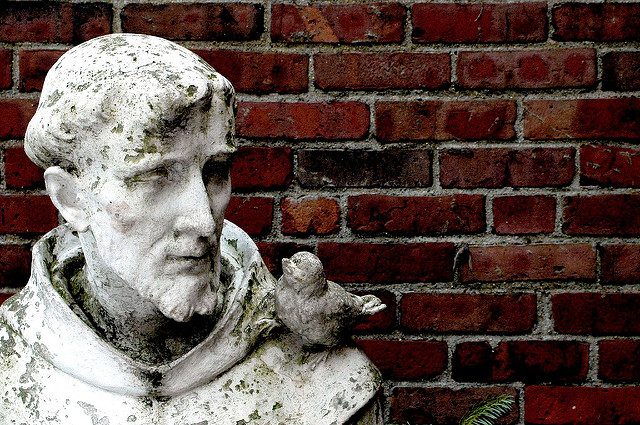
Photo Credit: beau-photo.
When I think about my journey into the Catholic Church an old song by Pedro the Lion comes to mind. It’s a great tune called “Letter from a Concerned Follower,” and the line I’m thinking of unfolds like this,
And I hear that you don’t change
How to you expect to keep up with the trends?
You won’t survive the information age
Unless you plan to change the truth
To accommodate the brilliance of men,
the brilliance of men.
Written from the perspective of a struggling Christian, Letter from a Concerned Follower asks Christ how He, and His Church, can expect to keep up with the times.
How do you expect to accommodate the brilliance of men?
Our ideas, innovations, and adjustments?
I think about this often because it’s the flipside of a question I get all the time.
Is older better?
Doesn’t the Christian Church need to innovate? Need to change? To adapt?
The historicity of the Catholic Church was key in my conversion: the unbroken line from the Apostles to today. The stalwart tug of doing things—in large part—the way they’ve been done for two thousand years. The assuredness of the authority of the Seat of Peter. An ancient understanding of the Eucharist, Baptism, and hierarchical structure of the Church.
As I meandered a sort of garden path towards a more ancient faith it was these old things that finally brought me home.
But, is older better?
First, it’s important to recognize that Catholics and non-Catholics understand the Christian Church in particularly different ways. This is fundamental for how we speak about the Church, and if we’re going to understand each other most clearly.
For the Catholic, the Church is that which was founded by Christ. A distinctively hierarchical, authoritative structure through which the Holy Spirit flows, through which Christians are bound together—which is mystical and holy. Like the Early Church Fathers, who set up bishoprics and assigned new leaders when older ones faltered and passed away, the Catholic Church sees itself as both invisible and visible.
An invisible union of all Christians; a visible authority on Earth.
To the ears of the average Evangelical, words like hierarchy and authority may have no place in their lexicon. I get it. The Church, instead, is that invisible union of all Christians around the world. Full stop.
Here, as I said, it’s important to understand the different meanings of the words we use.
But let’s not lose sight of our question, “Is older really better?”
In the 16th century Martin Luther, a Catholic monk, decided from a plain reading of Scripture that the Catholic Church had got, and was getting, a lot of things wrong. Chief among these concerns were indulgences, the papacy, and the nature of salvation. Luther made a split from the authority structure Catholic Church but it’s important—for our question—to understand that Luther was not an innovator.
Luther did not believe that was he was doing was innovation. He believed, based on his reading of Scriptures, and on some interpretations of Early Church Fathers like St. Augustine, that he had found what he believed to be a more correct interpretation of Scripture.
He believed his doctrine, in opposition to the Catholic Church, was actually closer to the sources.
Closer to what was originally believed by the writers of the New Testament (most of them at least).
Luther was not innovating but going back to the sources.
Luther was arguing that older was better: That the Catholic Church had strayed from a pure presentation of the Gospel with its addition of tradition.
To be fair, Luther’s understanding of sola Scriptura is widely different from how we’d describe it today. Luther—and his Lutherans—understood the importance of interpreting Scripture within the context of a community and, fundamentally, that not every individual Christian should read and interpret for themselves.
Luther, who was instrumental in getting his Bible into the hands of the people in their own language would later—rather swiftly—argue for it’s removal.
But once the cat’s out of the bag it’s almost impossible to stick him back in again.
Because claws.
Far from censoring the Bible or holding a monopoly, the Catholic Church rightly understood the danger of putting a difficult-to-understand text into the hands of the uneducated masses. The potential for misuse, abuse, and misunderstanding was enormous.
But the question remains, “Is older really better?”
Certainly Martin Luther, the father of the Reformation, thought so. His was a movement back to the Bible from within a Church that he saw as having gone astray.
Unfortunately, five centuries removed from Luther and the beginnings of the Lutheran church we’re left with an Evangelical Christianity based the Bible alone apart, even, from Luther’s understanding of how the Bible should be read: in a strict community context. Interpreting together.
And while Luther understood older to be better—a Christianity closer to its source—we’ve come along way in a different direction.
To oppose the claim that older is better is the argument that Christianity needs—must—constantly adapt and change. In its music, its message, its teaching… it’s theology.
But is this what Jesus intended? A constantly evolving Christianity?
Interestingly, many Catholic bishops and theologians, writing at the time of the Reformation, argued precisely against such a notion. Many Protestant Reformers, too.
That a Christianity, stripped of the authority of the Church, would have to constantly evolve and change and who was to say whose interpretation was right (and whose interpretations were wrong).
A Christianity based solely on a Bible which is up for interpretation—in which, if I don’t like the interpretation of Pastor Jim I can head down the street to study under Pastor Phil. In which, for most denominations, the idea of authority is untenable. In which even the most earnest and honest Christians must admit that we think we have it right but we can’t be sure (because the Bible can be confusing, and we’re not all Bible scholars).
Without a authority structure to definitively hand down teachings Christianity becomes a sort of survival of the fittest: which interpretation of the Bible can be made most modern, which is catching on, and which bits should we sweep under the rug?
Shucks, only half-mad Aunt Tilley believes in that anymore.
In this case, in my opinion, older is better.
In the end, my inestimable wife said it best in a discussion we had late one evening. Despite all of my best efforts and my most miserable examples she decided, a year after I did, to join the Catholic Church too.
She said that, ultimately, what it comes down to is a measure of humility.
The recognition that maybe we don’t know everything but maybe we should cleave to a Church with a distinctive, ancient, two-thousand year old history of doing things a certain way. That it’s humbling and, sometimes, I would add, humiliating, but it forces us not to put ourselves and our interpretations first but to trust in something bigger than ourselves—and with the weight of history and holiness behind it.
A Church that can trace its ancestry—with a straight line—back to Jesus Christ Himself when He stood on this very earth.
And although we might opine, like the concerned follower in our song,
And I hear that you don’t change
How to you expect to keep up with the trends?
we recognize that a constantly evolving, constantly adapting Church, is exactly the opposite of what the original Protestant Reformers had in mind. Exactly what Catholic writers warned the Reformers would happen. And exactly the opposite of the timeless message of Jesus who said that nothing will overcome His Church.
Stay in touch! Like The Cordial Catholic on Facebook:
Previous Post

April 19, 2016
What Canadian Catholics Need to Know About Assisted Suicide
Next Post

April 26, 2016 The Catholic Church Must Become More Protestant
Browse Our Archives
Select a Category Appearances Christian Living Explaining the Faith Podcast Tough Questions Uncategorized Why I'm Catholic
Select a Month January 2024 December 2023 November 2023 July 2023 June 2023 May 2023 April 2023 March 2023 February 2023 January 2023 December 2022 November 2022 October 2022 September 2022 August 2022 July 2022 June 2022 May 2022 April 2022 March 2022 February 2022 January 2022 December 2021 November 2021 October 2021 September 2021 August 2021 July 2021 June 2021 May 2021 April 2021 March 2021 February 2021 January 2021 December 2020 November 2020 October 2020 September 2020 August 2020 July 2020 June 2020 May 2020 April 2020 March 2020 February 2020 January 2020 December 2019 November 2019 October 2019 September 2019 August 2019 July 2019 June 2019 May 2019 April 2019 March 2019 February 2019 January 2019 December 2018 November 2018 October 2018 September 2018 August 2018 July 2018 June 2018 May 2018 April 2018 March 2018 February 2018 January 2018 December 2017 October 2017 September 2017 July 2017 May 2017 April 2017 March 2017 February 2017 January 2017 December 2016 November 2016 October 2016 September 2016 August 2016 July 2016 June 2016 May 2016 April 2016 March 2016 February 2016 January 2016 December 2015 November 2015 October 2015 September 2015 August 2015 July 2015 June 2015 May 2015 April 2015 March 2015 February 2015 January 2015 December 2014 November 2014 October 2014
Follow Us!
TAKE THE
Religious Wisdom Quiz
What was the name of the first murderer in the Bible?
Select your answer to see how you score.
Ishmael Cain Esau Lamech
Support this
Column


Related posts from The Cordial Catholic

232: The Trajectory of Conversion (w/ Phillip Campbell)
231: Becoming Catholic in a Church Crisis (w/...

229: Can Catholics and Evangelicals Agree on How...

227: What was Medieval Catholicism Really Like? (w/...
TRENDING AT PATHEOS Catholic

Rejecting Doom: Christian Hope And Human Action
Christianity is a religion of hope. We are to have hope and...

It’s What Comes From Within Which Matters
One of the most difficult things for us to understand is why...

Why I Choose the Eucharist Over the Sermon
Choose the Eucharist, Not the Sermon What are we supposed to get...

5 Design Elements Found in Spiritually Rooted Homes
Putting Spirituality Into Home Decor Our homes are more than our living...

Credo: A Story of God Told with the...
About 10 years ago, I began to imagine a personal "Credo" that...

The Anatomy of Divine Revelation in Catholic Thought
The claim that God has made Himself known to human beings is...
view all Catholic blogs
Ad-Free & Subscriber Log-In Subscription Support
- About Us
- 2026 Calendar
- Videos
- Podcasts
- Library of World Religions
- Faith In Media Tracker
- Advertise With Us
- Write for Us
- Privacy Policy
- Terms of Service
- Do Not Sell My Data
- Contact Us
- Radiant Digital
- Manage Newsletter Subscriptions
- Unsubscribe From Notifications
- Sitemap
Copyright 2008-2026, Patheos. All rights reserved.
Subscription Support Ad-Free & Subscriber Log-In
Follow Patheos