
BuddhistCatholicContemplativeEvangelicalGeneral ChristianHinduJewishLatter-day SaintMuslimNew VisionsProgressive Christian
Beliefs
- Buddhist
- Catholic
- Contemplative
- Evangelical
- General Christian
- Hindu
- Jewish
- Latter-day Saint
- More Voices
- Muslim
- New Visions
- Pagan
- Progressive Christian
Topics
- Religion News
- Food and Religion
- Sports and Religion
- Religious Art
- Religious Music and Entertainment
- Religious Events
- History and Religion
- Style and Religion
- Politics and Religion
- Women in Religion
- Recreation Outdoors and Religion
- Business Finance and Religion
- Careers Workplace and Religion
- Education and Religion
- Family Parenting and Religion
- Health Fitness and Religion
- Home and Religion
- Relationships and Religion
- Technology and Religion
- Travel and Religion
Columnists
- Buddhist Columnists
- Business Finance and Religion Columnists
- Careers Workplace and Religion Columnists
- Catholic Columnists
- Contemplative Columnists
- Education and Religion Columnists
- Evangelists Columnists
- Family Parenting and Religion Columnists
- General Christian Columnists
- Health Fitness and Religion Columnists
- Hindu Columnists
- History and Religion Columnists
- Home and Religion Columnists
- Jewish Columnists
- More Voices Columnists
- Latter Day Columnists
- Muslim Columnists
- New Visions Columnists
- Nonreligious Columnists
- Pagan Columnists
- Politics and Religion Columnists
- Progressive Columnists
- Recreation Outdoors and Religion Columnists
- Relationships and Religion Columnists
- Religion News Columnists
- Religious Art Columnists
- Religious Events Columnists
- Religious Music and Entertainment Columnists
- Sports and Religion Columnists
- Style and Religion Columnists
- Technology and Religion Columnists
- Travel and Religion Columnists
- Women in Religion Columnists
Resource Library
- 2026 Calendar
- Library of World Religions
- The 100 Most Holy Places on Earth
- Patheos Answers
- Podcasts
- Videos
- Faith Leaders Database
- Anglican Episcopalian
- Bahai
- Baptist
- Buddhism
- Christianity
- Confucianism
- Eastern Orthodoxy
- Hinduism
- Holiness and Pentecostal
- ISKCON
- Islam
- Judaism
- Lutheran
- Methodist
- The Church of Jesus Christ of Latter-day Saints
- New Age
- Paganism
- Presbytarian and Reformed
- Protestantism
- Religion Behind the Scenes
- Roman Catholic
- Scientology
- Shia Islam
- Sikhism
- Sufism
- Sunni Islam
- Taoism
- Zen
- See all religions
Research Tools
 Ad-Free & Subscriber Log-In Subscription Support
Ad-Free & Subscriber Log-In Subscription Support
Follow Patheos 

- Trending:
- Forgiveness
- |
- Marriage
- |
- Consciousness
- |
- Death Penalty
- |
- Election
- |
- Halloween
 The Cordial Catholic
- Home
- Catholic
- What Divides Us: Ecumenical Lessons from The Hobbit
What Divides Us: Ecumenical Lessons from The Hobbit
Last updated on: August 3, 2015 at 4:02 pm by K. Albert Little
What Divides Us: Ecumenical Lessons from The Hobbit 2015-08-03T16:02:31-04:00 K. Albert Little
Patheos Explore the world's faith through different perspectives on religion and spirituality! Patheos has the views of the prevalent religions and spiritualities of the world.
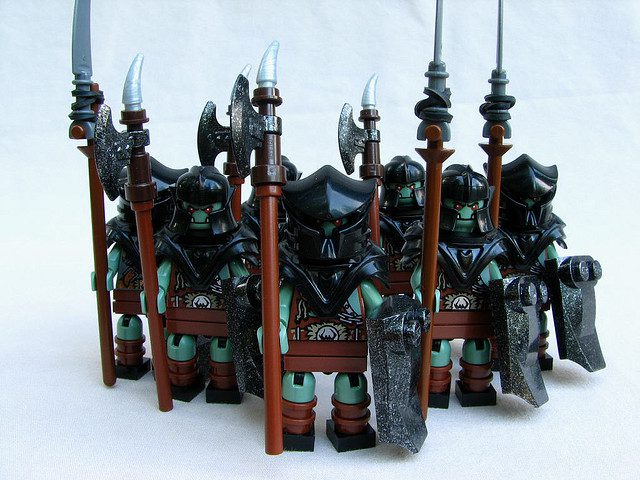
Orc Pikeman. Photo: EnochSun.
As I’ve been making my way towards the Catholic Church I’ve thought a lot about Christian unity. As a Protestant, I always struggled with the cascading number of Christian denominations. I always wrestled with church splits, spin-offs, and church plants. Truthfully, it hasn’t been front-of-mind but it’s lingered back there, creeping up once in a while in uncomfortable conversation.
Why are these so many Protestant denominations? How can there be so many presentations of the truth? How can there be so many interpretations of the Bible? How is it that if I don’t like what I hear in one place I can simply go to another? How does that make sense?
These are issues of clarity and authority, issues I’ve wrestled with lots on this blog, have always, on some level, been spinning around in my head. Sometimes I didn’t know how to name them.
Like what’s commonly called Jesus’ high priestly prayer recorded in the Gospel of John (see John 17). A prayer in which Jesus, God Himself, prays for Christian unity. In the face of so many different denominations believing in so many different interpretations of so many different things—how does this unity make sense? When fundamental issues about salvation, eternal life, moral living, and the end of the world differ enormously from Christian church to Christian church. Where do we even begin to call ourselves united?
It’s as if Jesus predicted the schisms of the Church.
When I began to more seriously read Catholic authors and as I began to devour the hours upon hours of debates, lectures, and seminars available on YouTube I realized that there was a Church claiming the unity that Christ called for, a Church which claimed a yearning for that unity since its very humbling beginning in the Upper Room.
Christ’s call for Christian unity is one of several reasons I’m on a journey towards the Catholic Church.
Forgive me an unabashedly nerdy reference?
In Peter Jackson’s final installment of J.R.R. Tolkien’s The Hobbit there’s a brilliant scene which, when I first saw it, struck me immediately as a perfect analogy for Christian unity. Fortunately, you don’t need to know a lot of the backstory to get the full effect—although reading, or watching, The Hobbit is highly recommended.
Here’s the gist of the thing.
Smaug the dragon, who was making merry on an incredible hoard of treasure, has been killed. At the news of Smaug’s death several parties descend on Dale, the former dwarf stronghold, to try to lay some claim (rightfully or otherwise) to the treasure therein. Imagine, if you will, dwarves, elves, and humans vying for some share in the heaps and heaps of glittering gold stored deep within the mountain.
However, as the armies of dwarves, elves, and men argue at the foot of the mountain another foe makes their appearance. Marching down the gently sloping hillside comes the marauding, sadistic Orc army.
Suddenly, the situation shifts. In dramatic fashion the differences, the quarrels, the debates amongst the elves, dwarves, and men vanish—they disappear. Suddenly, a much more portentous adversary is on the scene. Suddenly the problems of the three armies don’t seem so important as the threat from the one. Dwarves, elves, and humans turn their attention and make their united assault against the invading Orc army.
This is a beautiful, poignant illustration of Christian unity.
I heard a quote with a similar sentiment though I can’t place it’s origin,
When a thief breaks in, quarreling brothers become allies.
As North American Christians, we do not face much persecution. We do not face much hardship or peril. We don’t, in any ordinary sense, face anything like the moral or theological equivalent of a thief breaking into the Christian Church or an Orc army invasion. Elsewhere in the world this is not the case.
At what point will the quarrel out there be great enough to drive us together? At what point does the thief breaking in through the bedroom window send the brothers—fighting in the parlour—running up the stairs? At what point does the approaching Orc army cause dwarves, elves, and men to put aside their competing claims and take up arms together—to unite?
In the Catholic Church—and this could be true for the Eastern Orthodox Church as well—I’ve found a good case for Christian unity. As a Protestant, I was part of a tradition that split, for very good reasons, from a church that claimed succession right through to Peter and the apostles. When I began to read, when I began to seriously study Catholicism from Catholic authors, the beauty of the unity of the Church began to unfold for me. The beauty of a Church that calls back its separated brethren. A Church that in word and deed longs to be united—under a Pope, Pope Francis, who is making historic strides toward that end.
A Church that says, “Yes, you left and you had very good reasons but we’ve given this place a thorough cleaning and, by the way, look how beautiful it is.”
A Church that, contrary to everything I understood before, has a vibrant, rich, and relevant life among its faithful.
As a Protestant slowly but surely approaching entrance to the Catholic Church, looking out over the lay of the land, there’s nothing I pray for more than our unity. If this journey has taught me anything it’s that what I believed as a Protestant isn’t changed by becoming a Catholic it’s increased, it’s enriched, it’s made deeper. In the same way the coming of Christ and the grace of God swept away the Old Covenant and ushered in the New I feel I’ve found a fulfillment, a deepening of everything I understood about Christ and Christianity as a Protestant. And, of all places, I found it in the Catholic Church.
Out of all the words that our God spoke while on earth how many times did he pray? And here is one of his precious few recorded prayers. And these are some of his very last words and these are urgent in our ears today. A prayer for Christian unity, for His Church.
I pray we find a way and I’d like, for my part, to play a role in that. I pray, too, that it won’t take a thief, or an army to bring us back to our knees, together.
Previous Post

January 4, 2015
New Year's Journey
Next Post

January 7, 2015 Christmas for Catholics (as a Protestant)
Browse Our Archives
Select a Category Appearances Christian Living Explaining the Faith Podcast Tough Questions Uncategorized Why I'm Catholic
Select a Month January 2024 December 2023 November 2023 July 2023 June 2023 May 2023 April 2023 March 2023 February 2023 January 2023 December 2022 November 2022 October 2022 September 2022 August 2022 July 2022 June 2022 May 2022 April 2022 March 2022 February 2022 January 2022 December 2021 November 2021 October 2021 September 2021 August 2021 July 2021 June 2021 May 2021 April 2021 March 2021 February 2021 January 2021 December 2020 November 2020 October 2020 September 2020 August 2020 July 2020 June 2020 May 2020 April 2020 March 2020 February 2020 January 2020 December 2019 November 2019 October 2019 September 2019 August 2019 July 2019 June 2019 May 2019 April 2019 March 2019 February 2019 January 2019 December 2018 November 2018 October 2018 September 2018 August 2018 July 2018 June 2018 May 2018 April 2018 March 2018 February 2018 January 2018 December 2017 October 2017 September 2017 July 2017 May 2017 April 2017 March 2017 February 2017 January 2017 December 2016 November 2016 October 2016 September 2016 August 2016 July 2016 June 2016 May 2016 April 2016 March 2016 February 2016 January 2016 December 2015 November 2015 October 2015 September 2015 August 2015 July 2015 June 2015 May 2015 April 2015 March 2015 February 2015 January 2015 December 2014 November 2014 October 2014
Follow Us!
TAKE THE
Religious Wisdom Quiz
What happened to Jonah?
Select your answer to see how you score.
Thrown in a lion's den Swallowed by a great fish Imprisoned Shipwrecked
Support this
Column


Related posts from The Cordial Catholic
203: A Protestant Pastor, his Wife, and Their...

200: Reasons to Doubt Sola Scriptura (w/ Jimmy...
196: The African Roots of Catholicism (w/ Mike...
180: An Evangelical Exodus? (w/ Dr. Douglas Beaumont)
TRENDING AT PATHEOS Catholic

Rejecting Doom: Christian Hope And Human Action
Christianity is a religion of hope. We are to have hope and...

It’s What Comes From Within Which Matters
One of the most difficult things for us to understand is why...

Why I Choose the Eucharist Over the Sermon
Choose the Eucharist, Not the Sermon What are we supposed to get...

5 Design Elements Found in Spiritually Rooted Homes
Putting Spirituality Into Home Decor Our homes are more than our living...

Credo: A Story of God Told with the...
About 10 years ago, I began to imagine a personal "Credo" that...

The Anatomy of Divine Revelation in Catholic Thought
The claim that God has made Himself known to human beings is...
view all Catholic blogs
Ad-Free & Subscriber Log-In Subscription Support
- About Us
- 2026 Calendar
- Videos
- Podcasts
- Library of World Religions
- Faith In Media Tracker
- Advertise With Us
- Write for Us
- Privacy Policy
- Terms of Service
- Do Not Sell My Data
- Contact Us
- Radiant Digital
- Manage Newsletter Subscriptions
- Unsubscribe From Notifications
- Sitemap
Copyright 2008-2026, Patheos. All rights reserved.
Subscription Support Ad-Free & Subscriber Log-In
Follow Patheos