
BuddhistCatholicContemplativeEvangelicalGeneral ChristianHinduJewishLatter-day SaintMuslimNew VisionsProgressive Christian
Beliefs
- Buddhist
- Catholic
- Contemplative
- Evangelical
- General Christian
- Hindu
- Jewish
- Latter-day Saint
- More Voices
- Muslim
- New Visions
- Pagan
- Progressive Christian
Topics
- Religion News
- Food and Religion
- Sports and Religion
- Religious Art
- Religious Music and Entertainment
- Religious Events
- History and Religion
- Style and Religion
- Politics and Religion
- Women in Religion
- Recreation Outdoors and Religion
- Business Finance and Religion
- Careers Workplace and Religion
- Education and Religion
- Family Parenting and Religion
- Health Fitness and Religion
- Home and Religion
- Relationships and Religion
- Technology and Religion
- Travel and Religion
Columnists
- Buddhist Columnists
- Business Finance and Religion Columnists
- Careers Workplace and Religion Columnists
- Catholic Columnists
- Contemplative Columnists
- Education and Religion Columnists
- Evangelists Columnists
- Family Parenting and Religion Columnists
- General Christian Columnists
- Health Fitness and Religion Columnists
- Hindu Columnists
- History and Religion Columnists
- Home and Religion Columnists
- Jewish Columnists
- More Voices Columnists
- Latter Day Columnists
- Muslim Columnists
- New Visions Columnists
- Nonreligious Columnists
- Pagan Columnists
- Politics and Religion Columnists
- Progressive Columnists
- Recreation Outdoors and Religion Columnists
- Relationships and Religion Columnists
- Religion News Columnists
- Religious Art Columnists
- Religious Events Columnists
- Religious Music and Entertainment Columnists
- Sports and Religion Columnists
- Style and Religion Columnists
- Technology and Religion Columnists
- Travel and Religion Columnists
- Women in Religion Columnists
Resource Library
- 2026 Calendar
- Library of World Religions
- The 100 Most Holy Places on Earth
- Patheos Answers
- Podcasts
- Videos
- Faith Leaders Database
- Anglican Episcopalian
- Bahai
- Baptist
- Buddhism
- Christianity
- Confucianism
- Eastern Orthodoxy
- Hinduism
- Holiness and Pentecostal
- ISKCON
- Islam
- Judaism
- Lutheran
- Methodist
- The Church of Jesus Christ of Latter-day Saints
- New Age
- Paganism
- Presbytarian and Reformed
- Protestantism
- Religion Behind the Scenes
- Roman Catholic
- Scientology
- Shia Islam
- Sikhism
- Sufism
- Sunni Islam
- Taoism
- Zen
- See all religions
Research Tools
 Ad-Free & Subscriber Log-In Subscription Support
Ad-Free & Subscriber Log-In Subscription Support
Follow Patheos 

- Trending:
- Forgiveness
- |
- Marriage
- |
- Consciousness
- |
- Death Penalty
- |
- Election
- |
- Halloween
 The Cordial Catholic
- Home
- Catholic
- Did Jesus Rise From the Dead (and Does It Matter)?
Did Jesus Rise From the Dead (and Does It Matter)?
Last updated on: March 20, 2018 at 7:07 am by K. Albert Little
Did Jesus Rise From the Dead (and Does It Matter)? 2018-03-20T07:07:10-04:00 K. Albert Little
Patheos Explore the world's faith through different perspectives on religion and spirituality! Patheos has the views of the prevalent religions and spiritualities of the world.
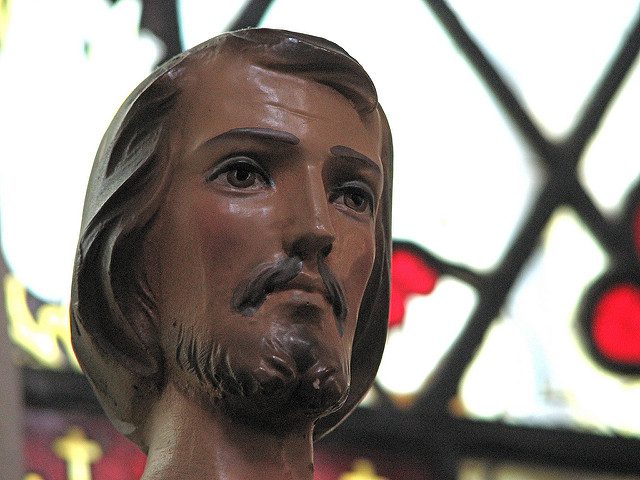
Photo Credit: markheybo.
I am the world’s greatest teacher.
I have a mug that says so.
In fact so far I’ve garnered about half a dozen similar mugs over a nearly decade’s long career. So it must be true.
I recently lent a friend my copy of The Case for Jesus by Brant Pitre. It’s far and away the best case for a real, historical Jesus. He does a great job of laying out, in a fulsome and scholarly way, the argument’s for Jesus existence in honest-to-goodness space and time.
And for his resurrection from the dead.
And it’s this, his resurrection, that I’ve been particularly thinking about lately. It’s this that the conversation with my friend orbited around, and why I lent him my book. Because it’s one thing to agree on the existence of a historical Jesus—that’s one conclusion that a person could come to—but another entirely to agree that he’s been raised from the dead.
So, has he? And what proof do we have?
Here our eyewitnesses are key.
We have plenty of eyewitness accounts of the life of Christ. That he lived and is a historical figure it beyond the realm of debate for serious academics—he lived; he was an actual person. The sources are clear.
On the account of his resurrection, however, we have equally good evidence if we’re willing to take their accounts seriously.
In fact, the Gospels record numerous witnesses to Jesus resurrection, his empty tomb, and his post-resurrection appearances. These witnesses saw something and their written accounts have been passed on to us. Accounts which began to be written down and circulated during their lifetime but also during the lifetimes of other witnesses, and naysayers.
Think about what this means. I’ll give you an example.
If I’m playing baseball with a group of friends and hit a double most of the friends in my group, because of the nature of the sport, will have seen me hitting a double.
If I show up at a friend’s house the following week bragging about the “home run” that I hit when we were playing baseball it won’t be long before my friend calls shenanigans.
I didn’t get a home run. No one saw it happen. In fact, everyone there saw me hit a double instead.
Likewise for the resurrection.
The eyewitness accounts recorded in the Gospels are so powerful precisely because they stood the test of peer pressure and scrutiny.
As the Early Church wrestled with its understanding of who Jesus was, their mission, and what to believe a plethora of strange and bizarre writings, ideas, and beliefs cropped up and each one, in turn, was tossed out by these foundational Christians. That the fact of the resurrection remained, and is so central to the Gospels and the letters that follow, demonstrate its position as both an orthodox belief and a historical reality.
Simply put, if Jesus’s followers, after his death, made up the resurrection to make themselves feel better such a claim would’ve never realistically stood up to public scrutiny.
Nevermind the scrutiny of the brutally oppressive and violent Roman Empire—which saw Christians as a threat, I might add.
OK, so what if the resurrection was just a hallucination, a lie, or merely a myth?
If it were a lie, as I’ve said, it simply wouldn’t stand up in the court of public opinion. A movement as large as Christianity became, from its meager roots, would’ve never have been able to spring up based on a simple lie for the same reason those that saw Jesus resurrected could’ve have been hallucinating: there are simply too many witnesses.
If everyone single person who saw Jesus resurrected were lying or hallucinating it’s either the greatest and most unachievable con game in history or the most widespread and remarkable case of mass hallucination ever recorded.
It simply doesn’t compute.
But maybe it was a myth.
I want to pause here, briefly, so answer a question I posed at the beginning: Does the resurrection matter? And I want to say an emphatic yes. It does. In fact, it changes everything.
I want to say that here because the idea of the resurrection as a myth is probably the most pervasive one going right now. And it makes the resurrection not matter.
But it wasn’t a myth.
As Brant Pitre, and other scholars alongside him, aptly point out the Gospels of the New Testament were not written and were never intended to be read as mere myths. They’re a form of ancient biography, and it’s a well-understood genre too.
While other collected books in the Bible, like parts of Genesis, may be written allegorically, the authors of the New Testament—who recorded the stories of Jesus’s life, death, and resurrection—did not intend theirs to be read as anything but straight up fact.
In fact, if the Gospels were really presented a kind of mythical Jesus who lived, died, and rose from the dead, then surely public opinion and discourse would rise up against them. Remember, the Gospel accounts began circulating within the lifetime of those that had seen and heard Jesus—resurrected and otherwise.
And, besides, the Gospels aren’t written as a myth.
These people knew Jesus, and wrote what they really knew about him just like the students who’ve mugged me in my career have known me too, right?
Sadly though, I’m probably not the world’s greatest teacher. Despite the mugs, and the eyewitness accounts, it probably doesn’t bode well for me.
Great, maybe? But world’s greatest?
But the resurrection, this is something different. Our wealth of evidence suggest it wasn’t a lie, it wasn’t a myth, an embellishment (thanks anyway Kindergarten students) or a mass hallucination. What the evidence points to is its reality: Jesus rose from the dead.
And this does change everything because it means that what Jesus said—what he taught about Himself, how to live, and what it all means—means something. And deserves our much closer inspection and attention.
Stay in touch! Like The Cordial Catholic on Facebook:
Previous Post
October 11, 2016
When Did the Historic Church Lose its Way?
Next Post

October 25, 2016 Why Does the Catholic Church Have So Many Rules?
Browse Our Archives
Select a Category Appearances Christian Living Explaining the Faith Podcast Tough Questions Uncategorized Why I'm Catholic
Select a Month January 2024 December 2023 November 2023 July 2023 June 2023 May 2023 April 2023 March 2023 February 2023 January 2023 December 2022 November 2022 October 2022 September 2022 August 2022 July 2022 June 2022 May 2022 April 2022 March 2022 February 2022 January 2022 December 2021 November 2021 October 2021 September 2021 August 2021 July 2021 June 2021 May 2021 April 2021 March 2021 February 2021 January 2021 December 2020 November 2020 October 2020 September 2020 August 2020 July 2020 June 2020 May 2020 April 2020 March 2020 February 2020 January 2020 December 2019 November 2019 October 2019 September 2019 August 2019 July 2019 June 2019 May 2019 April 2019 March 2019 February 2019 January 2019 December 2018 November 2018 October 2018 September 2018 August 2018 July 2018 June 2018 May 2018 April 2018 March 2018 February 2018 January 2018 December 2017 October 2017 September 2017 July 2017 May 2017 April 2017 March 2017 February 2017 January 2017 December 2016 November 2016 October 2016 September 2016 August 2016 July 2016 June 2016 May 2016 April 2016 March 2016 February 2016 January 2016 December 2015 November 2015 October 2015 September 2015 August 2015 July 2015 June 2015 May 2015 April 2015 March 2015 February 2015 January 2015 December 2014 November 2014 October 2014
Follow Us!
TAKE THE
Religious Wisdom Quiz
Blessed are the peacemakers, for they will be called ____ of God.
Select your answer to see how you score.
Disciples Servants Children Friends
Support this
Column


Related posts from The Cordial Catholic

227: What was Medieval Catholicism Really Like? (w/...
198: Why We Left Catholicism – and Why...
196: The African Roots of Catholicism (w/ Mike...

187: The History of the Papacy (w/ Erick...
TRENDING AT PATHEOS Catholic

Rejecting Doom: Christian Hope And Human Action
Christianity is a religion of hope. We are to have hope and...

It’s What Comes From Within Which Matters
One of the most difficult things for us to understand is why...

Why I Choose the Eucharist Over the Sermon
Choose the Eucharist, Not the Sermon What are we supposed to get...

5 Design Elements Found in Spiritually Rooted Homes
Putting Spirituality Into Home Decor Our homes are more than our living...

Credo: A Story of God Told with the...
About 10 years ago, I began to imagine a personal "Credo" that...

The Anatomy of Divine Revelation in Catholic Thought
The claim that God has made Himself known to human beings is...
view all Catholic blogs
Ad-Free & Subscriber Log-In Subscription Support
- About Us
- 2026 Calendar
- Videos
- Podcasts
- Library of World Religions
- Faith In Media Tracker
- Advertise With Us
- Write for Us
- Privacy Policy
- Terms of Service
- Do Not Sell My Data
- Contact Us
- Radiant Digital
- Manage Newsletter Subscriptions
- Unsubscribe From Notifications
- Sitemap
Copyright 2008-2026, Patheos. All rights reserved.
Subscription Support Ad-Free & Subscriber Log-In
Follow Patheos