
BuddhistCatholicContemplativeEvangelicalGeneral ChristianHinduJewishLatter-day SaintMuslimNew VisionsProgressive Christian
Beliefs
- Buddhist
- Catholic
- Contemplative
- Evangelical
- General Christian
- Hindu
- Jewish
- Latter-day Saint
- More Voices
- Muslim
- New Visions
- Pagan
- Progressive Christian
Topics
- Religion News
- Food and Religion
- Sports and Religion
- Religious Art
- Religious Music and Entertainment
- Religious Events
- History and Religion
- Style and Religion
- Politics and Religion
- Women in Religion
- Recreation Outdoors and Religion
- Business Finance and Religion
- Careers Workplace and Religion
- Education and Religion
- Family Parenting and Religion
- Health Fitness and Religion
- Home and Religion
- Relationships and Religion
- Technology and Religion
- Travel and Religion
Columnists
- Buddhist Columnists
- Business Finance and Religion Columnists
- Careers Workplace and Religion Columnists
- Catholic Columnists
- Contemplative Columnists
- Education and Religion Columnists
- Evangelists Columnists
- Family Parenting and Religion Columnists
- General Christian Columnists
- Health Fitness and Religion Columnists
- Hindu Columnists
- History and Religion Columnists
- Home and Religion Columnists
- Jewish Columnists
- More Voices Columnists
- Latter Day Columnists
- Muslim Columnists
- New Visions Columnists
- Nonreligious Columnists
- Pagan Columnists
- Politics and Religion Columnists
- Progressive Columnists
- Recreation Outdoors and Religion Columnists
- Relationships and Religion Columnists
- Religion News Columnists
- Religious Art Columnists
- Religious Events Columnists
- Religious Music and Entertainment Columnists
- Sports and Religion Columnists
- Style and Religion Columnists
- Technology and Religion Columnists
- Travel and Religion Columnists
- Women in Religion Columnists
Resource Library
- 2026 Calendar
- Library of World Religions
- The 100 Most Holy Places on Earth
- Patheos Answers
- Podcasts
- Videos
- Faith Leaders Database
- Anglican Episcopalian
- Bahai
- Baptist
- Buddhism
- Christianity
- Confucianism
- Eastern Orthodoxy
- Hinduism
- Holiness and Pentecostal
- ISKCON
- Islam
- Judaism
- Lutheran
- Methodist
- The Church of Jesus Christ of Latter-day Saints
- New Age
- Paganism
- Presbytarian and Reformed
- Protestantism
- Religion Behind the Scenes
- Roman Catholic
- Scientology
- Shia Islam
- Sikhism
- Sufism
- Sunni Islam
- Taoism
- Zen
- See all religions
Research Tools
 Ad-Free & Subscriber Log-In Subscription Support
Ad-Free & Subscriber Log-In Subscription Support
Follow Patheos 

- Trending:
- Forgiveness
- |
- Marriage
- |
- Consciousness
- |
- Death Penalty
- |
- Election
- |
- Halloween
 The Cordial Catholic
- Home
- Catholic
- How Come Non-Denominational Christians Can’t Agree?
How Come Non-Denominational Christians Can’t Agree?
Last updated on: February 20, 2019 at 2:50 pm by K. Albert Little
How Come Non-Denominational Christians Can’t Agree? 2019-02-20T14:50:23-04:00 K. Albert Little
Patheos Explore the world's faith through different perspectives on religion and spirituality! Patheos has the views of the prevalent religions and spiritualities of the world.
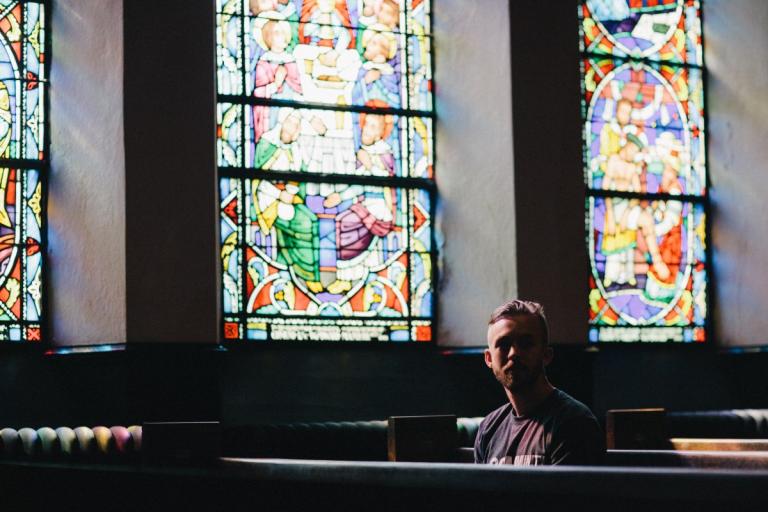
This article is part of the Tough Questions series. A series highlighting some of the difficult questions I was asking during my conversion from a non-denominational Christian to full communion with the Catholic Church. For more about my own conversion story, read What I Wish I Knew About Catholics (And Why I’m Becoming One).
As a non-denominational Christian I had a love-hate relationship with Matthew 18:15-17.
In context, Jesus is talking to his disciples—teaching—and brings up the issue of disagreement amongst believers. The teaching itself is very fascinating. Contrasted with the famous “eye for an eye; tooth for a tooth” law which God gave to the Israelites (Deut. 19:15-21) Jesus’s version of how to handle an argument within the Church is a beautiful glimpse into how the fulfilment of the Old Covenant, and the ushering in of the New, came on the wings of mercy, grace, and compassion.
It’s a profound juxtaposition. But as a non-denominational Christian what struck me every time wasn’t necessarily Jesus’s mercy but the order—His plan or framework—for what we do when we disagree. Matthew 18:15-17 says,
If your brother sins against you, go and confront him privately. If he listens to you, you have won your brother over. But if he will not listen, take one or two others along, so that ‘every matter may be established by the testimony of two or three witnesses.’ If he refuses to listen to them, tell it to the church. And if he refuses to listen even to the church, regard him as you would a pagan or a tax collector.
A clear hierarchy, drawn from Deuteronomy 19, exists here. If you and another Christian disagree,
- Privately confront your brother
- If he won’t listen, bring one of two others along
- If he still won’t listen, tell it to the church
- If he still refuses to listen, treat them as you would a pagan or tax collector
Of course, the beauty and compassion of Christ’s New Covenant is that Christ came to minister to the pagans and tax collectors. His simple message was: has your brother wronged you? Treat him like the people I came to save. It’s a brilliant turn of logic, and flips the law of the Old Testament on its head.
But that wasn’t what got my goat.
It was Step #3, every single time.
See, every time I read Matthew 18 I hit this stumbling block. What did Jesus mean by “the Church”?
I remember, early on in my journey towards Catholicism, meeting with my pastor to discuss some things I was thinking about. We sat across from each other, sharing a pizza and pops, and he said to me, “What’s the biggest thing on your mind right now? What’s convincing you the most to continue to pursue being Catholic?”
I had known this particular pastor for a long time. My wife and I had met in his church; he had married us. We’d been involved in nearly every faucet of ministry from small group leadership to missions outreach to helping to run a quarterly married couples’ night. We were friends, and he was genuinely interested.
I brought up this account from Scripture.
“Say you and I disagree on some point of doctrine,” I said. “If we can’t agree, even to the point of arguing verse for verse from the Bible, then Jesus says we’re supposed to bring in some help.”
“Yep,” he said. “There are plenty of aspect of Jesus’s teaching or matters of faith that we might disagree on. Bringing in some outside help, another pair of eyes, is helpful.”
“So,” I said, “we bring in one or two or three more people from our church to help discuss the problem. Maybe we bring in the elders of the church and we try really hard to find consensus but we still can’t.”
“That’s when we bring it to the whole church,” he said. “That’s what Jesus tells us to do.”
“But what church?” I asked.
And herein lies the problem: the system is broken.
Because if I have a problem with my non-denominational church’s teaching on Christian marriage, salvation, baptism, or the gifts of the Holy Spirit and I work through Jesus’ recommended problem-solving steps 1, 2, and 3 what happens if I still don’t agree?
Well, simple, I go to the church down the street.
I leave.
If I can’t, or don’t, agree with the peers in my church and their teaching I can simply take my proverbial ball and go play somewhere else—and there are lots of others options. The “church” that Jesus is talking about, then, would seem to have no authority over me at all. If you don’t agree with me, I can simply find somewhere else to worship that does.
The tough question I found myself asking, and I asked of my pastor back then, was what could Jesus have possibly meant by “the church”?
It’s clear, from even the most basic thought experiment, that it can’t be the non-denominational churches we see today. These churches are often spawned by disagreement; if we can’t agree we simply make a new church. So what did Jesus mean?
My search—spoiler alert—led me into the open arms of the Catholic Church. A Church which claims to be the church that Jesus was talking about. A church which traces its origins back to the very same disciples that Jesus was talking to, of whom He told, in His very next breath that, “whatever you bind on earth will be bound in heaven, and whatever you loose on earth will be loosed in heaven.” (Matt. 18:18)
A statement which the Catholic Church takes seriously; a God-given authority passed down through time and history to arbitrate matters of Christian faith.
As a non-denominational Christian I couldn’t answer the tough question of which Church Jesus was talking about. I couldn’t figure out why Christians couldn’t agree, even on matters of fundamental importance. It was because the system was broken. The church Jesus asked us to appeal to, in my world, didn’t exist and if we disagreed I could simply move on down the street and worship somewhere else on a Sunday morning.
But this was never how it was meant to be.
Instead, I came to believe that what Jesus must’ve meant was a church that had the authority and universality to decisively settle disagreements. A church which didn’t just start up in the gymnasium of a local school because a group of Christians disagreed with another church down the street. But, rather, a church which was everywhere with clear, concise, and historical links back to those very same disciples Christ was speaking to two-thousand years ago.
Previous Post

January 31, 2019
I Read the Whole Bible in 30 Days (And You Can Too!)
Next Post

February 21, 2019 Why Are There so Many Bad Catholics (And What Should We Do)?
Browse Our Archives
Select a Category Appearances Christian Living Explaining the Faith Podcast Tough Questions Uncategorized Why I'm Catholic
Select a Month January 2024 December 2023 November 2023 July 2023 June 2023 May 2023 April 2023 March 2023 February 2023 January 2023 December 2022 November 2022 October 2022 September 2022 August 2022 July 2022 June 2022 May 2022 April 2022 March 2022 February 2022 January 2022 December 2021 November 2021 October 2021 September 2021 August 2021 July 2021 June 2021 May 2021 April 2021 March 2021 February 2021 January 2021 December 2020 November 2020 October 2020 September 2020 August 2020 July 2020 June 2020 May 2020 April 2020 March 2020 February 2020 January 2020 December 2019 November 2019 October 2019 September 2019 August 2019 July 2019 June 2019 May 2019 April 2019 March 2019 February 2019 January 2019 December 2018 November 2018 October 2018 September 2018 August 2018 July 2018 June 2018 May 2018 April 2018 March 2018 February 2018 January 2018 December 2017 October 2017 September 2017 July 2017 May 2017 April 2017 March 2017 February 2017 January 2017 December 2016 November 2016 October 2016 September 2016 August 2016 July 2016 June 2016 May 2016 April 2016 March 2016 February 2016 January 2016 December 2015 November 2015 October 2015 September 2015 August 2015 July 2015 June 2015 May 2015 April 2015 March 2015 February 2015 January 2015 December 2014 November 2014 October 2014
Follow Us!
TAKE THE
Religious Wisdom Quiz
What does "Messiah" mean in Hebrew?
Select your answer to see how you score.
Chosen One Son of God Anointed One Savior
Support this
Column


Related posts from The Cordial Catholic
231: Becoming Catholic in a Church Crisis (w/...
212: Evangelicals, Here's How to Look for a...

204: The Great Big Protestant Problem with Scripture...
203: A Protestant Pastor, his Wife, and Their...
TRENDING AT PATHEOS Catholic

Rejecting Doom: Christian Hope And Human Action
Christianity is a religion of hope. We are to have hope and...

It’s What Comes From Within Which Matters
One of the most difficult things for us to understand is why...

Why I Choose the Eucharist Over the Sermon
Choose the Eucharist, Not the Sermon What are we supposed to get...

5 Design Elements Found in Spiritually Rooted Homes
Putting Spirituality Into Home Decor Our homes are more than our living...

Credo: A Story of God Told with the...
About 10 years ago, I began to imagine a personal "Credo" that...

The Anatomy of Divine Revelation in Catholic Thought
The claim that God has made Himself known to human beings is...
view all Catholic blogs
Ad-Free & Subscriber Log-In Subscription Support
- About Us
- 2026 Calendar
- Videos
- Podcasts
- Library of World Religions
- Faith In Media Tracker
- Advertise With Us
- Write for Us
- Privacy Policy
- Terms of Service
- Do Not Sell My Data
- Contact Us
- Radiant Digital
- Manage Newsletter Subscriptions
- Unsubscribe From Notifications
- Sitemap
Copyright 2008-2026, Patheos. All rights reserved.
Subscription Support Ad-Free & Subscriber Log-In
Follow Patheos