
BuddhistCatholicContemplativeEvangelicalGeneral ChristianHinduJewishLatter-day SaintMuslimNew VisionsProgressive Christian
Beliefs
- Buddhist
- Catholic
- Contemplative
- Evangelical
- General Christian
- Hindu
- Jewish
- Latter-day Saint
- More Voices
- Muslim
- New Visions
- Pagan
- Progressive Christian
Topics
- Religion News
- Food and Religion
- Sports and Religion
- Religious Art
- Religious Music and Entertainment
- Religious Events
- History and Religion
- Style and Religion
- Politics and Religion
- Women in Religion
- Recreation Outdoors and Religion
- Business Finance and Religion
- Careers Workplace and Religion
- Education and Religion
- Family Parenting and Religion
- Health Fitness and Religion
- Home and Religion
- Relationships and Religion
- Technology and Religion
- Travel and Religion
Columnists
- Buddhist Columnists
- Business Finance and Religion Columnists
- Careers Workplace and Religion Columnists
- Catholic Columnists
- Contemplative Columnists
- Education and Religion Columnists
- Evangelists Columnists
- Family Parenting and Religion Columnists
- General Christian Columnists
- Health Fitness and Religion Columnists
- Hindu Columnists
- History and Religion Columnists
- Home and Religion Columnists
- Jewish Columnists
- More Voices Columnists
- Latter Day Columnists
- Muslim Columnists
- New Visions Columnists
- Nonreligious Columnists
- Pagan Columnists
- Politics and Religion Columnists
- Progressive Columnists
- Recreation Outdoors and Religion Columnists
- Relationships and Religion Columnists
- Religion News Columnists
- Religious Art Columnists
- Religious Events Columnists
- Religious Music and Entertainment Columnists
- Sports and Religion Columnists
- Style and Religion Columnists
- Technology and Religion Columnists
- Travel and Religion Columnists
- Women in Religion Columnists
Resource Library
- 2026 Calendar
- Library of World Religions
- The 100 Most Holy Places on Earth
- Patheos Answers
- Podcasts
- Videos
- Faith Leaders Database
- Anglican Episcopalian
- Bahai
- Baptist
- Buddhism
- Christianity
- Confucianism
- Eastern Orthodoxy
- Hinduism
- Holiness and Pentecostal
- ISKCON
- Islam
- Judaism
- Lutheran
- Methodist
- The Church of Jesus Christ of Latter-day Saints
- New Age
- Paganism
- Presbytarian and Reformed
- Protestantism
- Religion Behind the Scenes
- Roman Catholic
- Scientology
- Shia Islam
- Sikhism
- Sufism
- Sunni Islam
- Taoism
- Zen
- See all religions
Research Tools
 Ad-Free & Subscriber Log-In Subscription Support
Ad-Free & Subscriber Log-In Subscription Support
Follow Patheos 

- Trending:
- Forgiveness
- |
- Marriage
- |
- Consciousness
- |
- Death Penalty
- |
- Election
- |
- Halloween
 The Cordial Catholic
- Home
- Catholic
- The Catholic as Pharisee
The Catholic as Pharisee
Last updated on: August 3, 2015 at 4:02 pm by K. Albert Little
The Catholic as Pharisee 2015-08-03T16:02:33-04:00 K. Albert Little
Patheos Explore the world's faith through different perspectives on religion and spirituality! Patheos has the views of the prevalent religions and spiritualities of the world.
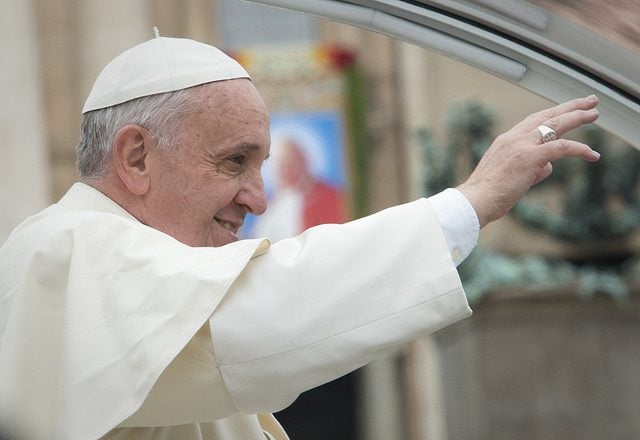
Pope Francis. Photo Credit: Aleteia Image Department.
So I sat down to write something entirely different but then I read Pope Francis’s homily from this morning and completely changed my mind.
Today’s gospel reading, according to the Lectionary, is about Jesus’s encounter with the Pharisees. It’s one of the famous encounter, you’ll recall, where the Pharisees question the authority of Jesus. They question Him and His disciples who are plucking grain and traveling (or working) on the Sabbath, the Jewish holy day, and healing and performing miracles. They questioned Jesus’s observance of the Jewish Law. It’s a truly interesting encounter and one with particular resonance and application when thinking about Catholicism.
See, as a younger Protestant we always, always, used Jesus’s verbal scrums with the Pharisees—his disdain and downright malevolence towards their religious practices—as ammunition against the Catholic Church. We did this. Even if it wasn’t necessarily explicit, and it often wasn’t, when we talked about the Pharisees—when we talked about being “religious” like it was a bad thing—we were referring to Catholicism.
I submit, dear readers, that I was wrong.
I was wrong and stupid to naturally equate religion with the Pharisees. I was wrong and stupid to automatically create that equation: The Pharisees were religious, Jesus condemned the Pharisees, therefore religion is bad.
I was stupid, but condemning religion based on Jesus’s condemnation of the Pharisees is nothing new.
I’ve recently heard Jesus’s encounter with the Pharisees explained in a different way though and Pope Francis, in his homily, echoes this similar explanation.
You have to remember, and we often forget, that the Pharisees were holy people. They were a sect of Jews who were trying their level best to follow the Jewish laws and customs. They wanted to live right by God. They truly did. This is abundantly clear from Scripture and from Jesus’s own words. He doesn’t come on the scene and lambast them for trying their best, he comes on the scene to tell them that their religiousness has to extend into their hearts.
Jesus didn’t come to condemn their religiousness, that can be found nowhere in the words and deeds of Jesus. He came to condemn their hearts.
Speaking about the Pharisees Pope Francis said,
They were strong, but on the outside. They were in a cast. The heart was very week, they didn’t know what they believed. And because of this their life, the outer part of their life, was completely regulated, but the heart was otherwise: a weak heart, and a skin that was plastered over, strong, harsh. Jesus, on the other hand, teaches us that the Christian should have a strong heart, a firm heart, a heart built on the rock, that is Christ; and then, in the way it goes out, it goes out with prudence.
What we forgot, or never knew, in my Protestant community was that Jesus never said there was anything wrong with religion. The problem Jesus tackled, and strongly condemned, was a religious practice missing the true, converted heart. What Pope Francis called, in his homily, “strong heart, a firm heart, a heart built on the rock, that is Christ.”
A heart geared towards doing God’s will, not just appearing to.
But the Catholic became the Pharisee, and the Catholic was an easy target. The religious trappings of Catholicism are thick. Catholic churches are ornate and extravagant. Catholics collect things like rosaries, statues, and crucifixes. Catholics sit down, stand up, and knee will alarming frequency. Catholics are an obvious analogue for Pharisees, and vice versa but if we aren’t careful we miss Jesus’s point entirely.
Jesus’s point was that our heart has to be right, our motives have to be right, and it can’t be merely about outward practice. The Pharisees Jesus condemned were trying to live according to God’s laws but they also wanted to be seen to be living according to God’s laws—they put their righteousness on display. Jesus didn’t condemned their pious religious practice in the same way that He wouldn’t, today, condemn the pious practice of Catholics. Jesus condemns the Catholic, the Protestant, or the Jew who is practising for the sake and sight of others, with what Pope Francis called “rotten hearts.”
As I begin to find meaning, beauty, and a fulsome depth in much of the ancient, Catholic religion it pains me that some might condemn me as a Pharisee. I hope I can do my part to cordially explain myself, and this is part of that. That religious practice—that religion—can be a pointer to Christ, can be wholly good and right and true and that it’s the heart that matters. That Jesus didn’t come to condemn religion, He came to make sure we practice it right.
Previous Post
December 14, 2014
Why I Love the Pope (and You Can Too!)
Next Post
December 16, 2014 Papal Infallibility and Why Some Popes are Evil
Browse Our Archives
Select a Category Appearances Christian Living Explaining the Faith Podcast Tough Questions Uncategorized Why I'm Catholic
Select a Month January 2024 December 2023 November 2023 July 2023 June 2023 May 2023 April 2023 March 2023 February 2023 January 2023 December 2022 November 2022 October 2022 September 2022 August 2022 July 2022 June 2022 May 2022 April 2022 March 2022 February 2022 January 2022 December 2021 November 2021 October 2021 September 2021 August 2021 July 2021 June 2021 May 2021 April 2021 March 2021 February 2021 January 2021 December 2020 November 2020 October 2020 September 2020 August 2020 July 2020 June 2020 May 2020 April 2020 March 2020 February 2020 January 2020 December 2019 November 2019 October 2019 September 2019 August 2019 July 2019 June 2019 May 2019 April 2019 March 2019 February 2019 January 2019 December 2018 November 2018 October 2018 September 2018 August 2018 July 2018 June 2018 May 2018 April 2018 March 2018 February 2018 January 2018 December 2017 October 2017 September 2017 July 2017 May 2017 April 2017 March 2017 February 2017 January 2017 December 2016 November 2016 October 2016 September 2016 August 2016 July 2016 June 2016 May 2016 April 2016 March 2016 February 2016 January 2016 December 2015 November 2015 October 2015 September 2015 August 2015 July 2015 June 2015 May 2015 April 2015 March 2015 February 2015 January 2015 December 2014 November 2014 October 2014
Follow Us!
TAKE THE
Religious Wisdom Quiz
What does "Golgotha" mean?
Select your answer to see how you score.
Holy Mountain City of Blood Hill of Sacrifice Place of the Skull
Support this
Column


Related posts from The Cordial Catholic
204: The Great Big Protestant Problem with Scripture...
196: The African Roots of Catholicism (w/ Mike...
166: How the Early Church Read the Bible...
162: Problems with Protestant Christianity (w/ Keith Nester)
TRENDING AT PATHEOS Catholic

Rejecting Doom: Christian Hope And Human Action
Christianity is a religion of hope. We are to have hope and...

It’s What Comes From Within Which Matters
One of the most difficult things for us to understand is why...

Why I Choose the Eucharist Over the Sermon
Choose the Eucharist, Not the Sermon What are we supposed to get...

5 Design Elements Found in Spiritually Rooted Homes
Putting Spirituality Into Home Decor Our homes are more than our living...

Credo: A Story of God Told with the...
About 10 years ago, I began to imagine a personal "Credo" that...

The Anatomy of Divine Revelation in Catholic Thought
The claim that God has made Himself known to human beings is...
view all Catholic blogs
Ad-Free & Subscriber Log-In Subscription Support
- About Us
- 2026 Calendar
- Videos
- Podcasts
- Library of World Religions
- Faith In Media Tracker
- Advertise With Us
- Write for Us
- Privacy Policy
- Terms of Service
- Do Not Sell My Data
- Contact Us
- Radiant Digital
- Manage Newsletter Subscriptions
- Unsubscribe From Notifications
- Sitemap
Copyright 2008-2026, Patheos. All rights reserved.
Subscription Support Ad-Free & Subscriber Log-In
Follow Patheos