
BuddhistCatholicContemplativeEvangelicalGeneral ChristianHinduJewishLatter-day SaintMuslimNew VisionsProgressive Christian
Beliefs
- Buddhist
- Catholic
- Contemplative
- Evangelical
- General Christian
- Hindu
- Jewish
- Latter-day Saint
- More Voices
- Muslim
- New Visions
- Pagan
- Progressive Christian
Topics
- Religion News
- Food and Religion
- Sports and Religion
- Religious Art
- Religious Music and Entertainment
- Religious Events
- History and Religion
- Style and Religion
- Politics and Religion
- Women in Religion
- Recreation Outdoors and Religion
- Business Finance and Religion
- Careers Workplace and Religion
- Education and Religion
- Family Parenting and Religion
- Health Fitness and Religion
- Home and Religion
- Relationships and Religion
- Technology and Religion
- Travel and Religion
Columnists
- Buddhist Columnists
- Business Finance and Religion Columnists
- Careers Workplace and Religion Columnists
- Catholic Columnists
- Contemplative Columnists
- Education and Religion Columnists
- Evangelists Columnists
- Family Parenting and Religion Columnists
- General Christian Columnists
- Health Fitness and Religion Columnists
- Hindu Columnists
- History and Religion Columnists
- Home and Religion Columnists
- Jewish Columnists
- More Voices Columnists
- Latter Day Columnists
- Muslim Columnists
- New Visions Columnists
- Nonreligious Columnists
- Pagan Columnists
- Politics and Religion Columnists
- Progressive Columnists
- Recreation Outdoors and Religion Columnists
- Relationships and Religion Columnists
- Religion News Columnists
- Religious Art Columnists
- Religious Events Columnists
- Religious Music and Entertainment Columnists
- Sports and Religion Columnists
- Style and Religion Columnists
- Technology and Religion Columnists
- Travel and Religion Columnists
- Women in Religion Columnists
Resource Library
- 2026 Calendar
- Library of World Religions
- The 100 Most Holy Places on Earth
- Patheos Answers
- Podcasts
- Videos
- Faith Leaders Database
- Anglican Episcopalian
- Bahai
- Baptist
- Buddhism
- Christianity
- Confucianism
- Eastern Orthodoxy
- Hinduism
- Holiness and Pentecostal
- ISKCON
- Islam
- Judaism
- Lutheran
- Methodist
- The Church of Jesus Christ of Latter-day Saints
- New Age
- Paganism
- Presbytarian and Reformed
- Protestantism
- Religion Behind the Scenes
- Roman Catholic
- Scientology
- Shia Islam
- Sikhism
- Sufism
- Sunni Islam
- Taoism
- Zen
- See all religions
Research Tools
 Ad-Free & Subscriber Log-In Subscription Support
Ad-Free & Subscriber Log-In Subscription Support
Follow Patheos 

- Trending:
- Forgiveness
- |
- Marriage
- |
- Consciousness
- |
- Death Penalty
- |
- Election
- |
- Halloween
 The Cordial Catholic
- Home
- Catholic
- Did the Catholic Church Just “Deliver” the Bible?
Did the Catholic Church Just “Deliver” the Bible?
Last updated on: March 14, 2018 at 2:20 pm by K. Albert Little
Did the Catholic Church Just “Deliver” the Bible? 2018-03-14T14:20:17-04:00 K. Albert Little
Patheos Explore the world's faith through different perspectives on religion and spirituality! Patheos has the views of the prevalent religions and spiritualities of the world.

I was once asked the question by a friend of mine, “Which is more important: The Bible or tradition?”
As a good evangelical I knew that the answer to any question in Sunday School was either “the Bible” or “Jesus” and although I wasn’t in Sunday School any longer I knew tradition couldn’t be the answer.
“The Bible,” I said confidently, congratulating myself for knowing so much about my faith.
“But who put the Bible together?” My friend replied. “Wasn’t it tradition?”
I had to admit, instantly, that he was right.
The Bible didn’t fall from the hands of God into the hands of the Church in one divine movement. Heck, it wasn’t even heroically thrust from the hands of the apostles into ours in some last desperate attempt to transmit the faith. In fact, the Bible wasn’t even collected up into its current form until about 400 years after the death of Christ. Over that time the letters, eye witness accounts, and documents which make up today’s Bibles were affirmed by people like St. Augustine and through Church Councils attended by bishops who traced their claim to any authority at all, back to the apostles, who traced their authority back to Christ.
It was these bishops, like Augustine, who leaned on the authoritative weight of their office to say, “These are the books which we accept as true, as infallible, as inspired by God. These are the books which should be collected together and read. This is the Bible that all Christians should read.”
In fact, if you start to look at the history of how the Bible was collected together, that history looks awfully Catholic.
At least this is what I realized when I began to do the research and if we’re honest with ourselves it’s the only real conclusion that can be made.
The Catholic Church put the Bible together and affirmed its infallibility.
Renown New Testament scholar N.T. Wright disagrees. In Scripture and the Authority of God, Wright rejects the claim that a decidedly Catholic Church authoritatively ruled over the assembly of the Bible. He says,
This makes a rather obvious logical mistake analogous to that of a soldier who, receiving order through the mail, concludes that the letter carrier is his commanding officer. Those who transmit, collect, and distribute the message are not in the same league as those who write it in the first place.
Wright concludes that the Catholic Church’s role in the assembly of the Bible is nothing more than that of a mail man. The Catholic Church and its bishops merely passed on books and letters which made up the New Testament as a mail man passes on a letter.
But, heavens above, the Church did not merely deliver the books of the Bible in tact.
The Church isn’t the postman, it’s the post office.
If, in Wright’s analogy, the word of God is a letter to be delivered the Church wasn’t merely the postman delivering but the post office, sorting out which letters go where, whose letter is genuine, whose letter is faked, who is reading what, what is going where.
The Church did the sorting. The Church did the deciding. The Church was the authority that collected the Bible together and decided what was in and what was out and, yes, it was messy and complicated but if the Bible has been recognized as divinely inspired it’s been because the Church decided which books were divinely inspired and put them all together.
It wasn’t as if all the “letters” to be delivered were neatly stacked on the boss’s desk waiting to be mailed.
It wasn’t as if all the books of the Bible were there, written, and ready to be collected up. That took discernment by a body with authority.
Because there are books, letters, and a whole bunch of stuff that Dan Brown likes to remind us about which didn’t make it in to our copies of the Bible we know that there’s stuff out there, elsewhere, that wasn’t good enough. For a myriad of reasons that stuff wasn’t included in the Bible.
And, therefore, it took more than a mail man to figure out which mail to deliver. History tells us, instead, that it took Church Councils, bishops, people who traced their authority back to the apostles in an unbroken line of succession, that put together our Bible and handed it down.
And understanding the ramifications of a conclusion like that takes an ample dose of humility. And, when considering which is more important the Bible or tradition it’s worth pausing, for at least a second, to consider the question a bit more closely. Because where did the Bible come from anyway?
And who put it together?
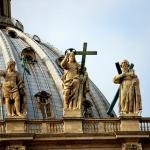
Photo by Wayne Stadler.
Previous Post

February 25, 2018
You Should Receive Communion Kneeling, On the Tongue
Next Post
March 18, 2018 Was Peter the First Pope?
Browse Our Archives
Select a Category Appearances Christian Living Explaining the Faith Podcast Tough Questions Uncategorized Why I'm Catholic
Select a Month January 2024 December 2023 November 2023 July 2023 June 2023 May 2023 April 2023 March 2023 February 2023 January 2023 December 2022 November 2022 October 2022 September 2022 August 2022 July 2022 June 2022 May 2022 April 2022 March 2022 February 2022 January 2022 December 2021 November 2021 October 2021 September 2021 August 2021 July 2021 June 2021 May 2021 April 2021 March 2021 February 2021 January 2021 December 2020 November 2020 October 2020 September 2020 August 2020 July 2020 June 2020 May 2020 April 2020 March 2020 February 2020 January 2020 December 2019 November 2019 October 2019 September 2019 August 2019 July 2019 June 2019 May 2019 April 2019 March 2019 February 2019 January 2019 December 2018 November 2018 October 2018 September 2018 August 2018 July 2018 June 2018 May 2018 April 2018 March 2018 February 2018 January 2018 December 2017 October 2017 September 2017 July 2017 May 2017 April 2017 March 2017 February 2017 January 2017 December 2016 November 2016 October 2016 September 2016 August 2016 July 2016 June 2016 May 2016 April 2016 March 2016 February 2016 January 2016 December 2015 November 2015 October 2015 September 2015 August 2015 July 2015 June 2015 May 2015 April 2015 March 2015 February 2015 January 2015 December 2014 November 2014 October 2014
Follow Us!
TAKE THE
Religious Wisdom Quiz
Which two apostles went up to the temple at the "hour of prayer" and healed a lame man in Acts 3?
Select your answer to see how you score.
Paul and Barnabas Peter and John Philip and Stephen James and Jude
Support this
Column


Related posts from The Cordial Catholic

232: The Trajectory of Conversion (w/ Phillip Campbell)

229: Can Catholics and Evangelicals Agree on How...

227: What was Medieval Catholicism Really Like? (w/...
212: Evangelicals, Here's How to Look for a...
TRENDING AT PATHEOS Catholic

Rejecting Doom: Christian Hope And Human Action
Christianity is a religion of hope. We are to have hope and...

It’s What Comes From Within Which Matters
One of the most difficult things for us to understand is why...

Why I Choose the Eucharist Over the Sermon
Choose the Eucharist, Not the Sermon What are we supposed to get...

5 Design Elements Found in Spiritually Rooted Homes
Putting Spirituality Into Home Decor Our homes are more than our living...

Credo: A Story of God Told with the...
About 10 years ago, I began to imagine a personal "Credo" that...

The Anatomy of Divine Revelation in Catholic Thought
The claim that God has made Himself known to human beings is...
view all Catholic blogs
Ad-Free & Subscriber Log-In Subscription Support
- About Us
- 2026 Calendar
- Videos
- Podcasts
- Library of World Religions
- Faith In Media Tracker
- Advertise With Us
- Write for Us
- Privacy Policy
- Terms of Service
- Do Not Sell My Data
- Contact Us
- Radiant Digital
- Manage Newsletter Subscriptions
- Unsubscribe From Notifications
- Sitemap
Copyright 2008-2026, Patheos. All rights reserved.
Subscription Support Ad-Free & Subscriber Log-In
Follow Patheos