
BuddhistCatholicContemplativeEvangelicalGeneral ChristianHinduJewishLatter-day SaintMuslimNew VisionsProgressive Christian
Beliefs
- Buddhist
- Catholic
- Contemplative
- Evangelical
- General Christian
- Hindu
- Jewish
- Latter-day Saint
- More Voices
- Muslim
- New Visions
- Pagan
- Progressive Christian
Topics
- Religion News
- Food and Religion
- Sports and Religion
- Religious Art
- Religious Music and Entertainment
- Religious Events
- History and Religion
- Style and Religion
- Politics and Religion
- Women in Religion
- Recreation Outdoors and Religion
- Business Finance and Religion
- Careers Workplace and Religion
- Education and Religion
- Family Parenting and Religion
- Health Fitness and Religion
- Home and Religion
- Relationships and Religion
- Technology and Religion
- Travel and Religion
Columnists
- Buddhist Columnists
- Business Finance and Religion Columnists
- Careers Workplace and Religion Columnists
- Catholic Columnists
- Contemplative Columnists
- Education and Religion Columnists
- Evangelists Columnists
- Family Parenting and Religion Columnists
- General Christian Columnists
- Health Fitness and Religion Columnists
- Hindu Columnists
- History and Religion Columnists
- Home and Religion Columnists
- Jewish Columnists
- More Voices Columnists
- Latter Day Columnists
- Muslim Columnists
- New Visions Columnists
- Nonreligious Columnists
- Pagan Columnists
- Politics and Religion Columnists
- Progressive Columnists
- Recreation Outdoors and Religion Columnists
- Relationships and Religion Columnists
- Religion News Columnists
- Religious Art Columnists
- Religious Events Columnists
- Religious Music and Entertainment Columnists
- Sports and Religion Columnists
- Style and Religion Columnists
- Technology and Religion Columnists
- Travel and Religion Columnists
- Women in Religion Columnists
Resource Library
- 2026 Calendar
- Library of World Religions
- The 100 Most Holy Places on Earth
- Patheos Answers
- Podcasts
- Videos
- Faith Leaders Database
- Anglican Episcopalian
- Bahai
- Baptist
- Buddhism
- Christianity
- Confucianism
- Eastern Orthodoxy
- Hinduism
- Holiness and Pentecostal
- ISKCON
- Islam
- Judaism
- Lutheran
- Methodist
- The Church of Jesus Christ of Latter-day Saints
- New Age
- Paganism
- Presbytarian and Reformed
- Protestantism
- Religion Behind the Scenes
- Roman Catholic
- Scientology
- Shia Islam
- Sikhism
- Sufism
- Sunni Islam
- Taoism
- Zen
- See all religions
Research Tools
 Ad-Free & Subscriber Log-In Subscription Support
Ad-Free & Subscriber Log-In Subscription Support
Follow Patheos 

- Trending:
- Forgiveness
- |
- Marriage
- |
- Consciousness
- |
- Death Penalty
- |
- Election
- |
- Halloween
 The Cordial Catholic
- Home
- Catholic
- The Amnesiac Church and the Modern Heresy
The Amnesiac Church and the Modern Heresy
Last updated on: August 3, 2015 at 3:59 pm by K. Albert Little
The Amnesiac Church and the Modern Heresy 2015-08-03T15:59:36-04:00 K. Albert Little
Patheos Explore the world's faith through different perspectives on religion and spirituality! Patheos has the views of the prevalent religions and spiritualities of the world.
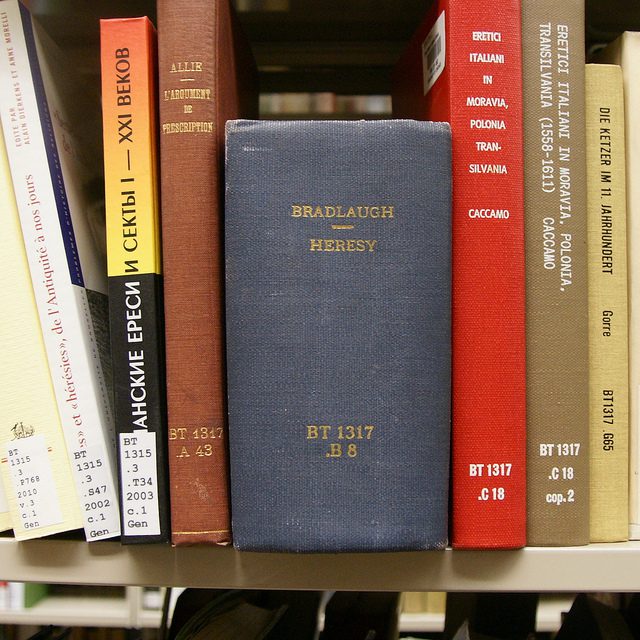
So Much Heresy. Photo Credit: Romana Klee.
I’ve written before about digging deep into Church history and the sort of dangerous pursuit that it can turn out to be. Indeed, lots of those diggers before me have dug around and wound up, like myself, on the rapid road to Rome. This in and of itself is fascinating.
One observation I’ve made, while digging into the history of Christianity, is the confounding reality of just how amnesiac we are about the history of our own faith. I say “we” and I know that’s always dangerous so let me qualify myself before I misspeak. By “we” I mean the evangelical Protestants that I run with—that I’ve ran with—the people that I know and read, and those that have been foundational in my Christian faith life for the last fifteen years. These are mainstream evangelical writers and speakers. These are, on the very local level, Baptist and Pentecostal communities. I think, especially, of the Pentecostal Church I “grew up” in the faith in while still a high school student.
In terms of our understanding of our own history, in my own experience, we are putting up a pretty weak showing. What’s truly confounding, however, are the ramifications of our shared amnesia and that is, remarkably, the repeating of centuries old heresies, over and over again, in the modern age.
The Catholic Church: Protector of Christianity
I think, in large part, this is a much larger societal problem. We, as creatures of sin and habit, are doomed to repeat or own mistakes, ad nauseum. We forget, for example, that when so-and-so political party came into power we were promised they wouldn’t do this-or-that, and they did it anyway. We forget, for example, that we have our freedoms and liberties because thousands of men and women fought against tyranny and hatred to protect them sixty years ago. We forget, again, that Christianity was, in sum and total, the Catholic Church for 1,500 years and that it followed, in the footsteps of the apostles, to protect the faith from teaching error.
The faith we hold, Catholic and Protestant, was protected, disseminated, and fulfilled in what we call, today, the Catholic Church. While Protestantism broke away from the hierarchical structure of the Catholic Church in the sixteenth century, the Catholic Church itself has remained, and retained, what it’s always seen as an unbroken line of succession from the earliest apostles, appointed by Jesus Christ.
We—and remember I’m speaking from my own experience—forget this.
As the Church grew and taught (and even amongst the earliest apostles in the New Testament) there were plenty of errors and misunderstandings creeping into to the various faith communities spread out across the Middle East, Europe, and Asia. What’s incredible, in our shared ignorance, is how many of these heresies are repeated, over and over again, in modern Christianity. How these heresies, which were soundly dealt with and put to bed by the Church in its authority centuries ago, continue to have new life breathed into them by own our widespread amnesia.
Nestorianism and Mary, the Mother of God
I recently wrote an article about Mary as Mother of God. In it I explained that the concept of Mary being the “Mother of God” was decided upon at the 4th century Council of Ephesus in response to the break-away teachings of Nestorius the Patriarch of Constantinople. It was promoted before then, resoundingly, by the Early Church Fathers. It was even, remarkably, held in belief by the early Protestant Reformers.
But the 4th century heresy of Nestorianism is, indeed, alive and well today. As I remarked in my article, if you asked the average Protestant in the Pentecostal church I attended during high school, a pretty good slice of average, North American evangelical Protestantism, if they believed in Mary as the Mother of God they would’ve scoffed at you. Without even knowing it, these well-meaning and faithful Christians are reliving this 4th century heresy.
Mary, Ever-Virgin
To remain, briefly, on the subject of Mary the Catholic Church (along with the Eastern Orthodox and some within Anglicanism) teach that Mary was perpetually a virgin. That is, she never had intercourse. The Greek word commonly understood to mean that Jesus had siblings could, likewise, be translated to say “cousins.”
And while the perpetual virginity of Mary might sound like some kind of theological gymnastic routine it was widely held, universally, by the Early Church Fathers and, to the surprise of my Protestant sensibilities, by all the Early Reformers as well.
Come again?
No, dear reader, you didn’t hear me wrong.
Despite the reality that the same aforementioned well-meaning Christians might scoff at the idea of Mary being ever-virgin this was a widespread belief both before and after the Protestant Reformation. Universally, the early Reformers, Luther, Zwingli, and Calvin wrote strongly of Mary’s remaining a virgin after the birth of Christ. As did the Early Church Fathers from Origen to Jerome to the much-beloved Augustine.
Yet, without even knowing it, modern day evangelical Protestantism subscribes to a heretical theology that wasn’t even accepted by the founders of the Protestant movement.
Our lack of historical memory leads us, likewise, into all sorts of other heresies—beliefs and situations soundly rejected, and roundly dealt with, more than a thousand years ago.
Then There’s Donatism…
The Donatists, in the mid-300’s, became heretics for insisting that, in essence, God couldn’t be at work in a community where sinful leaders lived or taught or where any serious sinners worshipped. To summarize an important part of Church history with the delicacy of a butcher’s knife, God wasn’t the god of the sinful and He didn’t work through those sorts of folks. While this heresy was wholly condemned by the Church, and Augustine himself wrote fiercely against it, it lives and breathes today in, among other areas, those that point fingers at the Catholic Church’s disappointing abuse scandal.
How can God work in that Church with those sinners. The abuse scandal was, and is, one of the most vehemently offensive things imaginable. But to say that God can’t work in a church full of sinners is to subscribe to Donatism, a 4th century heresy.
On a more mild level, to expect a Christian Church full of only the most pure and angelic parishioners isn’t only a pipedream, it’s akin to modern day Donatism.
…and Pelagianism
Likewise, the 5th century heresy of Pelagianism is, unfortunately, alive and well and has even been condemned, recently, by Pope Francis—some 1,500 years after it first sprung up as a heretical movement. Pelagianism which says, at its core, that man can be good enough on our own, is perhaps one of the most widespread of the ancient heresies. That message—chief amongst the zeitgeist of our wider culture—is also prevalent within Christianity. Before I ever attended a Catholic Mass and heard what’s called the penitential rite I, as a good, Bible-believing Protestant, hadn’t really thought of myself as in need of penance. Not on a serious level, at least.
Pelagianism denies the real need of the grace of God and says, as such, that we can do it on our own. How many of us, even if we don’t think that way, act accordingly?
Rediscovering our History
In the end it’s rather incredible, I think, to take a longview on the history of Christianity and to discover, rather dishearteningly, how frequent and fraught we are to repeat our own errors. It’s incredible to find that, once you start digging, so many of the old problems and difficulties of our history as Christians crop up perennially. Incredible, too, that even beliefs and doctrine held fast by the Reformers are jettisoned and misunderstood by the very denominations they began.
I dug, and I continue to dig, into the history of the Christian faith. For me, it’s led to a deeper appreciation of the claims and historicity of the Catholic Church. For me it’s been a fork in the road and a divergence. Regardless, however, of where it might lead, our collective amnesia, our forgetting of who we are and where we came from, dooms us to repeat ancient heresies, over and over again. We all, one way or another, need to get out our shovels and do that hard work. I think, for if nothing else, than to relearn what we used to know, to rediscover what the Church has taught, and to realize the nature of the tradition in which we, as all Christians, stand.
Previous Post

February 7, 2015
Let's Talk About Mary, Mother of God
Next Post
February 10, 2015 How Learning About Mary's Miracles Blew My Mind
Browse Our Archives
Select a Category Appearances Christian Living Explaining the Faith Podcast Tough Questions Uncategorized Why I'm Catholic
Select a Month January 2024 December 2023 November 2023 July 2023 June 2023 May 2023 April 2023 March 2023 February 2023 January 2023 December 2022 November 2022 October 2022 September 2022 August 2022 July 2022 June 2022 May 2022 April 2022 March 2022 February 2022 January 2022 December 2021 November 2021 October 2021 September 2021 August 2021 July 2021 June 2021 May 2021 April 2021 March 2021 February 2021 January 2021 December 2020 November 2020 October 2020 September 2020 August 2020 July 2020 June 2020 May 2020 April 2020 March 2020 February 2020 January 2020 December 2019 November 2019 October 2019 September 2019 August 2019 July 2019 June 2019 May 2019 April 2019 March 2019 February 2019 January 2019 December 2018 November 2018 October 2018 September 2018 August 2018 July 2018 June 2018 May 2018 April 2018 March 2018 February 2018 January 2018 December 2017 October 2017 September 2017 July 2017 May 2017 April 2017 March 2017 February 2017 January 2017 December 2016 November 2016 October 2016 September 2016 August 2016 July 2016 June 2016 May 2016 April 2016 March 2016 February 2016 January 2016 December 2015 November 2015 October 2015 September 2015 August 2015 July 2015 June 2015 May 2015 April 2015 March 2015 February 2015 January 2015 December 2014 November 2014 October 2014
Follow Us!
TAKE THE
Religious Wisdom Quiz
Which parable tells of a shrewd manager who is commended for his cleverness?
Select your answer to see how you score.
The Wise Virgins The Good Samaritan The Unjust Steward The Lost Sheep
Support this
Column


Related posts from The Cordial Catholic

227: What was Medieval Catholicism Really Like? (w/...
200: Reasons to Doubt Sola Scriptura (w/ Jimmy...
198: Why We Left Catholicism – and Why...
196: The African Roots of Catholicism (w/ Mike...
TRENDING AT PATHEOS Catholic

Rejecting Doom: Christian Hope And Human Action
Christianity is a religion of hope. We are to have hope and...

It’s What Comes From Within Which Matters
One of the most difficult things for us to understand is why...

Why I Choose the Eucharist Over the Sermon
Choose the Eucharist, Not the Sermon What are we supposed to get...

5 Design Elements Found in Spiritually Rooted Homes
Putting Spirituality Into Home Decor Our homes are more than our living...

Credo: A Story of God Told with the...
About 10 years ago, I began to imagine a personal "Credo" that...

The Anatomy of Divine Revelation in Catholic Thought
The claim that God has made Himself known to human beings is...
view all Catholic blogs
Ad-Free & Subscriber Log-In Subscription Support
- About Us
- 2026 Calendar
- Videos
- Podcasts
- Library of World Religions
- Faith In Media Tracker
- Advertise With Us
- Write for Us
- Privacy Policy
- Terms of Service
- Do Not Sell My Data
- Contact Us
- Radiant Digital
- Manage Newsletter Subscriptions
- Unsubscribe From Notifications
- Sitemap
Copyright 2008-2026, Patheos. All rights reserved.
Subscription Support Ad-Free & Subscriber Log-In
Follow Patheos