
BuddhistCatholicContemplativeEvangelicalGeneral ChristianHinduJewishLatter-day SaintMuslimNew VisionsProgressive Christian
Beliefs
- Buddhist
- Catholic
- Contemplative
- Evangelical
- General Christian
- Hindu
- Jewish
- Latter-day Saint
- More Voices
- Muslim
- New Visions
- Pagan
- Progressive Christian
Topics
- Religion News
- Food and Religion
- Sports and Religion
- Religious Art
- Religious Music and Entertainment
- Religious Events
- History and Religion
- Style and Religion
- Politics and Religion
- Women in Religion
- Recreation Outdoors and Religion
- Business Finance and Religion
- Careers Workplace and Religion
- Education and Religion
- Family Parenting and Religion
- Health Fitness and Religion
- Home and Religion
- Relationships and Religion
- Technology and Religion
- Travel and Religion
Columnists
- Buddhist Columnists
- Business Finance and Religion Columnists
- Careers Workplace and Religion Columnists
- Catholic Columnists
- Contemplative Columnists
- Education and Religion Columnists
- Evangelists Columnists
- Family Parenting and Religion Columnists
- General Christian Columnists
- Health Fitness and Religion Columnists
- Hindu Columnists
- History and Religion Columnists
- Home and Religion Columnists
- Jewish Columnists
- More Voices Columnists
- Latter Day Columnists
- Muslim Columnists
- New Visions Columnists
- Nonreligious Columnists
- Pagan Columnists
- Politics and Religion Columnists
- Progressive Columnists
- Recreation Outdoors and Religion Columnists
- Relationships and Religion Columnists
- Religion News Columnists
- Religious Art Columnists
- Religious Events Columnists
- Religious Music and Entertainment Columnists
- Sports and Religion Columnists
- Style and Religion Columnists
- Technology and Religion Columnists
- Travel and Religion Columnists
- Women in Religion Columnists
Resource Library
- 2026 Calendar
- Library of World Religions
- The 100 Most Holy Places on Earth
- Patheos Answers
- Podcasts
- Videos
- Faith Leaders Database
- Anglican Episcopalian
- Bahai
- Baptist
- Buddhism
- Christianity
- Confucianism
- Eastern Orthodoxy
- Hinduism
- Holiness and Pentecostal
- ISKCON
- Islam
- Judaism
- Lutheran
- Methodist
- The Church of Jesus Christ of Latter-day Saints
- New Age
- Paganism
- Presbytarian and Reformed
- Protestantism
- Religion Behind the Scenes
- Roman Catholic
- Scientology
- Shia Islam
- Sikhism
- Sufism
- Sunni Islam
- Taoism
- Zen
- See all religions
Research Tools
 Ad-Free & Subscriber Log-In Subscription Support
Ad-Free & Subscriber Log-In Subscription Support
Follow Patheos 

- Trending:
- Forgiveness
- |
- Marriage
- |
- Consciousness
- |
- Death Penalty
- |
- Election
- |
- Halloween
 A Green Ridge Devotional
- Home
- Catholic
- Why Don’t They Just Move?
Why Don’t They Just Move?
Last updated on: May 18, 2021 at 9:34 am by Punky Mantilla
Why Don’t They Just Move? 2021-05-18T09:34:45-05:00 Punky Mantilla
Patheos Explore the world's faith through different perspectives on religion and spirituality! Patheos has the views of the prevalent religions and spiritualities of the world.
This essay ran originally in the August 29, 2020 edition of the Sedalia Democrat. It is perennially relevant and has become relevant again with the onset of devastating flash flooding in Southwest Louisiana this week.
Why don’t they just move?
It’s a question I see after every major hurricane, including this week’s Category 4 Hurricane Laura, which battered the Louisiana coast.
Why would you live in an area where your property or even your life could be destroyed by a massive storm surge? Why does the government allow people to rebuild there? Why can’t we just move people further inland, to higher ground, where it’s safer? Isn’t it foolish to live where the wind and the waves are constantly trying to kill you?
And I remember.

Me on the ferryboat during the Great Flood of 1993, Liz Schleicher
I was just shy of kindergarten when the Great Flood of 1993 wreaked havoc on my riverside community. The memories still stand out brightly. It was June, maybe early July. We were driving to swimming lessons in the county seat. As we neared the public pool, we could see that the Illinois River had begun running over the road, roughly 350 feet out of its banks. My friend’s mother inched forward in her full-size van as the quick brown water swept across the pavement. We crawled along for a moment, then backed up, turned, and went home. It was my last look at that town for months. A few weeks later, the local levee would break, flooding 11,000 acres of land on both sides of the river and inundating homes and businesses. The river would later crest at an historic 42 feet. Full recession of the flood would not be complete until November.
I remember sandbags and tetanus shots. White aluminum cans of “emergency water” from Anheuser Busch. T-shirt fundraisers. National Guardsmen. Riverside houses that looked like they’d been bombed out, painted with colorful murals to hide the emptiness. Teachers who boated in to work. Trips to get groceries that took hours and hours. Laments and rocks hurled at the water’s edge. And a feeling, even at my young age, of being pinned, trapped in our little corner of the world between the wicked Illinois River and the mighty Mississippi.
Major floods had happened on the Illinois and Mississippi many times before, including 1965, 1973, and 1979. Minor flooding was so commonplace as to be almost boring. And major floods would happen again: 1995, 2008, 2015, 2017. But the Great Flood of 1993 was called a “500-year flood event.” It was not likely, experts said, that such a disaster would ever happen again in even our grandchildren’s lifetimes. But, in 2019, just a quarter-century later, the unthinkable happened again. The same broken levee, the same disastrous results. A river crest just two feet below “historic.”
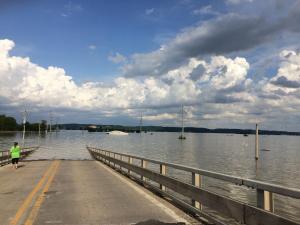
Joe Page Bridge after levee break, 2019, Liz Schleicher
“They should just leave.”
Gosh. I don’t know how many times I’ve heard it.
“There’s not that many people living there anyway. Turn it into a nature preserve.”
“The government should force them out.”
“How stupid can you get?”
“It’s time to talk about the wisdom of living near the river.”
Always said with the air of someone who knows it all. But what they don’t know, these who don’t live where hurricanes or floods or earthquakes or volcanoes threaten, is this:
“This is my home.”

Grafton, IL, July, 1993 — Volunteers of all ages helped with the flood relief. Here, seniors help fill sandbags. Photo by: Liz Roll/FEMA News Photo/Public Domain
This is my home. My parents’ home. My grandparents’ home. My great-great grandparents’ home. This is land our families have loved and lived on for almost 200 years. A place we’ve farmed and fought for over decades as the waters advance and recede around us. This is where we were born, and where we will be buried. It is part of us, and the blood that runs in our veins is mingled with the Mississippi.
Or the Gulf.
Or the lava flow.
Or the driving snow on the side of the mountain.
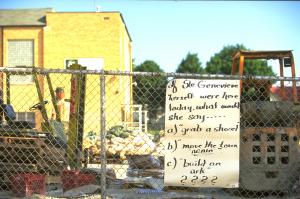
Ste. Genevieve, MO, Andrea Booher, FEMA, Public Domain
We can be prudent. We can regulate construction on the flood plain. Or build stronger buildings and storm shelters. We can buy insurance. We can plan, and develop wisely, and use all of our human wiles and technologies to pin down Mother Nature. But we can never box her in, no matter where we live. Always, sometimes, the environment will try to rise up and try to kill us. There is no such thing as perfect safety. We all live in a tension between love and danger, and when we find the spot where the love overcomes the danger, we call it home. That is no small thing.
That is why we don’t “just move.” No matter where we are, no matter what threatens.
Previous Post

May 11, 2021
People at Home
Next Post

May 22, 2021 Cork Board-May 22, Vigil of Pentecost
Browse Our Archives
Select a Category About Green Ridge Community Cork Board Family Nature Prayer Small Towns Work
Select a Month June 2021 May 2021 April 2021 March 2021 February 2021
Follow Us!
TAKE THE
Religious Wisdom Quiz
Who said, "I am the voice of one calling in the wilderness"?
Select your answer to see how you score.
Elijah Andrew Isaiah John the Baptist
Related posts from A Green Ridge Devotional
Small Towns, Kinship and the Body of Christ
TRENDING AT PATHEOS Catholic

The Parable Of The Sower And The Word...
One of Christ’s most famous parables is that of the sower who...

Rejecting Doom: Christian Hope And Human Action
Christianity is a religion of hope. We are to have hope and...

Why I Choose the Eucharist Over the Sermon
Choose the Eucharist, Not the Sermon What are we supposed to get...

5 Design Elements Found in Spiritually Rooted Homes
Putting Spirituality Into Home Decor Our homes are more than our living...

Credo: A Story of God Told with the...
About 10 years ago, I began to imagine a personal "Credo" that...

The Anatomy of Divine Revelation in Catholic Thought
The claim that God has made Himself known to human beings is...
view all Catholic blogs
Ad-Free & Subscriber Log-In Subscription Support
- About Us
- 2026 Calendar
- Videos
- Podcasts
- Library of World Religions
- Faith In Media Tracker
- Advertise With Us
- Write for Us
- Privacy Policy
- Terms of Service
- Do Not Sell My Data
- Contact Us
- Radiant Digital
- Manage Newsletter Subscriptions
- Unsubscribe From Notifications
- Sitemap
Copyright 2008-2026, Patheos. All rights reserved.
Subscription Support Ad-Free & Subscriber Log-In
Follow Patheos