
BuddhistCatholicContemplativeEvangelicalGeneral ChristianHinduJewishLatter-day SaintMuslimNew VisionsProgressive Christian
Beliefs
- Buddhist
- Catholic
- Contemplative
- Evangelical
- General Christian
- Hindu
- Jewish
- Latter-day Saint
- More Voices
- Muslim
- New Visions
- Pagan
- Progressive Christian
Topics
- Religion News
- Food and Religion
- Sports and Religion
- Religious Art
- Religious Music and Entertainment
- Religious Events
- History and Religion
- Style and Religion
- Politics and Religion
- Women in Religion
- Recreation Outdoors and Religion
- Business Finance and Religion
- Careers Workplace and Religion
- Education and Religion
- Family Parenting and Religion
- Health Fitness and Religion
- Home and Religion
- Relationships and Religion
- Technology and Religion
- Travel and Religion
Columnists
- Buddhist Columnists
- Business Finance and Religion Columnists
- Careers Workplace and Religion Columnists
- Catholic Columnists
- Contemplative Columnists
- Education and Religion Columnists
- Evangelists Columnists
- Family Parenting and Religion Columnists
- General Christian Columnists
- Health Fitness and Religion Columnists
- Hindu Columnists
- History and Religion Columnists
- Home and Religion Columnists
- Jewish Columnists
- More Voices Columnists
- Latter Day Columnists
- Muslim Columnists
- New Visions Columnists
- Nonreligious Columnists
- Pagan Columnists
- Politics and Religion Columnists
- Progressive Columnists
- Recreation Outdoors and Religion Columnists
- Relationships and Religion Columnists
- Religion News Columnists
- Religious Art Columnists
- Religious Events Columnists
- Religious Music and Entertainment Columnists
- Sports and Religion Columnists
- Style and Religion Columnists
- Technology and Religion Columnists
- Travel and Religion Columnists
- Women in Religion Columnists
Resource Library
- 2026 Calendar
- Library of World Religions
- The 100 Most Holy Places on Earth
- Patheos Answers
- Podcasts
- Videos
- Faith Leaders Database
- Anglican Episcopalian
- Bahai
- Baptist
- Buddhism
- Christianity
- Confucianism
- Eastern Orthodoxy
- Hinduism
- Holiness and Pentecostal
- ISKCON
- Islam
- Judaism
- Lutheran
- Methodist
- The Church of Jesus Christ of Latter-day Saints
- New Age
- Paganism
- Presbytarian and Reformed
- Protestantism
- Religion Behind the Scenes
- Roman Catholic
- Scientology
- Shia Islam
- Sikhism
- Sufism
- Sunni Islam
- Taoism
- Zen
- See all religions
Research Tools
 Ad-Free & Subscriber Log-In Subscription Support
Ad-Free & Subscriber Log-In Subscription Support
Follow Patheos 

- Trending:
- Forgiveness
- |
- Marriage
- |
- Consciousness
- |
- Death Penalty
- |
- Election
- |
- Halloween
 A Green Ridge Devotional
- Home
- Catholic
- A Short Spirituality of Naps
A Short Spirituality of Naps
Last updated on: May 25, 2021 at 9:53 am by Punky Mantilla
A Short Spirituality of Naps 2021-05-25T09:53:55-05:00 Punky Mantilla
Patheos Explore the world's faith through different perspectives on religion and spirituality! Patheos has the views of the prevalent religions and spiritualities of the world.
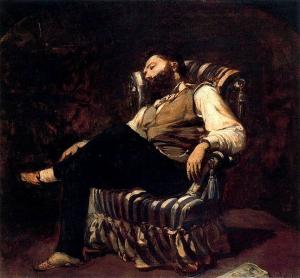
La migdiada, Ramon Marti Alsina, 1884, public domain
My seven-year-old daughter balked.
“Do I really have to rest?”
“Yes,” I said. “This is our schedule when you’re at school. It’s part of our day. You don’t have to fall asleep, but you do have to sit or lie down quietly and read, draw, pray. Rest and silence is good for your body and for your brain. It helps you grow.”
The conversation whisked me back in time. My grandfather, after eating his midday meal and before he returned to his farm chores, would take a seat in his old brown recliner. If his clothes were too dirty, he would lie on the dining room floor. Like the venerable Van Gleck grandsire in Hans Brinker, he would sometimes throw his red handkerchief over his face. Fifteen minutes, more or less, and then he was up, rested and ready for the afternoon.
In our Midwestern German farming culture, the institution of the midday nap hung on long into the 20th century. My father’s mother took one as well, darkening her bedroom and disappearing for exactly one hour to pray the Rosary and rest. Our babysitter enforced a strict post-lunch silence, mostly for her own sake. She called it her “forty winks,” and we sat silently in wonder, winking to ourselves and wondering how she made it work.
The nap, like many other beautiful old things, has mostly slipped away from us. I have found it dozing only in the old societies and odd corners of our country: a tiny, eccentric co-worker, who crawled under her desk with a sleep mask and a blanket for the remainder of her lunch hour. The Amish farm family from whom I get goat milk, who calls it their “noon-nap.”
The nap is even disappearing from the last bastions of siesta culture in places like India and Spain. It has been replaced by school and work, all the world over.
It is debatable whether our bodies benefit from a formal period of daytime rest. Most of us no longer engage in agriculture, allowing us to wake later in the day. Our sleep patterns have also changed drastically over the past century, morphing to fit technologies like electricity, central air conditioning and back-lit viewing screens. We’ve outgrown the bodily need for a siesta — but what about our souls? We might argue that the holiest of saints went without much sleep. Father Aloysius Roche recounts the efforts of many of them, including St. Catherine of Siena, who got two hours per night, and St. Francis of Assisi, who considered his down pillow to be a temptation of the Devil. On the other hand, our Lord himself didn’t let much get in the way of his shut-eye. The Rule of St. Benedict (and many monastic schedules afterward) codify a period of daytime rest.
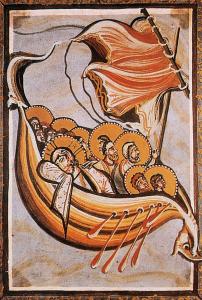
Jesus sleeps in the storm, Hitda Codex, 11th century, public domain
In our fast, noisy hive of a world, a nap is a small but powerful sign of contradiction. In the words of Bishop Conley, it “means witnessing to something more delightful, more profound, and more meaningful than what our world offers.” To rest is to acknowledge that our work will still be there when we awake, that not everything depends on our scurrying and striving. In napping, we witness that silence has value for our bodies and souls and that we as human beings matter more than the frantic productivity of the world. As the Catechism says of the Sabbath, it is a “protest against the servitude of work and the worship of money.”
A nap is a small rebellion, maybe just fifteen minutes under an old red handkerchief, but it is also a slice of eternity, “refreshment, light and peace.” Revolt against the world and rest, lying down to sleep or sitting quietly to pray, read, draw. It is good for your body and your soul. After all, “better is a handful of quietness than two hands full of toil and striving after the wind.” -Ecclesiastes 4:6
Previous Post

May 22, 2021
Cork Board-May 22, Vigil of Pentecost
Next Post

June 1, 2021 The House That Grandma Built
Browse Our Archives
Select a Category About Green Ridge Community Cork Board Family Nature Prayer Small Towns Work
Select a Month June 2021 May 2021 April 2021 March 2021 February 2021
Follow Us!
TAKE THE
Religious Wisdom Quiz
Nahum describes the Lord as riding in the whirlwind and storms. What does he say are the clouds?
Select your answer to see how you score.
The dust of his feet His chariot His glory His covering
Related posts from A Green Ridge Devotional

Peter's Mother-in-Law and the Dignity of Work
TRENDING AT PATHEOS Catholic

The Parable Of The Sower And The Word...
One of Christ’s most famous parables is that of the sower who...

Rejecting Doom: Christian Hope And Human Action
Christianity is a religion of hope. We are to have hope and...

Why I Choose the Eucharist Over the Sermon
Choose the Eucharist, Not the Sermon What are we supposed to get...

5 Design Elements Found in Spiritually Rooted Homes
Putting Spirituality Into Home Decor Our homes are more than our living...

Credo: A Story of God Told with the...
About 10 years ago, I began to imagine a personal "Credo" that...

The Anatomy of Divine Revelation in Catholic Thought
The claim that God has made Himself known to human beings is...
view all Catholic blogs
Ad-Free & Subscriber Log-In Subscription Support
- About Us
- 2026 Calendar
- Videos
- Podcasts
- Library of World Religions
- Faith In Media Tracker
- Advertise With Us
- Write for Us
- Privacy Policy
- Terms of Service
- Do Not Sell My Data
- Contact Us
- Radiant Digital
- Manage Newsletter Subscriptions
- Unsubscribe From Notifications
- Sitemap
Copyright 2008-2026, Patheos. All rights reserved.
Subscription Support Ad-Free & Subscriber Log-In
Follow Patheos