
BuddhistCatholicContemplativeEvangelicalGeneral ChristianHinduJewishLatter-day SaintMuslimNew VisionsProgressive Christian
Beliefs
- Buddhist
- Catholic
- Contemplative
- Evangelical
- General Christian
- Hindu
- Jewish
- Latter-day Saint
- More Voices
- Muslim
- New Visions
- Pagan
- Progressive Christian
Topics
- Religion News
- Food and Religion
- Sports and Religion
- Religious Art
- Religious Music and Entertainment
- Religious Events
- History and Religion
- Style and Religion
- Politics and Religion
- Women in Religion
- Recreation Outdoors and Religion
- Business Finance and Religion
- Careers Workplace and Religion
- Education and Religion
- Family Parenting and Religion
- Health Fitness and Religion
- Home and Religion
- Relationships and Religion
- Technology and Religion
- Travel and Religion
Columnists
- Buddhist Columnists
- Business Finance and Religion Columnists
- Careers Workplace and Religion Columnists
- Catholic Columnists
- Contemplative Columnists
- Education and Religion Columnists
- Evangelists Columnists
- Family Parenting and Religion Columnists
- General Christian Columnists
- Health Fitness and Religion Columnists
- Hindu Columnists
- History and Religion Columnists
- Home and Religion Columnists
- Jewish Columnists
- More Voices Columnists
- Latter Day Columnists
- Muslim Columnists
- New Visions Columnists
- Nonreligious Columnists
- Pagan Columnists
- Politics and Religion Columnists
- Progressive Columnists
- Recreation Outdoors and Religion Columnists
- Relationships and Religion Columnists
- Religion News Columnists
- Religious Art Columnists
- Religious Events Columnists
- Religious Music and Entertainment Columnists
- Sports and Religion Columnists
- Style and Religion Columnists
- Technology and Religion Columnists
- Travel and Religion Columnists
- Women in Religion Columnists
Resource Library
- 2026 Calendar
- Library of World Religions
- The 100 Most Holy Places on Earth
- Patheos Answers
- Podcasts
- Videos
- Faith Leaders Database
- Anglican Episcopalian
- Bahai
- Baptist
- Buddhism
- Christianity
- Confucianism
- Eastern Orthodoxy
- Hinduism
- Holiness and Pentecostal
- ISKCON
- Islam
- Judaism
- Lutheran
- Methodist
- The Church of Jesus Christ of Latter-day Saints
- New Age
- Paganism
- Presbytarian and Reformed
- Protestantism
- Religion Behind the Scenes
- Roman Catholic
- Scientology
- Shia Islam
- Sikhism
- Sufism
- Sunni Islam
- Taoism
- Zen
- See all religions
Research Tools
 Ad-Free & Subscriber Log-In Subscription Support
Ad-Free & Subscriber Log-In Subscription Support
Follow Patheos 

- Trending:
- Forgiveness
- |
- Marriage
- |
- Consciousness
- |
- Death Penalty
- |
- Election
- |
- Halloween
 A Green Ridge Devotional
- Home
- Catholic
- Blackberry Winter: The Folklore of Spring Snow
Blackberry Winter: The Folklore of Spring Snow
Last updated on: April 20, 2021 at 10:58 am by Punky Mantilla
Blackberry Winter: The Folklore of Spring Snow 2021-04-20T10:58:22-05:00 Punky Mantilla
Patheos Explore the world's faith through different perspectives on religion and spirituality! Patheos has the views of the prevalent religions and spiritualities of the world.
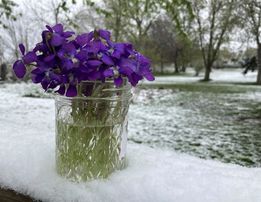
Liz Schleicher
Here in Green Ridge, the snow has been falling thickly since just after dawn. The squirrels don’t seem to mind, leaping clumsily between green branches covered with white. The robins don’t seem to mind, still battling each other in the backyard. The cows and donkeys across the street aren’t surprised either. Very little will deter them from enjoying the chilly grass and hay.
But the humans have been betrayed.
Snow in April is abominable,” said Anne of Ingleside in L.M Montgomery’s famous work of the same name.
“Like a slap in the face when you expected a kiss.”
We lament (every other year) that this year’s snow is too late, too cold and out of the natural order of things. Perhaps even a sinister sign of the changing climate. But in fact, late spring snow has been part of the human experience since ancient times. This is reflected in our literature, our music and our folklore all over the world.
The Farmer’ Almanac refers to a late-spring cold snap as “dogwood winter” and notes that local names for the weather phenomenon usually reflect whatever tree or shrub blooms predominantly in the area: locust winter. Redbud winter. Blackberry winter. Blackberries, especially, are most fruitful if subjected to a period of cold weather, and so this name stuck in many regions. Some places in Appalachia and the deeper South recognize all of them, claiming four or even five “little winters.” Far from being rare, the Almanac notes that a blackberry winter weather event occurs historically in about 50 percent of years.
In the 20th century, blackberry winter has been the subject of both word and song. It is the name of the band that recorded the soundtrack for the hillbilly drama Winter’s Bone and a mid-century jazz standard. It’s the title of anthropologist Margaret Mead’s autobiography and a famous Depression-era short story.
Farther back than that, an early fall or late spring snow was memorialized in folklore as “poor man’s fertilizer,” and savvy farmers plowed it into their fields. Modern science has confirmed what our ancestors observed: snow contains nitrogen. Blackberry winters were recorded in newspapers in the 1800s and in the journals of gentlemen farmers of the 1700s. Future President George Washington took note on May 4, 1774: “very cold and spits of snow all day with the wind blowing hard at NoWest.”
Even in ancient times, blackberry winter was noted and mythologized. In Vietnam, Rét nàng Bân (Miss Ban’s Winter) tells the tale of a hapless housewife upon whom the Jade Emperor has pity, extending the winter so she can complete her husband’s braided shirt. Today, a March snow in Vietnam is anthropomorphized as “Miss Ban.”
Our dismay over a late-spring snow is warranted. A hard freeze this week will kill tender plants and orchard blossoms in many parts of the country, crippling small farmers and making homegrown fruits scarce. We should pray to Saint Dorothy, patroness of fruit and flowers, that God spares at least some of this beauty and bounty. But of all God’s creatures, modern man is the only one whose memory is short enough to be surprised by blackberry winter. As we watch the April snow fall, let it be a humbling reminder. In all humanity’s modern glory, we still forget even the reality of the seasons. We are powerless against the whims of Mother Nature. We are still entirely dependent on the mercy of the Lord.
Previous Post

April 13, 2021
God the Child in Spring
Next Post

April 28, 2021 The Day The Pigs Would Die
Browse Our Archives
Select a Category About Green Ridge Community Cork Board Family Nature Prayer Small Towns Work
Select a Month June 2021 May 2021 April 2021 March 2021 February 2021
Follow Us!
TAKE THE
Religious Wisdom Quiz
What animal did fed Elijah?
Select your answer to see how you score.
Doves Sparrows Eagles Ravens
Related posts from A Green Ridge Devotional

Cork Board-May 22, Vigil of Pentecost

TRENDING AT PATHEOS Catholic

The Parable Of The Sower And The Word...
One of Christ’s most famous parables is that of the sower who...

Rejecting Doom: Christian Hope And Human Action
Christianity is a religion of hope. We are to have hope and...

Why I Choose the Eucharist Over the Sermon
Choose the Eucharist, Not the Sermon What are we supposed to get...

5 Design Elements Found in Spiritually Rooted Homes
Putting Spirituality Into Home Decor Our homes are more than our living...

Credo: A Story of God Told with the...
About 10 years ago, I began to imagine a personal "Credo" that...

The Anatomy of Divine Revelation in Catholic Thought
The claim that God has made Himself known to human beings is...
view all Catholic blogs
Ad-Free & Subscriber Log-In Subscription Support
- About Us
- 2026 Calendar
- Videos
- Podcasts
- Library of World Religions
- Faith In Media Tracker
- Advertise With Us
- Write for Us
- Privacy Policy
- Terms of Service
- Do Not Sell My Data
- Contact Us
- Radiant Digital
- Manage Newsletter Subscriptions
- Unsubscribe From Notifications
- Sitemap
Copyright 2008-2026, Patheos. All rights reserved.
Subscription Support Ad-Free & Subscriber Log-In
Follow Patheos