
BuddhistCatholicContemplativeEvangelicalGeneral ChristianHinduJewishLatter-day SaintMuslimNew VisionsProgressive Christian
Beliefs
- Buddhist
- Catholic
- Contemplative
- Evangelical
- General Christian
- Hindu
- Jewish
- Latter-day Saint
- More Voices
- Muslim
- New Visions
- Pagan
- Progressive Christian
Topics
- Religion News
- Food and Religion
- Sports and Religion
- Religious Art
- Religious Music and Entertainment
- Religious Events
- History and Religion
- Style and Religion
- Politics and Religion
- Women in Religion
- Recreation Outdoors and Religion
- Business Finance and Religion
- Careers Workplace and Religion
- Education and Religion
- Family Parenting and Religion
- Health Fitness and Religion
- Home and Religion
- Relationships and Religion
- Technology and Religion
- Travel and Religion
Columnists
- Buddhist Columnists
- Business Finance and Religion Columnists
- Careers Workplace and Religion Columnists
- Catholic Columnists
- Contemplative Columnists
- Education and Religion Columnists
- Evangelists Columnists
- Family Parenting and Religion Columnists
- General Christian Columnists
- Health Fitness and Religion Columnists
- Hindu Columnists
- History and Religion Columnists
- Home and Religion Columnists
- Jewish Columnists
- More Voices Columnists
- Latter Day Columnists
- Muslim Columnists
- New Visions Columnists
- Nonreligious Columnists
- Pagan Columnists
- Politics and Religion Columnists
- Progressive Columnists
- Recreation Outdoors and Religion Columnists
- Relationships and Religion Columnists
- Religion News Columnists
- Religious Art Columnists
- Religious Events Columnists
- Religious Music and Entertainment Columnists
- Sports and Religion Columnists
- Style and Religion Columnists
- Technology and Religion Columnists
- Travel and Religion Columnists
- Women in Religion Columnists
Resource Library
- 2026 Calendar
- Library of World Religions
- The 100 Most Holy Places on Earth
- Patheos Answers
- Podcasts
- Videos
- Faith Leaders Database
- Anglican Episcopalian
- Bahai
- Baptist
- Buddhism
- Christianity
- Confucianism
- Eastern Orthodoxy
- Hinduism
- Holiness and Pentecostal
- ISKCON
- Islam
- Judaism
- Lutheran
- Methodist
- The Church of Jesus Christ of Latter-day Saints
- New Age
- Paganism
- Presbytarian and Reformed
- Protestantism
- Religion Behind the Scenes
- Roman Catholic
- Scientology
- Shia Islam
- Sikhism
- Sufism
- Sunni Islam
- Taoism
- Zen
- See all religions
Research Tools
 Ad-Free & Subscriber Log-In Subscription Support
Ad-Free & Subscriber Log-In Subscription Support
Follow Patheos 

- Trending:
- Forgiveness
- |
- Marriage
- |
- Consciousness
- |
- Death Penalty
- |
- Election
- |
- Halloween
 A Green Ridge Devotional
- Home
- Catholic
- Who is a Traditional Woman?
Who is a Traditional Woman?
Last updated on: March 9, 2021 at 10:51 am by Punky Mantilla
Who is a Traditional Woman? 2021-03-09T10:51:09-06:00 Punky Mantilla
Patheos Explore the world's faith through different perspectives on religion and spirituality! Patheos has the views of the prevalent religions and spiritualities of the world.
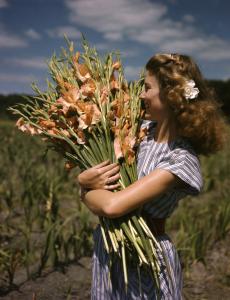
Flickr: The Commons/Joseph Janney Steinmetz Collection, State Library and Archives of Florida
In the past decade, many Catholics have been looking back to generations long-gone for guidance on how to navigate the present. There has been a popular resurgence of all things “traditional:” The Traditional Latin Mass. Gregorian chant. Habits and cassocks for religious people. Classic devotions and works of Catholic literature. A nascent back-to-the-land movement characterized by family farming and homeschooling. Some Catholics devoted to tradition emulate even the smallest details of style, like pipe smoking or mid-20th-century dresses and suits.
There has also been much serious discussion, even strife, over what makes a traditional Catholic man or woman. Must men and women conform to traditional gender roles? What makes a person masculine or feminine? Much of this discussion is centered on the role of women. In the name of tradition, many social questions of earlier centuries are being rehashed. Should a woman work outside the home? Should she pursue post-secondary education? Should she participate in politics? Should she seek to have a large family? What should she wear? Should she cover her head at Mass? What pursuits should she enjoy?
The bulk of this debate seems to take for granted that “tradition” refers to the American century roughly between the years of 1865 and 1965. Even more attention is given to the period of relative peace and prosperity post-World War II. Supporters of a “traditional” female ideal often share vintage paintings and advertisements of smiling, aproned middle-class white women in sweet dresses. They are depicted leading their young families to Mass, baking, or hanging laundry out to dry. But is this an accurate depiction of traditional womanhood?
To mark the anniversary of International Women’s Day, I have shared the true stories of some of my own female ancestors. All of them were “country girls” born during the commonly-defined era of “American Tradition” and before. The similarities end there. Which of them is the authentically traditional woman?
Tabitha, The Pioneer, Kentucky, 1797
Tabitha was born into a family of well-known early American settlers, but she married into a lineage even more famous: The Daniel Boone family. She was a widow with five children by age 33. The historical record indicates that it is likely she was still pregnant with her last child at the time of her husband’s death. Her astonishing accomplishments can’t be described any better than in these passages by Jess Thompson, a biographer of Midwestern pioneer life:
“Her ‘mark’ adorns numerous yellowed documents in the basement of the …county courthouse. She could not write her own name; she never went to school. Her girlhood was devoted to the hard chores of the frontier; she worked in the field at picking, piling and burning brush, rolling logs, building rail or brush fences, cutting grain with a sickle or binding behind the cradle. In her system of household economy, she used locust thorns for pins. She rode a horse well, could yoke and handle a double team of oxen, was a good marksman with the ‘rifle gun,” and could swing a two-bitted axe with telling effect. She built traps and caught wild turkeys and snared prairie chickens by the hundreds. Once, wading into the waters of McGee Creek, in water waist-deep, with her bare hands she is said to have helped her dogs drag down a deer.
This widow … appears to have been one of the outstanding business women of her time; the records tell the story of her numerous activities; she dealt in lands, buying and selling; she attended pioneer sales and did her own bidding; she loaned money, and unschooled though she was, negotiated notes and mortgages and executed documents with seemingly rare business acumen; when necessary, she went into the early … county courts and defended or maintained her rights, and judging from the records of her various lawsuits, with almost unfailing success.”
Goldie: The Tomboy, Oklahoma, 1908
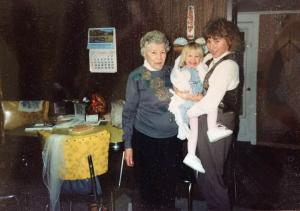
Family Photograph
Goldie was the sixth child of a family wealthy enough to send their sons and their daughters to college. She loved to play ball and shoot guns, Annie Oakley-style. She led Stillwater High School girls’ basketball team to a state championship in 1926 —wearing long sleeves, long bloomers and long socks for modesty’s sake.* She later played basketball at Oklahoma A&M. She married a veteran farmer, had eight children, and was active in the Methodist Church. She was familiar with grief. She lost one son in infancy and another as a young man. She enjoyed gardening and yard work but never lost her passion for sports. As an adult, she bowled competitively. She watched her favorite teams on TV and almost never missed her family’s athletic events. Her favorite professional basketball player was Dennis Rodman. She was stern and dignified, but quick to laugh and to praise. She wore a long necklace studded with a rainbow of birthstones, one for each descendant. As her body declined, her doctors told her one of her toes would have to be amputated: Her response? “Take the damn thing off, then!” She lived to be 96.
Dolores, The Doting Aunt, Illinois, 1924
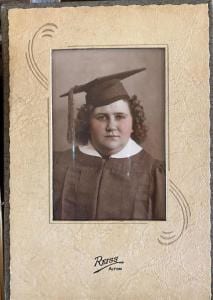
Family Photograph
Dolores was the baby girl of a large French Catholic farm family. She graduated high school, one of only a few girls in her class. Her womanhood was full of hardship. She saw many of her brothers sent off to war. Another brother was permanently disabled in a farming accident. She watched as diabetes maimed and killed her mother, who died in a state of psychosis at a sanitarium in a big city. She never married or entered religious life. Instead, she stayed home to serve her ailing parents and disabled brother. She was also a second mother for her brother’s many children. They remember her as a jolly woman who made a difficult world seem loving and full of magic. She died of diabetes at the age of 47.
Pauline: The Southern Lady, Missouri, 1924
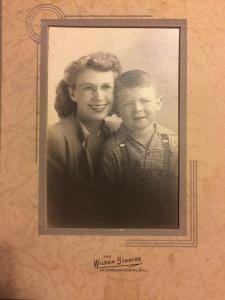
Family Photograph
Pauline’s girlhood was spent in the woods on the banks of a Southern Missouri river. Her life was molded by the Great Depression. Her father was a troubled man, a hellfire and brimstone Baptist pastor. It was perhaps because of this she grew up to be deeply faithful but unchurched, staying home to read her Bible and sing old gospel hymns. As a teen, she defied her father’s mores to earn money as a model in the window of a department store. It was there that her future husband passed by on the sidewalk and was smitten. They had two sons and a lovely farm. Pauline’s bubbling giggle, sassy sense of humor, beautiful smile and immaculate housekeeping belied her lifelong struggles with chronic pain. She suffered migraines so severe she sometimes required emergency care. She was somehow both tough and fragile. Always the proper lady, she wore pantyhose even under her slacks, kept chickens, grew ferns, and amassed a sizable antique collection. She suffered dementia and pined to be with her beloved husband after his death. She passed at the age of 93.
Edna: The Powerhouse, Illinois 1930
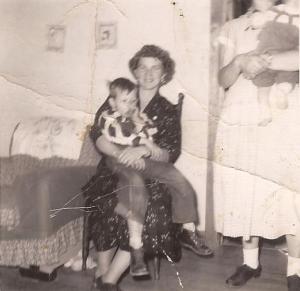
Family Photograph
Edna was a hard working and devout German Catholic girl. Her mental strength and capacity for physical labor far outstripped most men. She dropped out of school after the eighth grade in order to help support her family. She and other rural teen girls worked as linen aides at a hospital about an hour away. They boarded there during the week and only went home on the weekends. Despite her lack of secondary education, she was both smart and wise. Edna also married a WWII veteran and farmer. They had ten children, mostly rough-and-tumble boys. At various periods in her life, the family kept orchards, farm fields, gardens, hogs, chickens, a milk cow, and countless cats and dogs. They foraged and hunted to help fill the supper table. She was famous for her crocheted items, her intricate quilting and her homemade pies. She also loved sports. Except for God and family, nothing could come between her and St. Louis Cardinals baseball. She was a survivor of domestic abuse. She died tragically in a house fire at the age of 80 years.
Which of these women is authentically traditional, truly feminine, a life worthy of emulation? Is it the one who was the most beautiful? The one who had the most children? The strongest or the daintiest? The healthiest? The most or least educated? The one whose life of faith appeared the strongest?
Perhaps real tradition and real womanhood, like real history, is both richer and more complicated than we would like to make it.
*The linked picture in Goldie’s story is not her basketball team. This photo shows the kind of sports uniforms early 20th century girls would have worn.
Previous Post

March 5, 2021
Cork Board-March 5th, 2021
Next Post

March 12, 2021 Cork Board - March 12, 2021
Browse Our Archives
Select a Category About Green Ridge Community Cork Board Family Nature Prayer Small Towns Work
Select a Month June 2021 May 2021 April 2021 March 2021 February 2021
Follow Us!
TAKE THE
Religious Wisdom Quiz
How many letters (epistles) did Paul write in the New Testament?
Select your answer to see how you score.
14 10 12 13
Related posts from A Green Ridge Devotional

Small Towns, Kinship and the Body of Christ
TRENDING AT PATHEOS Catholic

Creation, Preservation, and Teleology in Catholic Theology
As I write this, it is very early Monday morning. Like millions...

The Parable Of The Sower And The Word...
One of Christ’s most famous parables is that of the sower who...

Rejecting Doom: Christian Hope And Human Action
Christianity is a religion of hope. We are to have hope and...

Why I Choose the Eucharist Over the Sermon
Choose the Eucharist, Not the Sermon What are we supposed to get...

5 Design Elements Found in Spiritually Rooted Homes
Putting Spirituality Into Home Decor Our homes are more than our living...

Credo: A Story of God Told with the...
About 10 years ago, I began to imagine a personal "Credo" that...
view all Catholic blogs
Ad-Free & Subscriber Log-In Subscription Support
- About Us
- 2026 Calendar
- Videos
- Podcasts
- Library of World Religions
- Faith In Media Tracker
- Advertise With Us
- Write for Us
- Privacy Policy
- Terms of Service
- Do Not Sell My Data
- Contact Us
- Radiant Digital
- Manage Newsletter Subscriptions
- Unsubscribe From Notifications
- Sitemap
Copyright 2008-2026, Patheos. All rights reserved.
Subscription Support Ad-Free & Subscriber Log-In
Follow Patheos