
BuddhistCatholicContemplativeEvangelicalGeneral ChristianHinduJewishLatter-day SaintMuslimNew VisionsProgressive Christian
Beliefs
- Buddhist
- Catholic
- Contemplative
- Evangelical
- General Christian
- Hindu
- Jewish
- Latter-day Saint
- More Voices
- Muslim
- New Visions
- Pagan
- Progressive Christian
Topics
- Religion News
- Food and Religion
- Sports and Religion
- Religious Art
- Religious Music and Entertainment
- Religious Events
- History and Religion
- Style and Religion
- Politics and Religion
- Women in Religion
- Recreation Outdoors and Religion
- Business Finance and Religion
- Careers Workplace and Religion
- Education and Religion
- Family Parenting and Religion
- Health Fitness and Religion
- Home and Religion
- Relationships and Religion
- Technology and Religion
- Travel and Religion
Columnists
- Buddhist Columnists
- Business Finance and Religion Columnists
- Careers Workplace and Religion Columnists
- Catholic Columnists
- Contemplative Columnists
- Education and Religion Columnists
- Evangelists Columnists
- Family Parenting and Religion Columnists
- General Christian Columnists
- Health Fitness and Religion Columnists
- Hindu Columnists
- History and Religion Columnists
- Home and Religion Columnists
- Jewish Columnists
- More Voices Columnists
- Latter Day Columnists
- Muslim Columnists
- New Visions Columnists
- Nonreligious Columnists
- Pagan Columnists
- Politics and Religion Columnists
- Progressive Columnists
- Recreation Outdoors and Religion Columnists
- Relationships and Religion Columnists
- Religion News Columnists
- Religious Art Columnists
- Religious Events Columnists
- Religious Music and Entertainment Columnists
- Sports and Religion Columnists
- Style and Religion Columnists
- Technology and Religion Columnists
- Travel and Religion Columnists
- Women in Religion Columnists
Resource Library
- 2026 Calendar
- Library of World Religions
- The 100 Most Holy Places on Earth
- Patheos Answers
- Podcasts
- Videos
- Faith Leaders Database
- Anglican Episcopalian
- Bahai
- Baptist
- Buddhism
- Christianity
- Confucianism
- Eastern Orthodoxy
- Hinduism
- Holiness and Pentecostal
- ISKCON
- Islam
- Judaism
- Lutheran
- Methodist
- The Church of Jesus Christ of Latter-day Saints
- New Age
- Paganism
- Presbytarian and Reformed
- Protestantism
- Religion Behind the Scenes
- Roman Catholic
- Scientology
- Shia Islam
- Sikhism
- Sufism
- Sunni Islam
- Taoism
- Zen
- See all religions
Research Tools
 Ad-Free & Subscriber Log-In Subscription Support
Ad-Free & Subscriber Log-In Subscription Support
Follow Patheos 

- Trending:
- Forgiveness
- |
- Marriage
- |
- Consciousness
- |
- Death Penalty
- |
- Election
- |
- Halloween

- Home
- Pagan
- The Corner Crone: Medusa – Speaking Truth to Power
The Corner Crone: Medusa – Speaking Truth to Power
Last updated on: July 13, 2020 at 6:30 pm by Martha Kirby Capo
The Corner Crone: Medusa – Speaking Truth to Power 2020-07-13T18:30:25+00:00 Martha Kirby Capo
Patheos Explore the world's faith through different perspectives on religion and spirituality! Patheos has the views of the prevalent religions and spiritualities of the world.
A few weeks ago I re-read Robin Corak’s Reclaiming Medusa. Like Robin, I’ve found myself mulling over Medusa’s mythologies and examining them through the lens of female empowerment and, more broadly, empowerment of the oppressed.
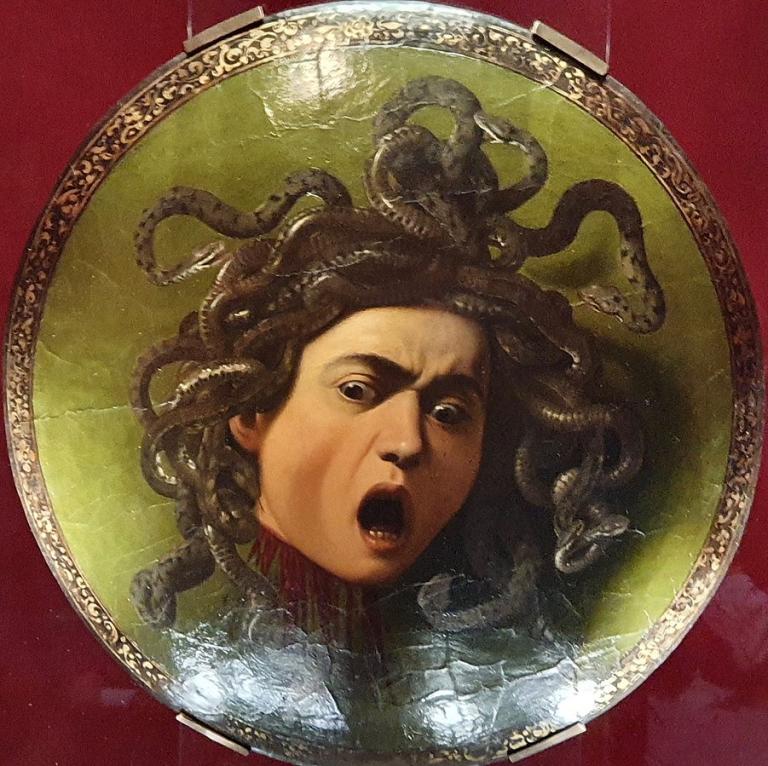
Medusa by Caravaggio, public domain image via Wikimedia Commons.

The Short Story
The shorthand of the story most of us remember is this: Medusa was a priestess at one of Athena’s Temples. Poseidon sees her, desires her, and assaults her. Athena then punishes Medusa for defiling Her Temple by giving Medusa a hideous aspect and a head full of snakes that can turn any man who looks upon her into stone.
Some time later, King Polydectes gives Perseus the task of cutting Medusa’s head off. Perseus receives all kinds of help from other gods (sandals, a highly polished shield) to achieve this quest, sneaks up on Medusa while she’s sleeping and lops off her head, bags it, uses it to smite hordes of enemies, and brings it back to Athena, who decorates her warrior’s shield with it.
Athena afterwards placed the head in the centre of her shield or breastplate. There was a tradition at Athens that the head of Medusa was buried under a mound in the Agora. (Paus. ii. 21. § 6, v. 12. § 2.) Dictionary of Greek and Roman Biography and Mythology.
A Closer Look
When many of us examine Medusa’s story, we can’t escape the theme of powerlessness in which it has its beginning. She’s one of three sisters (the Gorgons), two of whom are immortal. Medusa is mortal, less empowered. In some tellings of her story she is described as having gloriously golden locks of hair, and is so beautiful that every man who looks upon her wants to possess her. Athena punishes her because Medusa has dared to compare her beauty to Her own:
“It is affirmed by some that Medousa (Medusa) was beheaded because of Athene (Athena), for they say the Gorgon had been willing to be compared with Athene in beauty.” Pseudo-Apollodorus, Bibliotheca 2. 46 (trans. Aldrich) (Greek mythographer C2nd A.D.)
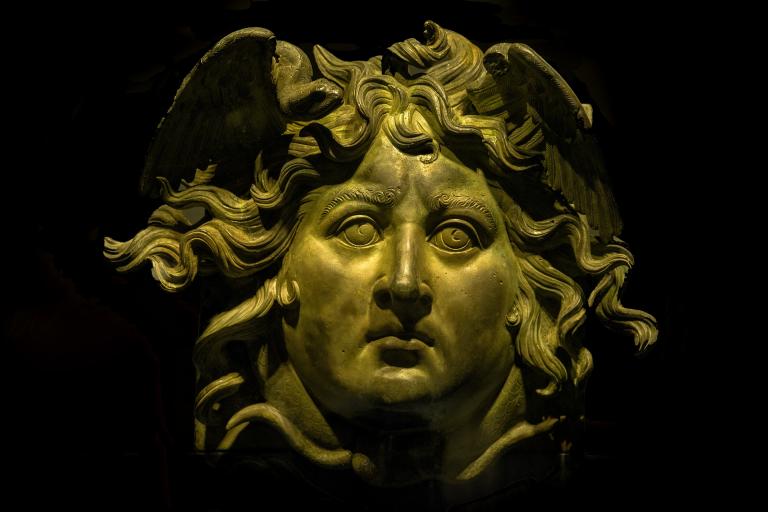
Some say Medusa once had beautiful, flowing hair. Photo by djedj via Pixabay.
The more familiar of her mythologies, however, tell us that she was punished because of Poseidon’s assault:
“[Medousa (Medusa)] was violated in Minerva’s [Athena’s] shrine by the Lord of the Sea (Rector Pelagi) [Poseidon]. Jove’s [Zeus’] daughter turned away and covered with her shield her virgin’s eyes. And then for fitting punishment transformed the Gorgo’s lovely hair to loathsome snakes.” Ovid, Metamorphoses 4. 770 ff (trans. Melville) (Roman epic C1st B.C. to C1st A.D.)
And make no mistake about it, it’s not like Medusa come-hithered Poseidon there on the beach. Poseidon pretty much felt like if he wanted “it” (and I say “it” because she was an object to possess) he could have it:
“Neptune [Poseidon], wert thou mindful of thine own heart’s flames, thou oughtst let no love be hindered by the winds–if neither Amymone, nor Tyro much be praised for beauty, are stories idly charged to thee, nor shining Alcyone, and Calyce, child of Hecataeon, nor Medusa when her locks were not yet twined with snakes, nor golden-haired Laodice and Celaeno taken to the skies, nor those whose names I mind me of having read. These, surely, Neptune, and many more, the poets say in their songs have mingled their soft embraces with thine own.” Ovid, Heroides 19. 129 ff (trans. Showerman) (Roman poetry C1st B.C. to C1st A.D.)
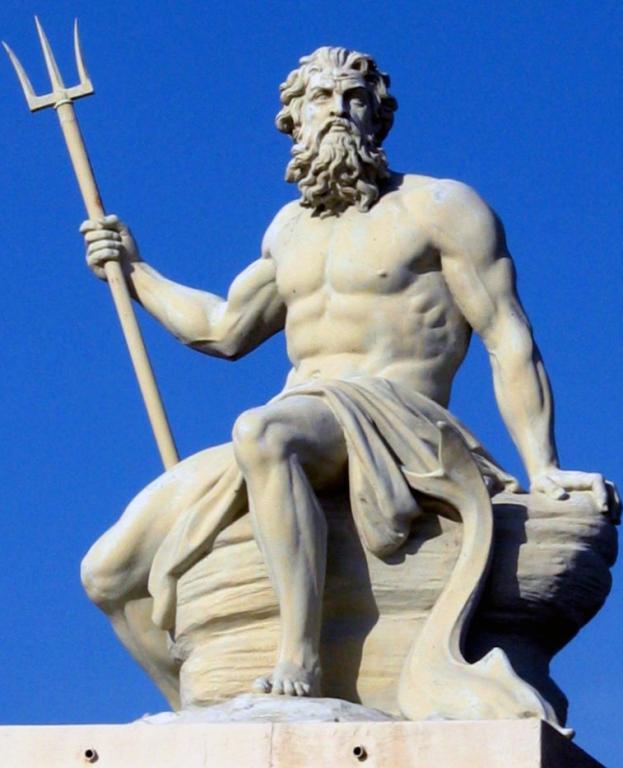
If Poseidon wants it, He gets it. Public domain photo via Wikimedia Commons.

“Soft Embraces” or “Resistance is Futile”?
Christobel Hasting’s The Timeless Myth of Medusa, a Rape Victim Turned Into a Monster explores how the interpretations of Medusa’s story have evolved through the ages. Steeped in a male point of view from the very beginning, her earliest stories show us how disempowered women have been. Medusa’s so sidelined that she’s not even at the center of her own story:
Popular retellings of the myth, however, focus on what happens next [after Athena punishes her]—and Perseus the starring role. […] It’s through this male-centered hero narrative that Medusa became shorthand for monstrosity. (Christobel Hasting, The Timeless Myth of Medusa, vice.com, April 2018)
Elizabeth Johnstone, in her ‘The Original ‘Nasty Woman’ extends this thought:
“Similarly, feminist scholars like Marija Gimbutas re-read the myth of Medusa as a beheading of early matriarchal societies by Greco-Roman culture. According to this interpretation, Neptune’s rape of Medusa and Perseus’s subsequent beheading of her represent the same effort to legitimize male privilege by muting female authority.” (The Atlantic, November 2006)
Examining Medusa in terms of the male gaze renders her powerless from beginning to end, objectifies her to the point of being a mere vessel knocked around (and up) for most of her life and ultimately betrayed and used by the very goddess to whom she had dedicated her life as a Temple priestess. How does Medusa’s story change, though, when viewed through a feminist lens?
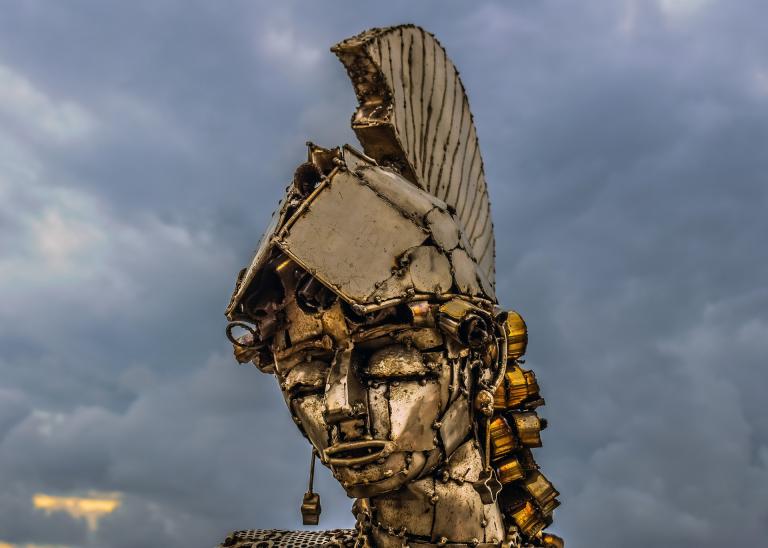
What if Athena’s curse was an act of protection? Photo by Dimitris Vetsikas via Pixabay.
Punishment or Present?
As I read different feminist reinterpretations of Medusa’s story, I ran across a piece by McKenzie Schwark, Snake Eyes: The Power to Turn the Patriarchy into Stone. She writes:
In examining the myth of Athena and Medusa further, the story also seems to be a suggestive fable, slyly teaching women how to look out for and protect one another in a society dominated by men, where rape is a constant threat. Athena was aware of Poseidon’s hunger for Medusa and knew of Medusa’s vow of celibacy. What if Athena’s curse on Medusa wasn’t a punishment at all, but an act of kindness and protection? (April 2019, bitchmedia.org)
Feminist interpretations of Medusa’s story show us ways to reclaim her as a modern protectress against patriarchal hierarchies seeking to disempower our efforts and silence our voices. Athena gives Medusa the gift of not only deflecting/reflecting the male gaze (or, stated another way, of speaking Truth to Power); in a society structured and rooted in male-specific values (and yes, I mean men legislating what happens to women’s bodies) Athena gives Medusa a shield that allows her to fight the patriarchy fearlessly.
This feminist viewpoint also helps to resolve the end of Medusa’s story, when Athena affixes her severed head to her own shield. While Perseus’ use of her head as a weapon against his enemies represents her further objectification as a Thing to be used solely for the benefit of a man, Athena’s use of Medusa’s head can be understood in terms of transcendence and as an icon of empowerment. “Look, upon my shield,” Athena seems to say, “and remember I offer protection.”
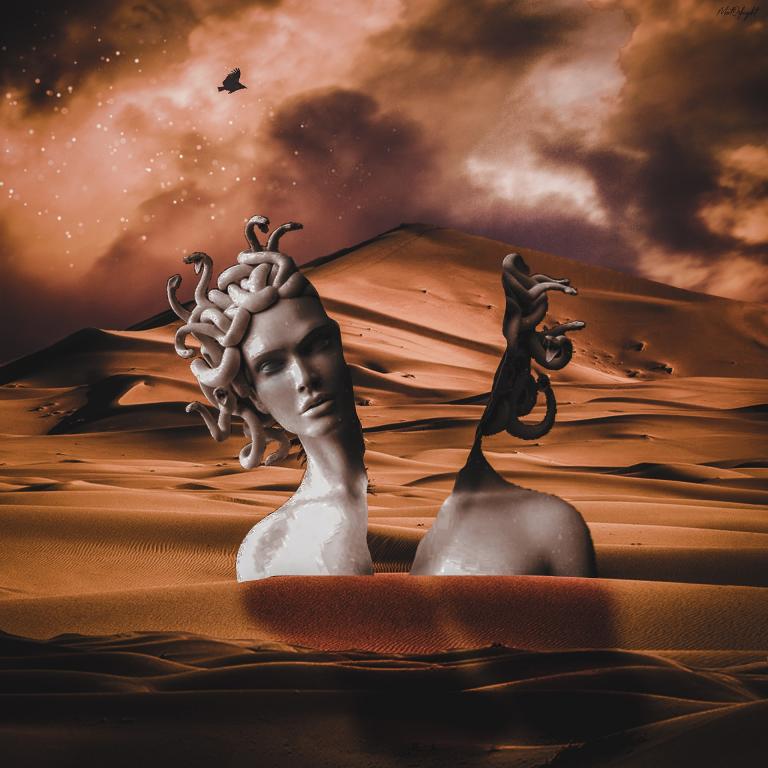
Medusa, then, is transformed. Image by mertozbagdat via Pixabay.
Transformation
Medusa, then, is transformed. When any of us, regardless of genders, seek to change a system of oppression we are also transformed. Change can be scary, but transformation—the reworking of everything we know and everything we know ourselves to be—is terrifying. When we step outside of the system we’re subject to vilification, ridicule, and intense pressure to fall back into line and conform. The majority will try any tactic—belittlement, shaming, othering, outing—to maintain the status quo, no matter how inequitable that status quo is.
Interpreting Medusa’s story through a feminist lens shows us the lengths we may have to go in order to step outside of the system and effect real, tangible change. Those battles may so alter who we are at our core that we may no longer recognize who we used to be before we sought to change the system. Perhaps we look in the mirror and are momentarily frozen in shock at the justice warriors we’ve had to become.
And then we take up Athena’s shield, embossed with Medusa’s terrifying head, and go back out there to fight against injustice once more time. And one more time again, and yet again still. As many times as we have to plus one more.
Because we’re not here to protect the status quo; we’re here to protect the rights of those who have been demeaned and dehumanized, those who have been erased and silenced by the status quo.
And we’re not afraid of being as terrifying as we need to be to make that happen.
Additional Sources
You can hear more of The Corner Crone during her Moments For Meditation on KPPR Pure Pagan Radio on TuneIn.
Previous Post

July 12, 2020
Druid in the City: Where’s the Water?
Next Post

July 14, 2020 Cross and Crossroads: Understanding & Identifying Cultural Appropriation
Browse Our Archives
Select a Category A Lakeside Hearth Adventures in Wortcunning Alone In Her Presence Arts, Crafts & Cooking Birthing Hereditary Witchcraft Book of Blackbirds Book Reviews Born-Again Witch Cauldron, Sword, Spear, & Stone Cermony and Liturgy Columns Community Dandelion Seeds Dear Jasmine Druid Thoughts Editor's Picks Everyday Pagan Family & Household Practice Family Traditions Full Frontal Magic Gateway Goddess Guest Articles Happily Heathen Health and Wellness Hearth of Hellenism Heathen Woman Hills of the Horizon History Holidays Horse Goddesses Interfaith Interviews Irish-American Witchcraft Jewish Witch Lamp & Labyrinth Letters from Midgard Literature, Media, Film, Music Loop of Brighid Love, Sex & Relationships Magic or Magick Making Light Naturalistic Traditions Nature News Outside The Circle Pantheisticon Politics Prayers, Poems, Blessings & Stories Queer Femme Mystic Queer of Swords Recipes Ritual and Practice Science and Research Seekers and Guides Seeking the Grail Socially Responsible Magic Spear of Athena Star Made Witch Syncretic Electric Technology The Blooming Staff The Busy Witch The Cartomancer The Crow's Nest The Dance of Pagan Recovery The Hearth of Hellenism The Lady's Quill The Other Side of the Hedge The Path of She The Rantin' Raven The Witches Next Door The Zen Pagan Theology, Ethics, Philosophy Tree City Witch Urban Earthwitch Wayfaring Woman Witch on Fire Wyrd Words
Select a Month January 2026 March 2025 December 2024 June 2024 April 2024 March 2024 January 2024 December 2023 November 2023 October 2023 August 2023 July 2023 May 2023 April 2023 March 2023 February 2023 January 2023 December 2022 November 2022 October 2022 September 2022 August 2022 July 2022 June 2022 May 2022 March 2022 February 2022 January 2022 December 2021 November 2021 October 2021 September 2021 August 2021 July 2021 June 2021 May 2021 April 2021 March 2021 February 2021 January 2021 December 2020 November 2020 October 2020 September 2020 August 2020 July 2020 June 2020 May 2020 April 2020 March 2020 February 2020 January 2020 December 2019 November 2019 October 2019 September 2019 August 2019 July 2019 June 2019 May 2019 April 2019 March 2019 February 2019 January 2019 December 2018 November 2018 October 2018 September 2018 August 2018 July 2018 June 2018 May 2018 April 2018 March 2018 February 2018 January 2018 December 2017 November 2017 October 2017 September 2017 August 2017 July 2017 June 2017 May 2017 April 2017 March 2017 February 2017 January 2017 December 2016 November 2016 October 2016 September 2016 August 2016 July 2016 June 2016 May 2016 April 2016 March 2016 February 2016 January 2016 December 2015 November 2015 October 2015 September 2015 August 2015 July 2015 June 2015 May 2015 April 2015 March 2015 February 2015 January 2015 December 2014 November 2014 October 2014 September 2014 August 2014 July 2014 June 2014 May 2014 April 2014 March 2014 February 2014 January 2014 December 2013 November 2013 October 2013 September 2013 August 2013 July 2013 June 2013 May 2013 April 2013 March 2013 February 2013 January 2013 December 2012 November 2012 October 2012 September 2012 August 2012 July 2012 June 2012 May 2012 April 2012 March 2012 February 2012 January 2012
Follow Us!
TAKE THE
Religious Wisdom Quiz
What does the name "Jacob" mean?
Select your answer to see how you score.
Friend of God Justified Supplanter Full of light
Related posts from Agora

Simple Witchery: To Keep Silent

Simple Witchery: Leaning On The Four Pillars


TRENDING AT PATHEOS Pagan

I was recently chatting with someone on Instagram. She asked me what...

While there are many people who share their results, the end of...

On July 23, I saw Christopher Nolan's The Odyssey which is Homer’s...

As I write this two big events have just finished up. One...

Restoring the Watershed of Divine Love
Perhaps cooperation is not something we manufacture through legislation, ideology, or moral...

Many UUs don’t pray because of bad experiences in a previous religion,...
view all Pagan blogs
Ad-Free & Subscriber Log-In Subscription Support
- About Us
- 2026 Calendar
- Videos
- Podcasts
- Library of World Religions
- Faith In Media Tracker
- Advertise With Us
- Write for Us
- Privacy Policy
- Terms of Service
- Do Not Sell My Data
- Contact Us
- Radiant Digital
- Manage Newsletter Subscriptions
- Unsubscribe From Notifications
- Sitemap
Copyright 2008-2026, Patheos. All rights reserved.
Subscription Support Ad-Free & Subscriber Log-In
Follow Patheos