
BuddhistCatholicContemplativeEvangelicalGeneral ChristianHinduJewishLatter-day SaintMuslimNew VisionsProgressive Christian
Beliefs
- Buddhist
- Catholic
- Contemplative
- Evangelical
- General Christian
- Hindu
- Jewish
- Latter-day Saint
- More Voices
- Muslim
- New Visions
- Pagan
- Progressive Christian
Topics
- Religion News
- Food and Religion
- Sports and Religion
- Religious Art
- Religious Music and Entertainment
- Religious Events
- History and Religion
- Style and Religion
- Politics and Religion
- Women in Religion
- Recreation Outdoors and Religion
- Business Finance and Religion
- Careers Workplace and Religion
- Education and Religion
- Family Parenting and Religion
- Health Fitness and Religion
- Home and Religion
- Relationships and Religion
- Technology and Religion
- Travel and Religion
Columnists
- Buddhist Columnists
- Business Finance and Religion Columnists
- Careers Workplace and Religion Columnists
- Catholic Columnists
- Contemplative Columnists
- Education and Religion Columnists
- Evangelists Columnists
- Family Parenting and Religion Columnists
- General Christian Columnists
- Health Fitness and Religion Columnists
- Hindu Columnists
- History and Religion Columnists
- Home and Religion Columnists
- Jewish Columnists
- More Voices Columnists
- Latter Day Columnists
- Muslim Columnists
- New Visions Columnists
- Nonreligious Columnists
- Pagan Columnists
- Politics and Religion Columnists
- Progressive Columnists
- Recreation Outdoors and Religion Columnists
- Relationships and Religion Columnists
- Religion News Columnists
- Religious Art Columnists
- Religious Events Columnists
- Religious Music and Entertainment Columnists
- Sports and Religion Columnists
- Style and Religion Columnists
- Technology and Religion Columnists
- Travel and Religion Columnists
- Women in Religion Columnists
Resource Library
- 2026 Calendar
- Library of World Religions
- The 100 Most Holy Places on Earth
- Patheos Answers
- Podcasts
- Videos
- Faith Leaders Database
- Anglican Episcopalian
- Bahai
- Baptist
- Buddhism
- Christianity
- Confucianism
- Eastern Orthodoxy
- Hinduism
- Holiness and Pentecostal
- ISKCON
- Islam
- Judaism
- Lutheran
- Methodist
- The Church of Jesus Christ of Latter-day Saints
- New Age
- Paganism
- Presbytarian and Reformed
- Protestantism
- Religion Behind the Scenes
- Roman Catholic
- Scientology
- Shia Islam
- Sikhism
- Sufism
- Sunni Islam
- Taoism
- Zen
- See all religions
Research Tools
 Ad-Free & Subscriber Log-In Subscription Support
Follow Patheos 

- Trending:
- Advent
- |
- Forgiveness
- |
- Thanksgiving
- |
- Election
- |
- Seasonal Holidays
- |
- Marriage

- Home
- Pagan
- The Balancing Path: Not All Meditations Are Created Equal
The Balancing Path: Not All Meditations Are Created Equal
Last updated on: January 4, 2022 at 8:43 am by Sidney Eileen
The Balancing Path: Not All Meditations Are Created Equal 2022-01-04T08:43:30+00:00 Sidney Eileen
Patheos Explore the world's faith through different perspectives on religion and spirituality! Patheos has the views of the prevalent religions and spiritualities of the world.
Not all meditations are created equal because they are not supposed to be equal. Different meditation techniques are designed to achieve different goals, and to work for different kinds of people in different situations. It’s not a competition, and it’s not possible to universally rank the “best” meditation techniques in an absolutist fashion. Anyone can propose their personal rankings for effective meditation techniques, but personal rankings are not going to be true for all people or all situations.

Different meditations work better for different people and situations. Image by Gundula Vogel via Pixabay.
What is Meditation
In the Western world, we tend to picture some figure of Eastern Wisdom sitting quietly in serene meditation, probably in pursuit of that elusive state of No Mind, or at least some intense inner calm and quiet which spawns forth the fruit of peaceful enlightenment.
Even in pagan and magical practice, we tend to translate that image into seeing ourselves sitting quietly in serene meditation, activating all our chakras and seeking inner focus and calm.
Not all meditation techniques involve sitting quietly. Not all meditations are intended to foster enlightenment or involve the concept of chakras. Only a very tiny portion of meditation techniques seek No Mind.
So, how do you define meditation? Since “meditation” is the state or technique of meditating, we must look at the definition of “meditate”.
According to the Merriam-Webster Dictionary:
Definition of meditate
intransitive verb
1: to engage in contemplation or reflection
He meditated long and hard before announcing his decision.
2: to engage in mental exercise (such as concentration on one’s breathing or repetition of a mantra) for the purpose of reaching a heightened level of spiritual awareness
According to the Cambridge Dictionary:
verb
1: to think calm thoughts in order to relax or as a religious activity:
Sophie meditates for 20 minutes every day.
2: to think seriously about something for a long time:
He meditated on the consequences of his decision.
You might notice that the two definitions are quite different, which is illustrative of the communication problems which can occur when well-meaning people say, “You need to meditate,” and give no further explanation.
The main overlap in the definitions is in the act of contemplation or reflection, but meditation is so much more than just thinking about something, no matter what kind of meditation you engage in. It is also the pursuit of clarity of thought and understanding. If your brain is fixated on something and running in circles like a caged animal, you might be contemplating, but you are definitely not meditating.
I define meditating as an act of contemplation or reflection, to achieve clarity of thought and understanding, with a specific goal or purpose in mind.
Common goals for meditation are mindfulness, enlightenment, cultivation of focus, centering and grounding, being in the moment, peace and equilibrium, self-exploration, metaphysical exploration, astral or other noncorporeal travel, shadow work, cognitive management, emotional management, anxiety management, understanding a puzzle or problem, manifestation, banishment, developing concentration, No Mind, and so, so many more.

Meditation can be performed while moving. Image by Antonika Chanel via Pixabay.
No, You Don’t Need to Sit Motionless
It can be incredibly helpful to sit motionless because established postures and physical quietness can help cue the brain to transition into a meditative state, but that doesn’t work for all people or all meditation goals. Neurodivergent and disabled people in particular are frequently unable to meditate using traditional motionless poses. If they don’t work for you, throw out those poses and find what does work for you.
There are always exceptions, but most meditation techniques are easiest to do when you are comfortable and relaxed. If sitting lotus kills your hips, knees, and back, then don’t do it! Zafu (meditation pillows) are helpful because they raise the hips above the knees, which is easier on the body, allowing most people to get comfortable and relaxed more easily. Sitting in a chair is also a perfectly viable option, especially if your body is averse to getting down on the floor. Even kicked back in your recliner or in a lawn chair can work if that is what allows you to relax and avoid all possible discomfort and pain.
Keeping your spine straight and aligned is usually best, but not absolutely necessary. If you have an inversion table for back problems, that might be an excellent place for short meditation sessions. If you have scoliosis, arthritis, spinal injury, or other problems that entirely prevent you from straightening your spine, you can still meditate. Focus on getting comfortable, keeping in mind that the majority of traditional poses and postures are designed for able-bodied people.
Savasana in yoga practice is a pose where you lie flat on your back, legs and arms spread slightly, palms up, fully relaxed. It is a meditation pose, and an excellent one to use if you meditate after exercise, even exercises other than yoga, because it allows for complete relaxation. It can also be particularly useful if you meditate to help you get to sleep.

Lying back in some grass and watching counting clouds can be quite meditative. Image by silviarita via Pixabay.
For some meditations, and for some people, it is helpful to keep the body occupied while you meditate, so you’re not distracted by fidgeting and restlessness.
In Buddhism there is a practice called Walking Meditation, where you walk in a slow, relaxed, deliberate manner while doing your meditation.
Just about any activity which allows your mind to be calm can be done while meditating. Household chores, gardening, exercising, and other repetitive tasks are excellent for this, especially if the purpose or goal of the meditation is mindfulness, being in the moment, and/or gratitude practices. Even eating can be meditative if you don’t rush through it, and pay full attention to every moment.
Most martial arts practices are extremely compatible with meditation techniques, especially when doing katas (memorized sequences and patterns of movement). Some, like Tai Chi and Qigong, were specifically developed as vehicles for meditation.
Creative activities might be an option, especially if you are proficient enough the activity does not require your full and undivided attention, and you enjoy it enough to lose track of time when doing it. For me, drawing, painting, and embroidery are potentially meditative activities. Crochet and knitting, flower arranging, sculpting, playing an instrument, or any other hand-worked creative activity are also common, but they will be personal. There is no single creative activity which is meditative for everyone.

Look for your own groove to most effectively meditate. Image by StockSnap via Pixabay.
If you want to try meditating while doing something completely different from the options I’ve mentioned, try it! The most important part is that you be able to calm your mind and free it from as many distractions as possible, while remaining occupied enough by a single thing to prevent your brain from bird walking. Exactly how you accomplish that is up to you, your body, and your mind.
Mushin, Wuxin, or No Mind
The concept of No Mind originates in Eastern philosophy and religion. In Japanese it is called “mushin”, and in Chinese it is called “wuxin”. “No mind” is an abbreviated literal translation of the Eastern concept into English.
I’m honestly not sure why the American Gnosis is obsessed with the idea that “perfect” meditation is meditation where the mind is empty of all thoughts. It is an elusive goal for most people, because that’s not how the human mind naturally works for the vast majority of people. It is especially problematic the way “empty of all thoughts” is interpreted by most Western people. If you try to tell your brain to be completely silent, it usually responds by throwing at you a rapid train of random thoughts which pile upon your consciousness like a runaway train.
Emptying your mind of all thoughts isn’t even a good way to describe what is ultimately a visceral experience elusive of description through words. It is something that must be experienced, and is difficult to effectively explain. This description by Fuyu was the best I could find online, and basically it describes Mushin as achieving pure thought without conscious words. It can be described as “empty” because your mind is not full of crowded words, but thoughts continue to exist. You are still thinking, just free from ego, judgement, or the filter of language.
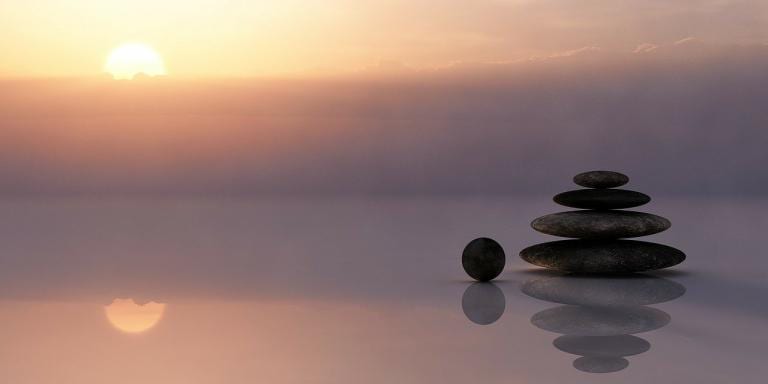
No Mind is elusive for most people. Image by Ralf Kunze via Pixabay.
Even for those people who do achieve No Mind, it is usually only after years of very dedicated meditation practice, using techniques which were developed specifically to foster that goal.
If you tell yourself that you are “doing it wrong” unless you can empty your mind of all thoughts, you are not only missing the point of meditation, but you are setting yourself up for abysmal failure. I recommend not pursuing that particular goal unless you are already proficient with meditation, especially mindfulness meditation where you develop the ability to be fully present in the moment and accepting of your thoughts and feelings as they come and go, without judgement.
Common Meditations Used by Pagans and Witches
I don’t think I could count how many times I have seen someone in pagan or witchy circles state definitively that they hate meditation and it doesn’t work for them. Then sometimes in the next breath, they proudly declare that they are proficient in some sort of shielding, grounding, centering practice, or that they regularly work magic or do divination.
Shielding, grounding, centering, energy gathering, astral projection, guided meditations, attunements, past life regression, cord cutting, shadow work, light work, praying, mindfulness, listening to deities/spirits, divination, automatic writing, energy manipulation and channeling, and so on, are all forms of meditation. I would even argue that most magical workings, and even most religious observances, are meditations, or contain aspects of meditation, at least if they have any chance at being successful.
If achieving your goal requires a calm and focused mind which is contemplative or reflective, then it is meditative. These purposes qualify as meditation because the better you are at achieving a calm, reflective, focused state of mind while doing them, the more likely you are to succeed.
Activities like trance and mediumship are not in and of themselves meditation, but often meditation is a component of the transition from a normal mental state into the state of trance or mediumship. Meditation is also sometimes part of the transition back to a normal mental state, especially if the practitioner prefers not to put themself through the discomfort of a jarring or shocking return to the mundane.
If you are reading this and have an active practice, you probably meditate quite a bit, even if you didn’t realize that was what you were doing. If that idea is jarring to you, I suggest lighting a candle on your altar and taking a few minutes to contemplate the ramifications of that idea on you and your practice. Explore why it is hard for you to accept that you have been meditating all along. Take a moment to observe that even this exercise is a form of meditation.

Meditation is key to developing many magical skills. Image by Enrique Meseguer via Pixabay.
Meditation is a Practice
You can develop your skills at meditating, but you can never perfect them. There is always something new to explore, something you can improve, just as with working magic in general.
The first thing to ask yourself is, what do you want to achieve through meditation? Meditation itself is not a goal. It is an activity. If you attempt the activity without a goal, you are never going to achieve the sort of mental clarity and understanding which is the hallmark of meditation.
If you approach meditation believing that it is nothing more than sitting and thinking, you will probably never achieve a meditative state. You’ll simply sit and think, while your thoughts meander randomly (or contemplate how stupid and pointless “meditation” is), and your frustration and boredom grow.
Often when reading up on how to meditate, the instructions will list the activity, but neglect to be clear about the goal. That doesn’t mean the goal doesn’t exist, but instead the thing you are trying to achieve is buried somewhere in the meat of the exercise, usually mindfulness or being in the moment. If you find it difficult to meditate, look for that goal and bring it into your conscious awareness before you attempt the meditation exercise. If that doesn’t work, try a different form of meditation which is more compatible with your goals, or try it while using a different physical position or activity. Mix and match mental exercises and physical approaches until you find what works for you.
Once you have your goal, if you’re not sure how to proceed, look for advice on how to achieve that goal. Keep in mind that it won’t always be labeled as meditation, especially if it was developed for Western esoteric practice. If, for example, you want to develop your abilities with divination, you’ll want to look up “how to divine using X”, where “X” is your medium of choice, like tarot, runes, bones, palmistry, and so on. You might get some interesting and useful hits adding “meditation” into your search terms, but not always.
If you are interested in traditional Eastern forms of meditation, I strongly advise seeking out instructions which are firmly rooted in older traditions and are being offered to a wider audience than just those who ascribe to an originating religion like Buddhism or Taoism, especially if the teacher is a long-standing member of such a religion. Just remember to be respectful of the history and origins of the techniques, and those who are offering to share with you.

Most refined meditation techniques have their roots in Asia. Image by M Ameen via Pixabay.
Luckily for us, even though meditation techniques are central to the practice of many Eastern religions, most do not require religion to be effective. Most such techniques are a product of how the human mind functions, rather than rituals dictated by culture or religious tradition, making them valuable to all humanity, and applicable to any spiritual path.
Deliberate Meditation Can Enhance Your Practice
At risk of beating a dead horse, deliberate meditation practice can enhance your magical and spiritual practice. That is most definitely true. What usually gets left out is that mindfulness meditation is the goal that is usually being recommended.
I have mentioned mindfulness as a goal repeatedly in this short article, because it is a foundational skill for other meditation techniques and goals. It is the one that has the specific goal of allowing you to be in the moment, and to accept all that is, has been, and will be, without judgement. It is the one that teaches you to find calm and understanding, so that you are better capable of focusing on that which needs your attention, and letting go that which does not.
Those skills are invaluable to metaphysical practice, and to overall mental and emotional wellbeing. Giving them deliberate attention and practice is always going to be beneficial, and of course, daily practice, even if it’s just a few minutes, will provide the most benefit, but don’t beat yourself up if you don’t manage that (I certainly don’t most days). Even intermittent mindfulness meditation carries benefits.

Deliberate meditation practice enhances your other meditations. Image by Okan Caliskan via Pixabay.
If you choose not to engage in deliberate mindfulness meditation, or rarely do, that doesn’t mean you are a failure as a witch or magic worker or pagan. Deliberate meditation is a tool. It might make things easier and faster, but there is no shortage of people who get extremely good at doing things without that specific tool.
All meditation practices (including the ubiquitous grounding, centering, shielding practices) can eventually lead you to a calm, mindful, reflective state of mind, because they are most effective and effortless when you achieve such a state of mind. Specifically engaging in mindfulness meditation is like a warmup before a strenuous workout, allowing you to more efficiently achieve your goals with less fatigue, soreness, and risk of injury. You can still do the workout even without a warmup, and potentially achieve all your goals, but it’s not ideal, and it will make things harder.
Like any responsible fitness coach, a responsible magical or spiritual teacher will most likely tell you to do your warmups. They really do help.
———
Want email notification for things I write or create, here and elsewhere? Sign up for blog notifications at SidneyEileen.com ———
SidneyEileen.com Facebook * Instagram * Twitter
———

About Sidney Eileen
Sidney Eileen is a non-binary, asexual, animistic, polytheist witch and artist. They acknowledge divinity and unique natures in not just the gods, but in all manner of ephemeral and supernatural beings, spirits, living beings, and the souls that embody the physical objects and spaces around us. Their practice is lifelong and of an intuitive nature, seeking fulfillment through mutable asymmetrical balance. You can read more about the author here.
Previous Post

April 7, 2020
Between Two Worlds: Stressed? Get Outside in Nature
Next Post

April 8, 2020 The Corner Crone: Reclaiming a Solitary Practice
Browse Our Archives
Select a Category A Lakeside Hearth Adventures in Wortcunning Alone In Her Presence Arts, Crafts & Cooking Birthing Hereditary Witchcraft Book of Blackbirds Book Reviews Born-Again Witch Cauldron, Sword, Spear, & Stone Cermony and Liturgy Columns Community Dandelion Seeds Dear Jasmine Druid Thoughts Editor's Picks Everyday Pagan Family & Household Practice Family Traditions Full Frontal Magic Gateway Goddess Guest Articles Happily Heathen Health and Wellness Hearth of Hellenism Heathen Woman Hills of the Horizon History Holidays Horse Goddesses Interfaith Interviews Irish-American Witchcraft Jewish Witch Lamp & Labyrinth Letters from Midgard Literature, Media, Film, Music Loop of Brighid Love, Sex & Relationships Magic or Magick Making Light Naturalistic Traditions Nature News Outside The Circle Pantheisticon Politics Prayers, Poems, Blessings & Stories Queer Femme Mystic Queer of Swords Recipes Ritual and Practice Science and Research Seekers and Guides Seeking the Grail Socially Responsible Magic Spear of Athena Star Made Witch Syncretic Electric Technology The Blooming Staff The Busy Witch The Cartomancer The Crow's Nest The Dance of Pagan Recovery The Hearth of Hellenism The Lady's Quill The Other Side of the Hedge The Path of She The Rantin' Raven The Witches Next Door The Zen Pagan Theology, Ethics, Philosophy Tree City Witch Urban Earthwitch Wayfaring Woman Witch on Fire Wyrd Words
Select a Month January 2026 March 2025 December 2024 June 2024 April 2024 March 2024 January 2024 December 2023 November 2023 October 2023 August 2023 July 2023 May 2023 April 2023 March 2023 February 2023 January 2023 December 2022 November 2022 October 2022 September 2022 August 2022 July 2022 June 2022 May 2022 March 2022 February 2022 January 2022 December 2021 November 2021 October 2021 September 2021 August 2021 July 2021 June 2021 May 2021 April 2021 March 2021 February 2021 January 2021 December 2020 November 2020 October 2020 September 2020 August 2020 July 2020 June 2020 May 2020 April 2020 March 2020 February 2020 January 2020 December 2019 November 2019 October 2019 September 2019 August 2019 July 2019 June 2019 May 2019 April 2019 March 2019 February 2019 January 2019 December 2018 November 2018 October 2018 September 2018 August 2018 July 2018 June 2018 May 2018 April 2018 March 2018 February 2018 January 2018 December 2017 November 2017 October 2017 September 2017 August 2017 July 2017 June 2017 May 2017 April 2017 March 2017 February 2017 January 2017 December 2016 November 2016 October 2016 September 2016 August 2016 July 2016 June 2016 May 2016 April 2016 March 2016 February 2016 January 2016 December 2015 November 2015 October 2015 September 2015 August 2015 July 2015 June 2015 May 2015 April 2015 March 2015 February 2015 January 2015 December 2014 November 2014 October 2014 September 2014 August 2014 July 2014 June 2014 May 2014 April 2014 March 2014 February 2014 January 2014 December 2013 November 2013 October 2013 September 2013 August 2013 July 2013 June 2013 May 2013 April 2013 March 2013 February 2013 January 2013 December 2012 November 2012 October 2012 September 2012 August 2012 July 2012 June 2012 May 2012 April 2012 March 2012 February 2012 January 2012
Follow Us!
TAKE THE
Religious Wisdom Quiz
What Christian group is known for its historic peace churches and pacifism?
Select your answer to see how you score.
Quakers Methodists Pentecostals Presbyterians
Related posts from Agora

Simple Witchery: To Keep Silent

Simple Witchery: Leaning On The Four Pillars


Simple Witchery: Resistance and Resilience in Hard Times
TRENDING AT PATHEOS Pagan

To help with the upcoming holiday season, I'm introducing the Holiday Helper...

10 years of the Power Sigil & Moving...
Last week while reorganizing my studio space, I found the sketchbook that...

Why are younger seekers drawn to Paganism and...
One of the things I've noticed the most is that I'm far...

When we talk about Greek religion, we often begin with the dodekatheion—the...

I was recently chatting with someone on Instagram. She asked me what...

On July 23, I saw Christopher Nolan's The Odyssey which is Homer’s...
view all Pagan blogs
Ad-Free & Subscriber Log-In Subscription Support
- About Us
- 2026 Calendar
- Videos
- Podcasts
- Library of World Religions
- Faith In Media Tracker
- Advertise With Us
- Write for Us
- Privacy Policy
- Terms of Service
- Do Not Sell My Data
- Contact Us
- Radiant Digital
- Manage Newsletter Subscriptions
- Unsubscribe From Notifications
- Sitemap
Copyright 2008-2026, Patheos, part of the Radiant Digital network of media brands. All rights reserved.
Subscription Support Ad-Free & Subscriber Log-In
Follow Patheos