
BuddhistCatholicContemplativeEvangelicalGeneral ChristianHinduJewishLatter-day SaintMuslimNew VisionsProgressive Christian
Beliefs
- Buddhist
- Catholic
- Contemplative
- Evangelical
- General Christian
- Hindu
- Jewish
- Latter-day Saint
- More Voices
- Muslim
- New Visions
- Pagan
- Progressive Christian
Topics
- Religion News
- Food and Religion
- Sports and Religion
- Religious Art
- Religious Music and Entertainment
- Religious Events
- History and Religion
- Style and Religion
- Politics and Religion
- Women in Religion
- Recreation Outdoors and Religion
- Business Finance and Religion
- Careers Workplace and Religion
- Education and Religion
- Family Parenting and Religion
- Health Fitness and Religion
- Home and Religion
- Relationships and Religion
- Technology and Religion
- Travel and Religion
Columnists
- Buddhist Columnists
- Business Finance and Religion Columnists
- Careers Workplace and Religion Columnists
- Catholic Columnists
- Contemplative Columnists
- Education and Religion Columnists
- Evangelists Columnists
- Family Parenting and Religion Columnists
- General Christian Columnists
- Health Fitness and Religion Columnists
- Hindu Columnists
- History and Religion Columnists
- Home and Religion Columnists
- Jewish Columnists
- More Voices Columnists
- Latter Day Columnists
- Muslim Columnists
- New Visions Columnists
- Nonreligious Columnists
- Pagan Columnists
- Politics and Religion Columnists
- Progressive Columnists
- Recreation Outdoors and Religion Columnists
- Relationships and Religion Columnists
- Religion News Columnists
- Religious Art Columnists
- Religious Events Columnists
- Religious Music and Entertainment Columnists
- Sports and Religion Columnists
- Style and Religion Columnists
- Technology and Religion Columnists
- Travel and Religion Columnists
- Women in Religion Columnists
Resource Library
- 2026 Calendar
- Library of World Religions
- The 100 Most Holy Places on Earth
- Patheos Answers
- Podcasts
- Videos
- Faith Leaders Database
- Anglican Episcopalian
- Bahai
- Baptist
- Buddhism
- Christianity
- Confucianism
- Eastern Orthodoxy
- Hinduism
- Holiness and Pentecostal
- ISKCON
- Islam
- Judaism
- Lutheran
- Methodist
- The Church of Jesus Christ of Latter-day Saints
- New Age
- Paganism
- Presbytarian and Reformed
- Protestantism
- Religion Behind the Scenes
- Roman Catholic
- Scientology
- Shia Islam
- Sikhism
- Sufism
- Sunni Islam
- Taoism
- Zen
- See all religions
Research Tools
 Ad-Free & Subscriber Log-In Subscription Support
Ad-Free & Subscriber Log-In Subscription Support
Follow Patheos 

- Trending:
- Forgiveness
- |
- Marriage
- |
- Consciousness
- |
- Death Penalty
- |
- Election
- |
- Halloween

- Home
- Pagan
- Hadrian’s Garden: Apollo & the Plague
Hadrian’s Garden: Apollo & the Plague
Last updated on: April 6, 2020 at 8:00 pm by Adrian Marcus
Hadrian’s Garden: Apollo & the Plague 2020-04-06T20:00:15+00:00 Adrian Marcus
Patheos Explore the world's faith through different perspectives on religion and spirituality! Patheos has the views of the prevalent religions and spiritualities of the world.
My Altar in Quarantine
My altar is an ever-changing entity in my household. I rearrange it frequently to keep it consistent with the growth of my practice, so objects and idols have come and gone over the years. Some pieces are passed on to friends, but usually things I do not currently find meaningful are packed away in a box. I recently moved, so I had the chance to start from scratch. One of the items I found in my storage box was a small marble statue of Apollo with a gilded harp.
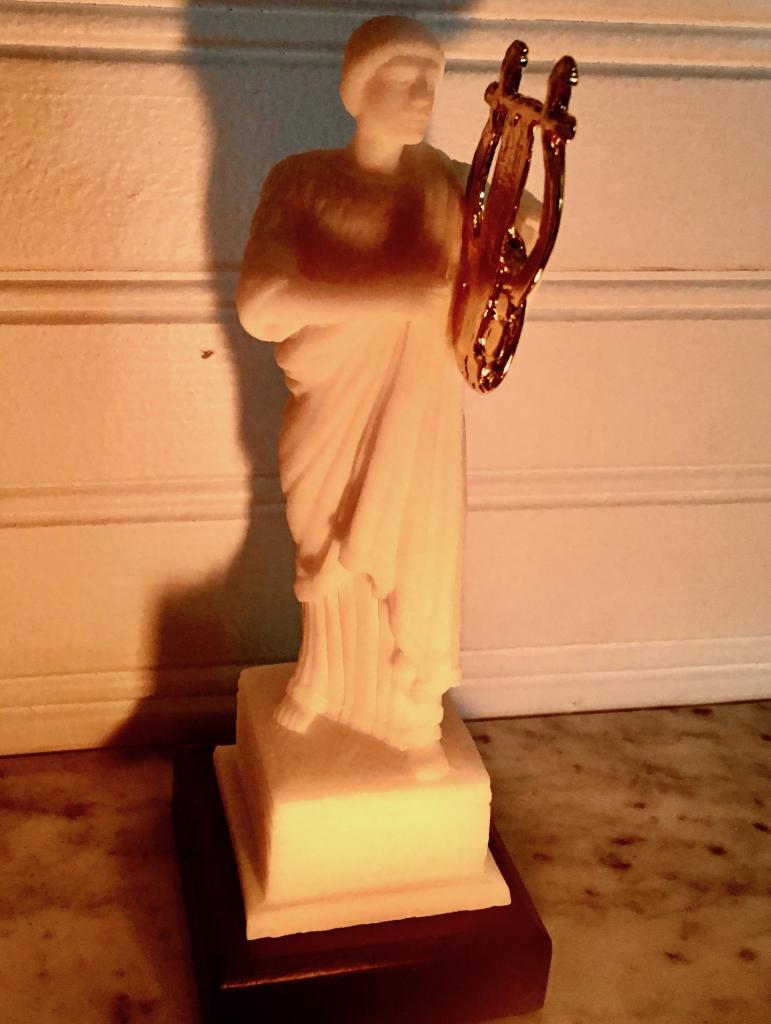
This piece is a very nice reproduction of a genuine Ancient Greek artifact and I purchased it because of Apollo’s association with the sun and the arts. However, a conversation I recently had with a friend about COVID-19 reminded me of one of the lesser known aspects of Apollo. He is the god of plague. Apollo has several epithets in ancient mythology associated with this trait such as Apollo Acestor (healer) or Apollo Medicus (physician). He is the god who delivers people from disease and plague, but he is also Apollo Parnopius (locust) who casts epidemics on people who displease him.
In myth, this is portrayed as Apollo Parnopius loosing an arrow into a city to start an epidemic. With this in mind it seemed that this statue, which I had not felt particularly connected to for a while, needed to be placed on my altar. In the ancient Mediterranean people made offerings to Apollo to ask for healing and whole societies made sacrifices and beseeched Apollo for aid in times of plague, so it seemed appropriate to continue that tradition in my own small way.
Until the quarantine orders happened and the World Health Organization classified this coronavirus a pandemic, I thought of plagues as a thing firmly placed in history. Surely we have the medical technology to handle a virus? We keep ourselves and our living spaces cleaner than the ancient people did, right?
This pandemic has been a wakeup call to our fragility. Some of the symptoms that put one at risk of death from this virus, like asthma and heart problems, are frighteningly common. When I look at all the people being laid off and all the businesses struggling, it seems the economic system that holds our society together might be even more fragile than us humans.
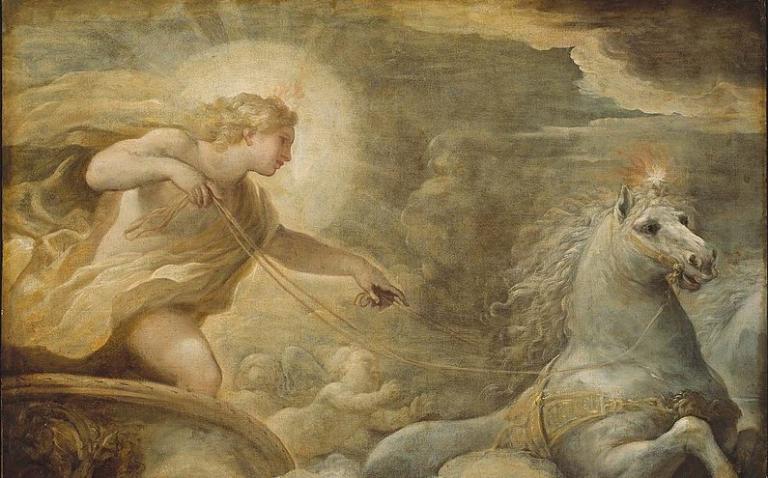
“Apollo in his Chariot” by Luca Giordano, from WikiMedia.

When I lit the scented candle on my newly arranged altar and watched the light dance over the statues of Apollo and Gaia, it struck me that they are probably indifferent to the struggle humanity and our economic system are currently going through. These primordial deities of earth and sun have seen many plagues and have seen countless societies collapse. It is not much of a stretch to think that some humans dying or, more importantly, the current economic system being slowed down would be good for the earth. If Apollo casts plague on societies which have displeased him, I can think of many ways in which he, a pagan deity of nature, would be furious at our world economic system.
I remain agnostic about the reality of the gods and I do not believe that COVID-19 was loosed upon the earth by an angry Apollo, but it is an interesting thought experiment. One of the things I like most about ancient Greek paganism is the concept of hubris, which says that humanity should be careful not to become too arrogant in its goals and abilities. Greek myth is rife with examples of humans who aimed too high and were cast down by the fury of the gods.
It is clear that this pandemic will leave a lasting psychological impact on our society and it will likely bring about numerous policy changes. My hope is that we go forward with a little more trepidation and an appreciation of the havoc one small act of nature can bring. If we can learn this lesson and curb our hubris, then perhaps we can begin to tackle the climate crisis in a mindful way and build a stronger society. One that is not as fragile in times of crisis. In the meantime, in my practice, I am going to keep burning candles and incense to Apollo the healer.
Previous Post

April 3, 2020
The Balancing Path: Moon Water with No Moonlight
Next Post

April 6, 2020 Cross and Crossroads: Starting a Paranormal Investigation Team
Browse Our Archives
Select a Category A Lakeside Hearth Adventures in Wortcunning Alone In Her Presence Arts, Crafts & Cooking Birthing Hereditary Witchcraft Book of Blackbirds Book Reviews Born-Again Witch Cauldron, Sword, Spear, & Stone Cermony and Liturgy Columns Community Dandelion Seeds Dear Jasmine Druid Thoughts Editor's Picks Everyday Pagan Family & Household Practice Family Traditions Full Frontal Magic Gateway Goddess Guest Articles Happily Heathen Health and Wellness Hearth of Hellenism Heathen Woman Hills of the Horizon History Holidays Horse Goddesses Interfaith Interviews Irish-American Witchcraft Jewish Witch Lamp & Labyrinth Letters from Midgard Literature, Media, Film, Music Loop of Brighid Love, Sex & Relationships Magic or Magick Making Light Naturalistic Traditions Nature News Outside The Circle Pantheisticon Politics Prayers, Poems, Blessings & Stories Queer Femme Mystic Queer of Swords Recipes Ritual and Practice Science and Research Seekers and Guides Seeking the Grail Socially Responsible Magic Spear of Athena Star Made Witch Syncretic Electric Technology The Blooming Staff The Busy Witch The Cartomancer The Crow's Nest The Dance of Pagan Recovery The Hearth of Hellenism The Lady's Quill The Other Side of the Hedge The Path of She The Rantin' Raven The Witches Next Door The Zen Pagan Theology, Ethics, Philosophy Tree City Witch Urban Earthwitch Wayfaring Woman Witch on Fire Wyrd Words
Select a Month January 2026 March 2025 December 2024 June 2024 April 2024 March 2024 January 2024 December 2023 November 2023 October 2023 August 2023 July 2023 May 2023 April 2023 March 2023 February 2023 January 2023 December 2022 November 2022 October 2022 September 2022 August 2022 July 2022 June 2022 May 2022 March 2022 February 2022 January 2022 December 2021 November 2021 October 2021 September 2021 August 2021 July 2021 June 2021 May 2021 April 2021 March 2021 February 2021 January 2021 December 2020 November 2020 October 2020 September 2020 August 2020 July 2020 June 2020 May 2020 April 2020 March 2020 February 2020 January 2020 December 2019 November 2019 October 2019 September 2019 August 2019 July 2019 June 2019 May 2019 April 2019 March 2019 February 2019 January 2019 December 2018 November 2018 October 2018 September 2018 August 2018 July 2018 June 2018 May 2018 April 2018 March 2018 February 2018 January 2018 December 2017 November 2017 October 2017 September 2017 August 2017 July 2017 June 2017 May 2017 April 2017 March 2017 February 2017 January 2017 December 2016 November 2016 October 2016 September 2016 August 2016 July 2016 June 2016 May 2016 April 2016 March 2016 February 2016 January 2016 December 2015 November 2015 October 2015 September 2015 August 2015 July 2015 June 2015 May 2015 April 2015 March 2015 February 2015 January 2015 December 2014 November 2014 October 2014 September 2014 August 2014 July 2014 June 2014 May 2014 April 2014 March 2014 February 2014 January 2014 December 2013 November 2013 October 2013 September 2013 August 2013 July 2013 June 2013 May 2013 April 2013 March 2013 February 2013 January 2013 December 2012 November 2012 October 2012 September 2012 August 2012 July 2012 June 2012 May 2012 April 2012 March 2012 February 2012 January 2012
Follow Us!
TAKE THE
Religious Wisdom Quiz
Who said, "To the pure, all things are pure"?
Select your answer to see how you score.
Paul John Peter James
Related posts from Agora

Simple Witchery: To Keep Silent

Simple Witchery: Leaning On The Four Pillars

Pergamum Unfurled: Magic with the Greek Gods (Book...

Pergamum Unfurled: Cunning Words (Review)
TRENDING AT PATHEOS Pagan

When we talk about Greek religion, we often begin with the dodekatheion—the...

I was recently chatting with someone on Instagram. She asked me what...

While there are many people who share their results, the end of...

On July 23, I saw Christopher Nolan's The Odyssey which is Homer’s...

As I write this two big events have just finished up. One...

Restoring the Watershed of Divine Love
Perhaps cooperation is not something we manufacture through legislation, ideology, or moral...
view all Pagan blogs
Ad-Free & Subscriber Log-In Subscription Support
- About Us
- 2026 Calendar
- Videos
- Podcasts
- Library of World Religions
- Faith In Media Tracker
- Advertise With Us
- Write for Us
- Privacy Policy
- Terms of Service
- Do Not Sell My Data
- Contact Us
- Radiant Digital
- Manage Newsletter Subscriptions
- Unsubscribe From Notifications
- Sitemap
Copyright 2008-2026, Patheos. All rights reserved.
Subscription Support Ad-Free & Subscriber Log-In
Follow Patheos